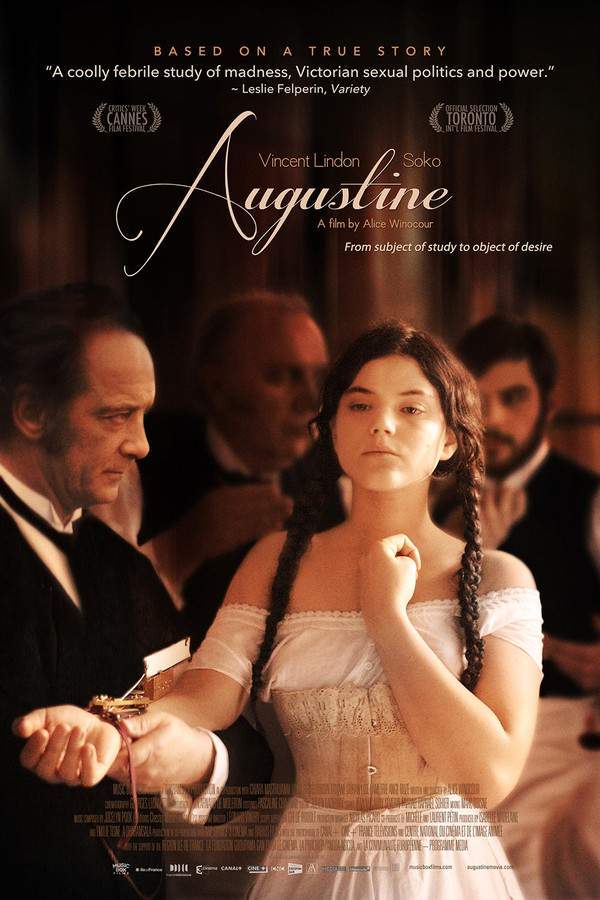
Augustine

A young kitchen maid, Augustine, experiences a sudden seizure that leaves her paralyzed, disrupting her life. She is then sent to an all-female psychiatric hospital where she comes under the intense scrutiny of the celebrated neurologist Dr. Charcot. He becomes fascinated by her unusual physical reactions and hypnotic displays. As their professional relationship evolves, Augustine's experiences trigger a profound and transformative journey for both her and the doctor, blurring the lines between patient and observer.
Where to Watch Augustine?
Find where to stream, rent, or buy Augustine (2013) in the US with current JustWatch availability, up-to-date pricing, and platform listings for subscription, rental, and digital purchase options.













Streaming availability powered by 
Warning: spoilers below!
Haven’t seen Augustine yet? This summary contains major spoilers. Bookmark the page, watch the movie, and come back for the full breakdown. If you're ready, scroll on and relive the story!
Timeline – Augustine (2013)
Trace every key event in Augustine (2013) with our detailed, chronological timeline. Perfect for unpacking nonlinear stories, spotting hidden connections, and understanding how each scene builds toward the film’s climax. Whether you're revisiting or decoding for the first time, this timeline gives you the full picture.
Last updated: October 09, 2025 at 16:22
Augustine (2013) Timeline Questions Answered – Chronology FAQ
Find frequently asked questions about the Augustine (2013) timeline, including chronological order, nonlinear jumps, cause-and-effect links, and scene sequence clarifications. This timeline FAQ helps explain when key events happen, how moments connect, and why the story unfolds in that specific order.
Why does Dr. Charcot use Augustine for public demonstrations?
Charcot uses Augustine as a test case to secure funding and legitimacy for his neurological research. The dramatic demonstration where he hypnotizes her and provokes a staged fit that ends with an orgasm is specifically designed to impress the roomful of doctors and convince them to support his work. The spectacle succeeds, earning enthusiastic approval and permission to continue his examinations.
Why does Augustine regain sensation after falling down the stairs?
The fall paradoxically awakens sensation in Augustine's previously paralyzed side. While the exact mechanism isn't medically explained in the film, the escape and subsequent physical trauma seem to break whatever psychological or neurological hold had kept her in a state of partial paralysis. This moment marks a turning point where her body responds to her will to be free.
Why does Charcot become so obsessed with Augustine beyond professional interest?
Charcot's fascination evolves from purely medical curiosity into something more personal and problematic. He becomes attracted to Augustine, sneaking into her room at night to observe her while she sleeps. The boundary between physician and observer blurs as he develops genuine feelings for her, even as he continues to treat her as a subject for his research. This crossing of professional lines is central to the film's exploration of power dynamics.
Why does Charcot spoon-feed Augustine when she stops eating?
When Charcot returns from Bordeaux, he discovers Augustine has been refusing food. He personally spoon-feeds her, insisting she must eat if she hopes to be well enough for his treatment. This moment demonstrates both his control over her and his continued investment in her wellbeing, though it also reinforces the unbalanced power dynamic where her survival depends on his attention.
Why does the hypnosis demonstration fail right before the lecture?
Charcot attempts to hypnotize Augustine to induce a seizure for his medical academy lecture, but the performance falters. Augustine leans in and whispers that she is cured, flexing her hand to prove she has regained sensation. This failure represents a shift in power - Augustine now controls her own body and chooses to reveal her recovery on her own terms rather than as part of Charcot's demonstration.
What is the significance of Augustine starting to menstruate?
Augustine begins menstruating during her time at the hospital, which is noted as a sign of her continuing sexual and physiological development. For Charcot, this represents progress in understanding her condition - her body is maturing naturally despite the neurological symptoms. The moment also highlights her transition from childlike dependence toward womanhood, adding complexity to the film's themes of body autonomy and medical objectification.
Why does Augustine escape from the sanatorium at the end?
Augustine escapes because she feels trapped by her dependence on Charcot and his refusal to let her leave. Despite his promises to help her once her condition improves, she recognizes that his treatment keeps her bound to the hospital. Her escape represents a reclaiming of autonomy - she chooses unknown freedom over continued participation in his program, even if that means leaving behind the security of his care.
What is the power dynamic between Charcot and Augustine?
The relationship is defined by extreme power imbalance. Charcot controls Augustine's fate - he can release her or keep her institutionalized, and he frames her condition as something only he can cure. Augustine is dependent on him for survival, food, and freedom. As time passes, Charcot crosses boundaries by entering her room at night and developing romantic feelings, while Augustine feels increasingly trapped despite his promises to help her.
Why does Augustine faint at the sight of blood?
While helping a fellow patient behead a chicken, Augustine feels faint at the sight of blood and loses consciousness. When she regains consciousness, she opens both eyes fully and can see normally again, though she still lacks sensation on one side. This incident shows her body's unpredictable responses and marks one of the few moments where she regains partial function, though sensation does not return.
What is the significance of the demonstration where Augustine experiences an orgasm?
During the demonstration for doctors, Charcot hypnotizes Augustine and provokes a staged fit that culminates in an orgasm before she collapses. This controversial display is presented as a breakthrough in understanding hysteria and earns enthusiastic approval from the audience. The moment establishes Charcot's willingness to use Augustine's body for spectacle and sets up the film's exploration of medical exploitation and blurred boundaries between treatment and manipulation.
What causes Augustine's paralysis after her initial seizure?
Augustine experiences a violent fit during dinner service that leaves her partially paralyzed - she loses feeling on one side of her body and one eye becomes unable to move. The exact neurological cause isn't medically explained in the film, but Charcot examines her and notes she shows no sensation where most people would expect it, a discrepancy that both unsettles and fascinates the medical staff.
Why does Charcot refuse to let Augustine leave the hospital?
Charcot refuses Augustine's requests to leave and find work elsewhere, insisting that he will help her once her condition improves. However, his refusal appears driven more by his desire to continue his research than by genuine concern for her health. Keeping Augustine institutionalized ensures he maintains access to his key case study and the potential for further demonstrations and professional advancement.

Explore Movie Threads
Discover curated groups of movies connected by mood, themes, and story style. Browse collections built around emotion, atmosphere, and narrative focus to easily find films that match what you feel like watching right now.
Movies about clinical power imbalances like Augustine
Explorations of ethical collapse within professional relationships under scrutiny.If you were fascinated by the tense relationship between Dr. Charcot and his patient in Augustine, this thread finds similar movies. Discover other intense dramas about ethical dilemmas, professional misconduct, and the psychological fallout when authority crosses the line.

The Good Doctor
2012

Apothecary
2014
Augustine
2013

Calling Dr. Gillespie
1942

Extreme Measures
1996

Life During Wartime
2010

Elephant Song
2014

The Full Treatment
1960

The Good Nurse
2022

Shock Treatment
1964

God’s Crooked Lines
2022

Pressure Point
1962

A Child’s Cry for Help
1994

Ankur Arora Murder Case
2013

Coma
1978
Narrative Summary
Stories in this thread typically center on a professional relationship defined by a significant power imbalance. The narrative explores how the authority figure becomes consumed by their study or control of the subject, leading to ethical transgressions. The journey often involves a quiet rebellion or awakening from the subordinate character, challenging the established dynamic.
Why These Movies?
Movies are grouped here because they share a core focus on the corrupting nature of power within institutional or professional settings. They create a similar mood of clinical oppression and psychological tension, making the viewer complicit in the act of observation.
Slow burn claustrophobic movies like Augustine
Stories where psychological tension builds within confined, oppressive spaces.If you appreciated the oppressive, methodical tension of Augustine set in the psychiatric hospital, explore these similar films. Find other heavy dramas with a steady pace that trap characters—and viewers—in psychologically intense and confined worlds.












Narrative Summary
Narratives in this thread unfold within a tightly controlled or isolated setting that becomes a character in itself. The plot progresses steadily, focusing on the internal psychological state of the protagonists as they confront the constraints of their environment. The journey is one of gradual self-discovery or defiance against the forces that confine them.
Why These Movies?
These films are united by their ability to create a cohesive, oppressive atmosphere through a combination of setting, pacing, and tone. They prioritize a heavy, psychologically intense mood over fast-paced action, offering a viewing experience defined by simmering dread and emotional weight.
Unlock the Full Story of Augustine
Don't stop at just watching - explore Augustine in full detail. From the complete plot summary and scene-by-scene timeline to character breakdowns, thematic analysis, and a deep dive into the ending - every page helps you truly understand what Augustine is all about. Plus, discover what's next after the movie.
Augustine Summary
Read a complete plot summary of Augustine, including all key story points, character arcs, and turning points. This in-depth recap is ideal for understanding the narrative structure or reviewing what happened in the movie.

Characters, Settings & Themes in Augustine
Discover the characters, locations, and core themes that shape Augustine. Get insights into symbolic elements, setting significance, and deeper narrative meaning - ideal for thematic analysis and movie breakdowns.


Similar Movies to Augustine
Discover movies like Augustine that share similar genres, themes, and storytelling elements. Whether you’re drawn to the atmosphere, character arcs, or plot structure, these curated recommendations will help you explore more films you’ll love.

The August Virgin
2020

Attenberg
2012
Hippocrates: Diary of a French Doctor
2015

Late August, Early September
1999

Preparations to be Together for an Unknown Period of Time
2021

A Dangerous Method
2011

Agnes of God
1985

Féminin plurielles
2018

One Day in August
2001

August
2017

Adoration
2019

Amorosa
1986

Anna M.
2007

The Goddesses
1972

August
1996
Explore More About Movie Augustine
Augustine (2013) Plot Summary & Movie Recap
Augustine (2013) Scene-by-Scene Movie Timeline
Augustine (2013) Spoiler-Free Summary & Key Flow
Movies Like Augustine – Similar Titles You’ll Enjoy
The August Virgin (2020) Plot Summary & Ending Explained
Attenberg (2012) Film Overview & Timeline
Hippocrates: Diary of a French Doctor (2015) Detailed Story Recap
Late August, Early September (1999) Plot Summary & Ending Explained
Preparations to be Together for an Unknown Period of Time (2021) Movie Recap & Themes
A Dangerous Method (2011) Ending Explained & Film Insights
Agnes of God (1985) Story Summary & Characters
Féminin plurielles (2018) Story Summary & Characters
One Day in August (2001) Film Overview & Timeline
August (2017) Spoiler-Packed Plot Recap
Adoration (2019) Ending Explained & Film Insights
Amorosa (1986) Movie Recap & Themes
Anna M. (2007) Spoiler-Packed Plot Recap
The Goddesses (1972) Complete Plot Breakdown
August (1996) Film Overview & Timeline