Plot Explained Spoilers guaranteed!
Plot Explained

Browse by genre

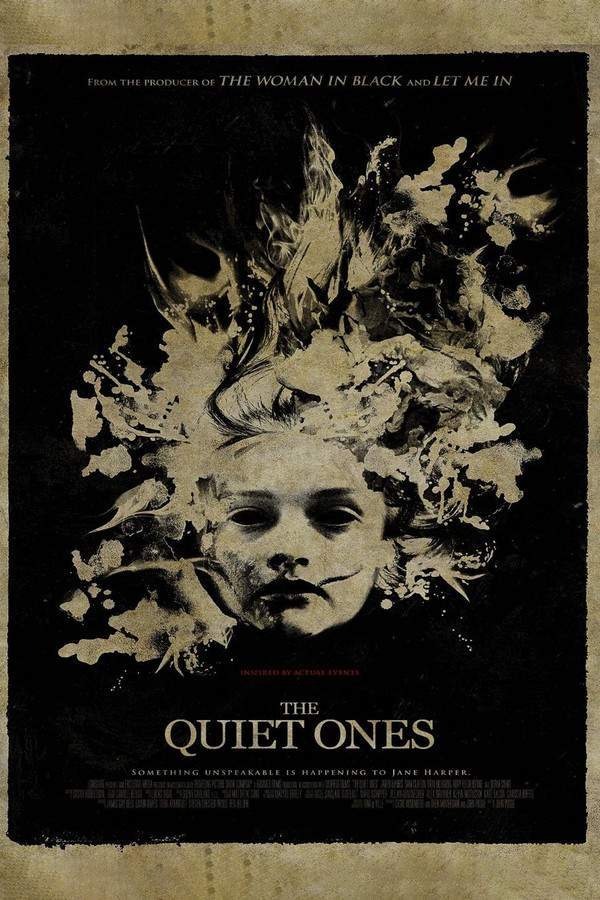
The Quiet Ones (2014) movie poster

Plot Summary

The Quiet Ones (2014) Plot Summary Explained

Release, runtime and language
2014 · 98 min · English
JustWatch #5,293 18
Directed by
John Pogue
Starring
Jared Harris, Olivia Cooke, Sam Claflin, Erin Richards

A film professor and his students undertake a risky investigation into a disturbing local legend, attempting to summon a dark force. Their experiments focus on a young woman, exploiting her emotional state to generate a poltergeist through increasingly intense psychological tests. As they delve deeper, the group confronts unforeseen consequences and a terrifying power they cannot control, leading to a descent into unimaginable horror.

On this page (6)
  1. 1 Where to watch
  2. 2 What happens: full plot
  3. 3 Plot questions answered
  4. 4 Movie threads
  5. 5 Movies like The Quiet Ones
  6. 6 Every angle

Where to watch

Where to Watch The Quiet Ones (2014)

Where can you watch The Quiet Ones? Stream, rent or buy it in the US, including on Fawesome, Plex and Tubi TV: current JustWatch availability with up-to-date prices.

Streaming availability powered by JustWatch

Full plot summary · contains spoilers

What Happens in The Quiet Ones: Full Plot Summary

The whole story of The Quiet Ones (2014) explained, from the opening scene to the final frame: every key event, every twist and what it all adds up to. Read it as a quick recap before the sequel, to check a scene you missed, or to finally understand what really happened.

A girl lies in a securely locked room. When a viewing slot opens, a young man peeks in just as loud music jolts her awake. May, 1974. During a lecture at Oxford University, Dr. Joseph Coupland (Jared Harris) presents his belief that paranormal events are simply manifestations of a person's chaotic thoughts. To illustrate his point, he shares footage from a previous case involving a boy named David Q (Sam Claflin), who once seemed normal until he started drawing Mr. Gregor, a figure he believed was influencing his reality. Joseph asserts that David Q's struggles were a result of his mental illness and that Mr. Gregor was merely a figment of his imagination. He then introduces the audience to Jane Harper (Olivia Cooke), the subject of his current experiment, someone even more troubled than David.

When a student questions Joseph’s methods regarding the mentally ill, the class descends into chaos. Afterward, outside the lecture hall, Joseph strikes up a conversation with Brian, who, despite not being an Oxford student, has been recruited to document the experiment. Joseph queries him about his cross, which belongs to his mother, leading to a discussion on faith and belief.

The setting shifts to the flat where the experiment is taking place, revealing that Joseph has enlisted Chrissy (Erin Richards), an Oxford student, as a test subject. Chrissy shares her own issues but is quick to point out Jane, who is in the locked room. Joseph probes Jane about a doll named Evie, which symbolizes her psychic turmoil. Scary occurrences unfold as Jane hopes for release from her pain but struggles with her traumatic past.

A dark atmosphere surrounds the experiment, prompting Joseph to push boundaries in pursuit of truth. He engages in his manipulative techniques while pushing Jane into emotional turmoil, revealing footage of David Q's deteriorating mental health, similar to Jane's. As Joseph loses funding from Oxford, he relocates the experiment, maintaining hope against odds.

Once in the countryside, tensions rise. Jane expresses a desire for connection while trapped in her solitude, and Joseph’s obsession with isolating Evie intensifies. Dark events ensue, including self-harm, as Joseph seeks to prove his theories at all costs.

The psychological experiment begins to unravel. Jane's condition worsens, and the group experiences unsettling experiences, like Jane's bizarre actions and grim harbingers of death. Despite Brian's concern for Jane, Joseph's chilling demeanor resists compassion and clarity, leading them deeper into danger.

As the experiments escalate, the group learns about dangerous rituals linked to a previous tragic event involving the Lilitu sect. While trying to control Jane’s manifestations, Joseph inadvertently fuels the chaos, and Jane starts to recall her past, realizing she was once Evie Dwyer, born into horror.

The final confrontation leads to violence and despair. As Brian strives to save Jane, chaos reigns, and tragic resolutions unfold. The experiment spirals out of control, resulting in deaths and the fiery expression of Jane's inner turmoil.

Fast forward to 2014, with Brian now an older man trapped in a chair, recounting his tale to a skeptical doctor. Despite Brian's insistence that Evie is responsible for the deaths of Chrissy, Harry, and Joseph, the doctor is convinced of Brian's guilt. As the horror lingers in the air, smoke begins to emerge from Brian's hands, hinting that he has become a vessel for Evie's malevolence.
Last updated: October 27, 2024 at 22:53

Was this helpful?

Plot questions answered

The Quiet Ones Plot Explained: Your Questions Answered

The questions people ask most about The Quiet Ones (2014): what happens in the confusing scenes, why the characters do what they do, the twists, hidden details and what the ending means. Each answer contains spoilers.

Q1

Why does Dr. Coupland believe paranormal events are caused by mental illness?

Dr. Joseph Coupland argues that paranormal phenomena are simply manifestations of a person's chaotic thoughts, not actual supernatural events. He supports this theory by referencing his previous case with a boy named David Q, who believed a figure named Mr. Gregor was influencing his reality. Joseph contends that David Q's experiences stemmed from mental illness, making Mr. Gregor a figment of his imagination rather than a real entity.

Foreshadowing: This theory is presented at the beginning of the film, setting up the central conflict between rational explanation and actual supernatural danger.

  • dr joseph coupland
  • mental illness
  • paranormal
  • david q
  • mr gregor
  • theory
Q2

Who is Evie Dwyer and what is her connection to Jane?

Jane Harper is actually Evie Dwyer, a girl born into horror who was the subject of a previous tragic event involving the Lilitu sect. The doll named Evie that Jane clings to represents her own psychic turmoil and fragmented identity. As the experiment progresses, Jane begins to recall her past and realizes her true origins.

Foreshadowing: Jane's attachment to the Evie doll and her traumatic memories hint at her深层身份 long before the reveal.

  • jane harper
  • evie dwyer
  • doll
  • identity
  • lilitu
  • true identity
Q3

What are the Lilitu rituals and why are they significant?

The Lilitu are an ancient sect whose dangerous rituals were connected to a previous tragic event involving Jane/Evie. When Joseph attempts to control Jane's manifestations through these rituals, he inadvertently provokes chaos rather than containing it. The rituals represent a supernatural mechanism that Joseph naively believes he can harness and control for his experiment.

Foreshadowing: The reference to dangerous rituals early in the experiment hints at the escalating supernatural threat.

  • lilitu
  • rituals
  • sect
  • supernatural
  • dangerous rituals
Q4

Why does Dr. Coupland relocate the experiment to the countryside?

Joseph relocates the experiment to the countryside after losing funding from Oxford University. He hopes the change of setting will revive interest in his research and provide the isolation needed to continue his work. The rural location also removes external oversight, allowing Joseph to push his increasingly dangerous methods further without accountability.

Foreshadowing: The move to isolation foreshadows the experiment spiraling out of control without external intervention.

  • countryside
  • funding
  • oxford
  • relocation
  • isolation
  • experiment
Q5

What happens to Chrissy, Harry, and Joseph at the end?

The experiment spirals out of control, resulting in violent deaths. Chrissy, Harry, and Joseph all die as the chaos escalates. Brian attempts to save Jane but fails, and the experiment concludes with tragic resolutions and several deaths. Joseph's pursuit of proof at any cost leads to the group's destruction.

Foreshadowing: Throughout the film, grim harbingers of death surround the group, building toward this fatal climax.

  • chrissy
  • harry
  • joseph
  • deaths
  • ending
  • tragedy
  • violence
Q6

How does Brian become a vessel for Evie?

In the 2014 frame, Brian recounts his tale to a skeptical doctor, insisting that Evie is responsible for the deaths. However, as he speaks, smoke begins emerging from his hands, suggesting he has become a vessel for Evie's malevolence. This implies the evil force has transferred to Brian, either as punishment for his involvement or as a manifestation of the entity's continued influence.

Foreshadowing: Brian's persistent belief in Evie's existence despite the doctor's skepticism hints at a deeper connection.

  • brian
  • evie
  • vessel
  • smoke
  • supernatural
  • 2014
  • possession
Q7

Why does Jane harm herself during the experiment?

Joseph uses manipulative techniques to push Jane into emotional turmoil, showing her disturbing footage of David Q's deterioration to intensify her psychological state. As Jane's condition worsens, she engages in self-harm, a manifestation of her psychic turmoil and the extreme emotional distress caused by Joseph's unethical testing methods. Her self-harm represents both her internal pain and the experiment's destructive impact on her mental state.

Foreshadowing: Joseph's footage of David Q foreshadows Jane's similar decline and self-destructive behavior.

  • jane
  • self-harm
  • emotional distress
  • manipulation
  • experiment
  • psychological
Q8

Why is Brian recruited to document the experiment?

Brian is not an Oxford student but is recruited by Joseph to document the experiment. Their initial conversation reveals Brian carries a cross belonging to his mother, indicating his faith and belief. Joseph's interest in Brian's cross suggests he may have selected Brian specifically because his spiritual background could either support or challenge the experiment's premise about supernatural versus psychological phenomena.

Foreshadowing: Brian's cross becomes significant as the supernatural elements intensify, potentially representing the conflict between faith and evil.

  • brian
  • recruit
  • cross
  • faith
  • document
  • experiment
  • oxford
Q9

Why is Brian considered guilty in 2014 despite his claims about Evie?

In 2014, Brian tells his story to a doctor who remains skeptical and views Brian as the culprit rather than a victim of supernatural forces. The doctor rejects Brian's insistence that Evie caused the deaths, instead believing Brian is mentally unstable and responsible for the murders. This creates ambiguity about whether the supernatural events were real or merely manifestations of the characters' psychological states.

Foreshadowing: Dr. Coupland's original theory about mental illness creating supernatural manifestations resurfaces in the doctor's dismissal of Brian.

  • brian
  • 2014
  • guilty
  • doctor
  • skepticism
  • mental illness
  • accountability
Q10

What does the Evie doll symbolize in the experiment?

The doll named Evie serves as a symbolic representation of Jane's psychic turmoil and fragmented mental state. Joseph probes Jane about the doll, using it as a tool to access her traumatic memories. The doll becomes increasingly significant as Jane's condition deteriorates, eventually revealing that Evie is not just a toy but connected to Jane's true identity as Evie Dwyer.

Foreshadowing: Jane's attachment to the Evie doll foreshadows the revelation of her actual identity.

  • evie
  • doll
  • symbol
  • psychic
  • turmoil
  • jane
  • identity

Movie threads

More Movies Like The Quiet Ones, by Mood & Story

Curated lists built around what makes The Quiet Ones tick: the same mood, the same kind of story or the same emotional payoff. Each list explains why these movies belong together.

Movies about dangerous experiments like The Quiet Ones

Scientific hubris unleashes a terror that cannot be contained or controlled. If you liked The Quiet Ones, explore other horror and thriller movies where scientific or psychological experiments go horribly wrong. These films often feature themes of exploitation, loss of control, and the terrifying price of ambition, creating a similar sense of dread and bleak consequences.

  • unsettling
  • scientific hubris
  • disturbing
  • tense
  • malevolent
  • claustrophobic
  • Tone: dark, bleak
  • Pacing: steady, escalating
Why these movies?

The story pattern: These narratives typically begin with a rational inquiry that devolves into chaos. A group, often led by a charismatic but flawed authority figure, conducts increasingly risky procedures on a subject, ignoring warning signs. The story's climax involves the complete collapse of the experiment, with the creators becoming victims of their own creation.

Why they belong together: Movies are grouped here due to their shared focus on the 'mad scientist' trope and the theme of knowledge pursued at a terrible cost. They share a dark tone, heavy emotional weight from themes of exploitation, and a bleak ending where the initial curiosity leads to inescapable doom.

Movies with oppressive dread like The Quiet Ones

A slow, suffocating build of tension where the real horror is in the mind. Find more movies like The Quiet Ones that masterfully build a sense of claustrophobic and psychological dread. These films share a steady, methodical pace, a dark and oppressive tone, and a heavy emotional weight, perfect for viewers seeking a deeply unsettling horror experience.
  • claustrophobic
  • oppressive
  • psychological
  • anxious
  • slow burn
  • unsettling
  • Tone: dark, oppressive, anxious
  • Pacing: steady, methodical
Why these movies?

The story pattern: The narrative pattern involves a gradual accumulation of small, unnerving details that erode the characters' and audience's sense of safety. The setting often feels confined, and the focus is on the psychological deterioration of the characters. The threat may be ambiguous, making the unease more potent as the story steadily marches towards a tragic conclusion.

Why they belong together: These films are united by their shared mood and tone. They create a similar viewing experience defined by a slow-burn, claustrophobic atmosphere, high psychological intensity, and a focus on disturbing themes. The pacing is consistently steady, building an overwhelming sense of impending doom.
If you liked this

Movies Like The Quiet Ones

Similar movies to The Quiet Ones: the same genre, themes or kind of story. Each one comes with its own plot summary, timeline and ending explained.

Browse all movie summaries

Every angle

The Quiet Ones (2014) Explained: Plot, Timeline & Characters

Everything about The Quiet Ones in one place: what happens in the plot summary, the timeline in chronological order, the characters and meaning and a spoiler-free summary. What's After the Movie adds the cast, box office and post-credit scenes.

Coming soon on iOS and Android

The Plot Explained Movie Summary App

Plot summaries, endings explained and timelines on your phone. Catch up on any movie in minutes, save your favorites and never miss a twist again.

Be the first to know when we launch. Your email stays private, always.

Learn more about the app