Plot Explained Spoilers guaranteed!
Plot Explained

Browse by genre

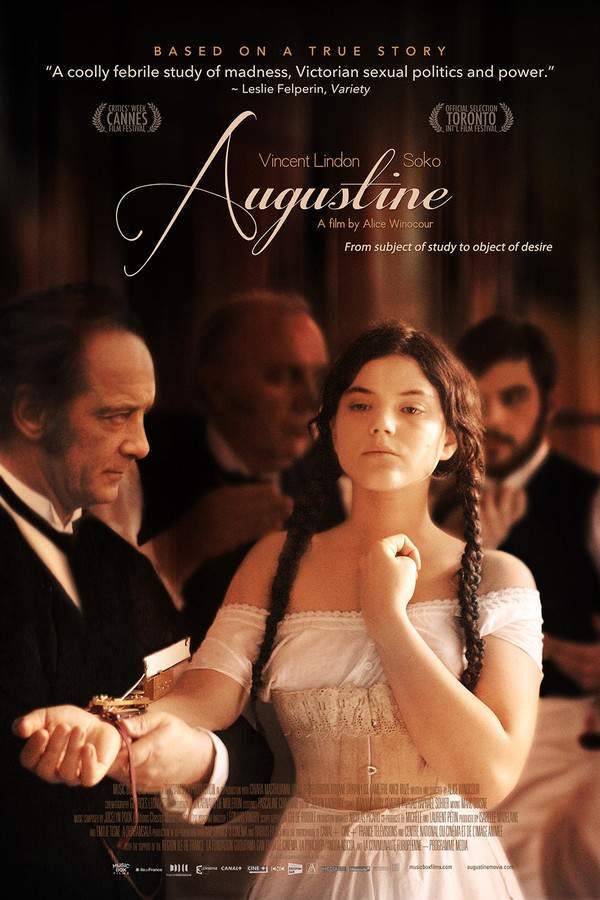
Augustine (2013) movie poster

Characters & Themes

Augustine (2013) Characters, Setting & Themes Explained

Release, runtime and language
2013 · 102 min · French
Loading streaming availability…
Directed by
Alice Winocour
Starring
Grégoire Colin, Chiara Mastroianni, Olivier Rabourdin, Vincent Lindon, Roxane Duran, Ange Ruzé

A young kitchen maid, Augustine, experiences a sudden seizure that leaves her paralyzed, disrupting her life. She is then sent to an all-female psychiatric hospital where she comes under the intense scrutiny of the celebrated neurologist Dr. Charcot. He becomes fascinated by her unusual physical reactions and hypnotic displays. As their professional relationship evolves, Augustine's experiences trigger a profound and transformative journey for both her and the doctor, blurring the lines between patient and observer.

On this page (9)
  1. 1 Where to watch
  2. 2 Characters explained (2)
  3. 3 Character relationship map
  4. 4 Where & when it takes place
  5. 5 Themes & meaning (3)
  6. 6 Character & meaning questions
  7. 7 Movie threads
  8. 8 Movies like Augustine
  9. 9 Every angle
Loading streaming availability…

2 main characters · contains spoilers

Augustine Characters Explained: Who Is Who

The main characters of Augustine (2013), heroes and villains: what drives them, how they change over the course of the story and what each of them reveals about the film's bigger ideas.

  • Augustine

    A kitchen maid who suddenly loses sensation and experiences seizures, becoming the subject of Charcot's experiments. She endures hypnotic inductions and public demonstration, yet she longs for freedom and control over her own body. Her experiences reveal both vulnerability and resilience within a coercive medical setting.

    • 🧭 Drama
    • ❗ Tragedy
    • 🩺 Medical Ethics
  • Jean-Martin Charcot

    played by Vincent Lindon

    A renowned neurologist who uses Augustine's case to push his theories and secure funding. He is both fascinated and possessive, often slipping away from professional boundaries to observe or even seduce his patient. His ambitions drive the research forward, culminating in a controversial and morally dubious dynamic.

    • ⚖️ Drama
    • 🧠 Science
    • 🔬 Power

Last updated: October 28, 2026 at 20:33

Was this helpful?

2 characters · 5 connections · contains spoilers

Augustine Character Relationship Map

Who is connected to whom in Augustine: family, love, friendships, rivalries and hidden ties, colour-coded. Pick a character to see their side of the story, or a connection to see what brings two characters together.

How much of the story to show
AAugustineJCJean-MartinCharcotVincent Lindon

Last updated: October 28, 2026 at 20:33

Was this helpful?

Setting

Where and When Does Augustine Take Place?

The setting of Augustine (2013): the year and time period, the places and locations, and how they shape the characters, the mood and the tension of the story.

Time period

Late 19th century

Set in the late 19th century, a period of rapid progress in neurology and hypnosis. Doctors used public demonstrations to attract funding and advance controversial theories about the female body. The atmosphere blends medical rigor with theatrical research, reflecting the era's boundaries between science and spectacle.

Location

Hospital, Sanatorium, Bordeaux

The film unfolds in a late-19th-century hospital and sanatorium setting, where neurological patients are observed as part of medical advances. Augustine's confinement takes place within a clinical environment that doubles as a spectacle for fellow doctors. The story also takes the action to Bordeaux for a conference, highlighting the era's culture of professional demonstrations and funding hunts.

  • 🏥 hospital
  • 🧪 historical setting
  • 🧬 medical research

Last updated: October 28, 2026 at 20:33

Was this helpful?

3 major themes

Augustine Meaning: Themes & Message Explained

What is Augustine (2013) really about? The emotional, social and philosophical themes the film keeps returning to, its symbolism and the message beneath the surface.

  • Ethics

    The narrative centers on the ethical tension of turning a patient into a test subject for funding. Augustine's consent is mediated by the prestige and ambition of Charcot, raising questions about autonomy and exploitation in medical research. The story exposes how scientific prestige can trump individual welfare, at least in the moment of discovery.

  • Confinement

    Augustine is kept within the hospital's walls, effectively imprisoned as a living tool for observation. Charcot's control—over her room, meals, and treatment—highlights power dynamics between physician and patient. The escape attempt becomes a bid for personal sovereignty against institutional confinement.

  • Female agency

    The film interrogates the female body and the constructs of hysteria imposed by male-dominated medicine. Augustine's menstruation and sexual undertones challenge the doctors' gaze and demand recognition of her agency. Her final escape reframes the narrative from medical triumph to reclaiming autonomy.

Last updated: October 28, 2026 at 20:33

Was this helpful?

Character & theme questions

Augustine Characters & Meaning: Your Questions Answered

The questions people ask about Augustine (2013): who the characters really are, their relationships, what the symbols mean, where it takes place and what the movie is really about. Each answer contains spoilers.

Q1

Where does Augustine take place?

The film is set primarily in a late-19th-century psychiatric hospital and sanatorium where neurological patients are observed for medical research. The story also moves to Bordeaux for a medical conference, reflecting the era's culture of professional demonstrations and funding hunts. The clinical environment serves a dual purpose as both a medical facility and a spectacle for doctors.

  • hospital setting
  • sanatorium
  • Bordeaux
  • psychiatric ward
  • medical setting
Q2

When is Augustine set?

Augustine is set in the late 19th century, during a period of rapid progress in neurology and hypnosis. This era was characterized by doctors using public demonstrations to attract funding and advance controversial theories about the female body. The atmosphere blends medical rigor with theatrical research, reflecting the era's boundaries between science and spectacle.

  • late 19th century
  • 1800s
  • historical setting
  • neurology era
  • hypnosis history
Q3

What are the main themes in Augustine?

The film explores three interconnected themes: ethics in medical research, confinement and institutional power, and female agency. The narrative examines how scientific prestige can override patient welfare, the power dynamics between physician and patient, and how the female body was constructed and controlled by male-dominated medicine. These themes intertwine through Augustine's journey from patient to escapee.

  • medical ethics
  • female agency
  • confinement
  • power dynamics
  • institutional control
Q4

How does Augustine explore medical ethics?

The film centers on the ethical tension of turning a patient into a test subject for funding and scientific advancement. Augustine's consent is compromised by the prestige and ambition of Dr. Charcot, raising questions about autonomy and exploitation in medical research. The story exposes how scientific achievement can trump individual welfare, showing the morally dubious dynamic between the doctor and his patient.

  • medical ethics
  • patient consent
  • exploitation
  • doctor patient relationship
  • scientific ambition
Q5

How does Augustine explore female agency?

The film interrogates how the female body was constructed and pathologized by male-dominated medicine. Augustine's menstruation and sexual undertones challenge the doctors' clinical gaze and demand recognition of her agency. Her final escape reframes the narrative from medical triumph to a reclaiming of autonomy, showing her resistance against objectification.

  • female agency
  • hysteria
  • female body
  • medical objectification
  • autonomy
Q6

What does Augustine say about confinement?

Augustine is kept within the hospital's walls, effectively imprisoned as a living tool for observation. Dr. Charcot's control over her room, meals, and treatment highlights the power dynamics between physician and patient. Her escape attempt becomes a bid for personal sovereignty against institutional confinement, representing her fight for freedom and self-determination.

  • confinement
  • institutional power
  • hospital imprisonment
  • patient autonomy
  • escape
Q7

Who is Augustine in the movie?

Augustine is a young kitchen maid who experiences sudden paralysis and seizures, becoming the subject of Dr. Charcot's neurological experiments. She endures hypnotic inductions and public demonstrations while confined in a psychiatric hospital. Throughout the film, she longs for freedom and control over her own body, showing both vulnerability and resilience within a coercive medical setting.

  • Augustine
  • kitchen maid
  • patient
  • hysteria
  • Charcot's patient
Q8

Who is Dr. Charcot in Augustine?

Jean-Martin Charcot is a renowned neurologist who uses Augustine's case to push his theories about hysteria and secure funding for his research. He is both fascinated and possessive of his patient, often crossing professional boundaries in his observations. His ambitions drive the research forward, creating a controversial and morally dubious dynamic with Augustine.

  • Jean-Martin Charcot
  • neurologist
  • doctor
  • hysteria research
  • Vincent Lindon
Q9

What kind of environment does Augustine depict?

The film depicts a claustrophobic clinical environment that doubles as a spectacle for fellow doctors. The psychiatric hospital serves as both a medical facility and a stage for public demonstrations of neurological conditions. This setting creates an unsettling atmosphere where patients become exhibits, blending medical advancement with theatrical performance.

  • psychiatric hospital
  • clinical environment
  • medical demonstration
  • voyeuristic setting

Movie threads

More Movies Like Augustine, by Mood & Story

Curated lists built around what makes Augustine tick: the same mood, the same kind of story or the same emotional payoff. Each list explains why these movies belong together.

Movies about clinical power imbalances like Augustine

Explorations of ethical collapse within professional relationships under scrutiny. If you were fascinated by the tense relationship between Dr. Charcot and his patient in Augustine, this thread finds similar movies. Discover other intense dramas about ethical dilemmas, professional misconduct, and the psychological fallout when authority crosses the line.

  • clinical
  • oppressive
  • psychologically intense
  • voyeuristic
  • unsettling
  • claustrophobic
  • Tone: tense, unsettling, melancholic
  • Pacing: steady, methodical
Why these movies?

The story pattern: Stories in this thread typically center on a professional relationship defined by a significant power imbalance. The narrative explores how the authority figure becomes consumed by their study or control of the subject, leading to ethical transgressions. The journey often involves a quiet rebellion or awakening from the subordinate character, challenging the established dynamic.

Why they belong together: Movies are grouped here because they share a core focus on the corrupting nature of power within institutional or professional settings. They create a similar mood of clinical oppression and psychological tension, making the viewer complicit in the act of observation.


Slow burn claustrophobic movies like Augustine

Stories where psychological tension builds within confined, oppressive spaces. If you appreciated the oppressive, methodical tension of Augustine set in the psychiatric hospital, explore these similar films. Find other heavy dramas with a steady pace that trap characters—and viewers—in psychologically intense and confined worlds.

  • claustrophobic
  • slow burn
  • psychologically intense
  • oppressive
  • unsettling
  • melancholic
  • Tone: tense, oppressive, melancholic
  • Pacing: steady, slow burn
Why these movies?

The story pattern: Narratives in this thread unfold within a tightly controlled or isolated setting that becomes a character in itself. The plot progresses steadily, focusing on the internal psychological state of the protagonists as they confront the constraints of their environment. The journey is one of gradual self-discovery or defiance against the forces that confine them.

Why they belong together: These films are united by their ability to create a cohesive, oppressive atmosphere through a combination of setting, pacing, and tone. They prioritize a heavy, psychologically intense mood over fast-paced action, offering a viewing experience defined by simmering dread and emotional weight.

If you liked this

Movies Like Augustine

Similar movies to Augustine: the same genre, themes or kind of story. Each one comes with its own plot summary, timeline and ending explained.

Browse all movie summaries

Every angle

Augustine (2013) Explained: Plot, Timeline & Characters

Everything about Augustine in one place: what happens in the plot summary, the timeline in chronological order, the characters and meaning and a spoiler-free summary. What's After the Movie adds the cast, box office and post-credit scenes.

Coming soon on iOS and Android

The Plot Explained Movie Summary App

Plot summaries, endings explained and timelines on your phone. Catch up on any movie in minutes, save your favorites and never miss a twist again.

Be the first to know when we launch. Your email stays private, always.

Learn more about the app