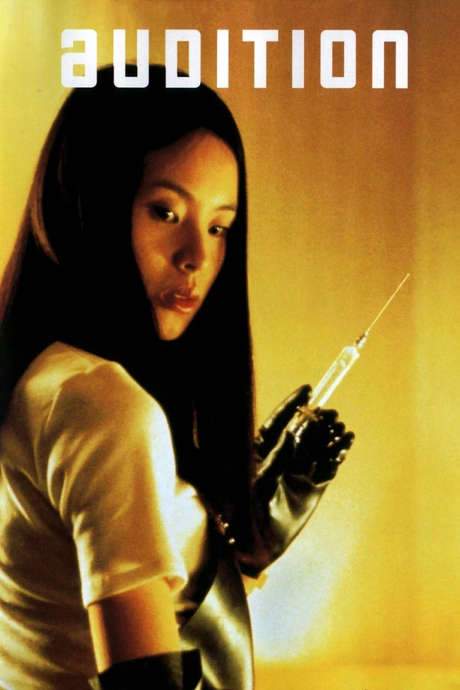
A tense, unforgettable meditation on longing, control, and the dangers of the idealized partner, this film follows Shigeharu Aoyama Ryo Ishibashi as he confronts love, loss, and the unsettling price of desire. Shigeharu Aoyama Ryo Ishibashi visits his wife Ryoko Aoyama Miyuki Matsuda in a hospital bed, where she dies from an illness the film leaves unnamed but all-consuming in its impact. Seven years pass, and the world of Shigeharu grows quiet and hollow until his teenage son, Shigehiko Aoyama Tetsu Sawaki, gently nudges him toward remarrying. The idea of rebuilding a life awakens something tender and fragile in him, yet the pursuit quickly spirals into something far more perilous.
His friend and former film producer Yasuhisa Yoshikawa Kanji Tsuda steps in with a daring, morally gray scheme: he stages a faux casting call, gathering seemingly suitable single women under the pretense of auditioning for a new TV series. In truth, they are sampling candidates to become Shigeharu’s new wife. Among the hopefuls, one woman stands out—Asami Yamazaki Eihi Shiina—who claims to have once trained as a ballet dancer before an injury altered her path. The moment Shigeharu beholds Asami, his fascination deepens into something almost worshipful, and he is eager to pursue a relationship with her, even as Yasuhisa grows increasingly suspicious of Asami’s past and the gaps in her résumé.
Asami’s life appears pared down to essentials: a sparse apartment, a single large sack, and a perpetually quiet presence by the phone, where she sits in stillness for days after the audition, waiting for a call that may never come. When the phone finally rings, she answers with an act that blends politeness and calculation, setting the tone for the whirlwind of dates that follows. After several meetings, Shigeharu invites Asami to a hotel where he intends to propose. She reveals burn scars on her body and, before they proceed to intimacy, demands that he profess his love. Moved by the intensity of her vow, he pledges himself to her completely. The next morning, a call from the front desk confirms that Asami has left, leaving Shigeharu both stunned and entranced.
Driven by a mix of faith and doubt, Shigeharu sets out to uncover the truth behind Asami’s résumé and the life she claims to have led. His search leads him into a labyrinth of disturbing clues: at a dance studio, a man with prosthetic feet recalls the violence that haunted Asami’s childhood; at a bar once frequented by her, a local man speaks of a body found with an extra tongue, an extra ear, and three extra fingers—details that haunt Shigeharu in memories and visions. The discoveries blur the lines between reality and fear, and Shigeharu’s sense of self begins to fracture as he experiences terrifying, destabilizing hallucinations tied to Asami’s shadowy past.
The nightmare intensifies when Asami infiltrates Shigeharu’s home. Jealousy flares as she spots a framed photograph of Ryoko, and she drugs the couple’s drinks, turning a fragile new romance into a vessel for power and control. The family dog is killed as part of her cold, escalating behavior, and Shigeharu finds himself succumbing to a brutal wakefulness: he is drugged, strapped to a chair, and subjected to a regimen of acupuncture needles that pierce him with a frightening chill. Asami reveals how deeply her need to be loved—and to be the sole object of that love—consumes everyone around her, insisting that Shigeharu’s love for others, including his son, is precisely what she cannot endure.
In a harrowing sequence at Asami’s apartment, the truth about her violence becomes undeniable. Shigeharu’s nightmare reality reveals itself in a cascade of brutal imagery: a sack in the corner holds a body that has suffered gruesome mutilation, a revelation that culminates in a scene of unimaginable horror as Asami beheads a man with prosthetic feet. When Shigeharu wakes, he is told he has been injected with a paralyzing agent, leaving him conscious but unable to move as Asami intensifies her torture. Yet within this storm of fear, the film asks whether love can survive an act of extreme possession.
The narrative circles back to the hotel, where Shigeharu is drawn into another moment of supposed reconciliation. He proposes again, and Asami accepts, locking them into a bleak, dangerous bond. In a shocking turn, Shigehiko returns home from school and confronts Asami, who attacks him. What follows is a moment that shatters Shigeharu’s illusion: he awakens to realize that the hotel sequence may be a false awakening, a haunting loop rather than a single moment in time. As the tension peaks, Shigehiko fights Asami and finally hurls her down a flight of stairs, breaking her neck. In the aftermath, Shigeharu urges his son to contact the authorities and faces the stark truth of what has transpired. As the dying Asami repeats a line she uttered on a date—an obsession with seeing him again—the film closes on a stark meditation about the limits of love and the violence it can mask.
- Shigeharu Aoyama Ryo Ishibashi emerges as a man torn between memory and longing, caught in a cycle of desire that blurs ethical lines.
- Ryoko Aoyama Miyuki Matsuda remains a haunting presence in his past, a touchstone that fuels his later decisions.
- Asami Yamazaki Eihi Shiina stands at the center of the storm as a figure of beauty and danger, whose pursuit of exclusive love becomes a weapon.
- Yasuhisa Yoshikawa Kanji Tsuda embodies the vigilant friend who questions the moral cost of chasing happiness.
- Shigehiko Aoyama Tetsu Sawaki anchors the story with a boy’s perspective on his father’s choices, contributing to the film’s emotional weight.