Year: 2005
Runtime: 96 mins
Language: Japanese
Director: Takashi Shimizu
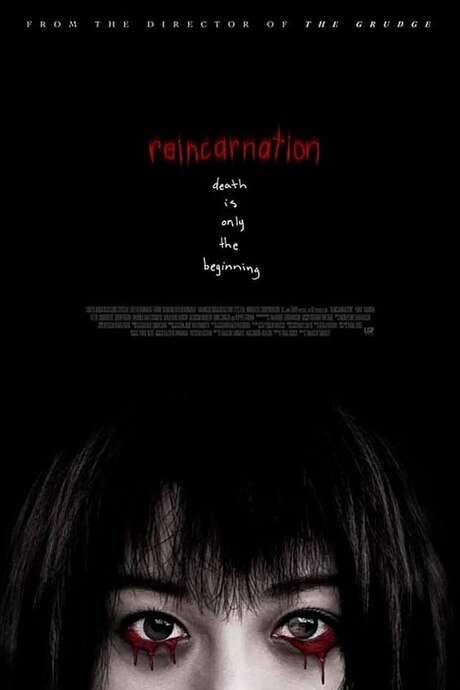
After being cast in a horror movie that dramatizes a real murder spree from more than four decades ago, a Japanese actress begins to suffer vivid, unsettling visions and inexplicable experiences that echo the atrocities. As the line between film and reality blurs, she discovers that death may be only the beginning.
Warning: spoilers below!
Haven’t seen Reincarnation yet? This summary contains major spoilers. Bookmark the page, watch the movie, and come back for the full breakdown. If you're ready, scroll on and relive the story!
Read the complete plot breakdown of Reincarnation (2005), including all key story events, major twists, and the ending explained in detail. Discover what really happened—and what it all means.
Norihasa Omori (Atsushi Haruta)—a professor bent on uncovering the mysteries of reincarnation—travels to a local hotel in 1970 and records himself committing a brutal slaughter: eleven lives, including guests, staff, and his own children. He then dies by his own hand, leaving behind a controversial piece of footage that dissolves into the ether and vanishes from memory. The act is chilling in its certainty, a calculated rite meant to probe what lies beyond death, and its disappearance stirs a quiet puzzle that future generations will chase.
Thirty-five years later, Ikuo Matsumura (Kippei Shiina), a horror filmmaker, resolves to make a film about the massacre. As the production draws near, Nagisa Sugiura (Yûka)—the actress cast to portray Omori’s daughter Chisato—begins to be haunted by the victims’ spirits. Her nights fracture into vivid nightmares, and she experiences unsettling hallucinations that blur the line between fiction and the past. Amid the creeping dread, she stumbles upon an old film camera that resembles the one Omori used, a relic that seems to unlock something ancient and ominous within the project.
In the midst of these eerie premonitions, Yayoi Kinoshita (Karina)—a college student drawn into the project—meets Yuka Morita (Marika Matsumoto), another actress who had auditioned for Ikuo’s film. Yuka claims she remembers things from a “past life” and shows Yayoi a birthmark that appears to echo signs of strangulation. The unsettled atmosphere thickens as unseen presences insinuate themselves, and soon Yuka is seized by ghostly forces that drag her away, leaving Yayoi with more questions than answers and a growing sense that the line between cinema and the supernatural is dangerously thin.
Yayoi’s research leads her to Ayumi Omori (Miki Sanjō), the massacre’s lone survivor and Omori’s wife. Ayumi explains that Omori had become obsessed with the idea that the body is merely a vessel, a vessel that could be emptied and reused by another presence after death. Her testimony adds a chilling layer to the myth surrounding the killings and hints at why the film’s cast might be drawing on forces they don’t fully understand.
As filming progresses, Nagisa’s hallucinations intensify. Her agent reviews the camera—the very instrument that holds Omori’s murders—expecting a straightforward artifact, only to find it contains a loop of events that seem to reenact themselves in real time. When the film begins to play, Nagisa and the other performers appear to step into the roles they portray, and the people she sees begin transforming into those roles before her eyes. The victims drift toward her as she makes a desperate escape, sprinting through the town while her agent watches everything unfold through Omori’s point of view, a perspective that becomes increasingly unreliable and claustrophobic.
In a climactic moment, Nagisa is cornered in a shop and seizes a shard of glass to end her life. She gazes into the window and sees Omori’s face staring back at her, a mirror of the original crime that now seems to foretell her own fate. Her agent watches, witnessing Omori reveal Nagisa’s reflection in the glass rather than his own before he cuts his throat. The boundary between killer and victim blurs as Nagisa slowly begins to reenact Omori’s suicide, only to be halted by a malevolent force in the form of a doll that utters a chilling claim: they will be together forever.
Behind the scenes, a group of executives reviews Nagisa’s take on the film. Among them is Ayumi, the survivor who carries the pain of the past into the present. As the production spirals toward its close, Nagisa collapses, her body shaking and her voice raw with fear, as crew members rush to assist. The finale unfolds in a mental ward, where Nagisa is restrained in a full-body wrap, still haunted by the souls of Omori’s children. Ayumi appears at the door, peering in as Nagisa’s world tightens around her. She passes Nagisa the toys the children loved— a red ball and a doll—signaling a eerie continuity between the living and the dead. Nagisa’s scream echoes down the corridor, but a sinister, almost serene smile spreads across her face as the ghosts close in, leaving the audience with a haunting image of possession, memory, and the price of peering too deeply into the past.

Last Updated: October 09, 2025 at 16:46
Discover curated groups of movies connected by mood, themes, and story style. Browse collections built around emotion, atmosphere, and narrative focus to easily find films that match what you feel like watching right now.
Characters unravel a supernatural mystery that begins to unravel their own sanity.If you liked Reincarnation, explore these other movies where characters investigate a supernatural past only to find it investigating them in return. These films combine eerie mystery with psychological horror, often featuring blurred realities and a descent into madness.
The narrative follows a protagonist, often a skeptic or a professional, who is drawn into investigating a mysterious past event. As they gather clues, the supernatural nature of the case becomes undeniable, and the boundary between their reality and the haunting begins to dissolve. The story's climax typically involves the investigator being consumed or permanently altered by the very forces they sought to understand.
Movies are grouped here because they share a core structure of a supernatural investigation that directly impacts the investigator's psyche. They blend mystery with psychological horror, creating a specific kind of dread where the search for answers leads to the loss of self.
Films where the environment itself becomes a source of inescapable, creeping horror.Find more movies with a suffocating atmosphere like Reincarnation. These films prioritize building a palpable sense of dread through haunting settings, supernatural Presence, and a focus on psychological torment over cheap thrills.
The narrative is less about a linear plot and more about the slow, inexorable buildup of dread. Characters are trapped in a situation or location plagued by a supernatural force. The story unfolds through escalating, inexplicable experiences and visions, focusing on the psychological deterioration of the characters as they confront a horror they cannot fight or flee.
These films are grouped by their shared emphasis on atmosphere as the primary engine of horror. They create a consistent mood of unease and foreboding, using the supernatural to explore themes of inherited trauma, psychological fragility, and inescapable fate.
Don't stop at just watching — explore Reincarnation in full detail. From the complete plot summary and scene-by-scene timeline to character breakdowns, thematic analysis, and a deep dive into the ending — every page helps you truly understand what Reincarnation is all about. Plus, discover what's next after the movie.
Track the full timeline of Reincarnation with every major event arranged chronologically. Perfect for decoding non-linear storytelling, flashbacks, or parallel narratives with a clear scene-by-scene breakdown.
Discover the characters, locations, and core themes that shape Reincarnation. Get insights into symbolic elements, setting significance, and deeper narrative meaning — ideal for thematic analysis and movie breakdowns.
Get a quick, spoiler-free overview of Reincarnation that covers the main plot points and key details without revealing any major twists or spoilers. Perfect for those who want to know what to expect before diving in.
Visit What's After the Movie to explore more about Reincarnation: box office results, cast and crew info, production details, post-credit scenes, and external links — all in one place for movie fans and researchers.
Discover movies like Reincarnation that share similar genres, themes, and storytelling elements. Whether you’re drawn to the atmosphere, character arcs, or plot structure, these curated recommendations will help you explore more films you’ll love.
Reincarnation (2005) Scene-by-Scene Movie Timeline
Reincarnation (2005) Movie Characters, Themes & Settings
Reincarnation (2005) Spoiler-Free Summary & Key Flow
Movies Like Reincarnation – Similar Titles You’ll Enjoy
Re/Member (2023) Ending Explained & Film Insights
Reborn (2018) Movie Recap & Themes
The Grudge (2019) Detailed Story Recap
Reeker (2005) Film Overview & Timeline
Unrest (2006) Film Overview & Timeline
The Resurrected (1991) Full Movie Breakdown
The Reincarnation of Sex (1982) Full Movie Breakdown
Mortuary (1982) Complete Plot Breakdown
Reincarnation (2004) Ending Explained & Film Insights
Retribution (1987) Spoiler-Packed Plot Recap
Revenant (1000) Film Overview & Timeline
This Night I’ll Possess Your Corpse (1967) Film Overview & Timeline
Death Smiles on a Murderer (1973) Story Summary & Characters
The Reincarnate (1971) Plot Summary & Ending Explained
Blood Reincarnation (1974) Movie Recap & Themes