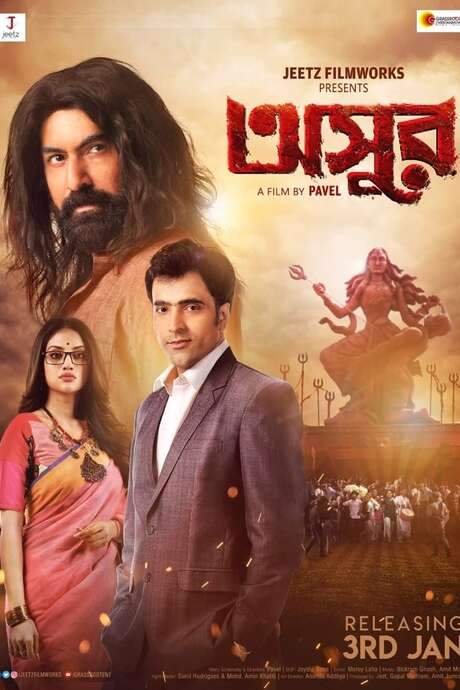
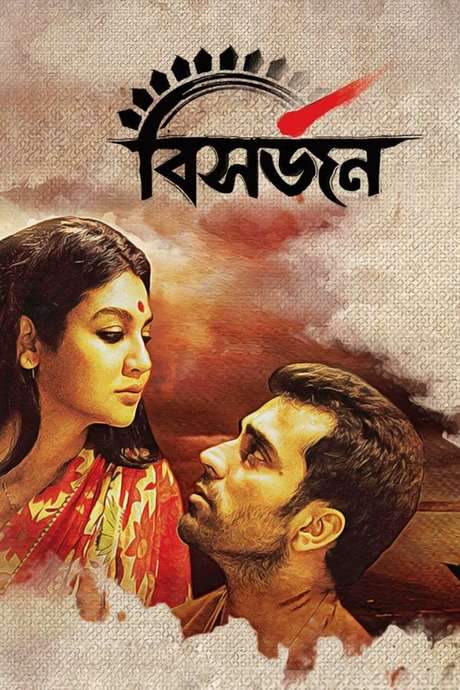
Kigan Mandi, [Jeet], is a profoundly passionate artist who easily forgets his surroundings while immersed in his own vivid thoughts. An eccentric, he frequently runs afoul of university life and ends up suspended from his job as a professor of art at Visva-Bharati University. When a photo shoot featuring a female student triggers a scandal, the university fires him. Freed from the dry discipline of campus rules, Kigan is excited by the prospect of directing his art with total creative control.
Kigan begins to experience visualizations of Goddess Durga in the form of a young girl who seems to accompany him in every frame of his work. This spiritual vision fuels his bold plan: to create the world’s largest Durga murti. To realize this dream, he relies on his friend since their undergraduate days, Aditi [Nusrat Jahan], who shares his artistic hunger. The project attracts attention from the corporate world, and Aditi’s father, [Biplab Chatterjee], steps in to navigate the tense politics of sponsorship and prestige. Yet a major sponsor, Bodhi, [Abir Chatterjee], who is also Aditi’s husband, forces a chilling condition: he wants Kigan’s name erased from all future mentions of the Durga idol. Aditi’s father rejects this petty demand, arguing that art must stand on its own merits.
With Bodhi’s company underwriting the puja, marketing reaches new heights. Ads, banners, and buzz surround the installation at Deshbandhu Park, drawing huge crowds and powerful sponsors eager for publicity. But Bodhi’s pride breeds insecurity as Kigan’s creation quickly eclipses other puja pandals in popularity. He hatches a plan to demolish the park’s puja and to exact revenge on Kigan, setting the stage for a dangerous collision of art, ego, and ambition.
One morning Bodhi confronts Kigan at the site, insinuating that the idol will soon cease to exist. He hints at destruction, leaving Kigan startled but confident that nothing short of his own life could end the masterpiece. The puja committee hosts a party where Aditi’s father publicly introduces Kigan as a prospective husband for Aditi, provoking tension. Kigan, feeling uneasy, undermines the moment with a blunt declaration that he loves Aditi only as a friend, and that Bodhi is the right match for her. The admission wounds her father, who suffers a cerebral attack and becomes paralysed, steering suspicion toward Kigan and driving a deeper rift between Kigan and Aditi.
Meanwhile, the pandal continues to attract larger crowds, and Bodhi intensifies his plan by orchestrating a phony bomb scare to create chaos and tarnish the festival’s image. The incident is magnified by biased media coverage, leading the police to order a ban on the puja and its dismantling after immersion. Kigan is briefly jailed for his quarrel with the police, but Bodhi soon releases him, revealing that the destruction of public ritual was his revenge and that he will not permit the puja to reopen under Kigan’s name.
Kigan confronts Bodhi and proposes reopening the puja after a short pause, but Bodhi remains firm. Distressed, Kigan seeks truth and reconciliation with Aditi, and the two begin to mend their relationship as Kigan admits his mistakes. He then investigates the wider picture and discovers that the injuries were two, not widespread, and that much of the crisis had been manufactured as paid news. He presses authorities to reconsider, meeting with the police commissioner and even the governor, but faces resistance.
A brutal confrontation with Bodhi at his home reveals a shocking truth: Bodhi is not merely a jilted sponsor but the father who raised Kigan’s own child as his own. He confesses that his aim was to protect the boy from what he saw as Kigan’s recklessness, while also acknowledging that Aditi had secretly collaborated in the plan to hurt Kigan out of love for him. The revelation shatters Kigan’s world. He believes his own passions have wrecked real relationships, and in a moment of despair decides to leave for Nevada to seek peace away from his art and the people he loves.
In Nevada, a crucial revelation emerges: Bodhi’s son has learned of a local ritual in which the artist burns idols himself. Bodhi and Aditi hurry back to Deshbandhu Park, but by then Kigan has set the pandal afire, accompanying the flames with his own life. He promises Durga that their story will endure even as the idol is destroyed. A sudden, heavy rain interrupts the fire, saving the idol and allowing the crowd to witness a miraculous preservation.
At the memorial, the Governor honors Kigan’s dedication, declaring that his work will be preserved as a landmark of art, heritage, and sacrifice for love. In the final images, Bodhi and Aditi are reunited, watching a helicopter carry Kigan’s statue to a new location, while Bodhi’s son plays with Kigan’s measuring tape, dreaming of becoming an artist. The film closes on a reflective note, raising questions about who the true Asur is: Bodhi, who acts from protective love and fear for his family, or Kigan, whose artistic fire consumed the very bonds he sought to protect. The story leaves us pondering the line between devotion and obsession, and whether some wounds can ever be truly repaired.