Plot Explained Spoilers guaranteed!
Plot Explained

Browse by genre

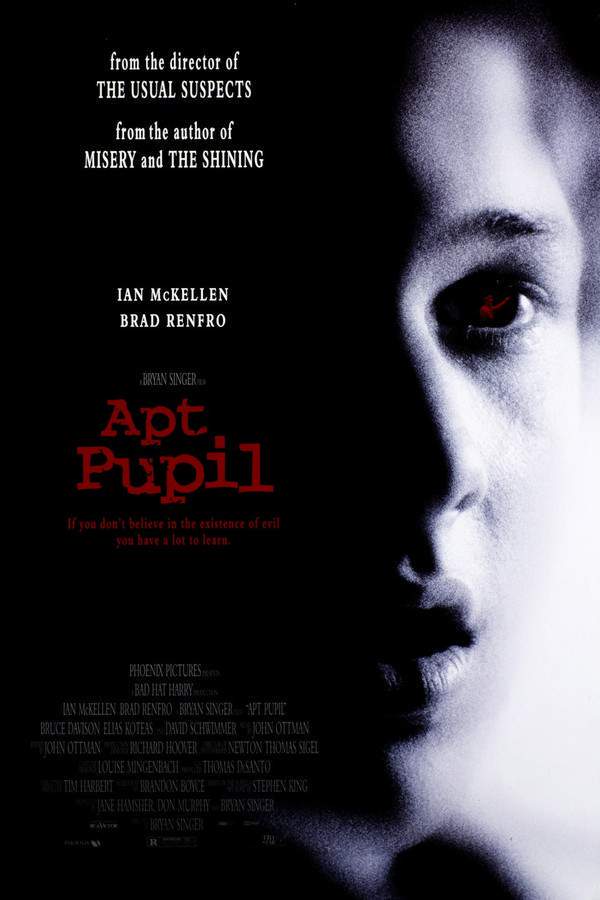
Apt Pupil (1998) movie poster

Plot Summary

Apt Pupil (1998) Plot Summary Explained

Release, runtime and language
1998 · 111 min · English
Directed by
Bryan Singer
Starring
Ian McKellen, Brad Renfro

A teenage boy develops a disturbing fascination with a former Nazi living in his town. The older man, burdened by a dark past, finds himself drawn into the boy’s intense interest. Their unusual relationship becomes increasingly complex, blurring the boundaries between captor and captive as a sinister secret is revealed, challenging the quiet facade of their community.

On this page (7)
  1. 1 Where to watch
  2. 2 What happens: full plot
  3. 3 Plot questions answered
  4. 4 The book behind the movie
  5. 5 Movie threads
  6. 6 Movies like Apt Pupil
  7. 7 Every angle

Where to watch

Where to Watch Apt Pupil (1998)

Where can you watch Apt Pupil? Stream, rent or buy it in the US, including on Tubi TV, Amazon Video and Apple TV Store: current JustWatch availability with up-to-date prices.

Streaming availability powered by JustWatch

Full plot summary · contains spoilers

What Happens in Apt Pupil: Full Plot Summary

The whole story of Apt Pupil (1998) explained, from the opening scene to the final frame: every key event, every twist and what it all adds up to. Read it as a quick recap before the sequel, to check a scene you missed, or to finally understand what really happened.

In the sun-soaked suburbs of Southern California during the pivotal year of 1984, a seemingly average and curious sixteen-year-old high school student named Todd Bowden stumbles upon a shocking secret about his reclusive and elderly neighbor, Arthur Denker. As it turns out, this old man is actually Kurt Dussander, a former Nazi Obersturmbannführer who has evaded justice and is now a fugitive war criminal. Driven by a dark fascination for the heinous activities of the Nazis during World War II, Todd resorts to blackmail when he threatens to expose Dussander’s true identity, compelling the old man to share harrowing tales of the death camps.

As their strange relationship deepens, Todd's life begins to unravel. His once-promising grades plummet, and his interest in his girlfriend, Heather McComb, dissipates entirely as he becomes further ensnared in Dussander's malignant influence. Struggling to maintain a façade of normalcy, Todd hides his academic failures from his unsuspecting parents. In a twisted turn of events, Dussander then employs a tactic of his own—he coerces Todd into studying diligently to reclaim his academic standing, ominously threatening to unveil Todd’s dark obsessions and secrets to his family.

In a shocking display of manipulation, Dussander poses as Todd's grandfather, accompanying him to a meeting with the school counselor, Edward French. As they delve into the horrors of wartime atrocities, both men are haunted by their shared discussions, revealing the psychological toll on both the youthful boy and the aged war criminal. The extent of this dark mentorship leads Dussander into a sinister descent; he begins referencing the gas chambers of his past by committing acts of animal cruelty.

In a fateful night filled with dread, Dussander attempts to eliminate a hobo who witnesses him in his military uniform. However, fortune takes a turn when Dussander suffers a heart attack. Seizing the moment, Todd steps in, completing the heinous act, cleaning up the scene, and feigning ignorance by calling for an ambulance for his manipulative mentor. At the hospital, however, the walls close in when Dussander is identified as a notorious war criminal by an ex-prisoner of the camps.

Meanwhile, Todd's academic prowess skyrockets—in a matter of weeks, he transforms from a struggling student to the valedictorian of his class. As he delivers an imposing speech referencing Icarus, he articulates the poignant notion that “All great achievements arose from dissatisfaction. It is the desire to do better, to dig deeper, that propels civilization to greatness.” This moment is starkly contrasted with scenes of Dussander’s search warrant being carried out, culminating in the grim discovery of the hobo's remains in the basement, painting a picture of the duality of Todd's rising success against Dussander's impending doom.

Ultimately, Todd manages to spin a web of deceit that shields him from investigation, convincing authorities that he remained oblivious to Dussander's infamous past. Yet, within the confines of the hospital, the weight of the world crushes Dussander; upon overhearing a group of Neo-Nazis that expose his compromised identity, he takes solace in a tragic exit, choosing to end his life by inducing an air embolism.

In a chilling finale, Mr. French confronts Todd, discovering the old man he believed to be his grandfather was, in fact, a war criminal. In an unexpected twist, Todd turns the tables, utilizing blackmail to intimidate French into silence, threatening to accuse him of inappropriate advances. Thus, as Dussander lies dead in his hospital bed, Todd Bowden emerges from high school—a transformed, now fully developed sociopath, irrevocably changed by the dark interactions with Kurt Dussander.

Last updated: January 14, 2025 at 19:25

Was this helpful?

Plot questions answered

Apt Pupil Plot Explained: Your Questions Answered

The questions people ask most about Apt Pupil (1998): what happens in the confusing scenes, why the characters do what they do, the twists, hidden details and what the ending means. Each answer contains spoilers.

Q1

Why does Todd become so fascinated with Dussander's Nazi past?

Todd is a intellectually curious teenager who develops a dark fascination with the Nazis after discovering Dussander's true identity. Rather than reporting him, Todd chooses to blackmail the old man, driven by a disturbing curiosity about the Holocaust and a desire to understand the depths of human evil. This obsession gradually consumes his life, affecting his grades, his relationship with his girlfriend, and ultimately his entire moral compass.

  • todd bowden
  • dussander
  • obsession
  • nazism
  • blackmail
  • psychological corruption
Q2

How does Todd blackmail Dussander into sharing stories about the camps?

After discovering that his neighbor Arthur Denker is actually Kurt Dussander, a former Nazi Obersturmbannführer, Todd threatens to expose him to the authorities unless Dussander tells him about his experiences in the death camps. Dussander, fearful of extradition and imprisonment, complies with Todd's demands, sharing increasingly disturbing details about the atrocities he witnessed and participated in.

  • blackmail
  • dussander
  • threat
  • exposure
  • confession
  • death camps
Q3

Why does Dussander force Todd to improve his grades?

Once Dussander realizes Todd has become dependent on their conversations and is neglecting his schoolwork, he turns the tables on the blackmailer. Dussander threatens to tell Todd's parents about the boy's dark obsessions unless he maintains his academic performance. This forces Todd back into studying, and he remarkably transforms from failing grades to becoming class valedictorian, a twisted form of mentorship that gives Dussander psychological control over the teenager.

  • grades
  • dussander
  • manipulation
  • control
  • academic pressure
  • valedictorian
Q4

What is the significance of Dussander killing animals in his oven?

After their sessions discussing the Holocaust, Dussander begins killing animals, specifically cats and dogs, in his gas oven, recreating the mechanism of the death camps on a smaller scale. This disturbing behavior demonstrates how the conversations are corrupting both characters: Dussander is regressing to his old ways while Todd becomes increasingly desensitized to cruelty and death. It marks a pivotal point in their dark relationship where the line between storyteller and participant blurs.

Foreshadowing: Earlier discussions about gas chambers foreshadow this disturbing behavior.

  • animals
  • gas oven
  • cruelty
  • death camps
  • regression
  • psychological descent
Q5

Who kills the hobo in the basement?

Dussander attempts to kill a hobo who recognizes him wearing his old Nazi uniform, stabbing him in a desperate attempt to silence a potential witness. However, Dussander suffers a heart attack during the attack. Todd arrives to find the dying hobo and, rather than helping him, finishes the murder by suffocating him, then cleans up the entire crime scene. This moment represents Todd's complete moral transformation, he has transitioned from curious observer to active participant in murder.

Foreshadowing: The earlier animal killings and discussions of killing foreshadow Todd's willingness to commit murder.

  • hobo
  • murder
  • dussander
  • todd
  • basement
  • crime scene
  • cover-up
Q6

How does Todd cover up the murder and avoid getting arrested?

After Dussander has a heart attack during the murder attempt, Todd arrives at the scene, suffocates the dying hobo to ensure his death, cleans the basement thoroughly, and disposes of evidence. When he calls for an ambulance for Dussander, he maintains complete composure, presenting himself as a concerned neighbor who just found the old man collapsed. During police questioning after Dussander's arrest, Todd convincingly plays dumb about Dussander's identity, and his status as a promising student makes him seem trustworthy.

  • cover-up
  • police
  • interrogation
  • evidence
  • deception
  • lies
  • manipulation
Q7

Why does Dussander kill himself at the hospital?

After being identified as a war criminal by a former concentration camp survivor at the hospital, Dussander knows his fate is sealed, he will be extradited to Israel to face trial for his crimes. When he overhears a group of Neo-Nazis in the hospital discussing his exposure, he makes the decision to take his own life rather than face justice. He injects himself with air, creating an air embolism that kills him, choosing death over the humiliation and accountability of a trial.

  • suicide
  • hospital
  • air embolism
  • extradition
  • trial
  • neo-nazis
  • exposure
Q8

What happens when Mr. French confronts Todd about Dussander?

After Dussander's death, Mr. French, Todd's school counselor who had met Dussander when he posed as Todd's grandfather, discovers the truth about the old man's identity as a war criminal. French confronts Todd, expecting the boy to be another victim. However, Todd completely reverses the situation, threatening to tell everyone that French made inappropriate advances toward him. This intimidation tactic effectively silences French and secures Todd's freedom from consequences.

  • mr. french
  • counselor
  • confrontation
  • blackmail
  • threats
  • silence
  • manipulation
Q9

What is the meaning of Todd's Icarus graduation speech?

Todd delivers his valedictorian speech about Icarus, stating that 'all great achievements arose from dissatisfaction' and the desire to 'do better, to dig deeper' propels civilization. The irony is devastating, Todd's 'achievement' is his transformation into a sociopath, and his 'desire to dig deeper' refers literally to digging into the depths of Nazi evil. The speech plays over the scene of police discovering the hobo's remains in Dussander's basement, juxtaposing ambition with corruption.

  • icarus
  • valedictorian
  • speech
  • ambition
  • symbolism
  • irony
  • graduation
Q10

How does Todd transform into a sociopath by the end of the movie?

Throughout the film, Todd's exposure to Dussander's stories and his participation in covering up murder gradually strip away his moral boundaries. What begins as dark curiosity becomes blackmail, which becomes complicity in murder, and finally active murder. By threatening Mr. French to secure his freedom, Todd demonstrates complete emotional manipulation without remorse. The film suggests that evil can be taught, the corrupting influence of proximity to Nazi atrocities has transformed a seemingly normal teenager into a calculating, manipulative sociopath.

Foreshadowing: The gradual decline in Todd's empathy, from enjoying animal cruelty stories to completing the hobo's murder, foreshadows his complete transformation.

  • transformation
  • sociopathy
  • corruption
  • evil
  • manipulation
  • moral decay
  • psychology
Q11

Why doesn't Todd show any remorse or change after everything that happens?

Todd's complete lack of remorse is the film's most disturbing element. From the beginning, he demonstrates traits of a budding psychopath, his initial fascination with evil, his willingness to blackmail, his manipulation of adults, and his emotional detachment during the murder and cover-up. Rather than being corrupted by Dussander, the film suggests Todd found in Dussander a mirror for his own latent darkness. By the end, he has fully embraced his manipulative nature and shows no indication of guilt or willingness to change.

Foreshadowing: Todd's initial blackmail of Dussander without any moral hesitation foreshadows his inability to feel guilt.

  • remorse
  • guilt
  • sociopathy
  • psychology
  • corruption
  • no redemption
  • ending
Q12

Why does Dussander share his war crimes stories with Todd?

Dussander initially shares his stories because Todd blackmails him, threatening exposure. However, Dussander comes to enjoy the role of storyteller, finding a willing listener who doesn't judge him. There's a psychological reversal where Dussander becomes both mentor and prisoner, gaining power through his narratives while remaining trapped by Todd's leverage. The act of recounting his crimes also seems to fulfill some deep psychological need, he has spent decades hiding, and confession, even forced confession, provides a twisted relief.

  • confession
  • stories
  • Holocaust
  • storytelling
  • manipulation
  • power dynamic
Q13

Why does Todd lose interest in his girlfriend Heather?

As Todd becomes more immersed in his sessions with Dussander, his interest in normal teenage activities deteriorates. Heather represents the life Todd is abandoning, his academic future, his social world, his humanity. His total obsession with Nazi stories and later his involvement in murder creates an unbridgeable gap between him and his former life. When he does briefly return to her, he shows no genuine emotion, and she can sense something is deeply wrong with him.

  • heather
  • girlfriend
  • neglect
  • obsession
  • isolation
  • relationship decay

Movie threads

More Movies Like Apt Pupil, by Mood & Story

Curated lists built around what makes Apt Pupil tick: the same mood, the same kind of story or the same emotional payoff. Each list explains why these movies belong together.

Dark Mentor Obsession Movies like Apt Pupil

Two characters become locked in a sinister dance of mutual manipulation and corruption. If you were fascinated by the toxic relationship in Apt Pupil, explore more movies about dangerous mentorships and mutual psychological destruction. These stories feature intense character studies where obsession and manipulation corrupt all involved, similar to the dynamic between Todd and Kurt Dussander.
  • psychological
  • manipulative
  • corrupting
  • claustrophobic
  • sinister
  • obsessive
  • Tone: dark, sinister, psychologically tense
  • Pacing: steady, character-driven escalation
Why these movies?

The story pattern: The narrative typically centers on a duo—often an older, corrupt figure and a younger, impressionable one—whose initial curiosity or power play evolves into a deeply intertwined and destructive relationship. The story unfolds through escalating acts of control, blackmail, and psychological games, culminating in a shared descent into darkness.

Why they belong together: These films are grouped together because they share a core focus on a two-person psychological battle that creates a claustrophobic, unsettling atmosphere. The similarity lies in the intense, character-driven tension and the theme of evil being a contagious force that corrupts through intimate contact.

Movies about Evil Hiding in Plain Sight like Apt Pupil

A seemingly peaceful community or life is disrupted by the revelation of a dark, hidden secret. Fans of Apt Pupil's theme of a Nazi war criminal living a quiet suburban life will enjoy these movies about secrets and evil hidden beneath a normal facade. These thrillers and dramas explore the chilling idea that darkness can reside next door, creating suspense as the truth is slowly revealed.

  • unsettling
  • suspenseful
  • dark secret
  • sinister
  • tense
  • psychological
  • Tone: dark, suspenseful, unsettling
  • Pacing: steady build, escalating dread
Why these movies?

The story pattern: The narrative pattern involves a protagonist discovering a terrible secret—often about a person, an institution, or the town itself—that has been carefully concealed. The plot revolves around the unraveling of this secret and the subsequent moral and psychological fallout, challenging characters' perceptions of safety and normality.

Why they belong together: These movies are united by their central theme of concealed malevolence and the dramatic tension of its exposure. They share a specific mood of creeping dread and suspense, built on the contrast between an ordinary setting and the shocking darkness hidden within it, leading to a profound sense of unease.

If you liked this

Movies Like Apt Pupil

Similar movies to Apt Pupil: the same genre, themes or kind of story. Each one comes with its own plot summary, timeline and ending explained.

Browse all movie summaries

Every angle

Apt Pupil (1998) Explained: Plot, Timeline & Characters

Everything about Apt Pupil in one place: what happens in the plot summary, the timeline in chronological order, the characters and meaning and a spoiler-free summary. What's After the Movie adds the cast, box office and post-credit scenes.

Coming soon on iOS and Android

The Plot Explained Movie Summary App

Plot summaries, endings explained and timelines on your phone. Catch up on any movie in minutes, save your favorites and never miss a twist again.

Be the first to know when we launch. Your email stays private, always.

Learn more about the app