Terribly Happy

Terribly Happy

Year: 2010

Runtime: 90 min

Language: Danish

Director: Henrik Ruben Genz

Drama

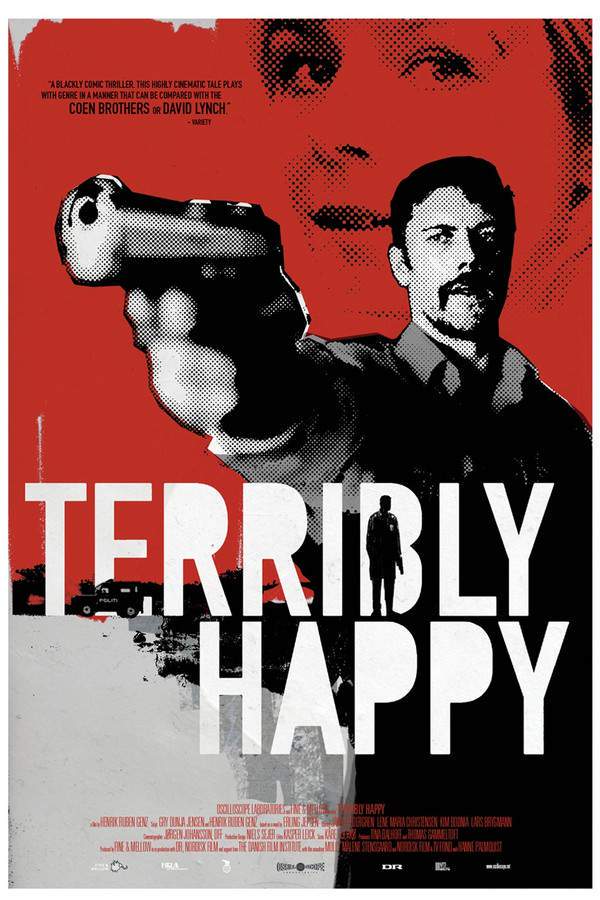
Following a personal breakdown, a cynical police officer, Robert Hanson, is reassigned to a seemingly peaceful rural town. There, he becomes involved with an enigmatic woman, finding his tough-cop perspective challenged by the town’s unusual atmosphere. As he navigates this unfamiliar environment, Hanson descends into a troubling and dangerous situation, forcing him to confront his own fractured sense of self.

Warning: spoilers below!

Haven’t seen Terribly Happy yet? This summary contains major spoilers. Bookmark the page, watch the movie, and come back for the full breakdown. If you're ready, scroll on and relive the story!

Terribly Happy (2010) – Full Plot Summary & Ending Explained

Read the complete plot breakdown of Terribly Happy (2010), including all key story events, major twists, and the ending explained in detail. Discover what really happened—and what it all means.

Copenhagen police officer Robert Hansen has been temporarily reassigned by his supervisor, the chief of police in Tonder, to serve as the only law enforcement officer in the small village of Skarrild, nestled within a damp lowland area. Recently emerging from therapy following a breakdown triggered by a violent confrontation with his wife and her lover, Robert feels a deep longing to complete his assignment so he can reunite with his daughter, Josefine, who has been misled to believe he is in Australia.

Upon his arrival in Skarrild, Robert encounters a cast of eccentric locals, including Dr. Zerleng and his two companions, the grocer and the village priest, who are eager for him to join their regular card game. He also meets Ingelise Buhl, a woman tormented by domestic abuse, who starts to weave herself into the fabric of Robert’s daily life. Robert’s curiosity leads him to a local bicycle shop, only to discover it’s been abandoned since the owner mysteriously vanished some time ago. It soon becomes apparent to Robert that the residents of Skarrild prefer administering their own form of justice rather than involving the authorities from Tonder.

As Robert takes on a protective stance towards Ingelise, feelings for her begin to blossom. Following an incident of violence from her husband, Jørgen, Robert visits her home, finding the door ajar. Inside, he stumbles upon an inebriated Jørgen sprawled on the stairs and discovers Ingelise battered and vulnerable in bed. During a moment of intense intimacy, she begins to seduce him, and, caught in the throes of passion, Robert accidentally suffocates her with a pillow when her gasps threaten to awaken Jørgen. Swiftly, he escapes without rousing Jørgen, who remains unconscious on the stairs. The following day, as the tragedy unfolds, Robert is compelled to re-enter the scene of his misfortunate act to investigate. Although he attempts to confess the truth, he is coerced by the doctor into a murky cover-up, as the physician insists the death was due to a heart attack. Frustratingly, Robert knows in his heart that Jørgen may have been responsible, yet the notion of leaving Ingelise’s child, Dorthe, an orphan weighs heavily on him, leading to a profound internal struggle and overwhelming guilt.

As Robert prepares for Ingelise’s funeral, he becomes aware of a button missing from his uniform pocket—a remnant of their tragic encounter. At the mournful luncheon, a warning from the priest echoes in his mind: he should keep an eye out for Jørgen, as townsfolk harbor deep-seated disdain for those who harm their wives. Later that night, Robert vigilantly parks outside Jørgen’s home only to witness a group of men forcibly escorting Jørgen towards the bog at gunpoint. For the first time, Robert acts decisively, brandishing his own gun and ordering the men to stop. He manages to rescue Jørgen, bringing him back home only to discover Dorthe hiding at the grocer’s and mistakenly revealing that she observed him leaving her house the night of her mother’s death. He skillfully convinces her that there was a misunderstanding and returns her to her father.

Tensions escalate when Jørgen challenges Robert to a drinking competition at a bar, leading them both to Robert’s apartment. In a drunken haze, Jørgen produces the missing button from Robert’s uniform, revealing that he has an inkling of the truth. In a moment of desperation, Robert retrieves his gun and fatally shoots Jørgen, thereafter disposing of his body in the bog. Exhausted, he returns to his police car and falls into a restless slumber.

The following day, the Tonder chief of police arrives, leading Robert to investigate a boot discovered in the bog—belonging to Jørgen. Anxiety mounts as Robert waits for his impending fate in the chief’s cruiser. However, the chief proposes an unsettling plan: they could simply label Jørgen’s death as suicide, absolving Robert of guilt and allowing him to return to his previous post in Copenhagen, close to his daughter once more. The notion of returning home brings a fleeting smile to Robert’s face.

As he gets ready to leave Skarrild behind and pack his bags, he stops by Dr. Zerleng’s ongoing card game to bid farewell. Yet, the locals are acutely aware of the dark happenings involving Ingelise and Jørgen. Expressing their relief at their departure, they also threaten that knowledge of Robert’s actions could be detrimental to his life back in Copenhagen. The grocer ominously remarks, “You’re our man now, Robert,” prompting Robert to take a seat at the table, seemingly embracing his fate as their new accomplice.

Last Updated: November 15, 2024 at 18:56

Mobile App Preview

Coming soon on iOS and Android

The Plot Explained Mobile App

From blockbusters to hidden gems — dive into movie stories anytime, anywhere. Save your favorites, discover plots faster, and never miss a twist again.

Sign up to be the first to know when we launch. Your email stays private — always.

Explore Movie Threads

Discover curated groups of movies connected by mood, themes, and story style. Browse collections built around emotion, atmosphere, and narrative focus to easily find films that match what you feel like watching right now.

Sinister Small Town Stories like in Terribly Happy

Where idyllic country settings hide dark secrets and twisted local justice.For viewers who liked the oppressive rural atmosphere of Terribly Happy, this list features movies like it where a peaceful country setting hides dark secrets, corrupt locals, and a sense of inescapable dread that traps an outsider.

unsettlingclaustrophobicoppressivetenseparanoidsinisterrural noir

Narrative Summary

Stories typically follow an outsider—a lawman, a newcomer, or a visitor—who enters a seemingly peaceful rural community. They soon uncover the town's dark underbelly, becoming entangled in a web of local secrets, corrupt power structures, and a skewed form of justice that challenges their own morality and often leads to their entrapment or downfall.

Why These Movies?

These films are grouped by their use of a specific setting—the sinister small town—as a primary antagonist. They share a mood of claustrophobia and paranoia, where the threat comes not from a single villain but from the entire community and its oppressive, unwritten rules.

Stories of Moral Collapse like in Terribly Happy

Character-driven stories where good intentions lead to inescapable moral decay.If you liked watching the policeman's moral demise in Terribly Happy, explore these similar movies about characters who make one wrong choice and are systematically pulled into a world of corruption, guilt, and irrevocable compromise.

tenseguilt-riddenpsychologicalbleakheavyunsettlingmoral dilemma

Narrative Summary

The narrative pattern is a linear or logical descent. A character, often with a flawed or vulnerable starting point, is faced with a series of escalating ethical dilemmas. Each compromise, whether accidental or coerced, tightens the trap, leading them further from their original morals until they are fully absorbed by the corruption they initially opposed.

Why These Movies?

These movies are united by a focused character arc of moral disintegration. They share a heavy emotional weight, a dark tone, and a steady pacing that makes the protagonist's downfall feel inevitable. The experience is defined by psychological tension and a bleak outlook on human fallibility.

Unlock the Full Story of Terribly Happy

Don't stop at just watching — explore Terribly Happy in full detail. From the complete plot summary and scene-by-scene timeline to character breakdowns, thematic analysis, and a deep dive into the ending — every page helps you truly understand what Terribly Happy is all about. Plus, discover what's next after the movie.

Terribly Happy Timeline

Track the full timeline of Terribly Happy with every major event arranged chronologically. Perfect for decoding non-linear storytelling, flashbacks, or parallel narratives with a clear scene-by-scene breakdown.

Terribly Happy Timeline

Characters, Settings & Themes in Terribly Happy

Discover the characters, locations, and core themes that shape Terribly Happy. Get insights into symbolic elements, setting significance, and deeper narrative meaning — ideal for thematic analysis and movie breakdowns.

Characters, Settings & Themes in Terribly Happy

Terribly Happy Spoiler-Free Summary

Get a quick, spoiler-free overview of Terribly Happy that covers the main plot points and key details without revealing any major twists or spoilers. Perfect for those who want to know what to expect before diving in.

Terribly Happy Spoiler-Free Summary

More About Terribly Happy

Visit What's After the Movie to explore more about Terribly Happy: box office results, cast and crew info, production details, post-credit scenes, and external links — all in one place for movie fans and researchers.

More About Terribly Happy

Similar Movies to Terribly Happy

Discover movies like Terribly Happy that share similar genres, themes, and storytelling elements. Whether you’re drawn to the atmosphere, character arcs, or plot structure, these curated recommendations will help you explore more films you’ll love.