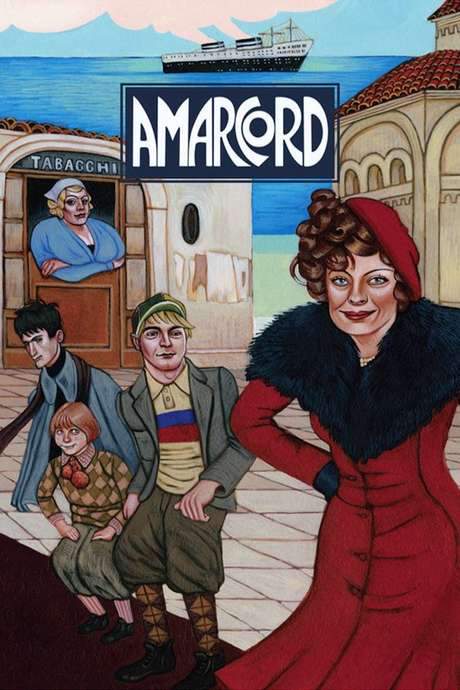
In a nostalgic Italian seaside town, adolescent Titta roams with his friends, stumbling into mischief while observing the town’s colorful eccentrics. He frequently clashes with his strict father but finds protection in his doting mother, and watches an array of characters—from extended relatives and fervent Fascist loyalists to alluring women—engage in absurd, sometimes surreal episodes that blend everyday life with fleeting fantasies.
Find where to stream, rent, or buy Amarcord (1973) in the US with current JustWatch availability, up-to-date pricing, and platform listings for subscription, rental, and digital purchase options.
Warning: spoilers below!
Haven’t seen Amarcord yet? This summary contains major spoilers. Bookmark the page, watch the movie, and come back for the full breakdown. If you're ready, scroll on and relive the story!
Explore the full timeline and setting of Amarcord (1973). Follow every major event in chronological order and see how the environment shapes the story, characters, and dramatic tension.
Last updated: October 04, 2025 at 16:53
Meet the key characters of Amarcord (1973), with detailed profiles, motivations, and roles in the plot. Understand their emotional journeys and what they reveal about the film’s deeper themes.
Last updated: October 04, 2025 at 16:53
Explore the central themes of Amarcord (1973), from psychological, social, and emotional dimensions to philosophical messages. Understand what the film is really saying beneath the surface.
Last updated: October 04, 2025 at 16:53
Browse frequently asked questions about Amarcord (1973) focused on characters, relationships, themes, symbols, setting, and story context. This movie info FAQ gives spoiler-aware explanations for character arcs, world details, and thematic interpretation so readers can better understand what the film is really about.
The film takes place in Borgo San Giuliano, a small town beside Rimini on Italy's Adriatic coast. It's depicted as a tight-knit community centered around a village square, where daily life unfolds through seasonal rituals like the fogheraccia (bonfire celebration). The setting serves as a nostalgic microcosm of provincial Italian life during the 1930s.
The story is set in 1930s Fascist Italy, during the height of Mussolini's regime. The era is woven into everyday life through school curricula emphasizing regime-approved history, official tours by authorities, and public parades. This political context casts a shadow over the otherwise playful small-town atmosphere.
Nostalgia is the central theme, with the film capturing warm childhood memories, summer adventures, and innocent mischief. The story balances tender recollections of small-town life against the encroaching gravity of fascism, preserving a personal history while showing how memory both cushions and exposes a community under political pressure.
Titta is the adolescent protagonist, a lively and curious boy navigating life in a small town under Fascist rule. He engages in mischief and imagination, tests boundaries at school and in confession, and harbors growing feelings for the older Gradisca. His observations reveal both warmth and humor in adolescence amid a heavy political atmosphere.
Gradisca is an alluring, glamorous older woman who becomes the object of Titta's youthful fascination. She introduces desire and complexity into the boy's world, embodying the town's flirtatious spirit within a society of strict rules. Her presence represents the tension between private desires and public duty under the regime.
Aurelio Biondi is Titta's father, a man with an anarchist past who attracts scrutiny from Fascist authorities. He is forced to drink castor oil as punishment, returning home weakened but resolute. His ordeal demonstrates the dangers and collateral impact of political surveillance on family life.
Miranda Biondi is Titta's nurturing, practical mother who sustains the family through everyday struggles. She preserves warmth and emotional stability as illness and death touch the household. Her care anchors the emotional center of the family amid social and political turmoil.
Growing up in Amarcord is portrayed as a local, intimate journey within a community under a stern regime. Titta navigates crushes, mischief, and curiosity about adulthood, negotiating boundaries with Gradisca and testing rules at school. The film frames maturation as both a personal and political experience, shaped by the era's constraints.
Teo is Aurelio's brother, confined to an insane asylum, who briefly escapes during a family excursion. His frantic plea for a woman and the resulting comic chaos reveal the town's tolerance for eccentricities within a rigid society. His brief moment of freedom punctuates the fragile line between confinement and imagination.
The fogheraccia is a traditional bonfire ritual in Borgo San Giuliano, one of the seasonal community celebrations captured in the film. These gatherings bring residents together for folklore and festivities, representing the town's collective traditions that persist even under political oversight.
Yes, Amarcord blends everyday life with fleeting fantasies and surreal episodes. The film employs a vignette-style structure where reality mingles with imagination, creating a lyrical, dreamlike quality. This approach serves the nostalgic tone, allowing memory itself to feel both vivid and intangible.
Discover curated groups of movies connected by mood, themes, and story style. Browse collections built around emotion, atmosphere, and narrative focus to easily find films that match what you feel like watching right now.
Vignette-style memoirs that blend bittersweet memory with everyday eccentricity.If you liked the wistful, vignette-driven storytelling of Amarcord, discover more movies that use an episodic structure to explore memory and place. These films, like Amarcord, create a bittersweet and dreamlike atmosphere, perfect for viewers seeking similar reflective journeys.
These narratives unfold not as traditional plots but as collections of memories and moments, often tied to a specific location or period. The focus is on atmosphere and character sketches over a driving plot, leading to a cumulative emotional impact that is more reflective than dramatic.
Movies are grouped here for their shared emphasis on mood and memory over plot, their melancholic yet often humorous tone, and their slow, deliberate pacing that allows the audience to soak in the atmosphere of a bygone world.
Stories where the mundane world is punctuated by strange, fantastical episodes.Fans of the surreal and humorous episodes in Amarcord will enjoy these movies that blend realistic settings with moments of fantasy and absurdity. Discover similar films where the line between reality and dream is playfully blurred, offering a unique and thought-provoking cinematic experience.
The narrative pattern involves a grounded, often small-town or familial setting that serves as a stage for eccentric characters and inexplicable events. The story embraces the illogical and the magical without fully abandoning reality, using surrealism to highlight the comedy and tragedy of human existence.
These films are connected by their unique tonal blend of earthy realism and playful surrealism. They share a moderate complexity that arises from this juxtaposition and a similar emotional weight that balances humor with poignant, sometimes melancholic, observations.
Don't stop at just watching - explore Amarcord in full detail. From the complete plot summary and scene-by-scene timeline to character breakdowns, thematic analysis, and a deep dive into the ending - every page helps you truly understand what Amarcord is all about. Plus, discover what's next after the movie.
Read a complete plot summary of Amarcord, including all key story points, character arcs, and turning points. This in-depth recap is ideal for understanding the narrative structure or reviewing what happened in the movie.
Track the full timeline of Amarcord with every major event arranged chronologically. Perfect for decoding non-linear storytelling, flashbacks, or parallel narratives with a clear scene-by-scene breakdown.