Plot Explained Spoilers guaranteed!
Plot Explained

Browse by genre

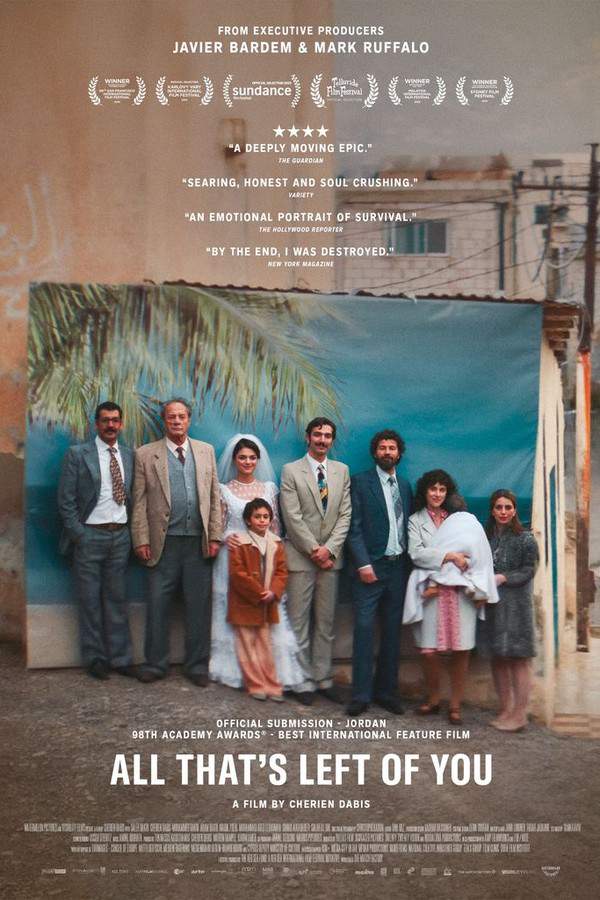
All That's Left of You (2026) movie poster

Timeline

All That's Left of You (2026) Timeline Explained – Every Event in Order

Release, runtime and language
2026 · 2 h 25 m · Arabic
Echo score 90
Loading streaming availability…
Starring
Saleh Bakri, Adam Bakri, Cherien Dabis, Muhammad Abed Elrahman, Dominik Maringer, Mohammad Bakri

Following a tense clash between a Palestinian teenager and Israeli soldiers during a West Bank demonstration, his mother narrates the personal and historical chain of events that brought him to that point, beginning with the forced displacement of his grandfather and the lasting impact on their family’s memory.

On this page (5)
  1. 1 Where to watch
  2. 2 Events in order (12)
  3. 3 Timeline questions answered
  4. 4 Movie threads
  5. 5 Every angle
Loading streaming availability…

12 events in order · contains spoilers

All That's Left of You Timeline: Events in Chronological Order

Every key event of All That's Left of You (2026) in order, scene by scene, with when and where it takes place. Use it to untangle flashbacks, time jumps and parallel storylines, to refresh your memory before the sequel or to find the exact scene you are thinking of.

  1. 1948: Bombardment, displacement and heart attack

    In Jaffa, Sharif's family endures heavy bombardment as they cling to their home. He chooses to move his family to Nablus to protect them while he negotiates with approaching forces. Soldiers violently expel him from the land, and he is sent to a prison camp where he endures months of hard labor before suffering a heart attack and finally reuniting with his family.

    When
    1948
    Where
    Jaffa
  2. Thirty years later: wedding and widowed Sharif

    Around 1978, an elderly Sharif, now widowed, attends the wedding of his youngest daughter while her elder sister plans to move to Toronto. Sharif's eldest son has relocated to Amman, illustrating the distances that separate the family. The ceremony marks a new chapter as the family contends with exile and migration.

    When
    circa 1978
    Where
    West Bank
  3. Family life in the West Bank: Salim, Hanan and the kids

    Sharif lives with his youngest son Salim, Salim's pregnant wife Hanan, and their two small children in the West Bank. The household endures daily hardship under occupation, shaping how they plan for the future. The looming threat of curfews and checkpoints casts a constant shadow over their routine.

    When
    circa 1978
    Where
    West Bank
  4. The curfew incident: humiliation in front of Noor

    One day, Salim takes Noor to collect medicine for Sharif when Israeli soldiers impose an impromptu curfew. Salim is forced at gunpoint to degrade himself and Hanan in front of Noor, an experience that seeds Noor's growing mistrust and patriotism. The incident becomes a catalyst for Noor's resolve to resist oppression.

    When
    early 1980s
    Where
    West Bank
  5. Noor grows older: protest and the turn to activism

    Ten years after the curfew incident, Noor is a teenage activist who roams the streets when schools close. He joins a street protest and is shot in the head as Israeli soldiers fire on the crowd. The shooting sends Noor to hospital and begins a sequence of life-and-death decisions for his family.

    When
    circa 1988
    Where
    West Bank
  6. Hospital transfer and brain death

    Hanan and Salim rush Noor to a hospital in Haifa, hoping for life-saving care, but bureaucratic delays and the severity of his injuries hinder recovery. Noor is declared brain dead after the attempt to save him. The couple faces an unbearable choice about his organs.

    When
    circa 1988-1989
    Where
    Haifa
  7. The organ donation decision

    Guided by the advice of a sheikh and the memory of Salim's mother dying for a kidney, Hanan and Salim choose to donate Noor's organs. Their decision saves six children's lives, turning a personal tragedy into a lifeline for others. The donation underscores a fragile, human bridge across enemies.

    When
    circa 1988-1989
    Where
    Haifa / West Bank
  8. Noor's body returns and funeral

    Noor's remains are returned to the West Bank for burial, and a somber funeral brings his family together to mourn and remember. The organ donation is celebrated in quiet gratitude, even as the political divide remains. Noor's legacy lingers in the memory of those who loved him.

    When
    1989
    Where
    West Bank
  9. Ari, the heart donor: meeting in Tirat Carmel

    Hanan and Salim travel to Tirat Carmel to meet Ari, Noor's heart recipient and the only surviving Israeli beneficiary. Ari is visibly apprehensive and does not speak, reflecting the distance between their lives and the trauma of occupation. The encounter acknowledges Noor's heart beating within a stranger.

    When
    circa 1989-1990
    Where
    Tirat Carmel
  10. 34 years later: a Toronto visit to Jaffa

    Now living in Toronto, Hanan and Salim return to Jaffa to reconnect with their past. They reunite with Ari, who explains that he did not join the army due to health issues. The visit frames Noor's story as it travels across borders and generations.

    When
    2022
    Where
    Toronto and Jaffa (Tel Aviv area)
  11. Noor's memory—'a good heart'

    Before parting, Hanan urges Ari to remember that Noor 'had a good heart,' insisting that his humanity outlasts the politics. The moment emphasizes shared humanity amid decades of conflict. Ari's guarded reaction hints at the complexity of memory in this history.

    When
    2022
    Where
    Tel Aviv/Jaffa
  12. Return to the roots: the childhood home

    Salim leads Hanan through his childhood neighborhood and toward the dilapidated ancestral home. They watch the sun set over the sea, and Salim recites the poem Sharif used to say seventy-four years earlier. The scene closes Noor's story by returning to its roots.

    When
    2022
    Where
    Salim's childhood neighborhood, Jaffa/Tel Aviv area

Last updated: May 19, 2026 at 05:53

Was this helpful?

Timeline questions answered

All That's Left of You Timeline Explained: Your Questions Answered

When does it happen, and why in that order? The questions people ask about the chronology of All That's Left of You (2026): time jumps, flashbacks, cause and effect between scenes and the correct order of events, each answered with spoilers.

Q1

Why did Salim agree to degrade himself and Hanan in front of Noor during the curfew

Salim was forced at gunpoint by Israeli soldiers imposing an impromptu curfew while he and Noor were collecting medicine for Sharif. With weapons aimed at him, Salim had no choice but to comply with the soldiers' demands to humiliate himself and his wife. The soldiers used their power to degrade the family as psychological warfare, and Noor was forced to watch his father's powerlessness, an experience that would profoundly shape his worldview.

  • curfew
  • humiliation
  • soldiers
  • noor
  • witness
Q2

Why did the curfew incident cause Noor to become radicalized

The humiliation Noor witnessed directly triggered his radicalization. Seeing his father forced to degrade himself and his mother at gunpoint seeded deep resentment toward Israeli occupation. Noor began to view his father's compliance as cowardice and turned instead to Sharif's unwavering patriotism as the moral example he wanted to follow.

Foreshadowing: Earlier in the story, Sharif's resolute determination to protect his ancestral home despite violent expulsion sets the contrast for what Noor sees as his father's failure.

  • noor
  • radicalization
  • humiliation
  • patriotism
  • salim
Q3

Why did Hanan and Salim decide to donate Noor's organs despite the conflict

Hanan and Salim were conflicted about donating Noor's organs to potential Israeli recipients who might harm their people. They ultimately decided to donate after consulting a sheikh and remembering that Salim's mother had died from a kidney shortage. The Islamic guidance emphasized saving lives, and they chose to let Noor's death give life to six children, turning personal tragedy into a humanitarian act.

Foreshadowing: Salim's mother died waiting for a kidney, which makes the donation decision a meaningful way to honor her memory.

  • organ donation
  • noor
  • sheikh
  • death
  • six children
Q4

Why did Ari stay silent when Hanan and Salim visited him in Tirat Carmel

Ari was visibly apprehensive and did not speak when Hanan and Salim visited him. As the only surviving Israeli recipient of Noor's organs, he likely felt uncomfortable meeting the family of the Palestinian teenager whose heart now beat inside him. The encounter symbolized the complex, traumatic divide between their peoples, and his silence reflected the emotional weight of that connection.

  • ari
  • heart recipient
  • silent
  • tirat carmel
  • meeting
Q5

What happened to Noor after he was shot in the head during the protest

Noor was shot in the head when Israeli soldiers opened fire on the protest crowd. Hanan and Salim rushed him to a hospital in Haifa for emergency care. Due to bureaucratic delays in obtaining permits and the severity of his injuries, Noor never recovered and was declared brain dead, leaving his family to face the unbearable decision about his organs.

  • noor
  • shot
  • protest
  • hospital
  • brain dead
Q6

Why did Hanan and Salim travel to meet Ari, the heart recipient

Hanan and Salim wanted to meet Ari to see the living proof that Noor's sacrifice saved lives. The meeting represented a fragile human bridge across the conflict. Despite the political divide, they chose to connect with the person carrying Noor's heart, though the encounter was emotionally charged and did not resolve the deeper wounds of occupation.

  • ari
  • heart
  • meeting
  • reconciliation
  • donation
Q7

What happened to Sharif after he was expelled from Jaffa in 1948

After being violently expelled from his land in Jaffa, Sharif was placed in an Israeli prison camp where he endured months of forced labor. He suffered a heart attack during his confinement, which ended his imprisonment and allowed him to reunite with his family in Nablus. The heart attack later caused ongoing heart problems that required medication decades later.

  • sharif
  • prison
  • heart attack
  • 1948
  • expulsion
Q8

Why did Hanan tell Ari to never forget that Noor had a good heart

Hanan urged Ari to remember that Noor had a good heart because she wanted to ensure Noor's humanity was not erased by the political context of his death. By emphasizing Noor's kindness rather than his status as a protester or casualty of conflict, Hanan Insisted his memory should be defined by compassion. This also served as a quiet reminder to Ari that the heart he received came from someone who was fundamentally good.

  • hani
  • ari
  • good heart
  • memory
  • humanity
Q9

What was the significance of the poem Salim recited at the end of the film

Salim recited the poem that Sharif used to say to him seventy-four years earlier, connecting the present moment to his childhood and his father's memory. The poem represented the family's oral history and the cultural identity that survived displacement, occupation, and loss. Reciting it at sunset beside their ancestral home demonstrated how memory and tradition persist despite decades of exile.

Foreshadowing: Sharif recited poems to Salim during their life in Nablus, embedding cultural memory into the next generation.

  • poem
  • sharif
  • salim
  • memory
  • tradition
Q10

Why did Noor join the protest in 1988 despite the danger

Noor joined the protest as a teenager after years of witnessing occupation violence, including the humiliation of his father during the curfew incident. With schools closed due to the political situation, Noor roamed the streets and became an activist. His participation in the protest represented the culmination of his growing political awareness and desire to resist oppression, despite the known risks.

Foreshadowing: The curfew incident planted the seed of resistance in Noor, and his closeness to Sharif's patriotism fueled his commitment.

  • noor
  • protest
  • 1988
  • activism
  • occupation

Movie threads

More Movies Like All That's Left of You, by Mood & Story

Curated lists built around what makes All That's Left of You tick: the same mood, the same kind of story or the same emotional payoff. Each list explains why these movies belong together.

Political Family Sagas like All That's Left of You

Family legacies shaped by the enduring trauma of political strife. Explore movies like All That's Left of You that delve into generational trauma and political conflict. These similar drama stories follow families whose lives are irrevocably shaped by historical strife and displacement.

  • somber
  • tragic
  • reflective
  • resilient
  • oppressive
  • contemplative
  • Tone: melancholic, tragic
  • Pacing: steady, deliberate
Why these movies?

The story pattern: These narratives often unfold across decades, showing how a single political event or ongoing conflict creates a ripple effect through a family's history. The journey is one of survival, memory, and the struggle to maintain identity against forces of erasure.

Why they belong together: They are grouped by their heavy focus on the intersection of the personal and political, a melancholic tone, and a steady pacing that allows the weight of history to be felt. The viewing experience is characterized by a profound sense of loss and a contemplative look at resilience.


Movies with Bittersweet Endings like All That's Left of You

Stories where profound grief finds a fragile, hopeful connection. Find movies similar to All That's Left of You that deliver a heavy emotional impact but end on a bittersweet note. If you liked its themes of loss and fragile hope, you'll appreciate these stories.

  • heartbreaking
  • bittersweet
  • resilient
  • hopeful
  • tragic
  • contemplative
  • Tone: bittersweet, melancholic
  • Pacing: steady, reflective
Why these movies?

The story pattern: The narrative pattern involves characters enduring immense tragedy and loss, often feeling hopeless. The climax or resolution provides a small but significant act—like an organ donation or a symbolic return—that creates a bridge across divides, offering a sense of meaning and fragile hope without diminishing the weight of the suffering.

Why they belong together: They share a specific emotional mix: a journey through overwhelming sadness and heaviness that culminates in a conclusion that is neither fully happy nor bleak. This creates a uniquely poignant and contemplative viewing experience that resonates deeply.

Every angle

All That's Left of You (2026) Explained: Plot, Ending, Timeline & Characters

Everything about All That's Left of You in one place: what happens in the plot summary, the timeline in chronological order, the characters and meaning, the ending explained and a spoiler-free summary. What's After the Movie adds the cast, box office and post-credit scenes.

Coming soon on iOS and Android

The Plot Explained Movie Summary App

Plot summaries, endings explained and timelines on your phone. Catch up on any movie in minutes, save your favorites and never miss a twist again.

Be the first to know when we launch. Your email stays private, always.

Learn more about the app