Plot Explained Spoilers guaranteed!
Plot Explained

Browse by genre

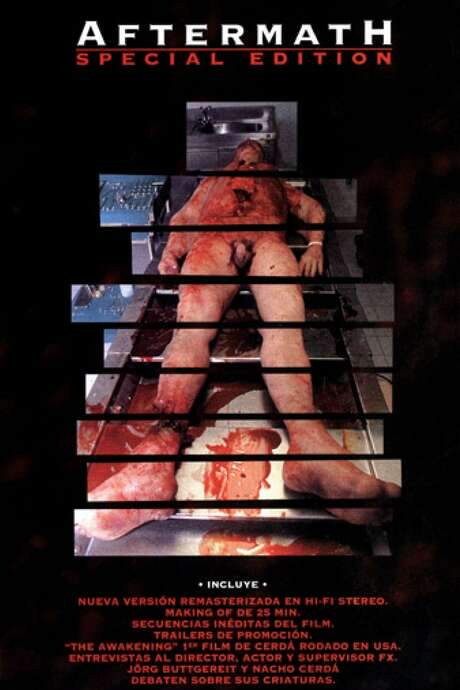
Aftermath (1994) movie poster

Plot Summary

Aftermath (1994) Plot Summary Explained

Release, runtime and language
1994 · 30 mins
Loading streaming availability…
Directed by
Nacho Cerdà
Starring
Pep Tosar, Xevi Collellmir, Ángel Tarris, Jordi Tarrida

When the others leave for the night, the last mortician begins to fondle the corpses. He quickly moves to the corpse of a young woman who died in a car crash.

On this page (6)
  1. 1 Where to watch
  2. 2 What happens: full plot
  3. 3 Plot questions answered
  4. 4 Movie threads
  5. 5 Movies like Aftermath
  6. 6 Every angle
Loading streaming availability…

Full plot summary · contains spoilers

What Happens in Aftermath: Full Plot Summary

The whole story of Aftermath (1994) explained, from the opening scene to the final frame: every key event, every twist and what it all adds up to. Read it as a quick recap before the sequel, to check a scene you missed, or to finally understand what really happened.

In a stark, unsettling sequence, Marta Arnau Marti dies in a car crash after she accidentally runs over a dog. An orderly wheels Marta’s body into a cold morgue drawer, passing a mourning couple while a nurse offers them a crucifix necklace. The orderly’s curiosity is piqued when he overhears two morticians performing autopsies on two male bodies. He lingers to catch a glimpse, then slips away when one mortician fixes him with a hard, unsettling glare.

Inside the morgue, the two morticians finish their work on the dead men, and as one of them leaves, the other remains and brings Marta’s body to the autopsy table. The scene quickly turns morbid and methodical as the mortician, Pep Tosar, moves Marta into a private space, undresses her, and begins a chilling, meticulous dissection. He removes the brain and uses a knife to touch and manipulate the body, tracing lines across her torso and, disturbingly, her intimate areas. The act grows increasingly explicit as he fondles her breasts and internals, pausing to take photographs of his disturbing handiwork. Unable to curb his urges, he proceeds to necrophilia, while his camera continues to record the grim tableau on its automatic setting.

After the horrific violation, the mortician continues with the autopsy, cleans the space, and then leaves the morgue. At home, the pajama-clad killer blends Marta’s heart into a pulpy substance, feeds a portion to his dog, and settles into his living room. The unsettling rhythm of domesticity returns as a baby’s cries echo from the television, and scraps of newspaper—upon which the dog gnaws—reveal Marta’s obituary, tying the living world back to the dead in a haunting loop. Among the bodies examined in the morgue that night is Cadáver Vin, portrayed by Xevi Collellmir, a reminder of the quiet, invisible presence of those who did not survive the crash.

Last updated: February 17, 2026 at 19:58

Was this helpful?

Plot questions answered

Aftermath Plot Explained: Your Questions Answered

The questions people ask most about Aftermath (1994): what happens in the confusing scenes, why the characters do what they do, the twists, hidden details and what the ending means. Each answer contains spoilers.

Q1

Why does the mortician desecrate Marta's body?

The mortician is driven by an uncontrollable sexual compulsion toward corpses. The film establishes his pattern by showing his curiosity about the autopsied male bodies before he locks himself alone with Marta's corpse. His act is not about Marta specifically, she becomes the object of his pre-existing pathology. The narrative presents his behavior as a culmination of deranged compulsion rather than a reaction to any characteristic of the victim herself.

Foreshadowing: Earlier, the orderly notices the mortician's intense focus during the autopsy of male bodies, hinting at his fixation on the dead.

  • mortician motivation
  • necrophilia cause
  • psychological disturbance
Q2

Why does the mortician choose Marta's body specifically?

Marta becomes his target because she is a young woman who dies alone with no immediate family present at the morgue. Her body is left unattended in a private moment while the other mortician leaves, creating the opportunity he needs. Her youth and the freshness of her death likely make her more appealing to someone with his specific fixation.

Foreshadowing: The orderly wheels Marta past a mourning couple receiving comfort, suggesting she may have fewer visitors or connections.

  • Marta victim selection
  • corpse choice reason
Q3

Why does the mortician take Marta's heart home?

The heart removal serves as a trophy and extension of his violation beyond the morgue. By blending it into pulp and feeding it to his dog, he brings the act of desecration into his domestic space, blurring the boundary between his professional life and personal pathology. This ritual transforms his home into an extension of the morgue, completing his perverse cycle.

  • heart trophy
  • organ removal meaning
  • domestic ritual
Q4

What is the significance of the dog in the story?

The dog serves as a narrative fulcrum connecting life and death. Marta accidentally runs over the dog, causing her fatal car crash, meaning the dog indirectly causes her death. Later, the mortician feeds Marta's heart to the same dog, completing a dark cycle where the animal that triggered her death now consumes part of her remains. This creates a haunting symmetry between the initial accident and the mortician's final act.

Foreshadowing: Marta's fatal accident is caused by striking the dog on the road, establishing the animal's central role.

  • dog meaning
  • accident cause
  • cycle of death
Q5

What do the domestic scenes at home represent?

The home scenes reveal the normalization of the mortician's depravity. He returns to his ordinary life, wearing pajamas, feeding his dog, watching television, as if nothing occurred. The baby cries from the TV and the obituary scraps create an ironic juxtaposition between new life/memory and his monstrous acts. His ability to seamlessly transition from the morgue to domestic normalcy shows a disturbing psychological compartmentalization.

  • home scenes meaning
  • domestic normalcy
  • psychological profile
Q6

Why does the film show Marta's obituary at the end?

The obituary reinforces the permanence of Marta's death and the mortician's complete erasure of her humanity. While he reduces her to organs and trophies, the obituary represents her former life and identity. The dog consuming the obituary fragments connects the living world's memory of her to the mortician's continued possession of her remains, leaving her story unresolved and haunting.

  • obituary significance
  • memory erasure
  • unresolved ending
Q7

Who is the mortician character in the film?

The mortician is portrayed as a solitary figure living alone with his dog. He works the night shift at the morgue, giving him access to fresh bodies. His行为 shows methodical planning, he locks doors, sets up photography, and cleanly disposes evidence. The film never names him or provides background, presenting him as an archetypal predator rather than a fully characterized individual.

  • mortician character
  • killer identity
  • night shift
Q8

What is the meaning of the baby's cries on the television?

The baby cries create an auditory contrast between innocence/life and the mortician's acts of death. The sound emanates from his normal domestic environment while he engages in grotesque behavior, suggesting that new life continues irrationally around him. This juxtaposition emphasizes the mortician's separation from normal human experience and the emptiness of his existence.

  • baby cries symbolism
  • life vs death contrast
Q9

Why does the mortician lock himself in the morgue?

Locking the door ensures privacy for his acts and prevents interruption from colleagues. This deliberate action shows premeditation and awareness that his behavior is shameful and criminal. The lock represents the boundary between his public professional persona and his private deviant behavior, which he carefully maintains.

  • morgue privacy
  • locked door meaning
  • premeditation
Q10

What does the ending of the film mean?

The ending depicts the mortician settling into his routine with no consequences shown for his actions. Marta's death has been fully instrumentalized, he violated her body, stole organs, and returned home to normal life. The unresolved ending suggests his pattern will continue indefinitely. The film offers no redemption, justice, or catharsis, only the persistence of evil in ordinary domestic spaces.

  • ending meaning
  • no justice
  • unresolved horror

Movie threads

More Movies Like Aftermath, by Mood & Story

Curated lists built around what makes Aftermath tick: the same mood, the same kind of story or the same emotional payoff. Each list explains why these movies belong together.

Movies about moral collapse like Aftermath

Characters spiraling into transgressive obsessions without redemption. If you were captivated by the grim descent in Aftermath, this thread features other films where characters fall into transgressive obsessions. Explore more movies like Aftermath that explore similar themes of psychological decay and moral depravity.

  • disturbing
  • unsettling
  • grim
  • voyeuristic
  • psychological
  • bleak
  • Tone: dark, bleak, disturbing
  • Pacing: steady, methodical
Why these movies?

The story pattern: The narrative follows a protagonist's linear and steady descent from a state of normalcy or quiet obsession into acts of profound transgression. The story structure is straightforward, often escalating without subplots, leading to a bleak conclusion that solidifies their depravity.

Why they belong together: Movies are grouped here because they share a dark, uncompromising tone, a heavy emotional weight centered on transgressive acts, and a steady pacing that methodically builds a sense of dread and moral decay without moments of relief.

Claustrophobic horror films similar to Aftermath

Intense horror films set in isolated, confined spaces that trap the mind. Fans of the confined, unsettling atmosphere of Aftermath will find more movies like it here. Discover similar psychological horror films that use isolated settings to create a deeply disturbing and claustrophobic viewing experience.

  • claustrophobic
  • unsettling
  • disturbing
  • isolated
  • psychological
  • tense
  • Tone: dark, unsettling, grim
  • Pacing: steady, tense
Why these movies?

The story pattern: The plot often unfolds almost entirely within a single, restrictive location—like a morgue, a basement, or a secluded house—intensifying the psychological pressure on the protagonist. The narrative is straightforward, focused on the escalating horror within the confined space, leading to a grim or bleak resolution.

Why they belong together: These films are connected by their shared use of a claustrophobic setting to generate unease, a dark and heavy tone devoid of humor, and a high-intensity focus on psychological disturbance and graphic, challenging themes.

If you liked this

Movies Like Aftermath

Similar movies to Aftermath: the same genre, themes or kind of story. Each one comes with its own plot summary, timeline and ending explained.

Browse all movie summaries

Every angle

Aftermath (1994) Explained: Plot, Timeline & Characters

Everything about Aftermath in one place: what happens in the plot summary, the timeline in chronological order, the characters and meaning and a spoiler-free summary. What's After the Movie adds the cast, box office and post-credit scenes.

Coming soon on iOS and Android

The Plot Explained Movie Summary App

Plot summaries, endings explained and timelines on your phone. Catch up on any movie in minutes, save your favorites and never miss a twist again.

Be the first to know when we launch. Your email stays private, always.

Learn more about the app