








#6,07518 Year: 2019
Runtime: 174 min
Language: English
Director: Terrence Malick
Echo Score: 75Budget: $9M
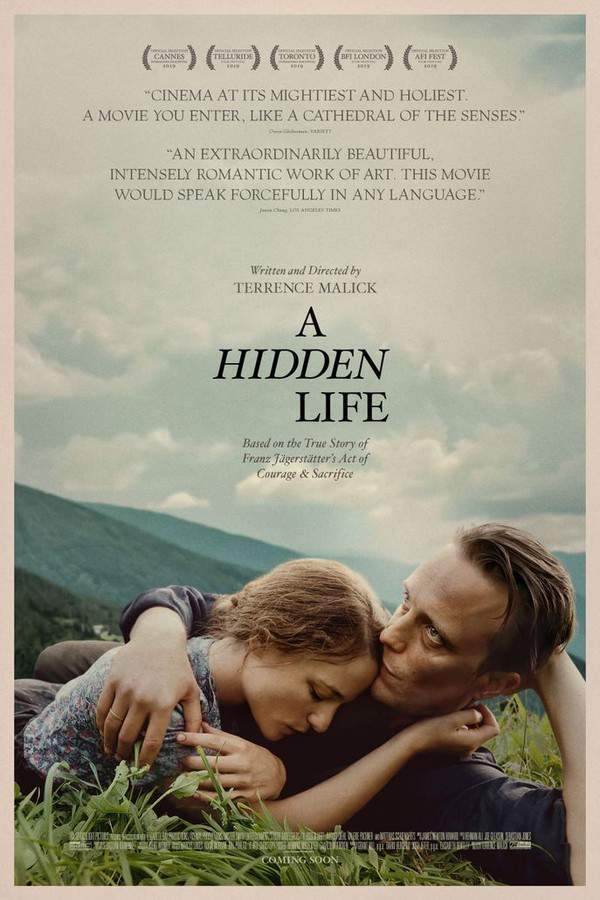
In pre-World War II Austria, devout farmer Franz Jägerstätter faces a profound moral dilemma as his country aligns with Nazi Germany. When he is ordered to swear an oath of allegiance to Hitler, he grapples with his conscience and faith. Ultimately, he makes a courageous and defiant choice that leads to tragic consequences, forcing him to risk everything he holds dear, including his family and his own life, in a powerful act of resistance.
Find where to stream, rent, or buy A Hidden Life (2019) in the US with current JustWatch availability, up-to-date pricing, and platform listings for subscription, rental, and digital purchase options.
Warning: spoilers below!
Haven’t seen A Hidden Life yet? This summary contains major spoilers. Bookmark the page, watch the movie, and come back for the full breakdown. If you're ready, scroll on and relive the story!
Trace every key event in A Hidden Life (2019) with our detailed, chronological timeline. Perfect for unpacking nonlinear stories, spotting hidden connections, and understanding how each scene builds toward the film’s climax. Whether you're revisiting or decoding for the first time, this timeline gives you the full picture.
Last updated: November 08, 2024 at 01:14
Find frequently asked questions about the A Hidden Life (2019) timeline, including chronological order, nonlinear jumps, cause-and-effect links, and scene sequence clarifications. This timeline FAQ helps explain when key events happen, how moments connect, and why the story unfolds in that specific order.
Franz refuses based on his deeply held Catholic faith and moral convictions. He believes that pledging allegiance to Hitler would mean participating in a regime that is fundamentally evil, particularly due to its persecution of Jews and other innocent people. Despite intense pressure from his village and the threat of execution, he cannot compromise his conscience, stating that he would rather die with a clear conscience than live with the guilt of supporting Nazi atrocities.
Early scenes show Franz as a devout man of faith who tends to his land with care and reverence, establishing his principled character.
After refusing to sign the oath of allegiance, Franz is arrested and imprisoned first in Enns, then transferred to Berlin. He spends months awaiting trial in harsh conditions. During this time, he maintains contact with his wife Fani through heartfelt letters. Eventually, he is tried, found guilty of sedition, and sentenced to death. Despite being offered multiple chances to renounce his stance and save his life, he remains steadfast and is executed in August 1943.
The call to arms presents the pivotal moral dilemma that sets the entire tragic trajectory of the story in motion.
Fani remains completely devoted to Franz throughout his ordeal, even though she knows his stance will lead to tragic consequences. She openly endorses his refusal, telling him that she would rather have him back as a poor man than as someone who compromised his integrity. During his imprisonment, she writes him letters filled with love and encouragement, providing him with the spiritual strength to endure. She also cares for their three daughters alone while facing hostility from neighbors.
Fani's unwavering support is established early as a counterweight to the village's pressure, showing the strength of their marriage.
Franz is sentenced to death for refusing military service and refusing to pledge allegiance to the Nazi regime. The court finds him guilty of sedition, viewing his refusal as a dangerous example that could inspire others to resist. Despite his humble status as a farmer, the Nazis treat his case severely as a warning against any form of dissent. His steadfastness during the trial, where he refuses to defend himself or renounce his beliefs, seals his fate.
The tension builds as Franz receives increasingly dire warnings that refusal means death.
While Franz is imprisoned, Fani and their three daughters endure significant hardship in St. Radegund. The family faces growing animosity from neighbors who cannot understand Franz's refusal to fight. They suffer social isolation and the constant fear of the Nazis targeting them. Fani must tend to the farm alone while raising their daughters, all while coping with the uncertainty of Franz's fate and eventually mourning his execution.
The village's pressure on Franz intensifies as neighbors question his patriotism, foreshadowing the isolation his family will face.
Franz believes that signing the oath would make him complicit in the Nazi regime's crimes, particularly the Holocaust. He cannot reconcile his Catholic faith with participating in a war he views as unjust and evil. He considers that saving his own life at the cost of his conscience would be a greater betrayal than death itself. His faith teaches him that eternal salvation matters more than earthly survival, and he chooses to remain faithful to his principles even at the ultimate cost.
Franz's devout character is established early, showing that his faith is the foundation of his moral stance.
Franz's trial takes place in Berlin after months of imprisonment. The proceedings represent the Nazi judicial system's version of justice, where the outcome is predetermined. Franz is given the opportunity to defend himself or renounce his stance, but he refuses to cooperate with what he sees as an unjust system. He is found guilty and sentenced to death. The trial serves as a final test of his convictions, which he passes with unwavering resolve.
The buildup of Franz's months in prison creates tension leading to this pivotal moment.
The villagers of St. Radegund struggle to understand Franz's principled stand. Most of the men in the village sign the oath and go to fight, viewing Franz's refusal as cowardice or stupidity rather than moral courage. They pressure Franz to reconsider, and after his arrest, their hostility extends to his wife Fani and children. The community's incomprehension highlights the isolation Franz and his family face, as most people cannot grasp the depth of his religious convictions.
Early scenes show the close-knit village community, making their later rejection more impactful.
Franz draws strength from several sources during his imprisonment: his Catholic faith provides spiritual resilience, his love for Fani sustains him emotionally, and his belief that his stand is morally right gives him purpose. The letters he exchanges with Fani are crucial, with each writing encouraging the other to remain steadfast. His conviction that he cannot betray his conscience, even to save his life, remains unbroken throughout his ordeal.
The development of the letter exchange system shows the deepening emotional connection between Franz and Fani during separation.
In August 1943, Franz Jägerstätter is executed by guillotine by the Third Reich. Despite having multiple opportunities to renounce his beliefs and sign the oath, he refuses every time. His death is swift but brutal. The film ends with Fani and their daughters maintaining their connection to him, with his legacy of principled resistance enduring. His sacrifice becomes a powerful symbol of moral courage against tyranny, though the ending is definitively tragic.
The buildup through his trial and multiple chances to recant leads inevitably to this tragic conclusion.
Discover curated groups of movies connected by mood, themes, and story style. Browse collections built around emotion, atmosphere, and narrative focus to easily find films that match what you feel like watching right now.
Stories of solitary figures upholding their principles against overwhelming force.For viewers seeking movies like A Hidden Life, this list features powerful dramas about solitary figures facing moral crises under oppressive regimes. These films share themes of conscientious objection, quiet defiance, and the heavy personal cost of standing by one's beliefs against overwhelming political force.
The narrative typically follows a protagonist confronted with a demand to betray their core values by a powerful authority. Their refusal initiates a slow, grinding conflict where the primary battleground is their own conscience and resilience. The story focuses on the internal struggle and the escalating consequences of their steadfastness, often leading to tragic but meaningful outcomes.
Movies are grouped here because they share a central theme of profound moral courage in the face of institutional evil. They possess a similar tone of somber gravity, a deliberate pacing that emphasizes the weight of the decision, and a focus on the internal, spiritual battle rather than external action.
Deliberate, heavy dramas where unwavering principles lead to inevitable sorrow.If you appreciated the deliberate pace and tragic weight of A Hidden Life, this collection highlights other slow burn films where a character's deep moral or spiritual conviction sets them on a collision course with a devastating outcome. These movies share a heavy emotional weight and a somber, immersive tone.
The narrative pattern is one of tragic inevitability. A protagonist, defined by a strong ethical or spiritual core, is placed in a situation that demands compromise. Their refusal creates a slow-moving avalanche of consequences. The pacing mirrors the grueling, protracted nature of their ordeal, amplifying the emotional impact of their ultimate sacrifice.
These films are united by a specific combination of slow pacing, high emotional intensity, a dark tone, and a sad ending that results from a character's moral choices. The shared experience is one of contemplative dread and profound sadness, making the viewer sit with the heavy cost of integrity.
Don't stop at just watching - explore A Hidden Life in full detail. From the complete plot summary and scene-by-scene timeline to character breakdowns, thematic analysis, and a deep dive into the ending - every page helps you truly understand what A Hidden Life is all about. Plus, discover what's next after the movie.
Read a complete plot summary of A Hidden Life, including all key story points, character arcs, and turning points. This in-depth recap is ideal for understanding the narrative structure or reviewing what happened in the movie.
Discover the characters, locations, and core themes that shape A Hidden Life. Get insights into symbolic elements, setting significance, and deeper narrative meaning - ideal for thematic analysis and movie breakdowns.
Discover movies like A Hidden Life that share similar genres, themes, and storytelling elements. Whether you’re drawn to the atmosphere, character arcs, or plot structure, these curated recommendations will help you explore more films you’ll love.
A Hidden Life (2019) Plot Summary & Movie Recap
A Hidden Life (2019) Scene-by-Scene Movie Timeline
A Hidden Life (2019) Spoiler-Free Summary & Key Flow
Movies Like A Hidden Life – Similar Titles You’ll Enjoy
The Pianist (2002) Ending Explained & Film Insights
A Secret (2008) Story Summary & Characters
Amen. (2003) Story Summary & Characters
The Aryan Couple (2004) Spoiler-Packed Plot Recap
Walking with the Enemy (2014) Movie Recap & Themes
Bonhoeffer (2003) Ending Explained & Film Insights
Bonhoeffer: Pastor. Spy. Assassin. (2024) Ending Explained & Film Insights
Bonhoeffer: Agent of Grace (2000) Movie Recap & Themes
As Far As My Feet Will Carry Me (2001) Complete Plot Breakdown
Resistance (2003) Complete Plot Breakdown
Naked Among Wolves (1963) Movie Recap & Themes
The Strange Death of Adolf Hitler (1943) Spoiler-Packed Plot Recap
My Life for Ireland (1941) Film Overview & Timeline
Hidden in Silence (1996) Full Summary & Key Details
Hangmen Also Die! (1943) Ending Explained & Film Insights