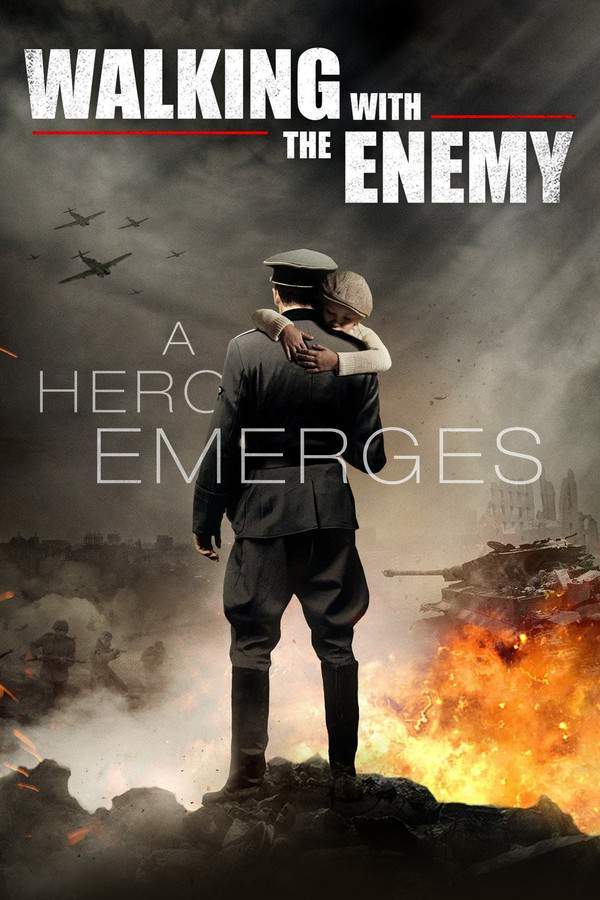
Year: 2014
Runtime: 124 min
Language: English
Director: Mark Schmidt
During World War II, a brave young man undertakes a perilous mission, disguising himself as a Nazi officer to infiltrate enemy territory. He risks his life to protect his family and countless others from the atrocities of the Holocaust. The story also explores the difficult decisions faced by Hungary’s leader as he struggles to maintain his nation’s integrity and compassion amidst the escalating conflict.
Warning: spoilers below!
Haven’t seen Walking with the Enemy yet? This summary contains major spoilers. Bookmark the page, watch the movie, and come back for the full breakdown. If you're ready, scroll on and relive the story!
Read the complete plot breakdown of Walking with the Enemy (2014), including all key story events, major twists, and the ending explained in detail. Discover what really happened—and what it all means.
As the dark specter of German occupation envelops Budapest in 1944, József, played by Ben Kingsley, a Jewish radio repair shop owner, confronts a heartrending choice: he must send his two young employees, Elek Cohen and Ferenc Jacobson, portrayed by Jonas Armstrong and Simon Kunz, back to their families. Taking advantage of a benevolent Catholic priest, they procure forged baptismal certificates, urging their families to use them as a vital escape route when they are coerced into joining the brutal Hungarian labor service, where Jewish men suffer horrific treatment—facing summary execution for any sign of weakness or injury.
In the midst of this turmoil, Carl Lutz, a steadfast figure at the Swiss diplomatic office known as the Glass House in Budapest, finds himself empowered to issue 8,000 Swiss passports to individual Jews. Yet, in a remarkable act of defiance, he expands this mandate, issuing passes for entire families rather than just solo individuals.
As Elek and Ferenc successfully navigate their escape from the labor service, they return home only to confront the devastating reality that their families have already been deported. Elek discovers his home thoroughly ransacked, finding only the baptismal certificates tucked away in a family photo, an invaluable memento he carries with him as a lifeline to hope.
In a dramatic twist, Hungarian leader Horthy clandestinely negotiates an armistice with Stalin. But this coup is quickly uncovered by the Nazis, who respond by abducting his son, storming Buda Castle, and ultimately overthrowing him, leading to his imprisonment in Germany. The fascist Arrow Cross Party, led by Ferenc Szálasi, rises to power, joining forces with the Nazis to relentlessly hunt down Jewish refugees.
Instinctively driven, Elek and Ferenc take it upon themselves to aid Jewish families in peril. They eventually establish a partnership with Lutz, who remains committed to the cause of protecting Hungarian Jews during this harrowing period. A poignant encounter introduces Elek to Hannah, a young Jewish woman whose life becomes entwined with his when Nazi officers track her to a hiding place shared by Elek and others.
Demonstrating remarkable courage, Elek defends Hannah, killing the intruding Nazis before any harm can come to her. Boldly, he and Ferenc later exhume the bodies of the Nazi officers they dispatched and don their uniforms. For several months, this audacious duo impersonates SS officers, skillfully redirecting thousands of Jews to safe havens where they embark on their treacherous journey towards freedom, all while under the ever-watchful eyes of the Swiss, and occasionally, a convent.
The narrative culminates with the triumphant arrival of the Russian army in Budapest, signaling the end of German occupation. Amidst the upheaval, Elek’s life hangs in the balance when an SS lieutenant aims at him, his son’s innocent act towards a group of captured Jews triggering a catastrophic chain of events. Astonishingly, the officer’s fate is sealed by a weary German commander, serving as a frightening reminder of the severe repercussions that follow acts of defiance against tyranny.
Fast forward thirteen years to 1958, the story transports us to New York City, where Elek’s son is joyously celebrating his adopted son’s wedding. This touching denouement resonates as a tribute to resilience and the passage of time, memorializing those who weathered the storm of human history’s darkest hours.
This film, anchored in true events, pays homage to the intrepid spirit of Pinchas Rosenbaum, whose valiant rescue efforts saved numerous lives during the tumult of World War II. It also highlights the tragic losses endured by his family, victims of Auschwitz alongside 500,000 Hungarian Jews, a haunting reminder of the war’s catastrophic toll.
Additionally, the narrative touches upon other significant figures such as SS Lt. Colonel Otto Skorzeny, Dieter Wisliceny, Ferenc Szalasi, Arrow Cross Captain Kovarcz, and Adolf Eichmann, whose haunting legacies resonate throughout history. The fates of Regent Horthy and his son, who were both imprisoned until the war’s conclusion, are also acknowledged as they faced their final days in Portugal, in 1957 and 1993, respectively.
In honor of heroism, Carl Lutz’s legacy is celebrated for forming the Swiss Legion (The Glass House), a bastion of hope that ultimately safeguarded countless lives. His story serves as a poignant reminder of the unyielding power of compassion and courage in the face of overwhelming adversity.
Last Updated: November 19, 2024 at 12:14
Discover curated groups of movies connected by mood, themes, and story style. Browse collections built around emotion, atmosphere, and narrative focus to easily find films that match what you feel like watching right now.
Thrilling true stories of ordinary people adopting dangerous disguises to survive.If you were captivated by the high-stakes disguise in Walking with the Enemy, you'll find similar tension in these films. This selection features true stories and historical dramas where characters must infiltrate enemy ranks, often during war, risking everything in a world of constant suspicion and imminent danger.
These narratives follow a protagonist who must shed their identity to assume a new, perilous one. The plot is driven by a series of close calls, escalating risks, and the immense pressure of deception. The journey is a psychological tightrope walk, focused on survival against a powerful, oppressive force.
They are grouped by their shared focus on the intense, suspenseful experience of an undercover mission. The mood is consistently tense and urgent, with a high-intensity pacing that keeps viewers on edge, united by themes of identity, deception, and courage in the face of tyranny.
Stories where hope and humanity persist amidst the overwhelming tragedy of war.For viewers who appreciated the blend of heavy historical drama and hopeful defiance in Walking with the Enemy, this thread collects similar films. These stories explore the Holocaust and other conflicts, highlighting moral courage and the painful, yet hopeful, fight for survival against overwhelming oppression.
The narrative pattern involves characters navigating a landscape of systemic violence and moral compromise. The central conflict is as much internal—struggling to maintain one's humanity—as it is external. The arc culminates in a mix of personal victory and profound collective loss, leaving a lasting emotional impact.
They share a heavy emotional weight and a bittersweet tone, masterfully blending grim historical settings with courageous, hopeful actions. The pacing is steady, allowing the gravity of the events to sink in, while the focus on moral courage and defiance creates a powerfully cohesive viewing experience.
Don't stop at just watching — explore Walking with the Enemy in full detail. From the complete plot summary and scene-by-scene timeline to character breakdowns, thematic analysis, and a deep dive into the ending — every page helps you truly understand what Walking with the Enemy is all about. Plus, discover what's next after the movie.
Track the full timeline of Walking with the Enemy with every major event arranged chronologically. Perfect for decoding non-linear storytelling, flashbacks, or parallel narratives with a clear scene-by-scene breakdown.
Discover the characters, locations, and core themes that shape Walking with the Enemy. Get insights into symbolic elements, setting significance, and deeper narrative meaning — ideal for thematic analysis and movie breakdowns.
Get a quick, spoiler-free overview of Walking with the Enemy that covers the main plot points and key details without revealing any major twists or spoilers. Perfect for those who want to know what to expect before diving in.
Visit What's After the Movie to explore more about Walking with the Enemy: box office results, cast and crew info, production details, post-credit scenes, and external links — all in one place for movie fans and researchers.
Discover movies like Walking with the Enemy that share similar genres, themes, and storytelling elements. Whether you’re drawn to the atmosphere, character arcs, or plot structure, these curated recommendations will help you explore more films you’ll love.
Walking with the Enemy (2014) Scene-by-Scene Movie Timeline
Walking with the Enemy (2014) Movie Characters, Themes & Settings
Walking with the Enemy (2014) Spoiler-Free Summary & Key Flow
Movies Like Walking with the Enemy – Similar Titles You’ll Enjoy
1945 (2017) Film Overview & Timeline
Anthropoid (2016) Spoiler-Packed Plot Recap
Defiance (2008) Movie Recap & Themes
The Match (2021) Plot Summary & Ending Explained
As Far As My Feet Will Carry Me (2001) Movie Recap & Themes
Hungarians (1978) Spoiler-Packed Plot Recap
Holocaust (1000) Spoiler-Packed Plot Recap
The 25th Hour (1967) Plot Summary & Ending Explained
In Enemy Country (1968) Film Overview & Timeline
The Journey (1959) Story Summary & Characters
Yesterday’s Enemy (1959) Spoiler-Packed Plot Recap
Verboten! (1959) Full Movie Breakdown
The Hungarian Dressmaker (2024) Film Overview & Timeline
Hangmen Also Die! (1943) Complete Plot Breakdown
The Enemy (1927) Spoiler-Packed Plot Recap