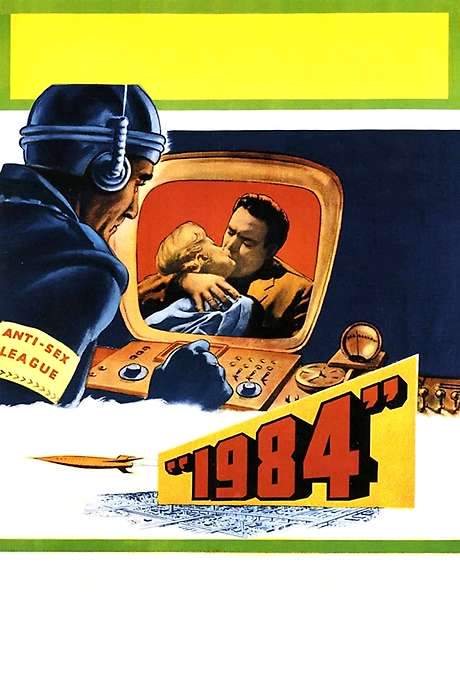




1984

1984

Year: 1956

Runtime: 90 mins

Language: English

Director: Michael Anderson

Drama

Big Brother is Watching. In a totalitarian future society, a man whose daily work is rewriting history tries to rebel by falling in love.

Warning: spoilers below!

Haven’t seen 1984 yet? This summary contains major spoilers. Bookmark the page, watch the movie, and come back for the full breakdown. If you're ready, scroll on and relive the story!

Timeline & Setting – 1984 (1956)

Explore the full timeline and setting of 1984 (1956). Follow every major event in chronological order and see how the environment shapes the story, characters, and dramatic tension.

Time period

1984

Set in a near-future Britain after a nuclear war, the world is divided into three superstates: Oceania, Eurasia, and Eastasia. London functions under a totalitarian regime where telescreens, memory erasure, and public rallies reinforce obedience. The narrative centers on the year 1984, a time of intensified control and ideological conformity.

Location

London, Airstrip One

London is the capital of Airstrip One, a province of Oceania ruled by a single Party. The city is shaped by constant surveillance and propaganda, with bomb-proof ministries watching over every public space. It embodies a world where privacy has vanished and loyalty to Big Brother is mandatory.

🌆 London 🕵️ Surveillance ⚖️ Totalitarianism

Last Updated: October 04, 2025 at 19:11

Main Characters – 1984 (1956)

Meet the key characters of 1984 (1956), with detailed profiles, motivations, and roles in the plot. Understand their emotional journeys and what they reveal about the film’s deeper themes.

Winston Smith (Edmond O'Brien)

A member of the Outer Party who quietly doubts Big Brother and keeps a forbidden diary. He navigates a world of censorship and propaganda, seeking truth amid manipulation. His relationship with Julia marks a dangerous turn toward personal rebellion within the Party’s surveillance labyrinth.

📝 Diary 🕵️ Surveillance 💭 Rebellion

Julia (Jan Sterling)

A fellow Outer Party member who shares Winston’s distrust of the regime and a craving for personal freedom. She helps initiate a clandestine romance and the possibility of resistance, even as both protect themselves from discovery. Her actions reveal how intimate acts can become political declarations.

❤️ Love 🕊 Rebellion

O'Connor (Michael Redgrave)

A high-ranking Inner Party figure who appears to be an ally but is revealed as a covert agent guiding dissenters toward the regime’s traps. He manipulates information and oversees the brainwashing process, embodying the regime’s calculated control over truth and loyalty.

🧠 Mind Games 🗝 Deception

R. Parsons (Donald Pleasence)

A semi-elite Outer Party member and Selina’s father who participates in the social life of the regime. He represents ordinary loyalty to the Party and the everyday climate in which dissent must survive, even as the state’s control tightens around him and those around him.

🗳 Propaganda 🧭 Loyalty 🧠 Brainwashing

Selina Parsons (Carol Wolveridge)

The little girl who denounces Winston as part of the regime’s indoctrination of youth. She exemplifies how children are taught to participate in surveillance and denunciation, blurring the line between innocence and complicity.

👶 Innocence 🧠 Indoctrination

Rutherford (Ronan O'Casey)

An Outer Party traitor who has been rehabilitated by the Ministry of Love. His appearance with Jones demonstrates the regime’s ability to manipulate loyalty and memory, presenting a supposedly 'return to order' that masks true control.

🗳 Reeducation 🪖 Propaganda

Jones (Mervyn Johns)

Another rehabilitated Outer Party figure, presented as a converted dissenter. His presence with Rutherford underscores how the Party fabricates legitimacy for loyalty and erases dissent through 'restoration'.

🗳 Reeducation 🧭 Loyalty

Charrington (David Kossoff)

The junk shop owner who appears as a benign neighbor and a doorway to Winston and Julia’s private space. His shop serves as a temporal refuge, a place where remnants of past life clash with the present watchfulness of the Regime.

🗝 Secret 🧭 Ambiguity

Syme (Bartlett Mullins)

A diligent party member whose existence underscores the regime’s emphasis on linguistic and bureaucratic efficiency. He represents the constant air of conformity in the Party’s language and thought control.

🗣 Language 🧭 Bureaucracy

Telescreen (Anthony Jacobs)

The voice of the telescreen, an ever-present device that broadcasts propaganda and tracks citizens. It is a symbol of the regime’s reach into private spaces and the coercive power of public surveillance.

🖥 Surveillance 🗺 Propaganda

Last Updated: October 04, 2025 at 19:11

Major Themes – 1984 (1956)

Explore the central themes of 1984 (1956), from psychological, social, and emotional dimensions to philosophical messages. Understand what the film is really saying beneath the surface.

🕵️ Surveillance

The state constantly monitors citizens through omnipresent telescreens and public displays of allegiance. Individual thought is policed as a crime, and even private spaces can be invaded by the Eye. Winston’s diary becomes an act of quiet rebellion in a system that normalizes surveillance.

🧠 Brainwashing

The regime uses coercive methods to reshape minds, including coercion, propaganda, and controlled 'rehabilitation.' The Ministry of Love orchestrates brainwashing to crush dissent, while public demonstrations show loyalty as a performative necessity. The Underground movement is framed as a dangerous fantasy maintained by state manipulation.

❤️ Love

Winston and Julia’s relationship becomes a personal revolt against a loveless, controlled society. Their bond offers a fragile refuge from constant monitoring and the state's suppression of intimacy. Yet love is weaponized by the Party to test loyalty and endurance, revealing the cost of rebellion.

Last Updated: October 04, 2025 at 19:11

Mobile App Preview

Coming soon on iOS and Android

The Plot Explained Mobile App

From blockbusters to hidden gems — dive into movie stories anytime, anywhere. Save your favorites, discover plots faster, and never miss a twist again.

Sign up to be the first to know when we launch. Your email stays private — always.

Explore Movie Threads

Discover curated groups of movies connected by mood, themes, and story style. Browse collections built around emotion, atmosphere, and narrative focus to easily find films that match what you feel like watching right now.

Movies about futile rebellion in dystopian systems like 1984

Individuals confront overwhelming power in a society designed to break them.If the bleak struggle against an all-powerful state in 1984 captivated you, explore more movies like it. These films depict similar dystopian worlds where individual rebellion is systematically crushed, exploring themes of psychological control, surveillance, and the heavy cost of defiance.

oppressivedefiantfutilesomberclaustrophobicanxiousgrim

Narrative Summary

Stories in this thread typically follow a protagonist's journey from passive acceptance to conscious rebellion against an oppressive system. This rebellion, often symbolized by a forbidden act of love or free thought, is met with brutal, calculated force. The narrative arc is one of inevitable defeat, where the system proves its absolute power by not just punishing the body, but by reprogramming the mind, ensuring total submission.

Why These Movies?

These movies are grouped by their shared theme of a seemingly unwinnable struggle against institutionalized power. They share a bleak tone, high intensity from psychological tension, and a heavy emotional weight derived from the extinguishing of hope and individuality.

Movies with slow burn psychological dread like 1984

A steady, methodical buildup of unease that culminates in psychological horror.For fans of the methodical, oppressive tension in 1984, this list features similar movies with a slow burn pace. These films masterfully build a sense of claustrophobic dread and psychological unease, leading to emotionally heavy and often bleak conclusions that linger long after the credits.

slow burnanxiousclaustrophobicuneasysomberpsychologicaloppressive

Narrative Summary

The narrative pattern involves a steady, often linear, progression where a sense of normalcy is slowly peeled back to reveal underlying horror or existential threat. There are few jarring jumps; instead, the tension simmers, building through small details, atmospheric pressure, and the growing awareness of inescapable doom. The climax is typically a release of this built-up psychological pressure, rather than a physical confrontation.

Why These Movies?

These films are connected by their masterful control of pacing and mood. They prioritize a steady, immersive build of anxiety and claustrophobia over fast-paced action, creating a deeply unsettling viewing experience defined by its pervasive sense of dread and heavy emotional resonance.

Unlock the Full Story of 1984

Don't stop at just watching — explore 1984 in full detail. From the complete plot summary and scene-by-scene timeline to character breakdowns, thematic analysis, and a deep dive into the ending — every page helps you truly understand what 1984 is all about. Plus, discover what's next after the movie.

1984 Summary

Read a complete plot summary of 1984, including all key story points, character arcs, and turning points. This in-depth recap is ideal for understanding the narrative structure or reviewing what happened in the movie.

1984 Summary

1984 Timeline

Track the full timeline of 1984 with every major event arranged chronologically. Perfect for decoding non-linear storytelling, flashbacks, or parallel narratives with a clear scene-by-scene breakdown.

1984 Timeline

1984 Spoiler-Free Summary

Get a quick, spoiler-free overview of 1984 that covers the main plot points and key details without revealing any major twists or spoilers. Perfect for those who want to know what to expect before diving in.

1984 Spoiler-Free Summary

More About 1984

Visit What's After the Movie to explore more about 1984: box office results, cast and crew info, production details, post-credit scenes, and external links — all in one place for movie fans and researchers.

More About 1984

Similar Movies to 1984

Discover movies like 1984 that share similar genres, themes, and storytelling elements. Whether you’re drawn to the atmosphere, character arcs, or plot structure, these curated recommendations will help you explore more films you’ll love.