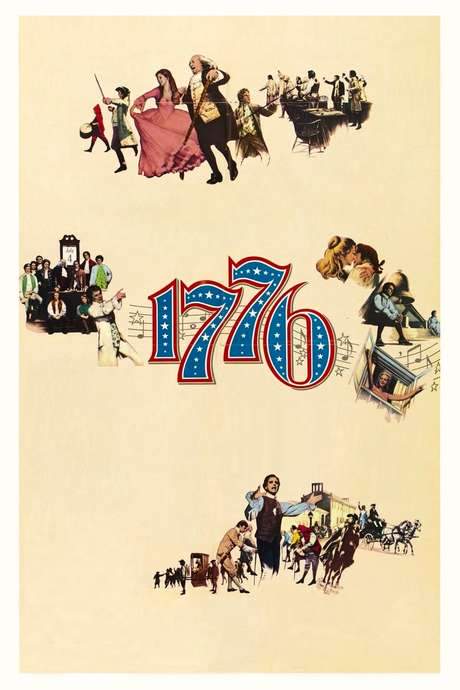











1776

1776

JustWatch#3,12838

Year: 1972

Runtime: 141 mins

Language: English

Director: Peter H. Hunt

DramaHistory

This adaptation brings the award‑winning stage musical to the screen, dramatizing the 1776 Continental Congress in Philadelphia, where delegates work to create a governing framework for the new United States. Benjamin Franklin and John Adams task Thomas Jefferson with drafting a declaration announcing independence from British rule.

Where to Watch 1776?

Find where to stream, rent, or buy 1776 (1972) in the US with current JustWatch availability, up-to-date pricing, and platform listings for subscription, rental, and digital purchase options.

Warning: spoilers below!

Haven’t seen 1776 yet? This summary contains major spoilers. Bookmark the page, watch the movie, and come back for the full breakdown. If you're ready, scroll on and relive the story!

Timeline & Setting – 1776 (1972)

Explore the full timeline and setting of 1776 (1972). Follow every major event in chronological order and see how the environment shapes the story, characters, and dramatic tension.

Time period

1776

Set in the spring and early July of 1776, the narrative tracks the final push toward declaring independence. Delegates debate and maneuver through factions, drafting a declaration while the fate of the colonies hangs in the balance. The period is defined by ideologicalrigor, political realignment, and the urgency of a nation in birth.

Location

Philadelphia, New Brunswick, New Jersey

The story centers on the Second Continental Congress in Philadelphia. It also references the army encampment in New Brunswick, New Jersey, highlighting the geographic mix of political negotiation and military readiness that defined the era. The settings underscore the colonies’ push toward unity and independence against Britain.

🗺️ Colonial setting 🗽 Independence movement 🏛️ Historic capitals

Last updated: October 04, 2025 at 18:32

Was this helpful?

Main Characters – 1776 (1972)

Meet the key characters of 1776 (1972), with detailed profiles, motivations, and roles in the plot. Understand their emotional journeys and what they reveal about the film’s deeper themes.

John Adams (William Daniels)

Massachusetts’s ardent advocate for independence, Adams is principled and forceful, often clashing with peers as he pushes for action. He seeks counsel from his wife and colleagues, balancing fiery conviction with strategic patience. His resolve is tested as the vote hinges on persuasion, alliance-building, and personal sacrifice for the greater good.

🗽 Patriotic 💼 Principled 🧠 Strategic

Abigail Adams (Virginia Vestoff)

Abigail is a steady, intelligent influence on her husband, offering practical counsel and emotional support. Her presence underscores the domestic dimension of political life and the broader idea that personal relationships fuel public action. She embodies resilience and insight that sustains the independence movement.

💬 Thoughtful 🇺🇸 Patriotic 🤝 Supportive

Benjamin Franklin (Howard Da Silva)

Franklin is a pragmatic, witty diplomat who champions independence while maintaining diplomatic tact. He helps smooth factional tensions and nudges Adams toward broader alliance-building. Franklin’s vision and experience lend a stabilizing influence to the pursuit of a united new nation.

🧠 Clever 🤝 Diplomatic 🇺🇸 Visionary

Thomas Jefferson (Ken Howard)

Jefferson serves as the primary drafter of the declaration, combining intellect with a sense of moral idealism. He reluctantly accepts the responsibility and works to craft language that can unite diverse interests. The process reveals his cautious stance on controversial issues like slavery, shaping the draft’s final content.

📝 Writer 🧠 Intellectual 💬 Articulate

Roger Sherman (Rex Robbins)

Sherman participates in the drafting process with a practical, collaborative spirit. He helps translate broad ideals into workable, persuasive language and works toward building consensus among states. His steadiness contributes to navigating the complexities of union-building.

🧭 Pragmatic 🗣️ Diplomatic 🤝 Collaborative

Edward Rutledge (John Cullum)

Rutledge leads the Southern delegates and asserts their opposition to certain terms, embodying regional interests. His firm stance triggers tensions and walkouts that test the unity of the Congress. He represents the mounting pressure from the South in shaping the final decision.

🔥 Assertive 🧭 Regionalist 🗳️ Influential

Caesar Rodney (William Hansen)

Rodney, battling illness, delivers a crucial but fragile vote for Delaware. His physical frailty at a pivotal moment highlights the personal cost behind historic decisions. His moment underscores how individual circumstances can alter the course of history.

💪 Determined 🩺 Fragile 🧭 Decisive

John Hancock (David Ford)

As President of Congress, Hancock guides proceedings and ultimately breaks the tie in favor of a declaration. He embodies leadership presence and the procedural authority needed to move the process forward. His support legitimizes the move toward independence.

👔 Leader 🗂️ Procedural 🇺🇸 Patriotic

Robert Livingston (John Myhers)

Livingston is a key delegate from New York, contributing to the drafting committee’s work and supporting the push for independence. His role underscores the broader involvement of northern states in the decision. He helps ensure the resolution gains cross-regional backing.

🧭 Collaborative 🗺️ Regional 🗡️ Influence

Josiah Bartlett (Daniel Keyes)

Bartlett represents New Hampshire and participates in the deliberations that shape the declaration. His presence adds to the chorus of delegates weighing liberty, governance, and the future nation. He contributes to the collective effort to secure consensus.

🤝 Delegated 🗳️ Participatory 🧭 Moderate

Samuel Chase (Patrick Hines)

Chase is a Maryland delegate whose support becomes pivotal as the states negotiate, reflecting the importance of persuasive appeals to secure unity. His stance influences the direction of the debate and the eventual outcome. He embodies the calculated risk involved in aligning with independence.

🗳️ Swing vote 🗣️ Persuasive 🇺🇸 Loyalist? (independence advocate)

Andrew McNair (William Duell)

As Congressional custodian, McNair is the steady presence who tolls the bell at the moment of signing. His role, though not political, marks the ceremonial heartbeat of the momentous decision. He bears witness to the transition from debate to a formal declaration.

🔔 Witness 🧭 Steady 🗝️ Ceremonial

Martha Jefferson (Blythe Danner)

Martha arrives to support her husband just as the draft nears completion, delivering encouragement and practical influence. Her presence underscores the domestic sphere’s contribution to a national political milestone. She embodies a stabilizing, inspiring force behind the independence movement.

💬 Encouraging 👩‍👧‍👦 Domestic strength 🇺🇸 Supportive

Last updated: October 04, 2025 at 18:32

Was this helpful?

Major Themes – 1776 (1972)

Explore the central themes of 1776 (1972), from psychological, social, and emotional dimensions to philosophical messages. Understand what the film is really saying beneath the surface.

🗽 Independence

Independence is the central throughline, driving heated debates and shifting alliances among delegates. The characters wrestle with the idea of breaking from Britain and forming a new nation. The process is portrayed as a mix of principled conviction and pragmatic compromise, culminating in the decision to pursue a declaration.

🤝 Persuasion & Compromise

The film emphasizes persuasion, negotiation, and the messy art of consensus. Leaders must win over skeptical colleagues and reconcile divergent interests. The narrative shows how concessions and strategic alliances are essential to achieving a common goal.

🧭 Leadership under Pressure

Delegates navigate intense pressure, time constraints, and public expectations. Choices are scrutinized, and leaders must balance vision with political reality. The story frames leadership as a test of resolve, collaboration, and the willingness to adapt.

Last updated: October 04, 2025 at 18:32

Was this helpful?

1776 (1972) Character & Theme Questions Answered – Info FAQ

Browse frequently asked questions about 1776 (1972) focused on characters, relationships, themes, symbols, setting, and story context. This movie info FAQ gives spoiler-aware explanations for character arcs, world details, and thematic interpretation so readers can better understand what the film is really about.

Q1

When is the movie 1776 set?

A.

The film is set in the spring and early July of 1776, during the final push toward declaring independence from Britain. This specific time period captures the height of the Continental Congress debates and the urgent political maneuvering leading up to the adoption of the Declaration of Independence.

1776time periodhistorical setting1776july 4colonial america
Q2

Where is 1776 set?

A.

The story is set primarily in Philadelphia, where the Second Continental Congress convenes. The film also briefly references the army encampment in New Brunswick, New Jersey, highlighting the connection between political deliberation in the city and military readiness in the field during the Revolutionary era.

settingphiladelphianew brunswicknew jerseycontinental congresscolonial america
Q3

What are the main themes of 1776?

A.

The film centers on three major themes: Independence as the driving force behind the delegates' debates and decisions; Persuasion and Compromise, showing how consensus-building through negotiation and strategic alliances is essential to achieving revolutionary goals; and Leadership under Pressure, depicting how figures navigate time constraints, factional disputes, and public expectations while balancing vision with political reality.

themesindependencecompromisepersuasionleadershipdeclaration of independence
Q4

What is the Continental Congress in 1776?

A.

The Continental Congress was the governing body of the American colonies during the Revolutionary period. In 1776, it served as the forum where delegates from the thirteen colonies debated whether to declare independence from Britain and crafted the framework for a new nation. The film portrays the intense political negotiations, factional disputes, and procedural votes that defined this historic body.

continental congressdelegatescoloniespolitical processrevolution
Q5

Who writes the Declaration of Independence in 1776?

A.

Thomas Jefferson serves as the primary drafter of the Declaration of Independence in the film. He is selected by Benjamin Franklin and John Adams for the task, combining intellectual idealism with moral conviction. The process reveals his cautious approach to controversial issues like slavery, and the drafting committee, which includes Roger Sherman and Robert Livingston, works to craft language that can unite diverse colonial interests.

thomas jeffersondeclaration of independencedraftcontinental congresswriting
Q6

Who is John Adams in the movie 1776?

A.

John Adams is portrayed as Massachusetts's most ardent advocate for independence, characterized by principled conviction and forceful advocacy. He frequently clashes with peers as he pushes for action, balancing fiery determination with strategic patience. His role centers on persuasion, alliance-building, and testing his resolve as he works to secure the votes needed for independence.

john adamsmassachusettsindependencedelegatecontinental congress
Q7

What role does Benjamin Franklin play in 1776?

A.

Benjamin Franklin appears as a pragmatic, witty diplomat who champions independence while maintaining diplomatic tact. He helps smooth tensions between factions and nudges John Adams toward broader alliance-building. Franklin's experience and vision lend a stabilizing influence to the pursuit of a united new nation, and he notably recruits Thomas Jefferson to draft the Declaration.

benjamin franklindiplomatindependencealliancecontinental congress
Q8

Who is Abigail Adams in 1776?

A.

Abigail Adams serves as a steady, intelligent influence on her husband John, offering both practical counsel and emotional support. Though physically absent from the Congress chamber for much of the film, her letters provide guidance and underscore the domestic dimension of political life. She embodies resilience and insight that sustains the independence movement from home.

abigail adamsjohn adamswifedomesticletterscounsel
Q9

Who leads the Southern delegates in 1776?

A.

Edward Rutledge leads the Southern delegates in the Continental Congress and represents the interests of the southern colonies. He firmly opposes certain terms in the draft declaration, particularly regarding slavery, triggering tensions and walkouts that test the unity of the Congress. His stance highlights the regional conflicts that had to be navigated to achieve independence.

edward rutledgesouthern delegatessouthoppositionslaverycontinental congress
Q10

Who delivers Delaware's vote in 1776?

A.

Caesar Rodney delivers Delaware's crucial vote for independence, despite battling illness. His physical frailty at this pivotal moment highlights the personal cost behind historic decisions. Rodney's fragile but determined effort to reach the Congress in time underscores how individual circumstances can alter the course of history.

caesar rodneydelawarevoteillnessdeclarationindependence
Q11

How does 1776 portray persuasion and compromise?

A.

The film emphasizes that achieving independence requires persuasion, negotiation, and the messy art of compromise. Delegates must win over skeptical colleagues and reconcile divergent colonial interests. The narrative shows how concessions and strategic alliances are essential to the revolutionary cause, portraying the political process as a complex balancing act between principle and practicality.

compromisepersuasionnegotiationdelegatesalliancesvoting
Q12

What geographic locations are featured in 1776?

A.

The film features Philadelphia as the primary setting, representing the seat of political decision-making. It also references New Brunswick, New Jersey, where the Continental Army was encamped. This geographic mix underscores the dual nature of the era: political negotiation in the city combined with military readiness in the field, both essential to the colonies' push for unity and independence.

locationsphiladelphianew brunswicknew jerseyarmymilitarycolonial settings
Q13

How does 1776 depict leadership under pressure?

A.

The film portrays leadership as a test of resolve, collaboration, and adaptability. Delegates navigate intense pressure, strict time constraints, and public expectations while balancing revolutionary vision with political reality. Characters like John Hancock, who guides proceedings as President of Congress, and Thomas Jefferson, who bears the weight of crafting the declaration, embody different facets of leadership tested by the stakes of nation-building.

leadershippressureresolvecollaborationjohn hancockthomas jeffersoncongress
Mobile App Preview

Coming soon on iOS and Android

The Plot Explained Mobile App

From blockbusters to hidden gems - dive into movie stories anytime, anywhere. Save your favorites, discover plots faster, and never miss a twist again.

Sign up to be the first to know when we launch. Your email stays private, always.

Explore Movie Threads

Discover curated groups of movies connected by mood, themes, and story style. Browse collections built around emotion, atmosphere, and narrative focus to easily find films that match what you feel like watching right now.

Political thrillers in a single room like 1776

Films where intense debate and procedure create drama within confined spaces.Movies like 1776 where the drama unfolds in a confined space through passionate debate and procedural suspense. If you enjoyed the tense, talk-driven narrative of 1776, you'll find similar stories of high-stakes decision-making in these claustrophobic political thrillers and historical dramas.

tensedeliberativeclaustrophobicpoliticaldramaticproceduralhistoric

Narrative Summary

Narratives in this thread typically center on a group of people, often delegates or officials, who are confined to one primary location—a courtroom, a war room, a jury chamber—facing a monumental decision. The plot progresses through arguments, alliances, and votes, with the outcome hinging on persuasion and compromise rather than physical force.

Why These Movies?

These movies are grouped together because they share a specific formula for creating tension: leveraging a single setting to amplify pressure, focusing on verbal and intellectual conflict, and building a steady, deliberative pace towards a pivotal vote or verdict that carries immense consequences.

Hopeful historical dramas with moral compromise like 1776

Stories about building something new that is tempered by difficult sacrifices.If you liked 1776's blend of a triumphant, happy ending with the sobering reality of political compromise, you'll appreciate these similar historical dramas. These movies explore the complex process of building a better future, where idealism is tested by the gritty realities of negotiation and sacrifice.

hopefulhistoricdramaticresolutethought-provokinginspiringsomber

Narrative Summary

The narrative pattern involves a group striving for a noble and seemingly impossible goal. The journey is defined by setbacks, internal conflicts, and the painful realization that perfection is unattainable, leading to necessary but morally ambiguous compromises. The story culminates in a hard-won victory that feels earned yet is shadowed by the cost.

Why These Movies?

These movies share a unique emotional mix: the uplifting feeling of a major historical achievement is balanced with a medium emotional weight derived from the difficult choices and sacrifices made along the way. They are hopeful but grounded, celebrating progress while acknowledging its imperfect nature.

Unlock the Full Story of 1776

Don't stop at just watching - explore 1776 in full detail. From the complete plot summary and scene-by-scene timeline to character breakdowns, thematic analysis, and a deep dive into the ending - every page helps you truly understand what 1776 is all about. Plus, discover what's next after the movie.

1776 Summary

Read a complete plot summary of 1776, including all key story points, character arcs, and turning points. This in-depth recap is ideal for understanding the narrative structure or reviewing what happened in the movie.

1776 Summary

1776 Timeline

Track the full timeline of 1776 with every major event arranged chronologically. Perfect for decoding non-linear storytelling, flashbacks, or parallel narratives with a clear scene-by-scene breakdown.

1776 Timeline

1776 Spoiler-Free Summary

Get a quick, spoiler-free overview of 1776 that covers the main plot points and key details without revealing any major twists or spoilers. Perfect for those who want to know what to expect before diving in.

1776 Spoiler-Free Summary

More About 1776

Visit What's After the Movie to explore more about 1776: box office results, cast and crew info, production details, post-credit scenes, and external links - all in one place for movie fans and researchers.

More About 1776

Similar Movies to 1776

Discover movies like 1776 that share similar genres, themes, and storytelling elements. Whether you’re drawn to the atmosphere, character arcs, or plot structure, these curated recommendations will help you explore more films you’ll love.