Plot Explained Spoilers guaranteed!
Plot Explained

Browse by genre

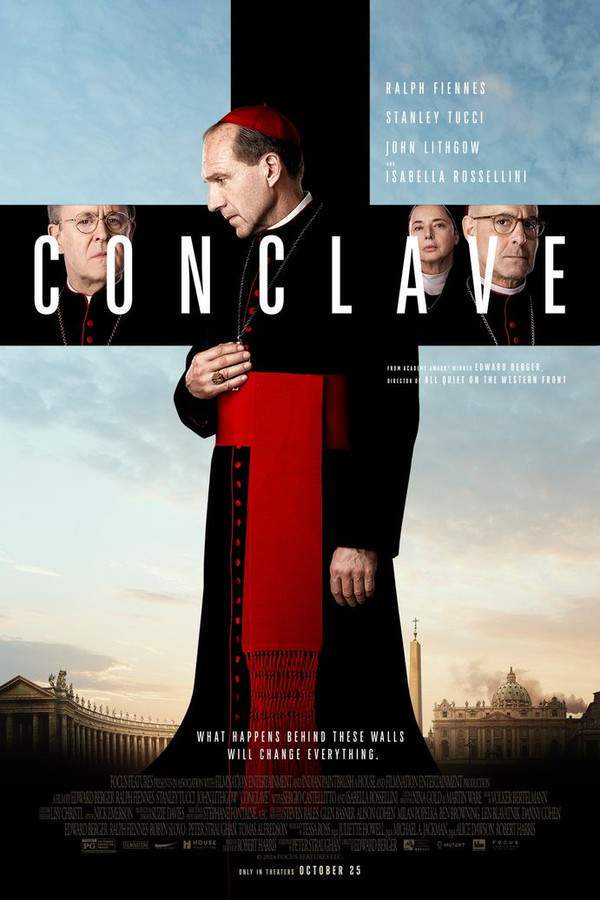
Conclave (2024) movie poster

Plot Summary

Conclave (2024) Plot Summary & Ending Explained

Release, runtime and language
2024 · 2 h · English
Echo score 80
Loading streaming availability…
Directed by
Edward Berger
Starring
Stanley Tucci, John Lithgow, Ralph Fiennes, Joseph Mydell, Sergio Castellitto, Brían F. O'Byrne
Budget
$20M

Following the unexpected death of the beloved Pope, Cardinal Lawrence (Ralph Fiennes) is entrusted with overseeing the secretive and ancient process of selecting a new pontiff. The Catholic Church’s most powerful leaders gather from around the world and are secluded within the Vatican, where they must navigate complex political maneuvering and personal convictions in their quest to choose the next leader of the Catholic Church.

On this page (8)
  1. 1 Where to watch
  2. 2 What happens: full plot
  3. 3 Plot questions answered
  4. 4 How it ends
  5. 5 The book behind the movie
  6. 6 Movie threads
  7. 7 Movies like Conclave
  8. 8 Every angle
Loading streaming availability…

Full plot summary · contains spoilers

What Happens in Conclave: Full Plot Summary

The whole story of Conclave (2024) explained, from the opening scene to the final frame: every key event, every twist and what it all adds up to. Read it as a quick recap before the sequel, to check a scene you missed, or to finally understand what really happened.

After the unexpected demise of the unnamed pope due to a heart attack, the College of Cardinals convenes in a secretive papal conclave to elect the new leader of the Catholic Church, under the guidance of Cardinal-Dean Thomas Lawrence. To his astonishment, Archbishop Benitez of Kabul appears, revealing that he was clandestinely appointed as a cardinal by the late pope.

As the conclave unfolds, four primary candidates emerge for the papacy: 1) Bellini, who embodies the progressive ideals of his predecessor, 2) Adeyemi, a socio-economically forward-thinking individual with conservative moral standings, 3) Tremblay, representing mainstream conservatism, and 4) Tedesco, a traditionalist advocating for the church to retreat from the Second Vatican Council’s inclusive policies. Tedesco's bigotry and abusive demeanor toward his staff paint him in a negative light, while speculation arises that both Tremblay and Adeyemi may have exploited their influence in the Vatican, contributing to the late pope's demise.

As the key players in the Church's liberal narrative, Bellini and Lawrence emerge as prime contenders for the papacy. However, both express their reluctance to accept the role for varied reasons. Bellini, while intrigued by the position, believes that a façade of disinterest will garner him respect from his peers. In contrast, Lawrence grapples with a profound crisis of faith that previously led him to contemplate resigning from his post. Despite initially voting for Bellini, Lawrence seems to hold back complete support, creating a tension that does not go unnoticed.

Prior to the first voting round, Lawrence delivers an impassioned speech urging the cardinals to advocate for diversity—a moment many interpret as a veiled campaign address. Intriguingly, Lawrence begins to gather research against rival candidates, justifying it as necessary due diligence for the defense of the Church, despite the breach of conclave protocols. A confidant of the late pope informs him that Tremblay had been dismissed on the day of the pope's death, a claim denied by Tremblay who produces an eyewitness to discredit the allegation.

As voting commences, no candidate secures the requisite two-thirds majority. Adeyemi emerges with a slight advantage while a handful of votes go to Lawrence, igniting Bellini's ire. Confronted with a lack of a unified liberal candidate, the progressives rally behind Adeyemi. In an unexpected twist, Bellini—a vocal opponent of Adeyemi's homophobia—strikes a deal to back Tremblay in exchange for a coveted bureaucratic position.

The tension escalates as one of the nuns entrusted with catering during the conclave boldly confronts Adeyemi in the cardinals' cafeteria, revealing to Lawrence her secret past with him: she bore Adeyemi's child at a young age. When confronted, Adeyemi admits to this truth and pleads for her forgiveness, but the atmosphere shifts as a whisper campaign undermines his candidacy, illustrating the cutthroat nature of the conclave.

Unbeknownst to many, Adeyemi suspects a conspiracy after learning that the nun was recently moved from Africa to the Vatican—an assignment he believes was orchestrated by Tremblay. In a desperate attempt to thwart Tremblay, Lawrence attempts to use the threat of exposure for personal gain, but Tremblay counters Lawrence's manipulations, revealing his own agenda.

In a pivotal scene, Lawrence uncovers incriminating documents in the late pope's residence that expose Tremblay's corrupt activities regarding vote buying. Faced with a moral dilemma, Bellini advocates for the destruction of the evidence but chooses to stand by Lawrence instead, shifting his allegiance toward solidifying a path to rid the conclave of Tremblay's grasp.

As the conclave progresses, a horrific suicide bombing in Rome results in mass casualties, shaking the very foundation of the Church's deliberations. Tedesco's reactionary rhetoric inflames tensions, demanding conflict against perceived threats, while Benitez, an advocate of reconciliation, challenges the Church to embrace evolution rather than perpetuate outdated traditions.

Ultimately, a heartfelt amalgamation of conviction among the cardinals leads to the election of Benitez as pope, yet not without its complications. Shortly before the announcement, Lawrence is faced with a shocking revelation about Benitez's past, potentially shattering his newfound papacy. Confronting Benitez, Lawrence learns of his intersex identity and the delicate choice he made regarding his anatomy, ultimately leading Lawrence to prioritize loyalty over ambition by keeping Benitez’s secret.

As the jubilant crowds celebrate the election of their new pope, Lawrence gazes out from his dormitory window, entangled in a web of politics, faith, and sacrifice, reflecting on the profound implications of power and the cost of ambition.
Last updated: November 25, 2024 at 19:24

Was this helpful?

Plot questions answered

Conclave Plot Explained: Your Questions Answered

The questions people ask most about Conclave (2024): what happens in the confusing scenes, why the characters do what they do, the twists, hidden details and what the ending means. Each answer contains spoilers.

Q1

Why was Archbishop Benitez at the papal conclave?

Archbishop Benitez of Kabul appeared at the conclave because the late Pope had secretly appointed him as a cardinal. This revelation surprised all the other cardinals, as Benitez's appointment had been kept confidential. His unexpected presence added another candidate to the race and represented the late Pope's vision for a more diverse and inclusive Church leadership.

Foreshadowing: The late Pope's decision to secretly appoint Benitez foreshadows his progressive legacy and sets the stage for the eventual election outcome.

  • cardinal benitez
  • conclave
  • papal election
  • archbishop benitez
  • secret appointment
Q2

Why did Cardinal Lawrence give the diversity speech before the vote?

Lawrence delivered the diversity speech as a veiled campaign address, urging cardinals to consider diversity in their choice for the next Pope. Though he presented himself as reluctant to accept the papacy, many cardinals interpreted his speech as a direct push for his own candidacy. This moment revealed Lawrence's deeper political ambitions despite his outward display of humility.

Foreshadowing: The speech established Lawrence as a key player whose influence extended beyond his role as Cardinal-Dean.

  • cardinal lawrence
  • diversity speech
  • conclave
  • campaign
  • papal candidate
Q3

Why did Bellini switch his vote to support Tremblay?

Bellini made a deal with Tremblay to back his candidacy in exchange for a coveted bureaucratic position within the Vatican. This political maneuver shocked other progressives, especially since Bellini had been a vocal opponent of Adeyemi's homophobia. The deal demonstrated how quickly political alliances shifted in the conclave's cutthroat environment.

Foreshadowing: Bellini's willingness to compromise his principles early on set the stage for his eventual redemption arc.

  • cardinal bellini
  • cardinal tremblay
  • deal
  • vote
  • conclave politics
Q4

Why was Adeyemi's candidacy destroyed by the nun's revelation?

A nun who worked in the conclave's cafeteria confronted Adeyemi, revealing she had borne his child years earlier in Africa. When Lawrence confronted him, Adeyemi admitted the truth. This personal scandal triggered a whisper campaign that severely damaged his candidacy, despite his strong polling position. The revelation exposed hypocrisy in his publicly conservative moral stance.

Foreshadowing: Adeyemi's secret past directly contributed to his downfall, showing how personal secrets became weapons in the conclave.

  • cardinal adeyemi
  • nun
  • scandal
  • child
  • conclave
  • candidacy
Q5

What evidence did Lawrence find against Tremblay?

Lawrence discovered incriminating documents in the late Pope's residence that proved Tremblay had engaged in vote buying, bribing cardinals to secure support for his candidacy. This evidence of corruption represented a serious breach of conclave rules and could have disqualified Tremblay entirely.

Foreshadowing: The late Pope's hidden files revealed the extent of corruption lurking beneath the conclave's sacred proceedings.

  • tremblay
  • bribery
  • vote buying
  • documents
  • evidence
  • corruption
Q6

Why was Benitez elected as the new Pope?

Benitez was elected as a compromise candidate who represented a middle ground among the warring factions. His progressive stance on reconciliation and his advocacy for Church evolution appealed to cardinals seeking reform after the scandal-plagued process. Unlike the other candidates who were tainted by scandals or controversial ideologies, Benitez represented a fresh start for the Church.

Foreshadowing: The late Pope's secret appointment of Benitez ultimately proved prophetic, as his vision for the Church prevailed.

  • benitez
  • pope election
  • new pope
  • conclave result
  • compromise candidate
Q7

What secret did Lawrence discover about Benitez before the election?

Lawrence learned that Benitez is intersex and had made a choice regarding his anatomy. This information, discovered just before Benitez's election was announced, could have completely derailed his candidacy and caused a major scandal for the Church.

Foreshadowing: The late Pope's trust in Benitez despite knowing this secret highlighted the themes of loyalty and acceptance.

  • benitez
  • secret
  • intersex
  • lawrence
  • identity
  • discovery
Q8

Why did Lawrence choose to keep Benitez's secret?

Lawrence decided to protect Benitez's secret out of loyalty to the late Pope, who had trusted Benitez enough to secretly appoint him as a cardinal. Rather than expose the truth and shatter the hope for a progressive new direction for the Church, Lawrence prioritized the Church's future over his own ambition and the potential scandal.

Foreshadowing: Lawrence's choice reflects his own journey from political maneuvering to principled sacrifice.

  • lawrence
  • benitez
  • secret
  • loyalty
  • sacrifice
  • choice
Q9

How did the Rome bombing affect the papal conclave?

A suicide bombing in Rome killed 52 people and damaged the Sistine Chapel, creating a major crisis during the conclave. The tragedy forced cardinals to reconsider the Church's direction and priorities. Tedesco's reactionary calls for conflict intensified divisions, while Benitez's message of reconciliation gained traction as the Church faced external tragedy.

Foreshadowing: The external crisis shifted internal politics, ultimately benefiting more moderate candidates.

  • bombing
  • rome
  • sistine chapel
  • terror attack
  • conclave
  • impact
Q10

Why was Lawrence reluctant to become Pope?

Lawrence grappled with a profound crisis of faith that had previously led him to contemplate resigning from his position as Cardinal-Dean. His spiritual doubt made him genuinely reluctant to accept the papacy, even as he remained deeply involved in the political maneuvering. This internal conflict created tension between his sense of duty and his personal spiritual struggles.

Foreshadowing: Lawrence's crisis of faith established his character as someone driven by conscience rather than ambition.

  • lawrence
  • crisis of faith
  • reluctant
  • pope
  • doubt
  • resignation

Ending explained

What Happens at the End of Conclave?

How Conclave (2024) ends, in short: the final scene, the last twist and what it means for the characters. The full ending explained, with every spoiler, lives on its own page.

Read the full ending explained

In the climax of Conclave, the fictional Cardinal Benitez is elected as the new pope after a dramatic conclave, where passions and politics run high. However, the revelation of Benitez’s secret—that he is intersex and had initially considered having surgery to conform to traditional gender norms—adds a profound layer of complexity to his victory. Cardinal Lawrence, who had initially aimed for a less politically charged election, opts to keep this secret quiet, recognizing that revealing it could destabilize the Church even further. The ending suggests that, despite all the political maneuvering, scandals, and ideological battles, the core message of the film revolves around the importance of acceptance and human imperfection. Cardinal Benitez's secret becomes a symbol of the hidden flaws everyone carries, reminding the audience that even those supposedly chosen for leadership are riddled with personal struggles and secrets. Ultimately, the film leaves viewers with a thought-provoking reflection on the possibility of a more inclusive future for the Church, one that perhaps relies more on love and understanding than on rigid dogmas and appearances. The concluding act underscores that, in a world full of secrets and contradictions, true leadership may come from embracing our flaws and advocating for compassion over perfection.

Conclave ending explained in full

Movie threads

More Movies Like Conclave, by Mood & Story

Curated lists built around what makes Conclave tick: the same mood, the same kind of story or the same emotional payoff. Each list explains why these movies belong together.

Thrillers of claustrophobic political intrigue like Conclave

Intense, strategic battles for power unfolding in isolated, high-pressure environments. If you liked the tense, behind-the-scenes power struggle in Conclave, you'll find similar movies here. These films focus on high-stakes political or corporate maneuvering within enclosed settings, where secrets are currency and trust is a liability, creating a consistently suspenseful and intellectually engaging experience.

  • claustrophobic
  • suspenseful
  • political
  • strategic
  • anxious
  • serious
  • Tone: tense, serious, morally ambiguous
  • Pacing: steady, methodical
Why these movies?

The story pattern: Narratives in this thread typically follow a procedural unveiling of secrets and shifting allegiances within a rigid, formal structure. A protagonist, often an insider with a moral compass, must navigate a web of hidden agendas and personal ambitions, leading to a climax that redefines the balance of power, often at a significant personal cost.

Why they belong together: Movies are grouped here for their shared focus on sophisticated, dialogue-driven tension within isolated settings. They prioritize intellectual suspense over physical action, featuring complex characters grappling with ethical dilemmas and the corrosive nature of ambition in a pressure-cooker atmosphere.

Movies about institutional corruption and crisis like Conclave

Stories where revered institutions are threatened by internal secrets and moral compromise. Fans of Conclave's exploration of faith, power, and secrecy will find similar movies here. These films delve into crises within respected establishments like governments, churches, or corporations, where idealistic protagonists uncover corruption and face profound moral dilemmas about loyalty and truth.

  • serious
  • contemplative
  • morally ambiguous
  • anxious
  • grave
  • procedural
  • Tone: serious, contemplative, tense
  • Pacing: steady, deliberate
Why these movies?

The story pattern: The typical narrative follows an insider—a believer in the system—who uncovers a rot that threatens the institution's very foundation. This discovery triggers a crisis of conscience, pitting their loyalty against the pursuit of truth, often leading to a bittersweet or ambiguous resolution where the institution survives but is fundamentally changed, and the protagonist is left scarred by the experience.

Why they belong together: These films are connected by their central theme of a systemic crisis and the resulting moral quandaries for their characters. They share a serious tone, a focus on thematic weight over action, and often conclude with a complex, morally nuanced ending rather than a simple victory.

If you liked this

Movies Like Conclave

Similar movies to Conclave: the same genre, themes or kind of story. Each one comes with its own plot summary, timeline and ending explained.

Browse all movie summaries

Every angle

Conclave (2024) Explained: Plot, Ending, Timeline & Characters

Everything about Conclave in one place: what happens in the plot summary, the timeline in chronological order, the characters and meaning, the ending explained and a spoiler-free summary. What's After the Movie adds the cast, box office and post-credit scenes.

Coming soon on iOS and Android

The Plot Explained Movie Summary App

Plot summaries, endings explained and timelines on your phone. Catch up on any movie in minutes, save your favorites and never miss a twist again.

Be the first to know when we launch. Your email stays private, always.

Learn more about the app