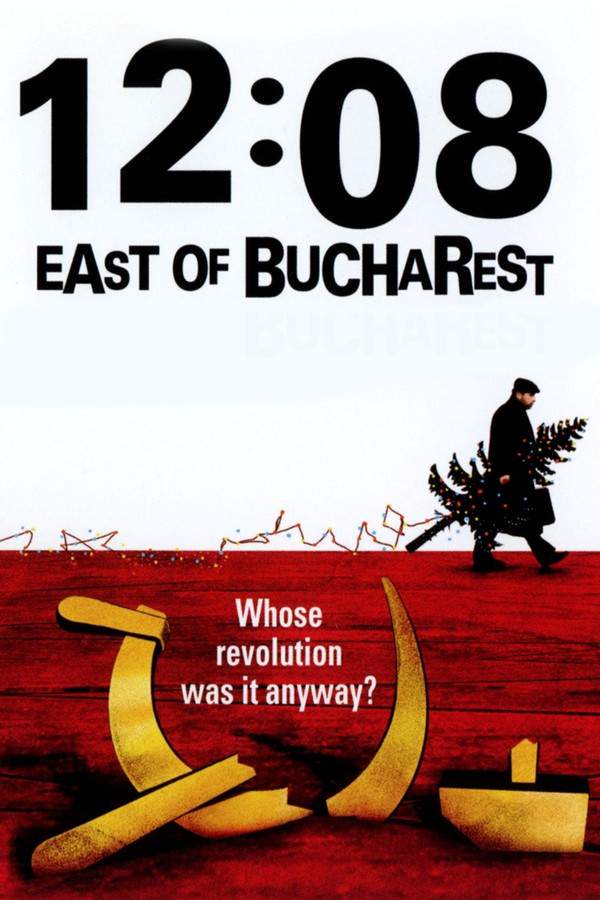
As Christmas nears in Bucharest following the revolution, a television station gathers a diverse group of individuals. They're tasked with recounting their supposed acts of bravery, specifically the moment they reportedly helped topple city hall and famously shouted "Down with Ceausescu!" prior to the dictator's dramatic helicopter departure. The event is revisited, revealing the complexities and potential inaccuracies of collective memory.
Find where to stream, rent, or buy 12:08 East of Bucharest (2007) in the US with current JustWatch availability, up-to-date pricing, and platform listings for subscription, rental, and digital purchase options.
Warning: spoilers below!
Haven’t seen 12:08 East of Bucharest yet? This summary contains major spoilers. Bookmark the page, watch the movie, and come back for the full breakdown. If you're ready, scroll on and relive the story!
Trace every key event in 12:08 East of Bucharest (2007) with our detailed, chronological timeline. Perfect for unpacking nonlinear stories, spotting hidden connections, and understanding how each scene builds toward the film’s climax. Whether you're revisiting or decoding for the first time, this timeline gives you the full picture.
Last updated: November 15, 2024 at 18:41
Find frequently asked questions about the 12:08 East of Bucharest (2007) timeline, including chronological order, nonlinear jumps, cause-and-effect links, and scene sequence clarifications. This timeline FAQ helps explain when key events happen, how moments connect, and why the story unfolds in that specific order.
The show questions whether citizens took to the streets before or after Ceausescu's helicopter escape on December 22, 1989. If they protested before his escape, their actions were genuinely revolutionary. If they demonstrated after, they were merely celebrating an outcome already decided. This distinction determines whether their claims to revolutionary heroism are legitimate or post-hoc mythmaking.
Jderescu frames the entire talk show around this precise question of timing.
Viewers call to suggest Manescu was drunk during the December 1989 events, implying his memories or claims are unreliable. This directly challenges his narrative of being the first to confront the dictatorship, introducing doubt about his credibility and the nature of his supposed heroism.
During the chaotic argument, Manescu exposes that Jderescu is actually a textile engineer, not a journalist as he presented himself. This revelation exposes the hypocrisy of those leading the discussion about historical truth, showing that many figures presenting themselves as authorities on the revolution are actually imposters with questionable backgrounds.
The previously reticent Piscoci, introduced as the man who once dressed as Santa Claus for children, unexpectedly becomes more vocal as the talk show deteriorates. His shift from silence to participation reflects the general breakdown of civility and the way the chaotic atmosphere emboldens people to share increasingly absurd perspectives, contributing to the farcical tone.
Timeline notes Piscoci as 'previously reticent' before his activation.
The title refers to the specific time, 12:08, referenced in the film concerning when something significant happened in Vaslui relative to Bucharest time. This precise timing becomes central to the debate about whether the events in Vaslui constituted a true revolution or merely a reaction to events already set in motion elsewhere.
The anticipated guests decline Jderescu's invitation, likely due to the sensitive nature of discussing whether their city had a genuine revolution. Many locals probably prefer not to publicly examine or potentially undermine their own revolutionary credentials, preferring to avoid scrutiny of their actions during those confusing days.
The civil discussion spirals into chaos when Manescu, agitated by challenges to his claims, begins attacking local dignitaries, including exposing Jderescu as an impostor. The already fragile veneer of respectable historical inquiry collapses, turning into personal attacks and revelations of hypocrisy, transforming the show into a grotesque spectacle.
The film examines how communities construct and contest narratives about their past, especially regarding revolutionary heroism. Through the collapsing talk show, it suggests that collective memory is often unreliable, self-serving, and vulnerable to fabrication, posing uncomfortable questions about what nations choose to remember about their histories.
The film portrays a society still grappling with its recent past, where people compete to claim revolutionary status despite the ambiguity of their actions. The talk show becomes a microcosm of post-communist Romania, where authenticity is questioned, credentials are fabricated, and the process of confronting history becomes itself chaotic and farcical.
The shift from serious discussion to farce serves the film's satire of how communities handle historical truth. By allowing the conversation to become absurd and ridiculous, the film suggests that the pursuit of definitive historical answers may be futile, highlighting human frailty, self-deception, and the absurdity of trying to establish objective truth about chaotic events.
Discover curated groups of movies connected by mood, themes, and story style. Browse collections built around emotion, atmosphere, and narrative focus to easily find films that match what you feel like watching right now.
Stories where personal and collective histories are called into question.If you enjoyed the way 12:08 East of Bucharest dissects personal and collective history, you'll appreciate these films. They feature characters grappling with the gap between their stories and reality, often in satirical or melancholic dramas that question the very nature of truth and heroism.
The narrative typically centers on a retrospective examination of a past event, forcing characters to confront the discrepancies between their recollections. The structure often involves interviews, flashbacks, or a live forum that builds tension not through action, but through the gradual erosion of a fabricated narrative, leading to a bittersweet or ironic conclusion.
Movies in this thread are grouped by their shared focus on the fallibility of memory and the construction of identity. They share a tone that blends intellectual satire with human melancholy, a steady pacing that allows for character revelations, and a thematic core that questions how we remember and why we lie, especially to ourselves.

Films that examine the awkward, disillusioned aftermath of political upheaval.Find more movies like 12:08 East of Bucharest that capture the bittersweet and satirical mood of life after a revolution. These films explore themes of collective memory, media spectacle, and the often unheroic truth behind historical events, blending drama with a sharp, ironic sense of humor.
Stories unfold in a society grappling with its new identity, often highlighting the absurd disconnect between revolutionary ideals and mundane reality. Characters are frequently seen trying to position themselves in the new order, leading to conflicts that expose hypocrisy, personal frailty, and the complex process of rewriting history. The journey is typically one of collective disillusionment.
These films are connected by their specific setting and tone. They share a bittersweet, reflective mood born from examining a society's scars and its awkward transition. The pacing is often steady, allowing for observational humor and character-driven drama, with a medium intensity focused on social and psychological tension rather than physical violence.
Don't stop at just watching - explore 12:08 East of Bucharest in full detail. From the complete plot summary and scene-by-scene timeline to character breakdowns, thematic analysis, and a deep dive into the ending - every page helps you truly understand what 12:08 East of Bucharest is all about. Plus, discover what's next after the movie.
Read a complete plot summary of 12:08 East of Bucharest, including all key story points, character arcs, and turning points. This in-depth recap is ideal for understanding the narrative structure or reviewing what happened in the movie.
Discover the characters, locations, and core themes that shape 12:08 East of Bucharest. Get insights into symbolic elements, setting significance, and deeper narrative meaning - ideal for thematic analysis and movie breakdowns.
Discover movies like 12:08 East of Bucharest that share similar genres, themes, and storytelling elements. Whether you’re drawn to the atmosphere, character arcs, or plot structure, these curated recommendations will help you explore more films you’ll love.
12:08 East of Bucharest (2007) Plot Summary & Movie Recap
12:08 East of Bucharest (2007) Scene-by-Scene Movie Timeline
12:08 East of Bucharest (2007) Spoiler-Free Summary & Key Flow
Movies Like 12:08 East of Bucharest – Similar Titles You’ll Enjoy
Uppercase Print (2021) Plot Summary & Ending Explained
Tales from the Golden Age (2011) Detailed Story Recap
A Farewell to Fools (2014) Story Summary & Characters
Bucharest - Vienna, 8:15 (2000) Ending Explained & Film Insights
The Rest Is Silence (2007) Spoiler-Packed Plot Recap
Offset (2006) Full Summary & Key Details
The Way I Spent the End of the World (2006) Detailed Story Recap
The Paper Will Be Blue (2006) Full Summary & Key Details
Libertate (2023) Spoiler-Packed Plot Recap
Look Ahead with Anger (1993) Spoiler-Packed Plot Recap
Tales from the Golden Age (2009) Movie Recap & Themes
Silent Wedding (2008) Plot Summary & Ending Explained
Coronation Street: Romanian Holiday (2009) Movie Recap & Themes
Kontinental ’25 (2025) Movie Recap & Themes
Réveillon (2023) Complete Plot Breakdown