Plot Explained Spoilers guaranteed!
Plot Explained

Browse by genre

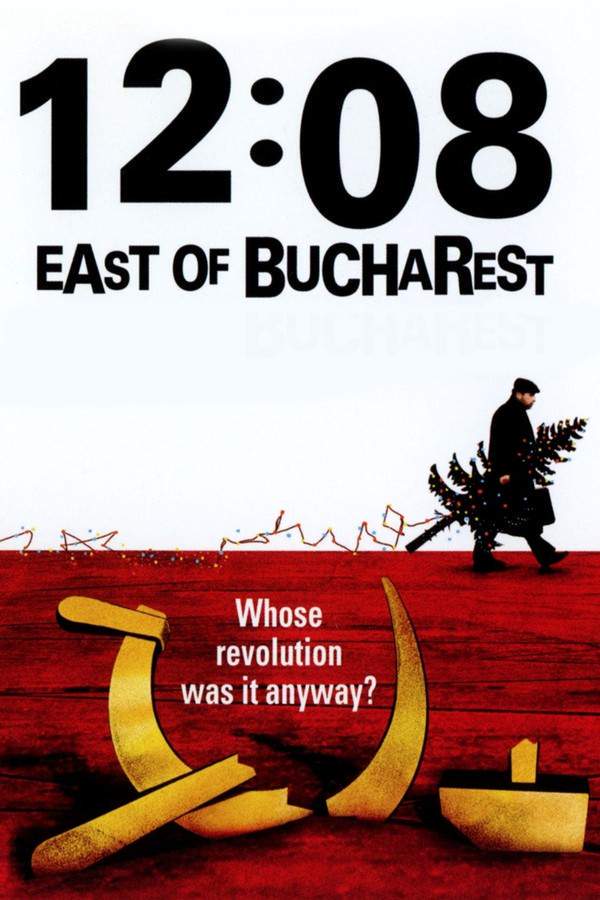
12:08 East of Bucharest (2007) movie poster

Spoiler-Free Summary

12:08 East of Bucharest (2007) Spoiler-Free Summary – What It's About

Release, runtime and language
2007 · 89 min · Romanian
Loading streaming availability…
Directed by
Corneliu Porumboiu

As Christmas nears in Bucharest following the revolution, a television station gathers a diverse group of individuals. They're tasked with recounting their supposed acts of bravery, specifically the moment they reportedly helped topple city hall and famously shouted "Down with Ceausescu!" prior to the dictator's dramatic helicopter departure. The event is revisited, revealing the complexities and potential inaccuracies of collective memory.

On this page (7)
  1. 1 Where to watch
  2. 2 What it is about
  3. 3 Is it worth watching?
  4. 4 After you watch
  5. 5 Movie threads
  6. 6 Movies like 12:08 East of Bucharest
  7. 7 Every angle
Loading streaming availability…

Spoiler-free summary · safe to read

What Is 12:08 East of Bucharest About? (No Spoilers)

The plot of 12:08 East of Bucharest (2007) without spoilers: what it is about, who it follows and where it takes place, told without the twists or the ending. Enough to decide whether it is your next watch, not enough to ruin it.

In the lingering chill of a Bucharest winter, a modest television station becomes the unlikely stage for a nation’s attempt to sift truth from myth. The country is still shaking off the shadows of the former regime, and the streets buzz with a mixture of hope, nostalgia, and the uneasy feeling that history may be more malleable than anyone would like to admit. Against this backdrop, a live talk‑show is conceived as a way to let ordinary citizens voice their recollections of the night that supposedly toppled a dictatorship, turning personal memory into public performance.

The project’s reluctant architect, Virgil Jderescu, wears two hats: a textile engineer by trade and a self‑appointed journalist by ambition. He is driven by a single, strangely acute question—did the people truly rise before the dictator’s departure, or did they simply celebrate a moment already decided? His yearning for clarity is both earnest and absurd, reflecting a society that clings to the idea that a single answer could settle years of uncertainty. To fill the empty seats, he summons two unlikely guests whose lives are as tangled as the nation’s recent past.

First is Tiberiu Manescu, a down‑on‑his‑luck professor whose flamboyant self‑portrait of revolutionary heroism borders on the theatrical. He carries a restless need to be remembered as a pioneer, a trait that both endears him to the audience and sets the stage for inevitable friction. Opposite him sits Emanoil Piscoci, an elderly, fastidious man whose past includes dressing as Santa Claus for local children—a reminder that even in times of upheaval, ordinary gestures persist. His quiet demeanor masks a deep, almost paranoid attention to detail, promising a tension between earnest recollection and skeptical inquiry.

Together, the trio embodies the uneasy dance between memory and myth, humor and pathos, in a post‑revolutionary world that is still learning how to speak its own story. The atmosphere crackles with a blend of earnest curiosity and absurdity, hinting at the chaotic possibilities that arise when a community is asked to re‑examine its most celebrated narrative.

Last updated: August 10, 2025 at 09:38

Was this helpful?

What to expect

Is 12:08 East of Bucharest Worth Watching? What It Feels Like

Is it dark, sad, slow, intense or confusing? The mood of 12:08 East of Bucharest (2007) in a few tags, without a word about how it ends. Each tag opens a list of movies that feel the same.

After you watch

Seen 12:08 East of Bucharest? Now Read the Spoilers

Once you have watched 12:08 East of Bucharest (2007), come back for the full story: the plot summary with spoilers, the timeline in chronological order, the characters and meaning.

Movie threads

More Movies Like 12:08 East of Bucharest, by Mood & Story

Curated lists built around what makes 12:08 East of Bucharest tick: the same mood, the same kind of story or the same emotional payoff. Each list explains why these movies belong together.

Movies about unreliable memory like 12:08 East of Bucharest

Stories where personal and collective histories are called into question. If you enjoyed the way 12:08 East of Bucharest dissects personal and collective history, you'll appreciate these films. They feature characters grappling with the gap between their stories and reality, often in satirical or melancholic dramas that question the very nature of truth and heroism.

  • satirical
  • reflective
  • uncomfortable
  • conversational
  • melancholic
  • ironic
  • Tone: satirical, melancholic, ironic
  • Pacing: steady, conversational
Why these movies?

The story pattern: The narrative typically centers on a retrospective examination of a past event, forcing characters to confront the discrepancies between their recollections. The structure often involves interviews, flashbacks, or a live forum that builds tension not through action, but through the gradual erosion of a fabricated narrative, leading to a bittersweet or ironic conclusion.

Why they belong together: Movies in this thread are grouped by their shared focus on the fallibility of memory and the construction of identity. They share a tone that blends intellectual satire with human melancholy, a steady pacing that allows for character revelations, and a thematic core that questions how we remember and why we lie, especially to ourselves.

Post-revolution satirical dramas like 12:08 East of Bucharest

Films that examine the awkward, disillusioned aftermath of political upheaval. Find more movies like 12:08 East of Bucharest that capture the bittersweet and satirical mood of life after a revolution. These films explore themes of collective memory, media spectacle, and the often unheroic truth behind historical events, blending drama with a sharp, ironic sense of humor.

  • satirical
  • melancholic
  • reflective
  • absurd
  • uneasy
  • political
  • Tone: bittersweet, reflective, absurd
  • Pacing: steady, observational
Why these movies?

The story pattern: Stories unfold in a society grappling with its new identity, often highlighting the absurd disconnect between revolutionary ideals and mundane reality. Characters are frequently seen trying to position themselves in the new order, leading to conflicts that expose hypocrisy, personal frailty, and the complex process of rewriting history. The journey is typically one of collective disillusionment.

Why they belong together: These films are connected by their specific setting and tone. They share a bittersweet, reflective mood born from examining a society's scars and its awkward transition. The pacing is often steady, allowing for observational humor and character-driven drama, with a medium intensity focused on social and psychological tension rather than physical violence.

If you liked this

Movies Like 12:08 East of Bucharest

Similar movies to 12:08 East of Bucharest: the same genre, themes or kind of story. Each one comes with its own plot summary, timeline and ending explained.

Browse all movie summaries

Every angle

12:08 East of Bucharest (2007) Explained: Plot, Timeline & Characters

Everything about 12:08 East of Bucharest in one place: what happens in the plot summary, the timeline in chronological order, the characters and meaning and a spoiler-free summary. What's After the Movie adds the cast, box office and post-credit scenes.

Coming soon on iOS and Android

The Plot Explained Movie Summary App

Plot summaries, endings explained and timelines on your phone. Catch up on any movie in minutes, save your favorites and never miss a twist again.

Be the first to know when we launch. Your email stays private, always.

Learn more about the app