



Plot Explained Spoilers guaranteed!
Plot Explained

Browse by genre

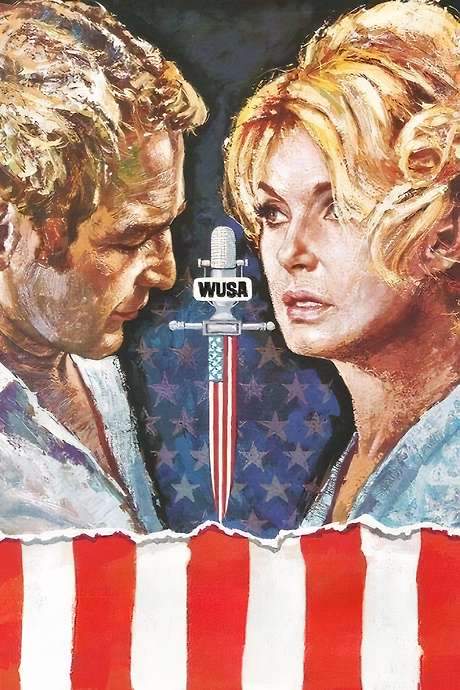
WUSA (1970) movie poster

Plot Summary

WUSA (1970) Plot Summary Explained

Release, runtime and language
1970 · 115 mins · English
Directed by
Stuart Rosenberg
Starring
Pat Hingle, Paul Newman, Cloris Leachman, Joanne Woodward, Bruce Cabot, Laurence Harvey

Love it or leave it. Rheinhardt, a cynical drifter, becomes an on‑air announcer for the right‑wing New Orleans station WUSA. Though he parrots the station’s reactionary editorials without agreeing, his detachment is shaken by his friend Geraldine and by Rainey, a troubled idealist neighbor who uncovers the station’s hidden, sinister agenda. As events spiral, Rheinhardt is forced to choose a side.

On this page (6)
  1. 1 Where to watch
  2. 2 What happens: full plot
  3. 3 Plot questions answered
  4. 4 Movie threads
  5. 5 Movies like WUSA
  6. 6 Every angle

Where to watch

Where to Watch WUSA (1970)

Where can you watch WUSA? Stream, rent or buy it in the US, including on Amazon Video, Apple TV Store and Fandango At Home: current JustWatch availability with up-to-date prices.

Streaming availability powered by JustWatch

Full plot summary · contains spoilers

What Happens in WUSA: Full Plot Summary

The whole story of WUSA (1970) explained, from the opening scene to the final frame: every key event, every twist and what it all adds up to. Read it as a quick recap before the sequel, to check a scene you missed, or to finally understand what really happened.

A drifter named Rheinhardt, Paul Newman, arrives in New Orleans and quickly scans a shelter, where he discovers his old acquaintance Farley, Laurence Harvey, running a scam as a preacher and owing him money.

Seeing a familiar name on a shelter, he encounters Farley, Laurence Harvey, who is still deep in his con, and Rheinhardt takes note of the tiny debt he’s owed and the uneasy balance between old grudges and new opportunites.

Rheinhardt goes to a bar, where he sees a woman named Geraldine, Joanne Woodward, threatened by a pimp who misreads her as soliciting on his turf.

Rheinhardt and Geraldine move in together, living in cheap housing surrounded by hippies. He gets a job at a conservative talk radio station called WUSA. The owner, Bingamon, Pat Hingle, is a white supremacist who uses the station to spread propaganda, with the constant refrain that something is wrong in the country and that things were better in the past.

Rheinhardt reads the station's reactionary editorials while he socializes with hippies who detest it. One of his neighbors is an earnest man named Rainey, Anthony Perkins, whose job is to survey welfare recipients. Rainey relies on a wealthy man named Clotho, Moses Gunn, to guide him to beneficiaries. Clotho introduces Rainey to several people who are scamming the welfare system.

Rainey eventually discovers that Clotho is working for Bingamon, making sure that Rainey's survey finds rampant fraud. WUSA uses that fraud as content for their editorials, feeding the hate-filled atmosphere that the station helps cultivate. The more Rainey learns, the more horrified he becomes, and when Bingamon hosts a hate rally, Rainey tries to assassinate him but shoots and kills another man instead. During the ensuing chaos, Rainey attempts to flee with his gun, but the crowd beats him to death.

Rheinhardt is ordered to the lectern to calm the crowd, but he makes a speech that only adds to the din. As Geraldine flees the rally, she is arrested and found with marijuana. Threatened with years in jail for felony possession, she hangs herself in a cell. Rheinhardt visits her grave before leaving town as cynical as he was when he arrived.

Last updated: October 09, 2025 at 11:12

Was this helpful?

Plot questions answered

WUSA Plot Explained: Your Questions Answered

The questions people ask most about WUSA (1970): what happens in the confusing scenes, why the characters do what they do, the twists, hidden details and what the ending means. Each answer contains spoilers.

Q1

Why does Rheinhardt accept a job at a radio station he clearly despises?

Rheinhardt is a cynical drifter who takes the job purely for financial survival and practical convenience. He needs money and a place to stay, and the job at WUSA offers steady pay with minimal commitment. He rationalizes that reading scripts he doesn't believe in is harmless, he's just a voice, not the message. This detachment is his defense mechanism: by never committing emotionally or intellectually, he avoids responsibility for the consequences of the station's propaganda.

  • Rheinhardt job WUSA motivation cynical drifter
Q2

How does Bingamon manipulate welfare fraud through Clotho?

Clotho appears to be an independent wealthy man guiding Rainey to welfare beneficiaries, but he's actually working for Bingamon. He deliberately steers Rainey to encounter people who are exploiting the welfare system, manufacturing evidence of widespread fraud. Bingamon then uses this curated data on WUSA to fuel his editorial attacks against welfare recipients and push his white supremacist agenda. The entire fraud narrative is orchestrated to provide content for the station's hate-filled programming.

  • Bingamon Clotho conspiracy welfare fraud manipulation
Q3

What drives Rainey to attempt assassinating Bingamon at the rally?

Rainey is an earnest idealist who genuinely wants to help welfare recipients. When he discovers that Clotho has been manipulating him to manufacture fraud evidence for Bingamon's propaganda machine, he realizes he's been complicit in hurting the very people he wanted to protect. The horror of this betrayal, combined with witnessing Bingamon host a hate rally promoting racism and violence, pushes Rainey to violent action. He sees assassination as the only way to stop a man he now recognizes as genuinely dangerous.

Foreshadowing: Rainey relies on Clotho to guide him to beneficiaries, establishing trust before the betrayal is revealed.

  • Rainey assassination Bingamon motive betrayal rally
Q4

Why does Geraldine commit suicide after being arrested at the rally?

Geraldine flees the chaotic rally but is arrested and found with marijuana. Facing felony possession charges that could land her in prison for years, she sees no way out of her desperate situation. The film suggests she feels trapped, not just by the legal threat but by the broader hopelessness of her circumstances. The combination of fear, desperation, and feeling cornered leads her to hang herself in her jail cell.

  • Geraldine suicide arrest marijuana jail rally
Q5

Why does the crowd kill Rainey after he shoots the wrong person?

Rainey attempts to assassinate Bingamon but shoots and kills another man instead, ironically, someone who may have been a random bystander or even a supporter of the rally. The crowd, already inflamed by Bingamon's hate-filled rhetoric and the chaos of the moment, turns violent. In the ensuing panic, they viciously beat Rainey to death as he tries to flee with his weapon. His failed assassination and the crowd's violent response symbolize how the hatred Bingamon cultivates ultimately destroys even those who try to fight it.

Foreshadowing: The rally is designed to inflame the crowd and amplify bigoted rhetoric, making violence inevitable.

  • Rainey killed crowd violence assassination rally
Q6

What happens when Rheinhardt is ordered to speak at the rally?

Bingamon orders Rheinhardt to the lectern to calm the crowd after the shooting chaos erupts. Instead of delivering a message of peace, Rheinhardt is so detached and disconnected from the situation that his speech is incoherent and ineffective, he simply adds to the noise and anger rather than quelling it. This moment exposes his fundamental powerlessness: even when given the chance to make a positive difference, his years of cynical detachment have left him incapable of meaningful action.

Foreshadowing: Rheinhardt has been reading the station's reactionary editorials while socializing with hippie neighbors who detest them, showing his habitual disengagement.

  • Rheinhardt speech rally failure powerless
Q7

Why does Rheinhardt leave town unchanged after everything he witnessed?

Rheinhardt visits Geraldine's grave and then departs New Orleans exactly as cynical and detached as when he arrived. The film deliberately presents this as a tragic stagnation, he has witnessed assassination, mob violence, the suicide of someone he loved, and a massive conspiracy to manipulate public opinion, yet none of it breaks through his protective numbness. His unchanged state is the film's bleak commentary: some people are incapable of moral awakening, and the systems of corruption continue unimpeded because of such detachment.

  • Rheinhardt unchanged ending cynicism departure
Q8

What is WUSA's hidden agenda beyond conservative talk radio?

WUSA is not merely a right-wing radio station, it's a propaganda machine run by white supremacist owner Bingamon. The station uses nostalgia-filled editorials about the country being corrupt and things being better in the past to cultivate fear and resentment. More sinisterly, it manufactures evidence of welfare fraud through Clotho's manipulation of Rainey, then broadcasts this fabricated data to justify its racist agenda. The station's real purpose is to spread white supremacist ideology and inflame racial tensions for political gain.

Foreshadowing: The station's constant refrain is that something is wrong in the country and things were better in the past, establishing the ideological foundation for the deeper conspiracy.

  • WUSA station agenda propaganda white supremacist conspiracy
Q9

What is the nature of Rheinhardt and Geraldine's relationship?

Rheinhardt and Geraldine meet when he rescues her from a pimp threatening her in a bar. They move in together into cheap housing surrounded by hippies, forming a domestic partnership built on mutual need rather than passion. Rheinhardt is fundamentally emotionally unavailable, and Geraldine is vulnerable and desperate. Their relationship reflects the film's themes of disconnection and fragility, it's a human connection that cannot survive the hostile environment around them, ultimately ending in tragedy when she's arrested and takes her own life.

  • Rheinhardt Geraldine relationship vulnerable connection
Q10

Who is Farley and what is his role in the story?

Farley is an old acquaintance of Rheinhardt who runs a scam as a preacher at the shelter in New Orleans. When Rheinhardt recognizes him, Farley owes him a small debt, which he partially pays. This encounter establishes the world of con artists and desperate grifters that surrounds Rheinhardt, and it underscores the moral ambiguity of everyone in this environment. Farley represents the petty scams that exist alongside the larger criminal enterprise of Bingamon's station, small-time deception in a world dominated by systemic corruption.

  • Farley preacher scam shelter debt con artist

Movie threads

More Movies Like WUSA, by Mood & Story

Curated lists built around what makes WUSA tick: the same mood, the same kind of story or the same emotional payoff. Each list explains why these movies belong together.

Movies about disillusioned idealists like in WUSA

Stories where hopeful characters are ground down by a corrupt and oppressive world. If you liked the grim exploration of idealism clashing with cynicism in WUSA, discover more movies where hopeful characters are crushed by corrupt systems. These similar political dramas and human rights stories feature heavy emotional weight and bleak endings.

  • disillusioned
  • grim
  • pessimistic
  • tense
  • oppressive
  • anxious
  • Tone: dark, bleak, pessimistic
  • Pacing: steady, methodical
Why these movies?

The story pattern: Narratives in this thread typically follow a character who begins with a sense of hope or moral purpose. As they engage with a corrupt institution, political machine, or cynical individual, their beliefs are systematically challenged and broken. The story arc is a downward spiral, often culminating in personal tragedy or a complete loss of faith.

Why they belong together: These films are grouped by their central thematic conflict—the destruction of idealism by cynicism. They share a dark, heavy tone, a steady pacing that builds towards inevitable despair, and a focus on the high-stakes emotional toll of confronting systemic corruption.


Movies about a cynic's awakening like in WUSA

A detached protagonist is forced to confront a moral crisis they tried to ignore. Find movies similar to WUSA that follow a cynical protagonist forced into a moral choice. These riveting political dramas explore themes of propaganda and individual responsibility, featuring tense pacing and heavy emotional consequences for characters who can no longer stay neutral.

  • cynical
  • tense
  • grim
  • consequential
  • morally complex
  • oppressive
  • Tone: dark, tense, grim
  • Pacing: steady build, consequential
Why these movies?

The story pattern: The narrative pattern follows a character who prioritizes self-preservation and disengagement. Their involvement in a morally dubious enterprise—like a propaganda station or criminal operation—is purely transactional. However, through their interactions with more idealistic characters or direct exposure to the consequences of their actions, their cynical armor cracks, leading to a climactic, often costly, choice.

Why they belong together: These movies share a specific character arc where a jaded individual undergoes a reluctant moral awakening. They are united by a tense, oppressive mood, a steady pacing that builds pressure on the protagonist, and a focus on the theme of moral compromise versus individual responsibility.

If you liked this

Movies Like WUSA

Similar movies to WUSA: the same genre, themes or kind of story. Each one comes with its own plot summary, timeline and ending explained.

Browse all movie summaries

Every angle

WUSA (1970) Explained: Plot, Timeline & Characters

Everything about WUSA in one place: what happens in the plot summary, the timeline in chronological order, the characters and meaning and a spoiler-free summary. What's After the Movie adds the cast, box office and post-credit scenes.

Coming soon on iOS and Android

The Plot Explained Movie Summary App

Plot summaries, endings explained and timelines on your phone. Catch up on any movie in minutes, save your favorites and never miss a twist again.

Be the first to know when we launch. Your email stays private, always.

Learn more about the app