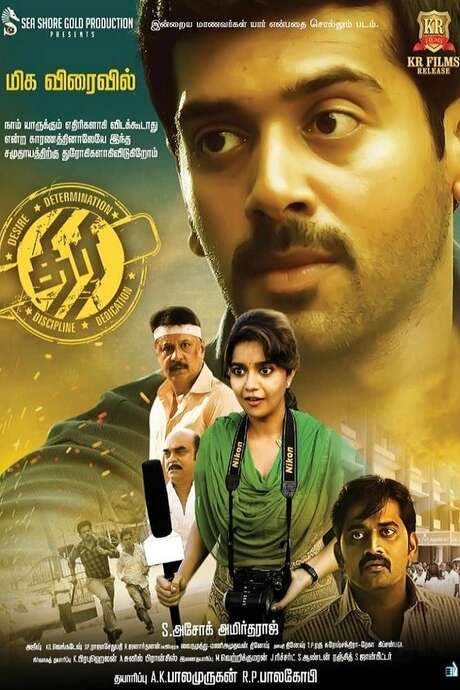
In 1970, Telleru Lake was one of the largest freshwater lakes in India and a lifeline for fishing and farming. For over forty years, fishing farms built on the lake, largely owned by Minister Vishakha Vani, Ramya Krishnan, have polluted the waters and strained the ecosystem that so many communities depend on. The story then shifts to Panja Abhiram, Sai Dharam Tej, a bright but skeptical youth from Eluru who believes in honesty and truth, even as he recoils from the corruption he sees within his own family. His father, Panja Dashrath, Jagapathi Babu, is a government official whose involvement in election rigging drives a wedge between father and son. With top marks in his exams, Abhiram earns a place at MIT, but when his father’s actions collide with the political machine, he decides to go deeper into the system to seek real change.
On his journey, Abhiram encounters Myra Hansen, Aishwarya Rajesh, an NRI who is searching for her missing brother Varun Hansen, a man whose work intersects with a local goon named Guna. The power struggle intensifies as Vani, the political heavyweight, forms a new party and achieves a sweeping victory, elevating her son Indukuri Vishnu Vardan to the position of Chief Minister of Andhra Pradesh and earning a reputation as the ultimate kingmaker. Amidst this political chessboard, Abhiram crosses paths with Mani, Rahul Ramakrishna, an auto driver, and his father, both drawn into the fight for justice against the elite.
Tragedy strikes when Varun Hansen is found dead, and the authorities offer little support to locate his body. After Abhiram clears the UPSC mains with stellar results, he heads to Delhi for the interview. On a train, he confronts distressing PTSD from a childhood incident and witnesses a vision of Mani being killed by Guna, whose actions are orchestrated under Vani’s orders. Despite this, Abhiram proceeds with the interview but shocks the interviewer with his critique of entrenched mentalities and eventually tops the exam. He soon discovers a troubling truth: the UPSC board selected him as an experimental tool to become the supreme authority of the district, insulated from political interference.
With newfound power, Abhiram pursues Guna, and in the process, he kills him. Yet at the same moment, he finds Myra unconscious; she has been brutally raped, and the assailant nearly claimed her life. He rushes her to the hospital and learns that Varun’s children have been killed, their bodies never found. Fueled by rage, Abhiram releases media footage that exposes how the system enabled such crimes. A crucial flashback reveals Varun’s work as a neurological doctor and how his wife, Radhika, died after consuming fish from Telleru Lake. Varun’s research makes it clear that the lake’s contamination is tied to Vani’s fish farms, a revelation that triggers a cascade of accountability.
Armed with evidence, Abhiram suspends his father and the health officer for falsifying reports about the lake. He goes to Vani to demand the removal of the farms and the ongoing construction on the lake. Vani responds with a personal Story: she explains that she was once a daughter of a socialist who believed in reform, but the Emergency era took away her loved ones and forced her to adapt to the system. She sides with the fishermen and proclaims that they will all be stakeholders in the farms, turning public opinion against Abhiram. In a bid to rally both sides, Abhiram calls a meeting; the event quickly spirals into violence, leaving multiple injuries and deaths. The UPSC board suspends him and launches a formal inquiry, while Abhiram learns that a central party had used him as a tool to manipulate Vani’s position.
As pressure mounts, Abhiram’s father faces trouble from the villagers; Abhiram intervenes to save him, and flashbacks reveal that Dasarath was an honest officer who was repeatedly transferred—an ordeal that ultimately pushed him toward corruption as a survival mechanism. The pair—Abhiram and his father—team up to present the full evidence in court. Justice Narasimham, navigating immense political pressure, orders the removal of Vani, Vijay Kumar, and Dasarath from their posts and mandates the demolition of all lake construction. The victory is bittersweet: Vani ends up hospitalized, and she tells Abhiram that, despite his efforts, the system is not easily changed.
A few days later, new construction on the lake resumes, and the villagers declare that their caste now deserves to rule. Abhiram receives support from Mani’s father, but tragedy strikes when he is ambushed and killed by Mani’s father and his gang who want the lake for themselves. In a final act of betrayal and remorse, Mani’s father apologizes for the violence, recognizing the corrosive cycle he has entered. The film closes on a somber note: Vani, overwhelmed by the political machine, takes her own life, and the two Telugu states are left reeling from the cost of power, with a closing montage honoring the real-life officers who risk everything to do their duties for society. For those who watch closely, the tale remains a stark meditation on how authority, loyalty, and justice intersect—and how easily institutions can bend, corrode, or crumble under pressure. The movie features a broad ensemble, including Boxer Dina in a supporting role, adding to the tapestry of characters who inhabit this charged landscape.




-wCh_qALMCX3pcw.jpg)