










Plot Explained Spoilers guaranteed!
Plot Explained

Browse by genre

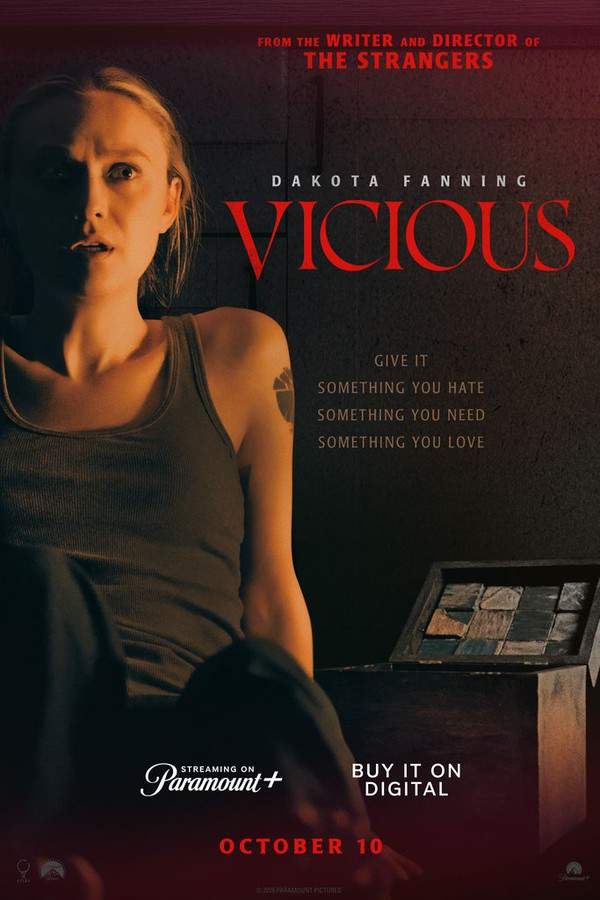
Vicious (2025) movie poster

Ending Explained

Vicious (2025) Ending Explained – Final Scene & Meaning

Release, runtime and language
2025 · 1 h 38 m · English
Echo score 61
JustWatch #2,459 8
Directed by
Bryan Bertino
Starring
Emily Mitchell, Dakota Fanning, Kathryn Hunter, Michael Abbott Jr., Mary McCormack, Rachel Blanchard

When Polly (Dakota Fanning) receives a mysterious box with a note to place three items—something she needs, hates and loves—the ritual quickly descends into a waking nightmare. Reality warps, memory betrays, and she faces a series of impossible choices, forced to confront the darkness inside her before it consumes everything she knows.

On this page (6)
  1. 1 Where to watch
  2. 2 What happens at the end
  3. 3 Final events in order
  4. 4 Ending questions answered
  5. 5 Movie threads
  6. 6 Every angle

Where to watch

Where to Watch Vicious (2025)

Where can you watch Vicious? Stream, rent or buy it in the US, including on fuboTV, Paramount Plus Essential and Paramount Plus Premium: current JustWatch availability with up-to-date prices.

Streaming availability powered by JustWatch

Ending explained · contains spoilers

What Happens at the End of Vicious?

How Vicious (2025) ends, what the final scene means, which earlier moments set it up and how to read the ending if the film leaves it open. The full ending explained, with every spoiler.

Polly’s night of terror ends when the cursed black box finally exhausts its power—not by the sacrifices it demanded, but by Polly’s refusal to surrender her loved ones. After the mysterious old woman leaves the box and an hour‑glass that begins to count down, Polly is told she must place something she hates, something she needs, and something she loves inside it.

She first tries to offer a pack of cigarettes, but the box rejects it; she cannot truly hate the habit she wants to quit. She then coughs up a key to a drawer of photos and a crucifix that belonged to her dead father—objects that embody the grief she has never allowed herself to confront. The box accepts these, forcing Polly to cut off a finger and a toe as “something she needs,” a literal and brutal act meant to make the sand stop.

When the spirits demand “something she loves,” they conjure a nightmarish vision of her sister Lainie and niece Aly dead, pressing Polly to cut them from her life. Polly resists, opting instead to offer a single strand of Aly’s hair. The sand keeps flowing, and the visions grow more deceptive, showing her that even the blood she bleeds into the box will not end the countdown.

Realizing the curse is less about the offerings and more about the box’s compulsive need to be passed on, Polly tracks down a stranger, Tara, and tries to hand the box over. Tara refuses, claiming she never saw Polly—another manipulation that shows the box can rewrite memory. The box, however, snaps back to Polly’s house; the old woman who first delivered it is now dying, having lost an eye and attempting to kill Polly before she can be taken. In her dying breath she admits the box chooses its victims, seeking out broken people whose weaknesses it can exploit.

Polly survives the old woman’s attack, and when the film’s final sequence reveals her sister’s home, Lainie and Aly are alive, the house only slightly untidy—proof that some of the night’s horrors were hallucinations. Polly bears a scar on her face, a missing finger and toe, physical reminders that the sacrifices were real even if the timeline was imagined. The hour‑glass continues to tick, and the box ultimately ends up with Tara, suggesting the cycle will begin anew.

In the end, Polly’s triumph lies not in halting the timer but in refusing to become the box’s pawn. She chooses to live with the pain and the marks, confronting her own failures and reclaiming agency over a curse that wanted her to betray everything she values. The film closes on her lighting a cigarette, a phone vibrating with an unseen call she deliberately ignores—an open‑ended reminder that the horror may linger, but she will no longer submit to it.

Last updated: December 10, 2025 at 15:57

Was this helpful?

The last 4 events

How Vicious Ends: The Final Events in Order

The last events of Vicious (2025) in chronological order, the run-up to the ending explained above. The complete timeline has all 14 events, scene by scene.

Open the full timeline
  1. Polly passes the box to Tara

    Realizing she must transfer the box to someone else, Polly visits Tara, Lainie's neighbor, and forcibly places the box in her hands. The exchange marks a new phase where the box continues its cycle of possession through others. Polly returns home with a sense of dread and relief mixed with fear.

    Where
    Tara's house
  2. Polly is attacked by the initial giver and fights back

    Returning home, Polly is attacked by the old woman who originally gave her the box, and she ultimately kills her. The killer muse about the box's evil nature, underscoring the artifact's corrupting power. The confrontation confirms that escaping the cycle is increasingly unlikely.

    Where
    Polly's house
  3. The box is gone, Tara still alive

    Polly emerges from her house to find the box missing and Tara still living. The apparent removal of the box offers a momentary sense of relief, yet the threat remains unresolved. Polly's relationships and trust are left cracked and unsettled.

    Where
    Polly's house
  4. Reunion with Lainie and Aly; Tara's shocking truth revealed

    Polly reunites with Lainie and Aly, but then checks on Tara, who denies knowing Polly or the box. It is revealed that Tara has killed her own parents and severed multiple fingers to please the box. The cycle of sacrifice spreads as the box's true reach becomes clear.

    Where
    Tara's house

Ending questions answered

Vicious Ending: Your Questions Answered

The questions people ask most about the ending of Vicious (2025): what the final scene means, how the twist works, what happens to each character and how to read the ending. Each answer contains spoilers.

Q1

Why does the box reject Polly's cigarettes as something she hates?

The box rejects the cigarettes because Polly cannot genuinely hate them, she only wants to quit the habit. The curse requires true hatred, not a superficial desire to change. This forces Polly to confront what she actually despises about herself and her life, rather than offering superficial sacrifices.

  • cigarettes
  • hate
  • offering
  • curse rejection
Q2

What do the photos and crucifix symbolize in the ritual?

The photos and crucifix belong to Polly's dead father. They represent the unresolved grief she has carried and never confronted. By coughing up these objects, the box forces her to face the emotional pain she has been avoiding, making the grief itself the sacrifice rather than physical objects.

  • father
  • crucifix
  • photos
  • grief
  • sacrifice
Q3

Why does Polly have to cut off a finger and toe?

The box demands a finger and toe as 'something she needs' to stop the hourglass sand. This brutal physical sacrifice is the box's way of taking something essential from Polly, her wholeness and mobility. The act is meant to show she is willing to lose part of herself to survive.

  • finger
  • toe
  • sacrifice
  • needs
  • mutilation
Q4

Are Polly's sister and niece alive at the end?

Yes, Lainie and Aly are alive in the final scene. The house is only slightly untidy, showing that the horrifying visions of their deaths were manipulations created by the box. However, Polly retains real scars, her missing finger and toe, proving that at least some of the night's events were not hallucinations.

  • sister
  • niece
  • alive
  • survival
  • hallucination
Q5

What happens to Tara and the box at the end?

Tara ends up with the cursed box. When Polly tries to pass it to her, Tara initially refuses and claims she never saw Polly, the box rewrites memories. However, the box ultimately returns to Polly's house, and in the final moments, it is shown with Tara, suggesting the curse has been successfully transferred to a new victim.

  • tara
  • new victim
  • curse transfer
  • cycle
Q6

Why does the old woman try to kill Polly at the end?

The old woman who delivered the box is dying by the time she attacks Polly. She has lost an eye and is barely alive. In her dying breath, she reveals that the box 'chooses its victims' and seeks out broken people. She likely attacked Polly to either complete the curse or prevent Polly from escaping its influence.

  • old woman
  • attack
  • dying
  • curse victim
Q7

Does Polly actually defeat the curse?

Polly does not stop the curse, she merely refuses to let it consume her. She survives by choosing not to sacrifice her loved ones and accepts her physical scars as the price of resistance. The box moves to Tara, so the cycle of violence continues, but Polly has reclaimed her agency by refusing to become the box's pawn.

  • curse
  • defeat
  • resistance
  • agency
  • survival
Q8

What does the final scene mean with the phone vibrating?

The final scene shows Polly lighting a cigarette while a phone vibrates with an unseen call she ignores. This symbolizes her refusal to submit to the curse's manipulations anymore. The open ending suggests the horror may linger, but Polly has chosen to face life on her own terms rather than answer the box's demands.

  • phone call
  • cigarette
  • refusal
  • open ending
Q9

What does it mean that the box chooses its victims?

The old woman reveals the box targets 'broken people whose weaknesses it can exploit.' This means the curse is not random, it seeks out individuals vulnerable to manipulation, using their personal flaws and traumas against them. Polly was chosen because of her unresolved grief and guilt.

  • victims
  • weakness
  • exploitation
  • selection
Q10

Why are some parts of the night real and others hallucinated?

The box appears to warp reality, making it impossible to distinguish what is real. Some events, the physical sacrifices, the old woman's attack, left real scars on Polly. Other events, the visions of killing her family, were likely manipulations. The ambiguity is intentional, reflecting the box's power to blur the line between reality and nightmare.

  • reality
  • hallucination
  • war
  • scar
  • confusion

Movie threads

More Movies Like Vicious, by Mood & Story

Curated lists built around what makes Vicious tick: the same mood, the same kind of story or the same emotional payoff. Each list explains why these movies belong together.

Supernatural horror movies with deadly rituals like Vicious

Characters facing a cruel supernatural entity with strict, brutal rules. If you're looking for movies like Vicious that feature intense supernatural trials, you've come to the right place. This list includes horror films where characters are trapped in a ritual or curse with brutal, non-negotiable rules. These movies share a similar feel of high-stakes dread and moral torment.

  • anxious
  • desperate
  • unsettling
  • nightmarish
  • high-stakes
  • brutal
  • Tone: dark, desperate
  • Pacing: fast, relentless
Why these movies?

The story pattern: The narrative pattern involves the introduction of a supernatural curse or entity that presents a clear, brutal set of rules. The protagonist is then thrust into a sequence of escalating trials, often involving terrible sacrifices, forcing them to confront their deepest fears and moral boundaries under extreme duress. The story is propelled by a constant race against time and the harsh logic of the supernatural force.

Why they belong together: These movies are grouped because they all focus on the terrifying experience of being subjected to a merciless supernatural system. They share a high level of intensity, a dark tone, and a plot-driven structure where survival hinges on completing a series of horrific tasks, creating a consistently tense and desperate viewing experience.

Psychological horror movies about facing inner darkness like Vicious

A descent into paranoia where reality blurs and the enemy is within. For viewers who liked the psychological depth of Vicious, this selection focuses on horror films about confronting inner demons. These movies explore themes of paranoia, fractured reality, and the struggle against a darkness that may come from within the protagonist, offering a similarly heavy and unsettling experience.

  • paranoid
  • claustrophobic
  • unsettling
  • psychological
  • desperate
  • nightmarish
  • Tone: dark, paranoid
  • Pacing: variable, often building
Why these movies?

The story pattern: The narrative journey is an inward one, charting a character's psychological collapse. The conflict arises from a confrontation with repressed memories, personal guilt, or a latent malevolence inside them. The plot often involves a distorted perception of reality, making the protagonist question what is real and who the true antagonist is, leading to a profound internal struggle.

Why they belong together: These films are united by their focus on psychological horror over purely physical threats. They share a heavy emotional weight, a dark and paranoid tone, and a common theme of the protagonist being forced to grapple with their own mind and morality. The experience is defined by a sense of claustrophobia and deep unease.

Every angle

Vicious (2025) Explained: Plot, Ending, Timeline & Characters

Everything about Vicious in one place: what happens in the plot summary, the timeline in chronological order, the characters and meaning, the ending explained and a spoiler-free summary. What's After the Movie adds the cast, box office and post-credit scenes.

Coming soon on iOS and Android

The Plot Explained Movie Summary App

Plot summaries, endings explained and timelines on your phone. Catch up on any movie in minutes, save your favorites and never miss a twist again.

Be the first to know when we launch. Your email stays private, always.

Learn more about the app