Plot Explained Spoilers guaranteed!
Plot Explained

Browse by genre

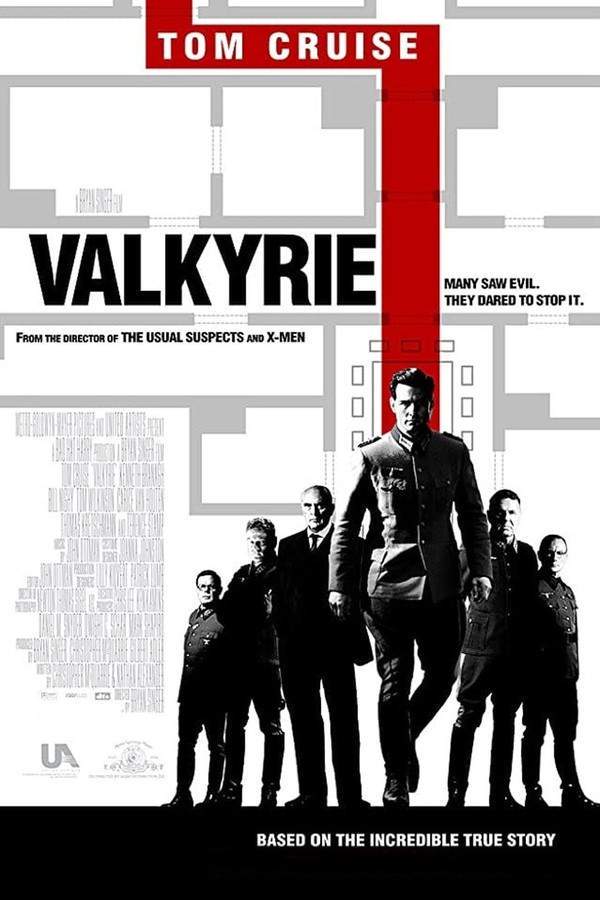
Valkyrie (2008) movie poster

Plot Summary

Valkyrie (2008) Plot Summary Explained

Release, runtime and language
2008 · 115 min · English
Loading streaming availability…
Directed by
Bryan Singer
Starring
Carice van Houten, Tom Cruise, Bill Nighy
Budget
$75M

During World War II, Colonel Claus von Stauffenberg struggles with the horrific realities of Hitler's rule and the direction Germany is taking. Deeply patriotic, he becomes involved with a group of conspirators planning to overthrow the Nazi regime. As time dwindles for Europe, von Stauffenberg takes a pivotal role in a dangerous plot to assassinate Hitler, leading to a tense and dramatic confrontation with immense consequences.

On this page (6)
  1. 1 Where to watch
  2. 2 What happens: full plot
  3. 3 Plot questions answered
  4. 4 Movie threads
  5. 5 Movies like Valkyrie
  6. 6 Every angle
Loading streaming availability…

Full plot summary · contains spoilers

What Happens in Valkyrie: Full Plot Summary

The whole story of Valkyrie (2008) explained, from the opening scene to the final frame: every key event, every twist and what it all adds up to. Read it as a quick recap before the sequel, to check a scene you missed, or to finally understand what really happened.

During the tumultuous period of World War II, Wehrmacht Colonel Claus Von Stauffenberg, portrayed by Tom Cruise, finds himself gravely injured during an RAF air raid in Tunisia, resulting in the loss of a hand and an eye. After being evacuated back home to Nazi Germany, things begin to escalate as Major General Henning Von Tresckow (played by Branagh) devises a desperate plan to eliminate Adolf Hitler. He attempts to smuggle a bomb onto the Führer's personal aircraft, but unfortunately, the bomb fails to detonate, leading Tresckow to Berlin to recover it safely. In the face of mounting challenges, he orders General Olbricht (portrayed by Bill Nighy) to find a substitute after the Gestapo arrests Major General Hans Oster.

Stauffenberg is then drawn into the German Resistance, where Olbricht introduces him to a clandestine committee that has attempted to assassinate Hitler in the past. Among the participants are General Ludwig Beck, Dr. Carl Goerdeler, and Erwin Von Witzleben. To Stauffenberg's shock, he learns that there are no contingency plans for what follows should Hitler be eliminated.

Amidst an air raid over Berlin, an inspiration strikes him — utilize Operation Valkyrie, a protocol designed to mobilize the Reserve Army to ensure order during a national emergency. The conspirators cleverly adjust the operation's orders to enable them to dismantle the Nazi regime after the assassination of Hitler. Recognizing that General Friedrich Fromm, the leader of the Reserve Army, holds the key to initiate this operation, they extend an invitation for him to lead the Wehrmacht in a post-Nazi Germany. However, Fromm is reluctant to directly partake in the plot.

To solidify their plans, they realize that the rewritten Operation Valkyrie documents must be signed by Hitler himself. Stauffenberg visits the Führer at his Berghof estate, where he is surrounded by prominent figures such as Dr. Joseph Goebbels, Wilhelm Keitel, Heinrich Himmler, Hermann Göring, and Albert Speer. During this meeting, Hitler praises Stauffenberg for his bravery in North Africa and unwittingly signs the modified orders, naively believing they are "for the best."

At the insistence of Goerdeler, Stauffenberg receives orders to assassinate both Hitler and Himmler at the Wolf's Lair, Hitler's command bunker. In a meeting prior to the plot, Colonel Mertz Von Quirnheim provides instructions regarding the bomb detonation. Stauffenberg also secures the cooperation of General Fellgiebel, who oversees all communications at the Lair, to cut off communication lines post-explosion.

On July 15, 1944, Stauffenberg attends a strategic assembly at the Wolf's Lair, carrying a briefcase bomb. However, he soon learns that Himmler is not present, which delays his opportunity to proceed with the assassination. As the meeting concludes, he faces bureaucratic hesitation from the committee; the turmoil within his ranks becomes evident as Olbricht mobilizes the Reserve Army without Fromm's knowledge, under the pretense of training exercises.

Despite securing his own escape and the safety of the bomb, Stauffenberg is confronted by Fromm, who warns him against taking further control over the army, threatening arrest. Stauffenberg, exasperated by the committee's procrastination, vehemently criticizes Goerdeler, who is slated for chancellorship after the coup.

On July 20, 1944, Stauffenberg returns to the Wolf's Lair with Lieutenant Haeften. To his dismay, he realizes that the meeting is being conducted in a summer barrack with open windows, leaving the bomb's potential destructiveness compromised. He meticulously positions the briefcase close to Hitler before stepping outside to wait for the explosion. However, an officer inadvertently shifts the briefcase behind a table leg, drastically reducing the blast's damage. Convinced that Hitler has been killed, Stauffenberg anxiously flees the scene.

As Stauffenberg heads back to Berlin, chaos ensues as reports surface that Hitler might have survived. Olbricht hesitates to mobilize the Reserve Army, fearing repercussions should Hitler still be alive. Unbeknownst to him, Mertz forges his orders to proceed. With Operation Valkyrie initiated, Stauffenberg and his allies command the arrest of key Nazi figures, but confusion abounds as lower-ranking officers become uncertain of their allegiance in the midst of rising suspicions regarding Hitler's fate. The General's refusal to join the plotters culminates in his detention.

As confusion deepens, Major Otto Ernst Remer mistakenly confirms Hitler's survival during a captivating phone call with Goebbels, leading to their recognition that they have contributed to a coup rather than quelling it. The plotters quickly find themselves besieged in the Bendlerblock as the headquarters escapes and the resistance leaders are captured. In a desperate attempt for self-preservation, General Fromm hastily organizes a court martial against the conspirators, defying Hitler's explicit orders for them to remain alive. Ultimately, the ringleaders meet grim fates: Colonel Stauffenberg's final words echo through history as he cries out, "Long live sacred Germany!" before facing a firing squad.

The concluding moments reveal that the conspiracy of July 20, 1944, marked the final of fifteen documented assassination attempts on Hitler orchestrated by Germans. Interestingly, the narrative also mentions Hitler's demise nine months later and the survival of Countess Nina Von Stauffenberg and her children through those dark times. A poignant dedication at the Memorial to the German Resistance serves as a reminder: You did not bear the shame. You resisted. You bestowed an eternally vigilant symbol of change by sacrificing your impassioned lives for freedom, justice, and honor.
Last updated: November 02, 2024 at 13:11

Was this helpful?

Plot questions answered

Valkyrie Plot Explained: Your Questions Answered

The questions people ask most about Valkyrie (2008): what happens in the confusing scenes, why the characters do what they do, the twists, hidden details and what the ending means. Each answer contains spoilers.

Q1

Why did Claus von Stauffenberg join the plot against Hitler?

Stauffenberg was deeply affected by his experiences during the war, particularly after being seriously injured in Tunisia where he lost a hand and an eye. Upon returning to Germany, he witnessed the horrors of Hitler's regime and the direction the country was taking. General Olbricht introduced him to the German Resistance, and he learned for the first time that no contingency plans existed for after Hitler's removal. This revelation, combined with his growing moral opposition to the Nazi regime, motivated him to join the conspiracy.

Foreshadowing: Earlier scenes show Stauffenberg's injury in Tunisia, which marks his transformation from a loyal soldier to a resistance member.

  • claus von stauffenberg
  • german resistance
  • hitler
  • motivation
  • conspiracy
Q2

How did Operation Valkyrie become part of the coup plan?

Operation Valkyrie was originally a protocol designed to mobilize the Reserve Army during a national emergency to maintain order. Stauffenberg realized it could be manipulated to give the conspirators legal authority to take control after Hitler's assassination. The group rewrote the operation's orders to enable them to arrest Nazi officials and seize power once Hitler was dead. This clever repurposing of a legitimate military protocol was central to their strategy.

Foreshadowing: The idea strikes Stauffenberg during an air raid over Berlin, showing how desperation can lead to innovative solutions.

  • operation valkyrie
  • reserve army
  • coup
  • conspiracy
  • contingency plan
Q3

Why did Hitler sign the modified Valkyrie documents?

Hitler signed the modified Operation Valkyrie orders during a meeting at his Berghof estate because Stauffenberg presented them as standard military documents. Hitler believed Stauffenberg was a loyal soldier, praising him for his bravery in North Africa. Unbeknownst to Hitler, the documents were actually rewritten orders that would enable the conspirators to seize power after his assassination. Hitler's arrogance and trust in his officers led him to sign without question.

Foreshadowing: Stauffenberg's prior meeting with Goerdeler establishes that they needed Hitler's signature to make the plan legal.

  • hitler signature
  • berghof
  • forged orders
  • conspiracy
Q4

Why did the July 15 assassination attempt not happen?

On July 15, 1944, Stauffenberg arrived at the Wolf's Lair with a briefcase bomb, but learned that Heinrich Himmler was not present at the meeting. The original plan required assassinating both Hitler and Himmler together. Without Himmler present, Stauffenberg faced a dilemma - killing Hitler without eliminating Himmler would leave the powerful SS leader alive to retaliate. He chose to abort the mission and wait for both targets to be present.

Foreshadowing: Earlier instructions from Colonel Mertz von Quirnheim emphasized the need to eliminate both targets.

  • july 15 1944
  • himmler
  • wolf's lair
  • assassination delay
Q5

Why did the bomb on July 20 fail to kill Hitler?

The July 20, 1944 assassination failed due to several factors. The meeting was held in a wooden summer barrack with open windows, which dispersed the blast. More critically, when Stauffenberg left the briefcase near Hitler, an officer inadvertently moved it behind a table leg, creating a barrier that absorbed much of the explosion's force. These two factors, combined with the bomb's timing mechanism, allowed Hitler to survive despite being close to the device.

Foreshadowing: Stauffenberg's careful positioning of the briefcase suggests he believed the bomb would succeed, making the failure more poignant.

  • july 20 1944
  • briefcase bomb
  • hitler survival
  • wolf's lair
  • explosion
Q6

How did news of Hitler's survival spread so quickly?

After the explosion, conflicting reports emerged about Hitler's fate. General Fellgiebel, responsible for cutting communication lines at the Wolf's Lair, was unable to fully isolate the site. When Major Otto Ernst Remer, a senior officer, received reports of the explosion, he contacted Joseph Goebbels directly to verify Hitler's status. Goebbels put Hitler on the phone with Remer, personally confirming he was alive. This confirmation spread rapidly through military channels and crushed the conspirators' plans.

Foreshadowing: The failure to cut all communication lines was a critical breakdown in the conspirators' coordination.

  • hitler survival
  • major remer
  • goebbels
  • communication
  • confirmation
Q7

Why did Operation Valkyrie fail to achieve its objectives?

Operation Valkyrie failed primarily because Hitler's survival was confirmed before the conspirators could consolidate power. When Remer verified Hitler's alive status through Goebbels, the narrative shifted from a legitimate emergency operation to an obvious coup. Many military officers who had been uncertain immediately turned against the plotters. Additionally, General Fromm, who had been reluctant to join the conspiracy, betrayed the conspirators to save himself by organizing their arrest.

Foreshadowing: Fromm's earlier reluctance to directly participate in the plot foreshadowed his eventual betrayal.

  • operation valkyrie failure
  • fromm
  • coup collapse
  • military support
Q8

Why did General Fromm turn against the conspirators?

General Fromm, commander of the Reserve Army, had been reluctant to directly participate in the conspiracy despite being invited to lead the post-Nazi government. When the plot failed and Hitler's survival was confirmed, Fromm saw an opportunity to save himself. He organized a hasty court martial against the conspirators, defying Hitler's explicit orders that they be kept alive for his own interrogation. By betraying the plotters, Fromm attempted to prove his loyalty to the regime.

Foreshadowing: Earlier in the film, Fromm warns Stauffenberg against taking control of the army, showing his wavering commitment.

  • general fromm
  • betrayal
  • reserve army
  • self-preservation
Q9

What happened to Claus von Stauffenberg after the coup failed?

After the coup collapsed, Stauffenberg was captured at the Bendlerblock headquarters. General Fromm convened a hasty court martial and ordered his execution. Before facing the firing squad, Stauffenberg's final words were "Long live sacred Germany!" - a testament to his conviction that his actions, though failed, were in service to his country and its people.

Foreshadowing: The film's constant tension about discovery foreshadows this inevitable but tragic conclusion.

  • stauffenberg execution
  • firing squad
  • final words
  • bendlerblock
Q10

How many assassination attempts were made on Hitler before July 20?

The July 20, 1944 plot was the last of fifteen documented assassination attempts on Hitler orchestrated by Germans. Previous attempts included Major General Henning von Tresckow's failed bomb plot on Hitler's aircraft, which failed to detonate. The conspiracy represented the culmination of years of resistance efforts within the German military and civilian population.

Foreshadowing: The film opens with Tresckow's failed attempt, establishing this as part of a longer struggle.

  • assassination attempts
  • hitler
  • fifteen attempts
  • resistance history
Q11

Why did the conspirators need to kill both Hitler and Himmler?

The conspirators specifically targeted both Hitler and Himmler because eliminating only one would leave the other dangerously capable of retaliating. Himmler, as head of the SS and Gestapo, possessed immense power and would have used his forces to crush any resistance and exact brutal revenge. Killing both leaders simultaneously was meant to paralyze the Nazi leadership's ability to respond and give the coup a chance to succeed.

Foreshadowing: Goerdeler's insistence that both must be eliminated shows the conspirators understood the stakes.

  • himmler
  • hitler
  • dual assassination
  • ss
  • gestapo target

Movie threads

More Movies Like Valkyrie, by Mood & Story

Curated lists built around what makes Valkyrie tick: the same mood, the same kind of story or the same emotional payoff. Each list explains why these movies belong together.

Tense Political Thrillers Like Valkyrie

Tense, race-against-time plots where characters risk everything to change the world. Find movies similar to Valkyrie that capture the suspense of a high-stakes conspiracy plot. These films often feature desperate attempts to overthrow tyrants, intricate assassination plans, and tense military intrigue, delivering a gripping and urgent viewing experience for fans of historical and political thrillers.

  • tense
  • urgent
  • high-stakes
  • claustrophobic
  • anxious
  • grim
  • Tone: tense, grim, urgent
  • Pacing: steady, methodical build
Why these movies?

The story pattern: Stories in this thread typically follow a group of conspirators as they form a plan, face near-discovery, and race against a ticking clock to execute a daring act that could alter the course of history. The narrative is driven by meticulous planning, escalating stakes, and the ever-present threat of betrayal or failure.

Why they belong together: These films are grouped together because they share a core DNA of tension, moral conflict, and the mechanics of a risky plot. They create a similar viewing experience defined by claustrophobic anxiety, high stakes, and a focus on the courage required to stand against overwhelming power.

Movies About Moral Sacrifice Like Valkyrie

Sobering stories of individuals who sacrifice everything for a moral principle. If you appreciated the heavy emotional weight and tragic heroism in Valkyrie, this section features similar historical dramas. These movies explore themes of patriotism versus tyranny, personal sacrifice for a greater good, and the somber, often sad conclusions that come from standing up against immense evil.

  • grim
  • solemn
  • heavy
  • desperate
  • patriotic
  • tragic
  • Tone: grim, tense, solemn
  • Pacing: steady, character-driven
Why these movies?

The story pattern: The narrative pattern follows a principled individual or group who, confronted with a grave moral injustice, decides to act. Their journey is one of conviction and growing resolve, leading to a climactic confrontation that may end in failure but ultimately serves as a powerful symbol of resistance and human dignity.

Why they belong together: These films are united by their exploration of heavy moral conflict within a historical context, a sober and tense tone, and an ending that is sad yet honorable. They resonate with viewers seeking profound stories about the cost of courage and the complex nature of heroism.

If you liked this

Movies Like Valkyrie

Similar movies to Valkyrie: the same genre, themes or kind of story. Each one comes with its own plot summary, timeline and ending explained.

Browse all movie summaries

Every angle

Valkyrie (2008) Explained: Plot, Timeline & Characters

Everything about Valkyrie in one place: what happens in the plot summary, the timeline in chronological order, the characters and meaning and a spoiler-free summary. What's After the Movie adds the cast, box office and post-credit scenes.

Coming soon on iOS and Android

The Plot Explained Movie Summary App

Plot summaries, endings explained and timelines on your phone. Catch up on any movie in minutes, save your favorites and never miss a twist again.

Be the first to know when we launch. Your email stays private, always.

Learn more about the app