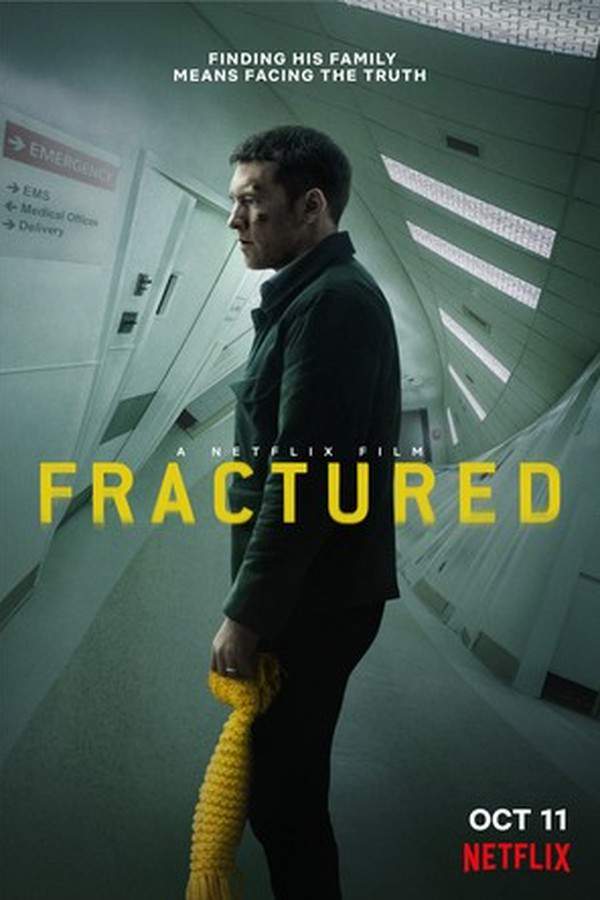
Jack Starks, a Gulf War veteran, barely survives a head wound and returns to Vermont in 1992 with troubling gaps in his memory. While wandering along a remote road, he encounters a struggling woman and her young daughter beside a broken-down truck. A quiet bond forms as the man agrees to help the family, sharing his dog tags with Jackie before continuing on his way. His act of kindness leads to a fateful stop when another driver offers him a ride, but the experience ends with Starks waking up near a dead police officer, wounded and stranded. He claims that someone else was present at the scene, but his amnesia makes him an unreliable witness, and he is ultimately found not guilty by reason of insanity and placed in a psychiatric institution.
Within the hospital, Starks is placed under the care of a psychiatrist and his team. The treatment that follows is brutal and unauthorized: a brutal sequence of injections, restraint in a straitjacket, and confinement inside a morgue-like drawer for sensory deprivation. In this disorienting captivity, Starks discovers something extraordinary—he can slip forward in time. He briefly finds himself in a future where an older Jackie works at a roadside diner and, though she doesn’t recognize him at first, she offers him shelter for a night. During a tense moment in her apartment, he re-encounters his own dog tags and clashes with Jackie, who implores him to leave, convinced he cannot be the person he claims to be. Yet the time shifts continue, allowing him to drift to the future again and again, where he and Jackie navigate the possibility of using this strange ability to alter his fate and possibly rescue his life.
As the new year arrives, a breakthrough comes when a sympathetic doctor, now convinced of Starks’s time-travel experiences, drives him to the childhood home of Jackie and her mother. There, he leaves a letter for Jackie’s mother, warning of a bleak future for Jackie and foretelling that she will be orphaned if left to a dangerous habit. Returning to the hospital, Starks experiences a sudden flashback to the head wound he suffered in the war, loses his footing on the ice, and, with renewed resolve, asks two doctors to place him back into the jacket for one final, decisive voyage.
He awakens in 2007, and the course of Jackie’s life has shifted in meaningful ways thanks to the letter. Jackie is no longer a waitress but a nurse, her life now brighter and more hopeful. The two characters meet again in a snowy street in 2007, with early hesitation giving way to recognition. Jackie’s head remains marked by the earlier wound, and she pulls over to offer him a ride to the hospital where she works. On the line, a phone call from Jackie’s mother—still alive and well—signals the changes time has wrought. The film closes as the couple drives on through the whitened world, and a final question hangs in the air: How much time do we have? The ending is underscored by the haunting refrain of the song “We Have All the Time in the World,” performed by Iggy Pop, as the screen fades to white.