Plot Explained Spoilers guaranteed!
Plot Explained

Browse by genre

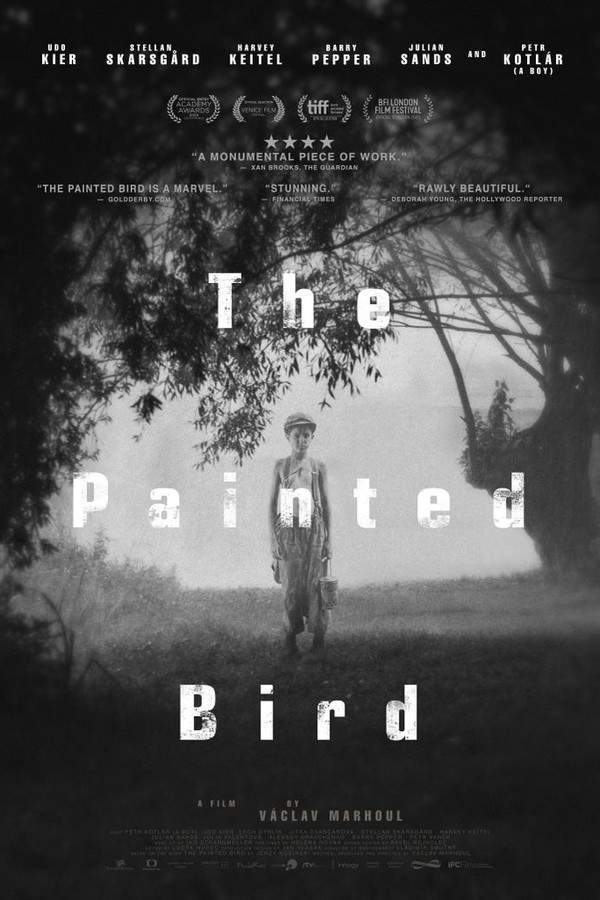
The Painted Bird (2019) movie poster

Plot Summary

The Painted Bird (2019) Plot Summary Explained

Release, runtime and language
2019 · 169 mins · Czech
Echo score 70
Starring
Stellan Skarsgård, Harvey Keitel, Udo Kier, Julian Sands, Barry Pepper, Alla Sokolova
Budget
$7.8M

Light is visible only in the dark After losing his parents, a young Jewish boy wanders Eastern Europe, seeking refuge during World War II.

On this page (5)
  1. 1 What happens: full plot
  2. 2 Plot questions answered
  3. 3 Movie threads
  4. 4 Movies like The Painted Bird
  5. 5 Every angle

Full plot summary · contains spoilers

What Happens in The Painted Bird: Full Plot Summary

The whole story of The Painted Bird (2019) explained, from the opening scene to the final frame: every key event, every twist and what it all adds up to. Read it as a quick recap before the sequel, to check a scene you missed, or to finally understand what really happened.

In a war-torn region of German-occupied Eastern Europe during World War II, a young boy finds himself living with his elderly aunt. Following her sudden death, he is caught off guard and inadvertently ignites a fire in their home, leading him to flee into the unknown. His journey unfolds into a series of harrowing encounters marked by ignorance, exploitation, and brutality.

Upon reaching his first village, the boy is sold to an old healer. Unfortunately, he is soon scapegoated for a series of misfortunes and cast into a river. His next refuge is with a miller and his wife; however, this sanctuary quickly turns dark when the miller commits a heinous act, gouging out the eyes of a younger man who he suspects of being affectionate towards his wife. Terrified, the boy escapes once again.

He later crosses paths with Lekh, a kind-hearted bird breeder who treats him with care. However, this relative peace is shattered when Lekh is involved with a wild woman, leading to her tragic fate at the hands of the angry local women who brutalize her for perceived disloyalty. Overcome by grief and despair, Lekh ultimately takes his own life, prompting the boy to leave yet again.

In search of solace, the boy discovers a tame horse with a broken leg and brings it to the next village, only to witness its brutal murder by a villager. His identity as a Jew exposes him to danger when partisans ask the locals to deliver him to the Germans. However, a German soldier assigned to execute him surprisingly lets him go. Yet, later, he falls into the hands of SS guards who take him to a nearby town. His life is spared once more through the intervention of a priest who offers him shelter, only to later arrange for him to stay with Garbos, a man whose darker inclinations lead to horrific consequences for both of them.

Once Garbos meets his grisly end, the boy is again left to fend for himself. Taken in by Labina, a woman who coerces the boy into performing sexual acts under the threat of violence, he eventually retaliates by killing her goat and fleeing her clutches.

Subsequently, the boy encounters the Red Army, specifically a sniper named Mitka. Mitka, however, is not without his own darkness, forcing the boy to witness the brutal reality of war as he avenges attacks on his comrades. As the Russian troops withdraw, they send the boy to an orphanage, a place where he feels isolated and attempts to escape repeatedly. After enduring a beating from an anti-Semitic shopkeeper, he exacts revenge and kills him.

Just when it seems he might find some semblance of family, a man named Nikodém arrives at the orphanage, tearfully claiming him as his son. However, the boy's trauma leaves him mute and unresponsive to Nikodém’s attempts to explain his past. While traveling by bus towards the prospect of a new home, the boy catches a glimpse of a number tattooed on his father’s arm. With a flick of his finger, he writes his name, Joska, on the bus window, marking an indelible moment in his harrowing journey through pain and survival.

Last updated: September 18, 2026 at 08:59

Was this helpful?

Plot questions answered

The Painted Bird Plot Explained: Your Questions Answered

The questions people ask most about The Painted Bird (2019): what happens in the confusing scenes, why the characters do what they do, the twists, hidden details and what the ending means. Each answer contains spoilers.

Q1

Why does the boy accidentally set the house on fire after his aunt dies?

The boy is living alone with his elderly aunt when she suddenly dies, and the shock of finding her body causes him to panic and startle. In that panic, he knocks over a lamp or candle, igniting the house. The fire forces him to flee into the surrounding countryside, beginning his long, traumatic journey through Eastern Europe.

  • house fire
  • aunt's death
  • beginning of journey
  • accident
Q2

Why is the boy blamed and thrown into the river by the villagers?

After being sold to an old healer in the first village, the boy is scapegoated whenever misfortunes strike the community. Because he is a stranger with no family ties, the villagers use him as a convenient target for their fears and frustrations, ultimately punishing him by casting him into a river even though he has done nothing wrong.

  • scapegoat
  • river punishment
  • first village
  • old healer
  • villagers
Q3

Why does the miller gouge out the younger man's eyes?

The miller becomes violently possessive of his wife after suspecting that a younger man has shown her affection. In a brutal act meant to punish the perceived rival and publicly humiliate him, the miller gouges out the younger man's eyes in front of the boy. The scene forces the boy to flee and exposes him to the casual, extreme violence that defines the world around him.

  • miller
  • eye gouging
  • jealousy
  • wife
  • violence
Q4

Why does Lekh take his own life after the wild woman is killed?

Lekh, the bird breeder, had briefly found happiness with a wild, marginalized woman who lived on the margins of the community. When local women brutally murder her for what they see as disloyalty and deviance, Lekh is left completely shattered. Having lost the one connection that gave him meaning, and facing an environment that punishes any deviation from its brutal norms, he sees no reason to continue living and takes his own life.

  • lekh
  • suicide
  • wild woman
  • bird breeder
  • murder by villagers
Q5

Why does the German soldier let the boy go instead of executing him?

After the partisans identify the boy as a Jew and order the villagers to hand him over to the Germans, a soldier is tasked with killing him. Instead of carrying out the order, the soldier unexpectedly releases him, leaving his survival to chance. The film offers no clear explanation, presenting the moment as one of the rare, irrational flickers of humanity inside an otherwise indifferent and cruel system.

  • german soldier
  • execution
  • partisans
  • mercy
  • spared
Q6

Why does the priest send the boy to live with Garbos?

After saving the boy from the SS, the priest agrees to shelter him but eventually decides he cannot keep the child himself. Instead of finding a genuinely safe home, he arranges for the boy to stay with Garbos, a local man whose predatory inclinations the priest either ignores, tolerates, or is complicit with. The decision reflects the film's broader point that even those in positions of moral authority fail to protect the boy.

  • priest
  • garbos
  • shelter
  • moral failure
  • complicity
Q7

How does the boy accidentally cause Garbos' gruesome death?

Garbos sexually abuses the boy during his stay, and in a moment of desperate self-defense the boy lashes out against him. The struggle ends with Garbos falling or being pushed in a way that results in a grisly death. The scene marks a turning point in the boy's psychological state, showing how repeated victimization pushes him toward violent retaliation.

  • garbos
  • accidental death
  • self-defense
  • abuse
  • retaliation
Q8

Why does the boy kill Labina's goat?

Labina sexually exploits the boy and threatens him with violence when he resists or fails to satisfy her. After enduring her abuse, the boy retaliates by killing her goat, the animal she values most. The act is his only available form of resistance against an adult who has complete physical power over him, and it allows him to escape her household.

  • labina
  • goat
  • retaliation
  • sexual abuse
  • escape
Q9

What does the boy witness when Mitka retaliates against the locals?

While staying with the Red Army sniper Mitka, the boy is exposed to a different but equally brutal side of the war. When Mitka's comrades are attacked by locals, he exacts revenge by killing villagers and burning their homes. The boy watches these retaliatory massacres, learning that cruelty is not limited to one army or ideology, and that civilians on every side are capable of indiscriminate violence.

  • mitka
  • red army
  • retaliation
  • civilian violence
  • war atrocities
Q10

Why does the boy kill the anti-Semitic shopkeeper at the orphanage?

After being sent to an orphanage following the Red Army's withdrawal, the boy continues to feel isolated and to attempt escape. A local shopkeeper, aware of his Jewish identity, beats him brutally during one of these escape attempts. Having absorbed violence as the only language he understands, the boy retaliates by killing the shopkeeper, a moment that confirms how deeply the cycle of brutality has embedded itself in him.

  • orphanage
  • shopkeeper
  • antisemitism
  • escape attempt
  • revenge killing
Q11

Why doesn't the boy respond to Nikodém when he claims to be his father?

By the time Nikodém arrives at the orphanage claiming to be the boy's father, the boy has been through years of abuse, exploitation, and violence. His trauma has rendered him mute and emotionally shut down, so even the possibility of being reunited with a parent cannot immediately reach him. His silence reflects the depth of his psychological damage rather than a rejection of Nikodém.

  • nikodém
  • mute
  • father
  • trauma
  • reunion
  • orphanage
Q12

What does the tattoo on Nikodém's arm mean, and why does the boy write his name on the window?

On the bus ride home, the boy sees a concentration camp number tattooed on Nikodém's arm, revealing that his father is also a Holocaust survivor. Realizing that his parent has endured the same systematic violence he has fled from, the boy responds by writing his name, 'Joska,' on the fogged window with his finger. The gesture is his first voluntary act of self-identification in the entire film, a small but significant reclaiming of identity amid inherited trauma.

  • tattoo
  • nikodém
  • joska
  • identity
  • holocaust survivor
  • ending explained

Movie threads

More Movies Like The Painted Bird, by Mood & Story

Curated lists built around what makes The Painted Bird tick: the same mood, the same kind of story or the same emotional payoff. Each list explains why these movies belong together.

Wartime child odysseys like The Painted Bird

Childhood dissolves in wartime, where every stranger is a threat and survival costs innocence. Movies like The Painted Bird that follow a young protagonist through the horrors of war, surviving from episode to episode as innocence is systematically destroyed. If you are looking for emotionally heavy war dramas centered on children navigating hostile territory, antisemitism, and loss of innocence, this collection gathers the most devastating entries in the genre.

  • loss of innocence
  • childhood trauma
  • wartime survival
  • oppressive
  • haunting
  • harrowing
  • Tone: dark, bleak, somber
  • Pacing: episodic, variable rhythm
Why these movies?

The story pattern: These stories typically unfold as picaresque journeys where a child, often orphaned or separated from caregivers, traverses a war-torn landscape. Each new location introduces a different figure, an exploitative stranger, a reluctant protector, or a brutal authority, who shapes the child's understanding of human nature. Pacing alternates between moments of false safety and sudden violence, mirroring the unpredictability of survival itself. The child rarely speaks much, observing and absorbing trauma through visual storytelling. By the end, even if the child is physically reclaimed, psychological healing remains impossible; the final image usually reveals the damage has become permanent.

Why they belong together: These films share a commitment to depicting war through a child's perspective, foregrounding loss of innocence rather than military strategy. The tone is overwhelmingly dark and bleak, with heavy emotional weight, graphic violence, and disturbing content. The narratives are episodic rather than linear-plot-driven, using a series of encounters to build cumulative dread. Movies cluster around WWII, the Holocaust, and Eastern European settings, but the pattern extends to any conflict where children bear the brunt of adult cruelty.

Bleak, unrelenting films like The Painted Bird

Suffocating cruelty with no relief, where hope is a lie and suffering compounds endlessly. If you are searching for movies like The Painted Bird that refuse to soften the blow, this collection gathers the most punishing and nightmarish viewing experiences in cinema. Expect graphic violence, disturbing themes, existential despair, and endings that confirm there is no escape from the cruelty depicted. These films share an unyieldingly dark tone, heavy emotional weight, and a commitment to showing human evil without redemptive framing.

  • brutal
  • oppressive
  • nightmarish
  • desolate
  • suffocating
  • unforgiving
  • Tone: dark, bleak, nightmarish
  • Pacing: variable, unpredictable rhythm
Why these movies?

The story pattern: The structure of these films is built around sustained, oppressive atmosphere rather than clean narrative arcs. Episodes of slow, almost documentary-style observation of suffering are punctuated by sudden, shocking acts of violence that feel arbitrary and inescapable. Protagonists are usually powerless, displaced, or marked for harm before the story begins, with minimal agency. Pacing refuses to grant the viewer recovery time, shifting abruptly between quiet dread and explosive brutality. Thematically, the films explore xenophobia, antisemitism, exploitation, and the absence of moral order. Whatever hope flickers briefly is extinguished, and the ending, frequently ambiguous or explicitly bleak, rejects the comfort of resolution.

Why they belong together: These films share an uncompromising commitment to depicting suffering without sentimentality or salvation. The tone is dark, bleak, and oppressive; pacing is variable, mixing slow atmospheric buildups with sudden shocks; emotional weight is heavy; intensity is high. They are the kind of cinema viewers describe as difficult, devastating, or unwatchable yet artistically essential. They tend to draw from art cinema and Eastern European traditions, prioritizing allegory and existential weight over conventional drama. Recommended for audiences seeking cinema that tests endurance and refuses easy answers.

If you liked this

Movies Like The Painted Bird

Similar movies to The Painted Bird: the same genre, themes or kind of story. Each one comes with its own plot summary, timeline and ending explained.

Browse all movie summaries

Every angle

The Painted Bird (2019) Explained: Plot, Timeline & Characters

Everything about The Painted Bird in one place: what happens in the plot summary, the timeline in chronological order, the characters and meaning and a spoiler-free summary. What's After the Movie adds the cast, box office and post-credit scenes.

Coming soon on iOS and Android

The Plot Explained Movie Summary App

Plot summaries, endings explained and timelines on your phone. Catch up on any movie in minutes, save your favorites and never miss a twist again.

Be the first to know when we launch. Your email stays private, always.

Learn more about the app