








Plot Explained Spoilers guaranteed!
Plot Explained

Browse by genre

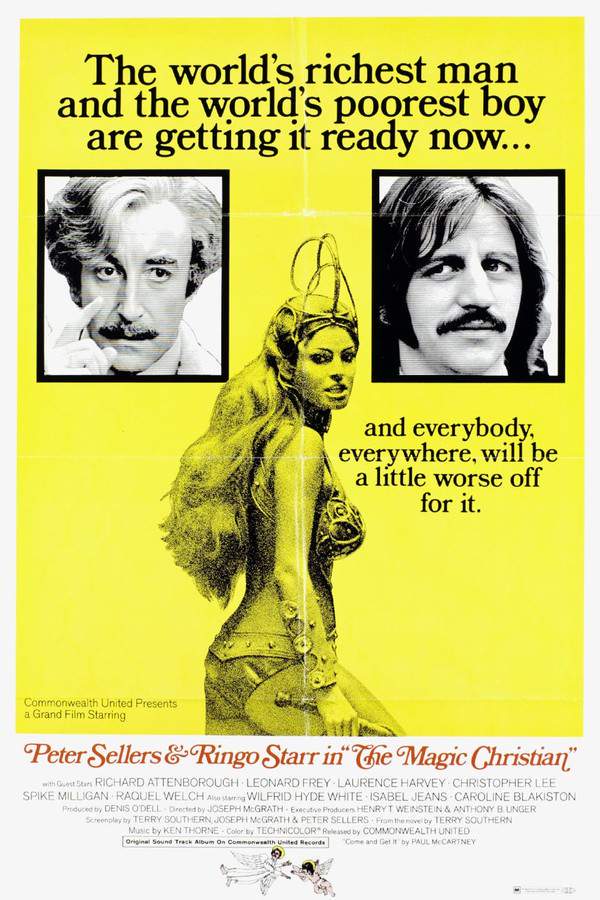
The Magic Christian (1969) movie poster

Timeline

The Magic Christian (1969) Timeline Explained – Every Event in Order

Release, runtime and language
1969 · 92 mins · English
JustWatch #21,368 6
Directed by
Joseph McGrath
Starring
Roman Polanski, Graham Chapman, John Cleese, Richard Attenborough, Peter Sellers, Ringo Starr

A wildly anti‑establishment, anti‑war, anti‑trust, anti‑social satire, it follows Sir Guy Grand, the richest man on Earth, who adopts a homeless drifter named Youngman. Together they set out to prove that anyone—and anything—can be bought, exposing greed and corruption with absurd humor.

On this page (6)
  1. 1 Where to watch
  2. 2 Events in order (14)
  3. 3 Timeline questions answered
  4. 4 Movie threads
  5. 5 Movies like The Magic Christian
  6. 6 Every angle

Where to watch

Where to Watch The Magic Christian (1969)

Where can you watch The Magic Christian? Stream, rent or buy it in the US, including on IndieFlix, Fawesome and Mometu: current JustWatch availability with up-to-date prices.

Streaming availability powered by JustWatch

14 events in order · contains spoilers

The Magic Christian Timeline: Events in Chronological Order

Every key event of The Magic Christian (1969) in order, scene by scene, with when and where it takes place. Use it to untangle flashbacks, time jumps and parallel storylines, to refresh your memory before the sequel or to find the exact scene you are thinking of.

  1. Theatre prank during Hamlet

    Guy Grand and his newly adopted heir bribe a Shakespearean actor to strip during a live performance of Hamlet. The audacious moment tests social boundaries and exposes how people react when money is involved. It establishes the film's central joke that everyone has their price, given enough incentive.

    When
    opening scene
    Where
    London theatre stage
  2. Traffic warden bribery and ticket consumption

    Grand persuades a traffic warden to cancel a parking ticket and even devour the ticket's plastic covering. The warden eagerly complies, savoring the bribe and the absurdity of the request. The scene underscores the film's satirical attack on bribery as social currency.

    When
    early day
    Where
    City street
  3. Rembrandt portrait auction and nose cutting

    At Sotheby's, Grand learns a Rembrandt School portrait might fetch around £10,000, but he makes a pre-auction bid of £30,000 to secure it. After the purchase, he cuts the nose from the canvas with scissors, shocking the bewildered director Mr. Dugdale. The act demonstrates his view that value is arbitrary and purchasable.

    When
    pre-auction
    Where
    Sotheby's auction house
  4. Restaurant gluttony show

    In an elegant restaurant, Grand stages a loud display of gluttony, becoming the institution's most conspicuous patron. He orders extravagant dishes and dominates the scene with an ostentatious appetite. The moment satirizes excess as a form of performance and control.

    When
    evening
    Where
    Elegant restaurant
  5. Bribed Boat Race victory

    During the annual Oxford rowing race, Grand bribes the Oxford coach to have their boat ram the Cambridge shell. Cambridge's crew is unfairly defeated, and the spectators react with a mix of disbelief and amusement. The prank illustrates his belief that sport and society can be steered by money.

    When
    during the event
    Where
    Boat Race on the river
  6. Pheasant hunt disruption

    In a traditional pheasant hunt, Grand uses an anti-aircraft gun to down a bird, turning a rural ritual into a spectacle of power. The gun's whistle cuts through the hunt, leaving the participants both horrified and amused. The episode broadens the scope of his social experiments.

    When
    seasonal event
    Where
    Pheasant hunt
  7. Boarding The Magic Christian

    Guy and Youngman purchase tickets for the luxury liner The Magic Christian and join the ship's richest passengers. They present themselves as observers of high society, ready to test its values. The voyage is cast as a controlled stage for their moral theater.

    When
    boarding
    Where
    The Magic Christian, onboard
  8. Onboard mischief and surreal encounters

    On board, a solitary drinker is approached by a flamboyant cabaret singer who may be a transvestite, provoking uneasy reactions. A vampire poses as a waiter, adding to the surreal disruption of normal service. The ship's atmosphere turns into a carnival of outrageous social provocations.

    When
    aboard, early voyage
    Where
    Ship's bar and public areas
  9. Unsettling cinema scene: head transplant

    A cinema sequence aboard the ship shows the unsuccessful transplant of a black person's head onto a white body, provoking distress and disbelief among the guests. The sensational scene is another extreme test of social boundaries under pay. It reinforces the film's critique of commodification and racial boundaries.

    When
    aboard, mid-voyage
    Where
    Ship's cinema
  10. Captain drunkenness and gorilla intervention

    The ship's captain appears in a drunken stupor and is carted off by a gorilla, amplifying the sense that everything aboard is unraveling. Panic spreads as guests realize something is terribly wrong with their voyage. The moment escalates the satire toward its climax.

    When
    mid-voyage
    Where
    Ship's bridge
  11. Machine room ritual and spectacle

    A crowd is directed to the machine room where the Priestess of the Whip, aided by topless drummers, conducts a ritual with hundreds of slave girls chained to the ceiling. The scene is visually shocking and deliberately dehumanizing. It crystallizes the film's critique of spectacle and power.

    When
    crescendo
    Where
    Machine room
  12. Warehouse reveal and 'SMASH CAPITALISM'

    Passengers break out into daylight only to discover the ship is actually a structure inside a warehouse and that they have never left London. A large painted sign reading 'SMASH CAPITALISM' appears on the interior wall as the crowd stumbles to freedom. The reveal reframes the voyage as a meticulously staged social experiment.

    When
    reveal moment
    Where
    Warehouse interior
  13. Free money vat spectacle

    Grand fills a huge vat with urine, blood, and animal excrement and saturates it with thousands of banknotes. He entices crowds of workers by shouting 'Free money!' and they dive in to recover the cash. The chaotic scene culminates in a riotous display of greed and release.

    When
    late act
    Where
    City square around vat
  14. Ending back in the park

    Back in the park where the story began, Grand and Youngman bribe the park warden to let them sleep there, suggesting this simple act is a more direct method to achieve their ends. They remain calm and collected, mirroring the earlier coolness of their social experiments. The film closes on their unwavering, amused expressions.

    When
    finale
    Where
    Park

Last updated: October 09, 2025 at 11:28

Was this helpful?

Timeline questions answered

The Magic Christian Timeline Explained: Your Questions Answered

When does it happen, and why in that order? The questions people ask about the chronology of The Magic Christian (1969): time jumps, flashbacks, cause and effect between scenes and the correct order of events, each answered with spoilers.

Q1

Why does Guy Grand adopt a homeless man as his heir?

Guy Grand adopts Youngman because he needs a willing participant and heir to carry out his social experiments. Grand believes anyone can be corrupted by money, and having a loyal companion helps him execute his elaborate pranks while maintaining an outward appearance of legitimacy. Youngman becomes both student and collaborator in Grand's mission to expose human greed.

Foreshadowing: The adoption scene at the park's fountain establishes their relationship early, showing Grand selecting someone with nothing to lose.

  • Guy Grand
  • Youngman
  • adoption
  • heir
  • social experiment
Q2

Why does the traffic warden agree to eat the parking ticket?

The traffic warden accepts the bribe because Grand offers him enough money to make the absurd request irresistible. The warden not only revokes the ticket but actually eats the plastic covering, delighting in the absurdity. This scene demonstrates Grand's core belief: everyone has a price, and the amount varies with the individual and the stakes.

Foreshadowing: This early prank establishes the film's central joke that money can make people do anything.

  • traffic warden
  • bribe
  • parking ticket
  • corruption
Q3

Why does Grand cut the nose off the Rembrandt portrait?

Grand purchases the painting for £30,000 at Sotheby's, then deliberately destroys it by cutting off the nose with scissors. This act proves his point that art value is arbitrary and exists only because people assign worth to it. By destroying something supposedly worth £10,000, he demonstrates that money gives people the power to redefine value on their own terms.

Foreshadowing: The auction scene occurs after smaller pranks, showing Grand escalating from testing individuals to attacking institutions.

  • Rembrandt
  • painting
  • Sotheby's
  • destruction
  • art value
Q4

Why does the Oxford crew agree to ram the Cambridge boat?

Grand bribes the Oxford coach to have his crew deliberately ram the Cambridge boat during the annual Boat Race. The bribe is substantial enough to convince them to throw away sportsmanship and tradition. This prank illustrates Grand's belief that even institutions like rowing competitions, which appear to operate on skill and honor, can be manipulated by sufficient financial incentive.

Foreshadowing: The Boat Race prank follows earlier public pranks, showing Grand's experiments moving from one-on-one bribery to corrupting group activities.

  • Oxford
  • Cambridge
  • Boat Race
  • rowing
  • bribe
  • cheating
Q5

What is The Magic Christian ship actually made of?

The Magic Christian is not a real ship at all, it is an elaborate stage set built inside a warehouse in London. The passengers never leave dry land. When they break out of the ship's interior, they discover they have been inside a massive artificial structure the entire time. This reveal exposes the entire voyage as a theatrical deception, reinforcing the film's themes about illusion and reality.

Foreshadowing: The ship contains surreal elements like a vampire waiter and transvestite singer, hinting that nothing aboard is genuine.

  • Magic Christian
  • ship
  • warehouse
  • set
  • reveal
  • fake
Q6

Why do people dive into the vat of urine and blood for money?

Grand fills a vat with urine, blood, and animal excrement, then drops thousands of real banknotes into the foul mixture. When he shouts "Free money!" city workers eagerly dive in to retrieve the cash, completely disregarding the disgusting contents. This scene dramatically proves Grand's thesis: people will endure humiliation and even physical discomfort for financial gain, no matter how degrading the circumstances.

Foreshadowing: The vat scene is the climax of Grand's public experiments, the largest scale demonstration of his philosophy.

  • vat
  • money
  • urine
  • blood
  • greed
  • crowd
  • free money
Q7

Why do Grand and Youngman return to the park at the end?

After their elaborate social experiments throughout the film, Grand and Youngman return to the same park where they met. They bribe the park warden to let them sleep there, suggesting that their grand spectacle was perhaps unnecessary, true fulfillment might come from simple, humble acts. The ending remains ambiguous about whether their "education" of society actually changed anything.

Foreshadowing: The park return mirrors the opening scene, creating a circular structure that questions whether any real progress was made.

  • park
  • ending
  • finale
  • return
  • warden
  • bribe
Q8

Why does the Shakespearean actor agree to strip during Hamlet?

Grand bribes a Shakespearean actor to undress during a live performance of Hamlet. The bribe amount is apparently sufficient to overcome the actor's professional dignity, audience expectations, and potential career consequences. This opening prank establishes the film's premise that anyone can be bought, regardless of their social standing or professional reputation.

Foreshadowing: This first prank sets up the central joke that everyone has their price, which drives all subsequent experiments.

  • Hamlet
  • actor
  • theatre
  • strip
  • bribe
  • Shakespeare
Q9

What does the "SMASH CAPITALISM" sign represent?

When passengers break out of the fake ship, they discover a large painted sign reading "SMASH CAPITALISM" on the warehouse wall. This is Grand's ultimate statement, a declaration that his entire elaborate production was meant as a satirical attack on capitalist values. The sign frames all his pranks as intentional political commentary rather than mere mischief.

Foreshadowing: The warehouse reveal comes after the most extreme spectacle, suggesting everything was calculated to build toward this message.

  • SMASH CAPITALISM
  • warehouse
  • sign
  • message
  • satire
  • capitalism
Q10

Why does the head transplant scene on the ship disturb the passengers?

A cinema aboard the ship shows a controversial sequence depicting a black person's head being transplanted onto a white body, which fails dramatically. The scene disturbs passengers because it tackles racial identity, scientific ethics, and the commodification of the human body. It represents another boundary Grand tests, how far will people allow scientific spectacle to go when money is involved.

Foreshadowing: The cinema scene follows increasingly surreal onboard events, pushing the limits of what guests will accept.

  • head transplant
  • cinema
  • race
  • surgery
  • shock
  • disturbing
Q11

Why do Grand and Youngman stay so calm during their pranks?

Throughout all the escalating chaos, Grand and Youngman maintain a composed, almost serene demeanor. This "calm, almost ceremonial restraint" is central to their characters, they view their experiments as intellectual exercises rather than mere vandalism. Their detachment allows them to observe the reactions of others while appearing civilized and in control, which makes their provocations even more unsettling.

Foreshadowing: Their consistent coolness contrasts sharply with the chaos erupting around them throughout the film.

  • Grand
  • Youngman
  • calm
  • composure
  • demeanor
  • restraint

Movie threads

More Movies Like The Magic Christian, by Mood & Story

Curated lists built around what makes The Magic Christian tick: the same mood, the same kind of story or the same emotional payoff. Each list explains why these movies belong together.

Satirical Prank Movies like The Magic Christian

Films that use absurd humor and elaborate stunts to critique society. Discover more movies like The Magic Christian that use outrageous pranks and absurd humor for sharp social satire. This collection features films where characters provocatively challenge authority and expose corruption, perfect for fans of witty, anti-establishment comedy.

  • satirical
  • absurd
  • anarchic
  • playful
  • provocative
  • cynical
  • Tone: whimsical, cynical, provocative
  • Pacing: variable, vignette-based
Why these movies?

The story pattern: Stories often follow charismatic instigators who design elaborate and often surreal public spectacles. The narrative typically unfolds as a series of escalating vignettes or pranks, each targeting a different institution or human flaw, building toward a broader commentary on a corrupt or absurd world.

Why they belong together: These films are grouped by their shared method of critique: using humor as a weapon. They blend a whimsical, playful tone with a cynical core, creating a unique viewing experience that is both amusing and intellectually provocative.

Movies with Detached Protagonists like The Magic Christian

Stories about calm protagonists orchestrating chaos from a distance. If you liked the cool, detached demeanor of the protagonists in The Magic Christian, explore these films featuring characters who calmly orchestrate or observe absurdity. These stories offer a unique blend of intellectual satire and surreal comedy, delivered with a restrained, almost ceremonial style.

  • detached
  • absurd
  • satirical
  • cool
  • observational
  • philosophical
  • Tone: detached, satirical, absurd
  • Pacing: steady, observational
Why these movies?

The story pattern: The narrative is driven by protagonists who are not personally swept up in the emotional turmoil they create or witness. Their journey is one of demonstration or experimentation, leading the audience through a series of bizarre events while maintaining a critical, observational distance from the unfolding chaos.

Why they belong together: These movies share a specific character dynamic and tone. The calm, controlled center of the story creates a unique vibe where the absurdity feels more like a philosophical experiment than pure farce, resulting in a thoughtful and distinctly cool viewing experience.

If you liked this

Movies Like The Magic Christian

Similar movies to The Magic Christian: the same genre, themes or kind of story. Each one comes with its own plot summary, timeline and ending explained.

Browse all movie summaries

Every angle

The Magic Christian (1969) Explained: Plot, Timeline & Characters

Everything about The Magic Christian in one place: what happens in the plot summary, the timeline in chronological order, the characters and meaning and a spoiler-free summary. What's After the Movie adds the cast, box office and post-credit scenes.

Coming soon on iOS and Android

The Plot Explained Movie Summary App

Plot summaries, endings explained and timelines on your phone. Catch up on any movie in minutes, save your favorites and never miss a twist again.

Be the first to know when we launch. Your email stays private, always.

Learn more about the app