








Plot Explained Spoilers guaranteed!
Plot Explained

Browse by genre

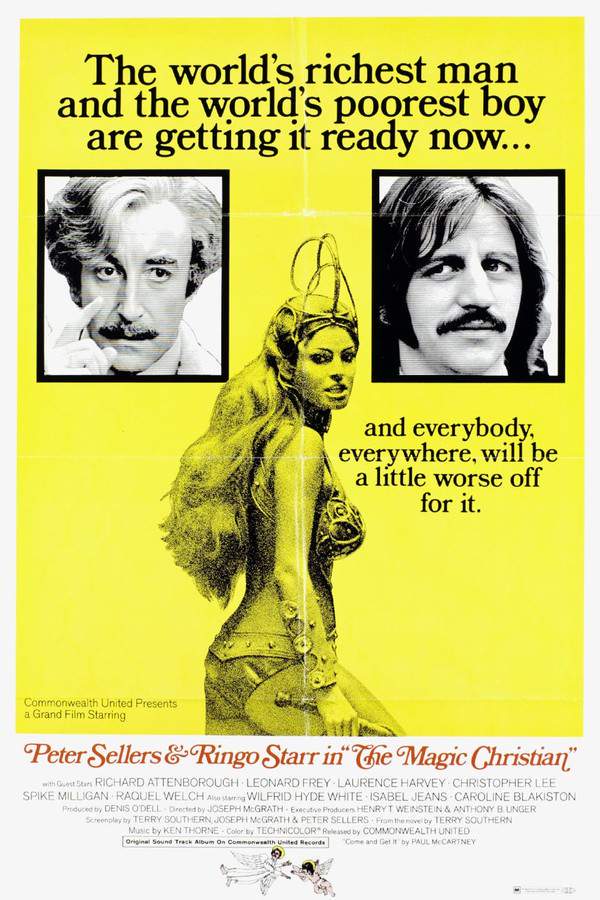
The Magic Christian (1969) movie poster

Characters & Themes

The Magic Christian (1969) Characters, Setting & Themes Explained

Release, runtime and language
1969 · 92 mins · English
JustWatch #21,372 2
Directed by
Joseph McGrath
Starring
Roman Polanski, Graham Chapman, John Cleese, Richard Attenborough, Peter Sellers, Ringo Starr

A wildly anti‑establishment, anti‑war, anti‑trust, anti‑social satire, it follows Sir Guy Grand, the richest man on Earth, who adopts a homeless drifter named Youngman. Together they set out to prove that anyone—and anything—can be bought, exposing greed and corruption with absurd humor.

On this page (8)
  1. 1 Where to watch
  2. 2 Characters explained (7)
  3. 3 Where & when it takes place
  4. 4 Themes & meaning (3)
  5. 5 Character & meaning questions
  6. 6 Movie threads
  7. 7 Movies like The Magic Christian
  8. 8 Every angle

Where to watch

Where to Watch The Magic Christian (1969)

Where can you watch The Magic Christian? Stream, rent or buy it in the US, including on IndieFlix, Fawesome and Mometu: current JustWatch availability with up-to-date prices.

Streaming availability powered by JustWatch

7 main characters · contains spoilers

The Magic Christian Characters Explained: Who Is Who

The main characters of The Magic Christian (1969), heroes and villains: what drives them, how they change over the course of the story and what each of them reveals about the film's bigger ideas.

  • Sir Guy Grand (Peter Sellers)

    An eccentric, supremely confident billionaire who treats wealth as a scientific tool for social reform. He engineers elaborate pranks with chilling calm, deriving amusement from the disruption of others' certainties. His philosophy that 'everyone has a price' guides the film's escalating stunts and exposes the fragility of social morals under wealth's pressure.

    • 💎 Rich
    • 🧠 Calculating
    • 🎭 Performer
  • Youngman Grand (Ringo Starr)

    The homeless man taken in as Guy Grand's adoptive heir, a cynical observer who gradually reveals a curious, perceptive innocence. He becomes the moral barometer of the story, asking whether society's rules apply when money speaks loudly enough. His perspective grounds the satire in human vulnerability rather than mere farce.

    • 🧒 Outsider
    • 🧭 Inquisitive
    • 🕊️ Hope
  • Director in Sotheby's (John Cleese)

    The curator-like figure who witnesses the Rembrandt's nose being cut and the pre-auction bravura. He embodies the cultivated rationality of the art world suddenly confronted by profiteering performance; his shock exposes the fragility of institutions when money talks.

    • 🏛️ Art world
    • 😮 Shock
    • 🧭 Skeptical
  • Oxford Coach (Richard Attenborough)

    The commanding coach of the Oxford rowing team who agrees to a bribe to ram the Cambridge boat. His willingness to manipulate a classic athletic contest demonstrates how deeply wealth and status can infiltrate even traditional, revered institutions. His actions become a crucial hinge in the satire of privilege and competition.

    • 🚣‍♂️ Sports
    • 💰 Corruption
    • 🏁 Competition
  • Dame Agnes Grand (Isabel Jeans)

    A matriarch of the Grand clan, embodying the aristocratic self-assurance and social gatekeeping that the pranks critique. She benefits from the spectacle as a symbol of established privilege, and her presence underscores the class-centered lens through which the jokes unfold.

    • 👑 Aristocracy
    • 🗝️ Gatekeeper
    • 🧭 Status
  • Priestess of the Whip (Raquel Welch)

    A provocative figure in the ship-bound sequence who leads the ceremonial slave-girl tableau. Her appearance amplifies the film's surreal, carnival-like atmosphere and comments on the exploitation and spectacle associated with power.

    • 🎭 Performance
    • 🔥 Sensuality
    • 🌀 Chaos
  • Solitary Drinker (Roman Polanski)

    A lone patron at the ship's bar who embodies the crowd's complicity and detachment as the chaos unfolds. His presence punctuates the film's themes of loneliness within public excess and the ease with which ordinary people become part of an extravagant spectacle.

    • 🍷 Isolation
    • 🧠 Observation
    • 🕯️ Contemplation

Last updated: October 04, 2025 at 15:21

Was this helpful?

Setting

Where and When Does The Magic Christian Take Place?

The setting of The Magic Christian (1969): the year and time period, the places and locations, and how they shape the characters, the mood and the tension of the story.

Time period

1960s

The events take place in the late 1960s London milieu, a period of counterculture and media spectacle. Real-world icons and lookalikes appear as part of a satirical panorama of wealth and fame. The narrative treats contemporary institutions—art houses, universities, and luxury liners—as stages for social experiments, reflecting the era's curiosity about money, status, and mass media.

Location

London, The Magic Christian (Ship), Sotheby's Auction House, Thames River (London), Park (London)

The story unfolds across a London-centric stage: the upscale world of Sotheby's and high society aboard the luxury liner The Magic Christian, as well as everyday city spaces like parks and public quays along the Thames. The shipboard misadventure is staged as a self-contained illusion within a warehouse, revealing how the city's famous locations can double as stages for spectacle. The settings juxtapose elegant interiors with crowded urban spaces, highlighting wealth's reach and the performative nature of modern life.

  • 🏙️ Urban London
  • 🛳️ Ship setting
  • 🏛️ Art and high society venues
  • 🌳 Parks and public spaces

Last updated: October 04, 2025 at 15:21

Was this helpful?

3 major themes

The Magic Christian Meaning: Themes & Message Explained

What is The Magic Christian (1969) really about? The emotional, social and philosophical themes the film keeps returning to, its symbolism and the message beneath the surface.

  • Capitalism Satire

    The film treats money as a social lever, testing how far people will go for a bribe and what they will sacrifice to maintain appearances. Guy Grand's orchestration exposes how consumer culture and wealth steer behavior, often erasing ethical boundaries. The Rembrandt nose-cut, the boat race manipulation, and the burial of cash reveal a spectrum of incentives that reduce humans to market transactions.

  • Spectacle of Society

    Pranks and staged vignettes turn public spaces into theaters where social roles are mocked and probed. The film uses lookalikes, outrageous performances, and ritualistic debauchery to critique fame, media sensationalism, and the voyeuristic appetite of audiences. By presenting serious scenes as mass entertainment, it questions what is considered art, entertainment, and acceptable spectacle.

  • Aristocracy and Power

    The elite and their rituals—gilded restaurants, auctions, and yacht-like fantasies—are exposed as fragile façades that money can subvert. Grand's patronage and the assembled wealth reveal how privilege shapes reality, control, and social norms. The closing signs of 'SMASH CAPITALISM' inside a warehouse underscore the tension between wealth, power, and genuine societal progress.

Last updated: October 04, 2025 at 15:21

Was this helpful?

Character & theme questions

The Magic Christian Characters & Meaning: Your Questions Answered

The questions people ask about The Magic Christian (1969): who the characters really are, their relationships, what the symbols mean, where it takes place and what the movie is really about. Each answer contains spoilers.

Q1

Where is the movie set?

The story takes place in late 1960s London, unfolding across upscale venues like Sotheby's auction house, luxury settings aboard a ship called The Magic Christian, and everyday urban spaces including parks and public quays along the Thames River. The shipboard scenes are cleverly revealed to be staged inside a warehouse, highlighting how the city itself becomes a stage for spectacle.

Foreshadowing: Early scenes establish London as both a literal location and a symbolic playground for wealth's performative experiments.

  • london
  • 1960s
  • sotheby
  • thames
  • urban setting
  • venue
Q2

Who is Sir Guy Grand?

Sir Guy Grand is an eccentric billionaire played by Peter Sellers who believes everyone has a price. He treats wealth as a scientific tool for social reform, engineering elaborate pranks to expose how money can corrupt individuals and institutions. His calm, methodical approach to disrupting social certainties makes him both a catalyst for the film's events and a sharp critique of elite privilege.

Foreshadowing: His confidence in the opening scenes establishes his role as a social engineer rather than a typical wealthy protagonist.

  • peter sellers
  • sir guy grand
  • billionaire
  • wealth
  • social experiment
  • prankster
Q3

Who is Youngman Grand?

Youngman Grand is a homeless man played by Ringo Starr who is adopted as Guy Grand's heir. He serves as the story's moral barometer, a cynical yet curious observer who questions whether society's ethical rules truly matter when money speaks louder. His perspective grounds the satire in human vulnerability rather than pure farce.

Foreshadowing: His initial introduction as a homeless drifter establishes his role as both outsider and reluctant participant in Grand's experiments.

  • ringo starr
  • youngman grand
  • homeless
  • adoption
  • moral compass
  • observer
Q4

What is the main message about money?

The film satirizes money as a social lever that can override ethics and dignity. Through staged bribes at an auction, a rigged boat race, and a literal burial of cash, Guy Grand tests how far people will go for financial gain. The message suggests consumer culture reduces human relationships to market transactions, with wealth having the power to corrupt even respected institutions.

Foreshadowing: The opening pranks immediately establish money as the primary force driving characters' choices.

  • capitalism
  • money
  • bribery
  • corruption
  • consumer culture
  • wealth
  • greedy
Q5

How does the film critique media and fame?

The film uses lookalikes, outrageous performances, and ritualistic public spectacles to mock fame, media sensationalism, and audiences' voyeuristic appetite. By presenting serious scenes, like an art auction or a rowing competition, as mass entertainment, it questions what society considers legitimate art and acceptable spectacle. The warehouse reveal of the ship sets the tone for this meta-commentary on performance and reality.

Foreshadowing: The use of celebrity lookalikes throughout hints at the film's interest in manufactured image and public perception.

  • spectacle
  • fame
  • media
  • lookalikes
  • performance
  • satire
  • entertainment
  • critique
Q6

How does the movie view wealth and privilege?

The film exposes aristocratic institutions as fragile façades that money can easily subvert. Through Guy Grand's patronage and the orchestrated wealth displays, the narrative reveals how privilege shapes reality and social norms. The closing 'SMASH CAPITALISM' signs inside the warehouse underscore the tension between accumulated wealth and genuine societal progress, suggesting elite power is more performative than substantive.

Foreshadowing: Early scenes in Sotheby's and high-society settings establish the pretensions that the pranks ultimately dismantle.

  • aristocracy
  • privilege
  • power
  • elite
  • wealth
  • facade
  • class
  • social norms
Q7

Does the 1960s setting matter?

The late 1960s London setting places the film in a period of counterculture and media spectacle, allowing it to critique contemporary institutions, art houses, universities, and luxury liners, as stages for social experimentation. The era's curiosity about money, status, and mass media provides the perfect backdrop for Guy Grand's inquiry into what people will do for wealth and how easily traditional values collapse under financial pressure.

Foreshadowing: The period's experimental spirit is reflected in the film's own playful approach to narrative structure.

  • 1960s
  • counterculture
  • london
  • era
  • 1960s london
  • social experiment
  • period
Q8

What does the Oxford-Cambridge boat race scene represent?

The boat race scene, in which the Oxford coach (Richard Attenborough) accepts a bribe to ram the Cambridge boat, demonstrates how deeply wealth can infiltrate even revered traditional institutions. A classic athletic contest becomes corrupted by money, serving as a sharp example of the film's argument that all social rituals, regardless of tradition or prestige, have a price tag.

Foreshadowing: Earlier scenes establish the cultural significance of the Oxford-Cambridge rivalry before subverting it.

  • oxford
  • cambridge
  • boat race
  • rowing
  • bribery
  • richard attenborough
  • tradition
  • corruption
Q9

What is the significance of the fake ship setting?

The revelation that the Magic Christian ship scenes are staged inside a warehouse serves as a meta-commentary on performance, illusion, and the constructed nature of luxury. It reinforces the film's theme that wealth and status are often elaborate performances, the ship is a set, the passengers are actors, and the spectacle is designed to test observers. This self-aware theatricality amplifies the satire of society's susceptibility to illusion.

Foreshadowing: The deliberate theatricality of early scenes hints that reality itself is being performed.

  • warehouse
  • ship
  • illusion
  • performance
  • stage
  • set
  • fake
  • revelation
Q10

What does the ending mean?

The film ends with Guy and Youngman returning to their starting point in the park, having 'educated' the world through their pranks but leaving the ultimate impact open to reflection. This circular structure suggests that while corruption has been exposed, genuine societal change remains uncertain. The ambiguity invites viewers to consider whether exposure alone is enough or whether the cycle of wealth and manipulation continues indefinitely.

Foreshadowing: The return to the park mirrors the film's opening, emphasizing the cyclical nature of the satire.

  • ending
  • ambiguous
  • conclusion
  • interpretation
  • park
  • circle
  • reflection
  • change

Movie threads

More Movies Like The Magic Christian, by Mood & Story

Curated lists built around what makes The Magic Christian tick: the same mood, the same kind of story or the same emotional payoff. Each list explains why these movies belong together.

Satirical Prank Movies like The Magic Christian

Films that use absurd humor and elaborate stunts to critique society. Discover more movies like The Magic Christian that use outrageous pranks and absurd humor for sharp social satire. This collection features films where characters provocatively challenge authority and expose corruption, perfect for fans of witty, anti-establishment comedy.

  • satirical
  • absurd
  • anarchic
  • playful
  • provocative
  • cynical
  • Tone: whimsical, cynical, provocative
  • Pacing: variable, vignette-based
Why these movies?

The story pattern: Stories often follow charismatic instigators who design elaborate and often surreal public spectacles. The narrative typically unfolds as a series of escalating vignettes or pranks, each targeting a different institution or human flaw, building toward a broader commentary on a corrupt or absurd world.

Why they belong together: These films are grouped by their shared method of critique: using humor as a weapon. They blend a whimsical, playful tone with a cynical core, creating a unique viewing experience that is both amusing and intellectually provocative.

Movies with Detached Protagonists like The Magic Christian

Stories about calm protagonists orchestrating chaos from a distance. If you liked the cool, detached demeanor of the protagonists in The Magic Christian, explore these films featuring characters who calmly orchestrate or observe absurdity. These stories offer a unique blend of intellectual satire and surreal comedy, delivered with a restrained, almost ceremonial style.

  • detached
  • absurd
  • satirical
  • cool
  • observational
  • philosophical
  • Tone: detached, satirical, absurd
  • Pacing: steady, observational
Why these movies?

The story pattern: The narrative is driven by protagonists who are not personally swept up in the emotional turmoil they create or witness. Their journey is one of demonstration or experimentation, leading the audience through a series of bizarre events while maintaining a critical, observational distance from the unfolding chaos.

Why they belong together: These movies share a specific character dynamic and tone. The calm, controlled center of the story creates a unique vibe where the absurdity feels more like a philosophical experiment than pure farce, resulting in a thoughtful and distinctly cool viewing experience.

If you liked this

Movies Like The Magic Christian

Similar movies to The Magic Christian: the same genre, themes or kind of story. Each one comes with its own plot summary, timeline and ending explained.

Browse all movie summaries

Every angle

The Magic Christian (1969) Explained: Plot, Timeline & Characters

Everything about The Magic Christian in one place: what happens in the plot summary, the timeline in chronological order, the characters and meaning and a spoiler-free summary. What's After the Movie adds the cast, box office and post-credit scenes.

Coming soon on iOS and Android

The Plot Explained Movie Summary App

Plot summaries, endings explained and timelines on your phone. Catch up on any movie in minutes, save your favorites and never miss a twist again.

Be the first to know when we launch. Your email stays private, always.

Learn more about the app