Plot Explained Spoilers guaranteed!
Plot Explained

Browse by genre

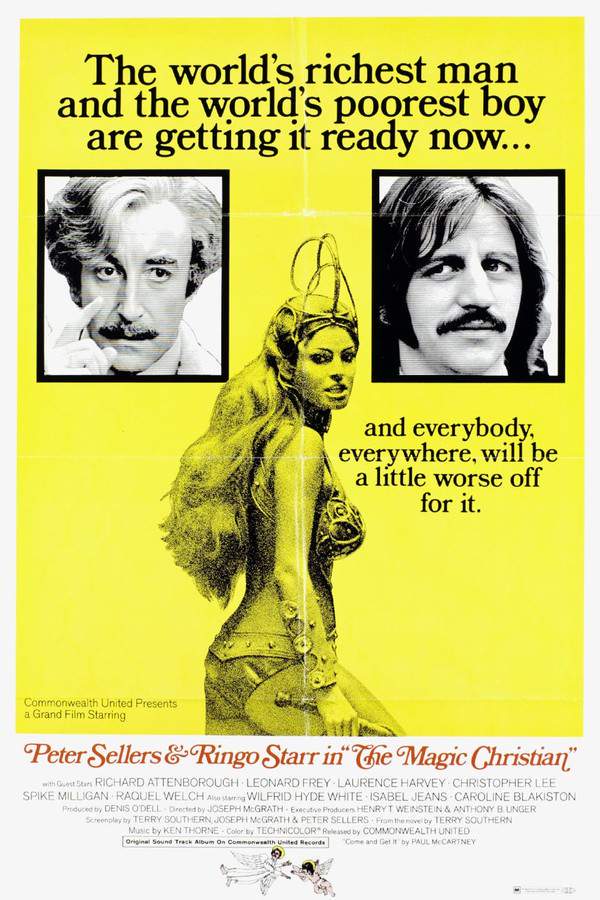
The Magic Christian (1970) movie poster

Plot Summary

The Magic Christian (1970) Plot Summary Explained

Release, runtime and language
1970 · 92 min · English
JustWatch #21,604 6
Directed by
Joseph McGrath
Starring
Peter Sellers, Ringo Starr, Christopher Lee, Laurence Harvey, Wilfrid Hyde-White, Spike Milligan

Eccentric billionaire Sir Guy Grand (Peter Sellers) undertakes a provocative experiment to demonstrate that everyone is susceptible to bribery. He takes a homeless man, renames him Youngman Grand, and subjects him to a series of increasingly bizarre and outrageous situations. These pranks range from corrupting authority figures to disrupting prestigious institutions, all to prove his cynical view of human nature and the pervasive influence of money.

On this page (6)
  1. 1 Where to watch
  2. 2 What happens: full plot
  3. 3 Plot questions answered
  4. 4 Movie threads
  5. 5 Movies like The Magic Christian
  6. 6 Every angle

Where to watch

Where to Watch The Magic Christian (1970)

Where can you watch The Magic Christian? Stream, rent or buy it in the US, including on Fawesome, Mometu and Plex: current JustWatch availability with up-to-date prices.

Streaming availability powered by JustWatch

Full plot summary · contains spoilers

What Happens in The Magic Christian: Full Plot Summary

The whole story of The Magic Christian (1970) explained, from the opening scene to the final frame: every key event, every twist and what it all adds up to. Read it as a quick recap before the sequel, to check a scene you missed, or to finally understand what really happened.

Sir Guy Grand, an enigmatic tycoon with a flair for the bizarre, engages in a series of outrageous pranks with his newly adopted protégé, Youngman Grand, a homeless man rescued from the urban wilderness. This peculiar pair revels in a world of manipulation, constantly showcasing the idea that "everyone has their price" - it's merely a matter of discovering the right amount.

Their antics commence with trivial jokes, like bribing a Shakespearean actor to remove his attire mid-performance during a rendition of Hamlet, or convincing a traffic warden to devour a parking ticket along with its plastic cover, all for a hefty sum. As their laughter-inducing schemes escalate, Grand’s targets rise in stature and the scale of their pranks expands.

At the prestigious Sotheby's art auction house, Grand learns that a rare portrait from the Rembrandt School could fetch an impressive £10,000 at auction. In a jaw-dropping move that leaves the director, Mr. Dugdale, speechless, Grand submits a pre-auction bid of an astounding £30,000 (approximately £623,700 today) and, after successfully acquiring the artwork, he shockingly severed the portrait's nose from its canvas with a pair of scissors, while an astonished Dugdale gapes in disbelief. In another grandiose exploit, he turns a lavish restaurant into a spectacle of excess, where he becomes the center of attention, and later, he bribes the coach of the Oxford rowing team to illegally collide with their Cambridge rivals during the celebrated Boat Race, ultimately ensuring an unfair yet hilarious victory.

In a traditional pheasant hunt, Grand escalates the absurdity by utilizing an anti-aircraft gun to dispatch his targets. Throughout these madcap scenarios, Grand insists his pranks serve an “educational” purpose, illustrating his belief that everyone has a price, just waiting to be uncovered.

As Guy Grand and his offbeat companion, Youngman Grand, socialize with the elite aboard the opulent ship, The Magic Christian, they are surrounded by a surreal cast of characters resembling cultural icons like John Lennon and Yoko Ono. While the luxurious voyage appears to offer a reprieve from the humdrum, things take a peculiarly uncanny twist. A lone patron at the bar is approached by an overly flamboyant cabaret performer, while a mysterious vampire doubles as a waiter, dishing out an array of unsettling beverages. The absurdity peaks with a shocking film screening featuring a failed medical operation that tries to transplant a black man’s head onto a white body, leaving the passengers in a state of disbelief.

Amid panic, the passengers scramble to escape the ship, only to realize their captain is intoxicated and unable to help. In a scene reminiscent of a Shakespearean comedy, guests confront the unsettling truth that they are trapped on a ship devoid of a functional crew. A group, inspired by Youngman Grand, ventures into the machine room only to discover the odd sight of the Priestess of the Whip, flanked by topless drummers and attended by a bewildering assembly of slave girls in simple loincloths. As they find an escape route, they’re met with the shocking understanding that The Magic Christian is merely an elaborate set within a warehouse, and their entire escapade has unfolded in the very heart of London.

After this chaotic adventure subsides, Guy Grand orchestrates his next audacious act: he creates a massive vat filled with a grotesque mixture of urine, blood, and animal waste, then tosses in stacks of banknotes. With a casual demeanor, he beckons the local workforce to partake in what seems to be a treasure trove, exclaiming “Free money!” The allure of easy riches draws a crowd, leading to a frenzied scene as individuals dive into the messy concoction in hopes of retrieving the submerged cash. This chaotic moment is eerily accompanied by the iconic tune "Something in the Air" by Thunderclap Newman.

As the film draws to a close, Guy and Youngman Grand return to the park where it all began, again bribing the park warden, aiming for a more straightforward approach to achieving their largely unspoken ambitions.
Last updated: November 17, 2024 at 18:23

Was this helpful?

Plot questions answered

The Magic Christian Plot Explained: Your Questions Answered

The questions people ask most about The Magic Christian (1970): what happens in the confusing scenes, why the characters do what they do, the twists, hidden details and what the ending means. Each answer contains spoilers.

Q1

Why does Sir Guy Grand cut the nose off the painting at Sotheby's?

Grand bids £30,000 on a Rembrandt portrait solely to destroy it in front of the auction director. This极端行为 is meant to demonstrate that money can make people do anything, even destroy art. By paying an absurd amount just to ruin something precious, Grand proves his point that everyone has their price - the art world values money over cultural significance.

Foreshadowing: The earlier prank where Grand bribes a Shakespearean actor to strip during Hamlet already establishes his pattern of corrupting prestigious institutions for amusement.

  • Sotheby's
  • Rembrandt portrait
  • auction
  • money corruption
  • art destruction
Q2

Why does Grand bribe the Oxford rowing coach to crash into Cambridge?

Grand pays the Oxford coach to have his team deliberately collide with their Cambridge rivals during the annual Boat Race. This prank targets two prestigious institutions simultaneously - Oxford and Cambridge universities - and shows that even athletic competition can be bought. The resulting chaotic victory illustrates Grand's belief that all human endeavors, including tradition and sportsmanship, have a price.

Foreshadowing: Earlier pranks progressively target higher-status targets, moving from a single actor to a restaurant to now the universities.

  • Oxford
  • Cambridge
  • Boat Race
  • rowing
  • bribe
  • sports corruption
Q3

What is the purpose of Grand's pranks throughout the film?

Grand repeatedly states his pranks are 'educational' - they demonstrate his cynical philosophy that everyone has their price. Each increasingly outrageous scheme tests whether people will compromise their principles, morality, or dignity for money. The film presents these as social experiments proving that human greed and corruption are universal, regardless of status or profession.

Foreshadowing: The very first scene establishes Grand's mission: finding Youngman and testing his theory that everyone can be bought.

  • pranks
  • social experiment
  • bribery
  • human nature
  • corruption
Q4

Why is The Magic Christian revealed to be a warehouse set?

After passengers panic during the surreal ship events, they discover the entire ship is an elaborate movie set in a London warehouse. This twist blurs reality and illusion, reinforcing the film's theme that appearances are deceptive. The ship represents a microcosm of society - a fake environment where people behave absurdly, unaware they're being manipulated.

Foreshadowing: The surreal encounters on board - the vampire waiter, bizarre cabaret, and shocking film - already signal something is unnatural about the ship.

  • Magic Christian ship
  • warehouse
  • illusion
  • reality
  • set
  • surreal
Q5

What does the 'free money' vat scene represent?

Grand creates a vat filled with urine, blood, and animal waste, then throws in cash and tells local workers it's 'free money.' People dive in desperately to retrieve the bills despite the disgusting medium. This scene symbolizes how people will degrade themselves for money, regardless of how filthy the means. It visually demonstrates the film's bleak view that greed overrides basic dignity.

Foreshadowing: This is the culmination of Grand's repeated demonstrations that humans will do anything for money.

  • free money
  • vat
  • greed
  • degradation
  • class struggle
  • workers
Q6

Why does Grand return to the park at the end of the film?

The film ends exactly where it began - Grand and Youngman back at the park, bribing the warden again. This cyclical structure suggests Grand's experiment is endless; he has proven nothing and learned nothing. The ambiguous ending implies human corruption is inescapable and the pursuit of proving this point is itself pointless - but Grand continues regardless.

Foreshadowing: The opening scene establishes the park as where Grand finds Youngman, creating the cycle that repeats at the end.

  • park ending
  • cycle
  • repetition
  • ambiguous ending
Q7

Why does the ship sequence include surreal elements like a vampire waiter?

The Magic Christian voyage features bizarre characters including a vampire waiter and unsettling cabaret performer. These surreal figures represent the weirdness hidden beneath the surface of 'respectable' high society. The ship journey into the ocean mirrors Alice in Wonderland - entering a topsy-turvy world where normal rules don't apply, preparing for the revelation that everything is fake.

Foreshadowing: The film establishes early on that Grand operates in a world between reality and absurdity.

  • vampire
  • surreal
  • cabaret
  • ship
  • absurdity
  • high society
Q8

Why does Grand use an anti-aircraft gun for pheasant hunting?

During a traditional pheasant hunt, Grand escalates from standard hunting to using military equipment. This extreme overkill demonstrates that when you have enough money, no social norm or safety constraint matters. The hunt is another test of whether traditional pastimes can also be corrupted by wealth - the answer is yes, absolutely.

Foreshadowing: Previous pranks have progressively broken more social boundaries, leading to military weaponry.

  • pheasant hunt
  • anti-aircraft gun
  • weapon
  • class
  • military
Q9

Why does Grand adopt Youngman as his heir?

Grand rescues a homeless man from the park, renames him Youngman Grand, and makes him his companion in the experiments. Youngman serves as both student and audience - he participates in the pranks and represents the 'everyman' who might also be corruptible. Grand seems to view him as a son figure to continue his work, though the film never fully explains the emotional motivation.

Foreshadowing: The opening scene establishes their bond as the foundation for all subsequent events.

  • Youngman
  • adoption
  • heir
  • homeless
  • hiring relationship
Q10

What is the film's message about human nature?

The film presents a darkly cynical view that every person has a price - morality, dignity, and principles can all be bought given enough money. Through escalating pranks targeting everyone from actors to aristocrats, the movie suggests universal corruption exists across all social classes and professions. However, the cyclical ending implies this 'truth' provides no real satisfaction or resolution.

Foreshadowing: Grand's repeated mantra that 'everyone has their price' is demonstrated repeatedly but never proven wrong or right.

  • human nature
  • corruption
  • greed
  • morality
  • social commentary
  • cynicism

Movie threads

More Movies Like The Magic Christian, by Mood & Story

Curated lists built around what makes The Magic Christian tick: the same mood, the same kind of story or the same emotional payoff. Each list explains why these movies belong together.

Satirical Corruption Farces Like The Magic Christian

Movies using dark humor and absurdity to critique societal greed and power. If you liked the biting social commentary of The Magic Christian, explore more movies that use dark humor and absurdist plots to expose corruption. These cynical satires challenge authority and question the influence of money, often with a chaotic and farcical tone.

  • satirical
  • cynical
  • absurd
  • provocative
  • unsettling
  • farce
  • Tone: dark, cynical, sardonic
  • Pacing: variable, episodic
Why these movies?

The story pattern: Narratives in this thread often follow a central provocateur or a series of escalating events designed to test and reveal the moral failings of individuals and systems. The structure can be episodic, building toward a bleak or ambiguous conclusion that reinforces the film's cynical worldview.

Why they belong together: These films are grouped by their shared commitment to using comedy as a weapon for social critique. They combine a dark, sardonic tone with absurdist humor and a focus on themes like corruption, greed, and the fragility of morality, creating a uniquely unsettling and thought-provoking vibe.

Movies with Absurdist Pranks Like The Magic Christian

Stories where characters orchestrate bizarre scenarios to test human nature. Fans of the chaotic pranks in The Magic Christian will enjoy these movies featuring elaborate social experiments and absurdist humor. Discover films where characters disrupt the status quo through bizarre schemes, leading to unpredictable and often unsettling outcomes.

  • absurd
  • chaotic
  • farce
  • unsettling
  • whimsical
  • bizarre
  • Tone: whimsical, dark, unsettling
  • Pacing: variable, chaotic
Why these movies?

The story pattern: The narrative pattern involves a character or duo with significant resources or a singular obsession embarking on a series of disruptive, loosely connected events. The plot is less about a traditional arc and more about the cumulative effect of these chaotic interventions, often leaving the conclusion open to interpretation.

Why they belong together: These movies share a core premise of societal disruption through absurd acts. They are united by a variable, often chaotic pacing, a blend of dark whimsy, and a focus on the farcical outcomes of testing human behavior, creating a vibe of controlled anarchy and pointed observation.

If you liked this

Movies Like The Magic Christian

Similar movies to The Magic Christian: the same genre, themes or kind of story. Each one comes with its own plot summary, timeline and ending explained.

Browse all movie summaries

Every angle

The Magic Christian (1970) Explained: Plot, Timeline & Characters

Everything about The Magic Christian in one place: what happens in the plot summary, the timeline in chronological order, the characters and meaning and a spoiler-free summary. What's After the Movie adds the cast, box office and post-credit scenes.

Coming soon on iOS and Android

The Plot Explained Movie Summary App

Plot summaries, endings explained and timelines on your phone. Catch up on any movie in minutes, save your favorites and never miss a twist again.

Be the first to know when we launch. Your email stays private, always.

Learn more about the app