











Plot Explained Spoilers guaranteed!
Plot Explained

Browse by genre

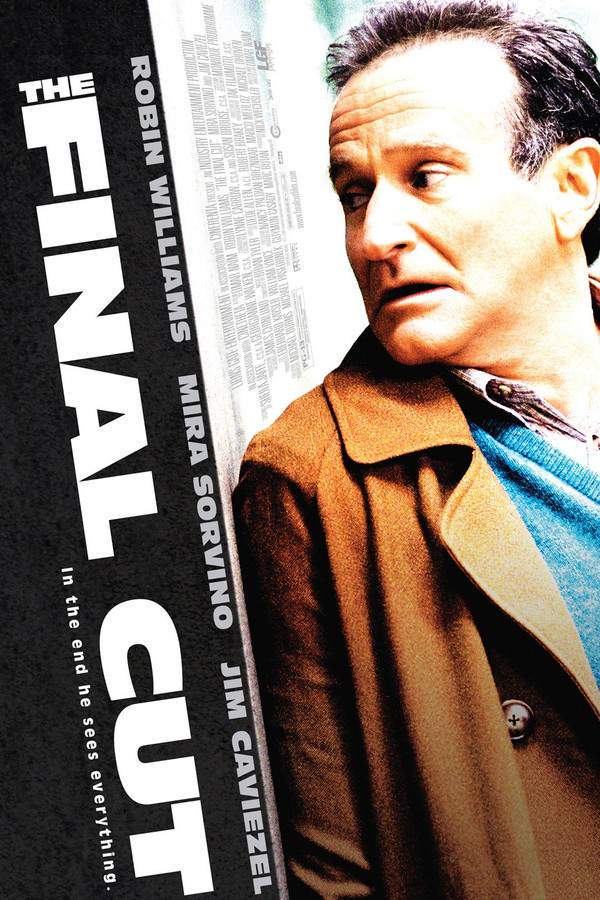
The Final Cut (2004) movie poster

Plot Summary

The Final Cut (2004) Plot Summary Explained

Release, runtime and language
2004 · 95 min · English
JustWatch #18,041 7
Directed by
Omar Naim
Starring
Robin Williams, James Caviezel, Mira Sorvino

In a future where memories can be digitized and altered, Alan Hakman, a skilled "cutter," grapples with his own complicated past while pursuing his passion for storytelling. Haunted by his history, Alan faces a moral dilemma when a tempting offer promises both financial reward and the potential to expose buried secrets. His quest for redemption becomes increasingly perilous as he confronts the dark truths about himself and the industry he works in.

On this page (6)
  1. 1 Where to watch
  2. 2 What happens: full plot
  3. 3 Plot questions answered
  4. 4 Movie threads
  5. 5 Movies like The Final Cut
  6. 6 Every angle

Where to watch

Where to Watch The Final Cut (2004)

Where can you watch The Final Cut? Stream, rent or buy it in the US, including on Fawesome, Kanopy and Tubi TV: current JustWatch availability with up-to-date prices.

Streaming availability powered by JustWatch

Full plot summary · contains spoilers

What Happens in The Final Cut: Full Plot Summary

The whole story of The Final Cut (2004) explained, from the opening scene to the final frame: every key event, every twist and what it all adds up to. Read it as a quick recap before the sequel, to check a scene you missed, or to finally understand what really happened.

In this futuristic narrative, we follow Alan Hakman, portrayed by Robin Williams, who is haunted by a tragic childhood memory. As a young boy, he witnessed his friend fall to his death while they played in an abandoned building. Fast forward to the present day, and a revolutionary technology known as "Zoe" chips is introduced. These chips are implanted in individuals at birth, documenting their entire lives, which are then edited and screened at their funerals.

As a video editor, or "cutter", Alan's job revolves around processing these intimate recordings, accommodating the wishes of grieving families. This involves interviewing relatives to discern which memories to highlight and which to omit. Unfortunately, in the hands of some, like Alan, this power becomes a double-edged sword. He unconsciously morphs into a cold and ruthless figure, prioritizing the portrayal of the deceased in a favorable light over an authentic representation of their lives.

However, Alan's world is rocked when he uncovers a shocking memory related to his friend, whom he had presumed to be dead. Intrigued and desperate, he searches for his friend's Zoe chip, only to discover that a staggering 80% of the population do not have these implants. Instead, he stumbles upon his own recording, revealing surprising truths about that fateful day. The supposed "blood" he remembered is uncovered to be mere paint, suggesting that his friend may have survived after all.

As Alan unravels these secrets, the narrative takes a gripping turn when activists confront him, demanding that the life of his deceased subject be made public. In a dramatic clash, Alan's life turns into a desperate bid for survival, culminating in tragedy when he is fatally shot by an activist, who rationalizes the murder as justifiable. The impact of his choices echoes throughout the story, leaving the audience to ponder the ethical dimensions of memory and representation. The film also features notable performances by Mira Sorvino and James Caviezel.

Last updated: November 03, 2024 at 12:04

Was this helpful?

Plot questions answered

The Final Cut Plot Explained: Your Questions Answered

The questions people ask most about The Final Cut (2004): what happens in the confusing scenes, why the characters do what they do, the twists, hidden details and what the ending means. Each answer contains spoilers.

Q1

Why does Alan become a cold and ruthless cutter?

Alan transforms into a ruthless cutter because he unconsciously projects his own buried trauma onto his work. His childhood memory of witnessing his friend's death haunts him, and instead of processing it, he channels that emotional detachment into editing deceased people's lives. Over time, this coping mechanism hardens into a cold professional demeanor where he prioritizes creating favorable portrayals of the dead over authentic representations, using the editing power as a double-edged sword to avoid confronting his own painful truth.

Foreshadowing: Early scenes show Alan's emotional distance even as he handles intimate recordings, hinting at the psychological toll his job takes.

  • alan hakman
  • cutter
  • transformation
  • emotional detachment
  • trauma
Q2

How do Zoe chips work in the movie?

Zoe chips are tiny devices implanted in individuals at birth that continuously record their entire lives through first-person video. These recordings are stored and later edited by professional 'cutters' like Alan, who work with grieving families to determine which memories to include or exclude for funeral screenings. The technology essentially creates a digitized life archive that can be selectively edited to present any narrative the family desires.

  • zoe chips
  • technology
  • memory recording
  • cutters
  • funeral editing
Q3

What does Alan discover about his childhood friend?

Alan discovers that his childhood friend, whom he believed died falling from the abandoned building, may have actually survived. When Alan accesses his own Zoe recording from that day, he sees that the 'blood' he remembers is actually paint, suggesting his friend walked away from the incident. This revelation challenges everything Alan believed about his past and drives him to search for his friend's Zoe chip to learn the full truth.

Foreshadowing: The opening childhood scene leaves ambiguous whether the friend truly died or just disappeared.

  • childhood friend
  • truth
  • blood
  • paint
  • memory
  • alan's past
Q4

Why was the blood actually paint?

The 'blood' Alan remembered was actually paint because the children were playing in an abandoned building that was being used for an art project or painting. Alan's memory had distorted the traumatic event over time, creating a false recollection of witnessing his friend's death. When he finally views his own Zoe recording, the visual evidence proves his memory was unreliable, showing paint instead of blood and suggesting his friend never actually fell to his death.

Foreshadowing: The childhood scene emphasizes the ambiguity of what Alan witnessed, with no clear confirmation of death.

  • paint
  • blood
  • memory distortion
  • childhood trauma
  • unreliable memory
Q5

Why don't 80% of people have Zoe chips?

The movie reveals that 80% of the population does not have Zoe chips implanted, highlighting the inequality and selective adoption of the technology. This discovery complicates Alan's search for his friend's chip, as many people simply opted out or couldn't afford the implant. The film uses this detail to critique how even revolutionary technology becomes another divide between socioeconomic classes.

Foreshadowing: Alan's difficulty finding his friend's data early on hints that not everyone is in the system.

  • zoe chip inequality
  • 80 percent
  • population
  • technology access
Q6

Why do the activists confront Alan?

The activists confront Alan because they want the life of his deceased subject made public, believing that hidden truths deserve to be exposed. They see Alan as complicit in the system of memory manipulation, where cutters like him edit reality to serve families' wishes rather than presenting authentic records. Their confrontation escalates into violence when they perceive Alan's refusal to cooperate as another example of keeping truth buried.

Foreshadowing: The ethical tension around editing memories is established early through Alan's job and the families' conflicting desires.

  • activists
  • confrontation
  • privacy
  • truth
  • memory manipulation
Q7

How does Alan die in the movie?

Alan is fatally shot by one of the activists during their confrontation. The activist rationalizes the murder as justifiable, believing that exposing the truth about the deceased person (and by extension, challenging the entire memory editing system) justifies killing Alan. This tragic climax underscores the film's bleak commentary on the cost of truth in a world where powerful interests control historical narratives.

Foreshadowing: The escalating tension between Alan and the activists foreshadows a violent confrontation.

  • alan's death
  • shot
  • activist murder
  • tragic ending
Q8

What is Alan searching for throughout the movie?

Alan is searching for his childhood friend's Zoe chip to learn the truth about what really happened in the abandoned building. Believing his friend died, Alan has carried guilt for decades. When he discovers a shocking memory related to this friend, he becomes obsessed with finding the friend's recorded life data to confirm whether his friend actually survived. This search drives his investigation and ultimately leads him to uncover uncomfortable truths about his own memory.

Foreshadowing: The discovery of the shocking memory related to his childhood friend kicks off the entire investigation.

  • friend's chip
  • search
  • truth
  • childhood
  • investigation
Q9

Why is Alan's own recording significant?

Alan's own recording is significant because it contains the only objective evidence of what actually happened in his childhood. Rather than continuing to rely on his distorted memories, Alan can access his Zoe chip footage to see the truth. This recording reveals the reality that his memories have been warped, showing him that his friend may have survived and that the traumatic event wasn't what he believed it to be.

  • own recording
  • zoe chip
  • evidence
  • truth
  • childhood memory
Q10

What ethical questions does the movie raise about memory?

The movie raises profound ethical questions about who controls human memory and truth. It explores whether it's right to edit people's life stories for emotional comfort, whether families should have the power to rewrite history, and whether technology that records every moment creates more harm than good. Alan's own story demonstrates how recorded memories can either heal or destroy, depending on how they're used.

  • ethics
  • memory
  • truth
  • editing
  • technology
  • privacy
Q11

Why does Alan become obsessed with uncovering his past?

Alan becomes obsessed with his past because discovering his childhood friend's memory forces him to question everything he believed about himself and that day. His entire identity has been built on the guilt of witnessing his friend's death, so learning that the truth might be completely different threatens his self-understanding. This revelation unlocks decades of suppressed trauma and compels him to seek the objective truth his own recorded memories can provide.

Foreshadowing: Alan's haunted demeanor from the opening suggests his past has always controlled him.

  • obsession
  • past
  • trauma
  • guilt
  • self-discovery

Movie threads

More Movies Like The Final Cut, by Mood & Story

Curated lists built around what makes The Final Cut tick: the same mood, the same kind of story or the same emotional payoff. Each list explains why these movies belong together.

Dystopian Memory Tech Thrillers like The Final Cut

Stories that question the human cost of technology that controls our past. If you liked The Final Cut's exploration of memory manipulation, you'll find similar movies here. This thread gathers science fiction thrillers where advanced technology like surveillance, memory alteration, or mind control creates a morally complex and often terrifying world, forcing characters to confront dark truths.

  • thought-provoking
  • dystopian
  • suspenseful
  • paranoid
  • morally ambiguous
  • grim
  • Tone: dark, paranoid, morally ambiguous
  • Pacing: steady, methodical
Why these movies?

The story pattern: These narratives often follow a solitary professional or expert who becomes entangled in the dark side of the technology they work with. Their investigation uncovers a conspiracy or a deeply buried personal truth, leading to a crisis of conscience and a confrontation with a powerful, corrupt system. The journey is typically introspective and paranoid.

Why they belong together: They are grouped together by their shared foundation in a 'what if' technological premise that directly challenges concepts of truth and identity. The tone is consistently dark and suspenseful, driven by moral dilemmas rather than physical conflict, and they often conclude with bleak or tragic resolutions that underline their cautionary themes.

Movies with Haunted Protagonists like The Final Cut

Characters burdened by a traumatic past seek truth, only to find a tragic end. For viewers who appreciated the heavy emotional weight and tragic arc of Alan Hakman in The Final Cut. These films feature morally complex characters grappling with a dark past, whose search for redemption leads them into a dangerous and ultimately sorrowful confrontation with the truth.

  • melancholic
  • morally ambiguous
  • grim
  • tragic
  • suspenseful
  • psychological
  • Tone: melancholic, grim, tragic
  • Pacing: steady, character-driven
Why these movies?

The story pattern: The plot is a slow unraveling of a mystery intrinsically tied to the protagonist's own buried guilt or trauma. As they piece together the truth, they are forced to confront the worst parts of themselves or the people they trusted. The narrative structure is often a downward spiral, where each revelation increases the psychological burden rather than providing relief, leading to a climactic moment of tragic self-awareness or sacrifice.

Why they belong together: These films share a core character archetype: the skilled but broken individual on a psychologically intense and personally costly investigation. The experience is defined by a heavy, melancholic mood, a steady pacing that builds dread, and an emotionally devastating conclusion that offers little to no catharsis, leaving a lasting impression of sorrow.

If you liked this

Movies Like The Final Cut

Similar movies to The Final Cut: the same genre, themes or kind of story. Each one comes with its own plot summary, timeline and ending explained.

Browse all movie summaries

Every angle

The Final Cut (2004) Explained: Plot, Timeline & Characters

Everything about The Final Cut in one place: what happens in the plot summary, the timeline in chronological order, the characters and meaning and a spoiler-free summary. What's After the Movie adds the cast, box office and post-credit scenes.

Coming soon on iOS and Android

The Plot Explained Movie Summary App

Plot summaries, endings explained and timelines on your phone. Catch up on any movie in minutes, save your favorites and never miss a twist again.

Be the first to know when we launch. Your email stays private, always.

Learn more about the app