Plot Explained Spoilers guaranteed!
Plot Explained

Browse by genre

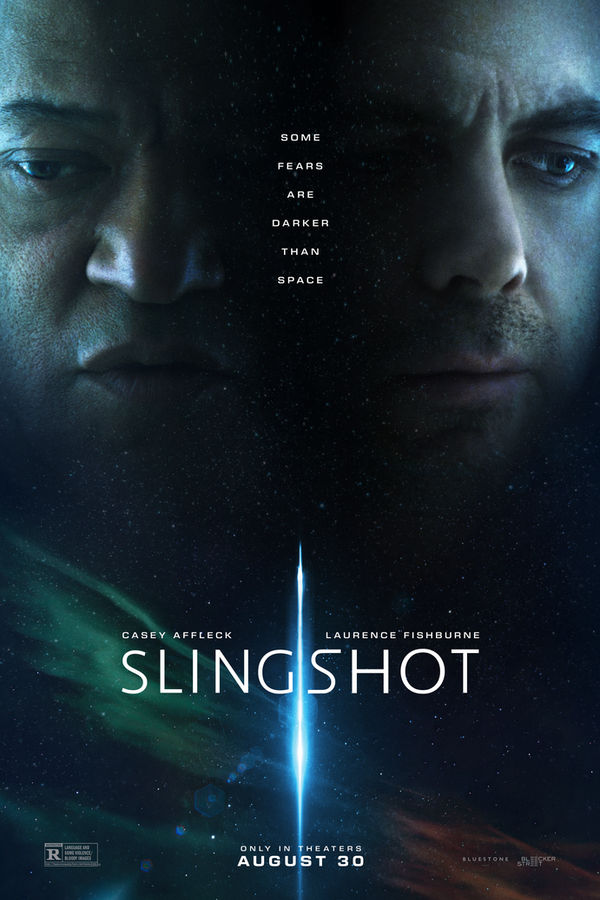
Slingshot (2024) movie poster

Plot Summary

Slingshot (2024) Plot Summary & Ending Explained

Release, runtime and language
2024 · 1 h 49 m · English
Echo score 50
JustWatch #3,064 32
Directed by
Mikael Håfström
Starring
Laurence Fishburne, Casey Affleck, Emily Beecham, Nikolett Barabas, David Morrissey, Harry Szovik

A team of astronauts undertakes a dangerous mission to Saturn's moon Titan. During their journey, the boundaries of reality become unclear, and one crew member struggles to maintain their sanity. The mission's success hinges on a risky slingshot maneuver, which could either propel them towards Titan or leave them lost in the vastness of space.

On this page (7)
  1. 1 Where to watch
  2. 2 What happens: full plot
  3. 3 Plot questions answered
  4. 4 How it ends
  5. 5 Movie threads
  6. 6 Movies like Slingshot
  7. 7 Every angle

Where to watch

Where to Watch Slingshot (2024)

Where can you watch Slingshot? Stream, rent or buy it in the US, including on Hulu, Hoopla and Kanopy: current JustWatch availability with up-to-date prices.

Streaming availability powered by JustWatch

Full plot summary · contains spoilers

What Happens in Slingshot: Full Plot Summary

The whole story of Slingshot (2024) explained, from the opening scene to the final frame: every key event, every twist and what it all adds up to. Read it as a quick recap before the sequel, to check a scene you missed, or to finally understand what really happened.

Astronaut John (Casey Affleck) awakens from a hibernation cycle aboard the spacecraft Odyssey 1, on a mission to Saturn's moon, Titan. The primary objective is to harvest vast natural resources like methane, which are essential for Earth, before making the long journey back. Since the mission spans several years, the crew must alternate between periods of wakefulness and sleep, typically waking every 90 days for routine maintenance and communication with Earth to ensure their trajectory remains intact.

As John's awareness returns, he reconnects with his fellow crew members, including Captain Franks (Laurence Fishburne)—the mission's leader—and Nash (Tomer Capone), an aeronautics specialist. However, John grapples with the disorienting effects of hibernation, which make him forget critical things, including his girlfriend Zoe's (Emily Beecham) last name. Nash offers reassurance, explaining the severe side effects of the drugs used during hibernation and that eventually, John will piece it all back together.

The crew meticulously checks the ship's systems and informs Earth that they are on target for the most perilous part of their journey: executing a “slingshot” maneuver around Jupiter, which will propel them towards Titan. Just as John recalls Zoe’s last name, the crew returns to slumber.

When they awaken next, John is the first to rise and is suddenly knocked unconscious by a falling ceiling panel. As Captain Franks and Nash investigate, they find evident damage to the hull and some internal components, despite the ship's computers showing no record of any impact. Captain Franks suspects structural strain may have caused the ship to warp.

Nash begins to exhibit signs of paranoia, voicing concerns that the ship’s integrity has been compromised and that they cannot survive the slingshot maneuver. He tries to persuade John to rebel against Captain Franks by forcing their hibernation pods to awaken 12 hours early in order to reprogram the ship for a return to Earth instead of proceeding to Titan. John initially agrees but insists this mutiny should only occur with clear evidence of danger.

They awaken early, but Nash's breakdown intensifies as he expresses doubts about their chances of survival. John remains unconvinced, prioritizing their mission's success. Suddenly, Captain Franks reveals himself, having anticipated their plan and awakening early to prevent it. He successfully leads them through the slingshot maneuver, defying Nash, who continues to spiral further into paranoia and despair.

As their journey progresses, John's own mental state deteriorates, leading him to hallucinate conversations with Zoe and fearful visions of the ship’s decay. When the crew awakens again, Nash appears to have lost significant mental function, failing to recall vital personal details. He brings to John's attention a critical issue with the reactor output that, unless fixed, could prevent them from reaching Titan.

John, recognizing the urgency but still grounded in reality, points out Nash's fragile state. Captain Franks then confirms that the reactor’s issues are intentional sabotage, pulling out a gun and accusing Nash of using John's access code to undermine their mission. In a bid to control the situation, Captain Franks decides that Nash must return to hibernation to thwart further sabotage attempts, escorting both men under the threat of violence.

As John is put under sedation, he witnesses Captain Franks brutally attack Nash, potentially killing him. In the subsequent awake cycle, it’s clear Nash is absent, while Captain Franks grows increasingly aggressive, brandishing his weapon to maintain order. John experiences escalating hallucinations and is led to believe Zoe is attempting to reach out to him. The captain accuses John of losing his grip on reality and shockingly reveals that Zoe was not real; she was a fabricated figment, a psychological test by the company.

Frightened and desperate, John demands to see Nash, suspecting foul play. After a violent confrontation, John manages to overpower Captain Franks. When he uses the ship's computer to locate Nash, it confirms a harrowing truth: John has been entirely alone, sailing through space with only his delusions for company. He is, in fact, Captain John Nash Franks, and everything has been a figment of his imagination.

Amid the chaos of his dissolving reality, John fervently pleads for Zoe's guidance, and she emerges on the radio, revealing the shocking truth: he is not in space at all but trapped in a simulated environment beneath a New Mexico facility, part of an experiment to assess the effects of isolation and hibernation. An earthquake has cut him off from help, exacerbating his unstable mental state.

Zoe implores John to escape via the airlock. With a bloody and unhinged Captain Franks adamantly urging him to stay focused on the mission, John wrestles with the competing narratives in his mind. In a decisive moment, he chooses to plunge through the airlock, entering a real world that is far from the fabricated void of space he believed he was traversing. As he emerges into an underground chamber, clarity washes over him; he recognizes the nature of his hallucinations before he is ultimately pulled into the abyss—the true depths of his mind’s turmoil unraveling in a tragic finality.
Last updated: October 24, 2024 at 08:19

Was this helpful?

Plot questions answered

Slingshot Plot Explained: Your Questions Answered

The questions people ask most about Slingshot (2024): what happens in the confusing scenes, why the characters do what they do, the twists, hidden details and what the ending means. Each answer contains spoilers.

Q1

Why does Nash want to mutiny against Captain Franks?

Nash becomes convinced the ship is structurally compromised after discovering unexplained hull damage and believes they cannot survive the slingshot maneuver around Jupiter. He fears the mission will kill them all and tries to convince John to awaken early and reprogram the ship to return to Earth instead of proceeding to Titan.

  • nash
  • mutiny
  • captain franks
  • ship damage
  • slingshot maneuver
Q2

What happens to Nash on the Odyssey 1?

Nash suffers a complete mental breakdown. After the slingshot, his cognitive function declines severely, he forgets personal details and appears to lose touch with reality. Captain Franks ultimately accuses Nash of sabotaging the reactor and forces him back into hibernation, though John later discovers Nash never existed at all.

Foreshadowing: Earlier hints of Nash's paranoia and concerns about the ship's integrity foreshadow his complete mental collapse.

  • nash
  • mental breakdown
  • sabotage
  • captain franks
Q3

Is Zoe real in Slingshot?

No, Zoe is not real. Captain Franks reveals to John that Zoe was never a real person, she was a fabricated figment of John's imagination, created as part of a psychological test by the company conducting the experiment. John had been hallucinating conversations with her throughout the mission.

Foreshadowing: John's inability to remember Zoe's last name despite repeated attempts foreshadows that she exists only in his mind.

  • zoe
  • hallucinations
  • psychological test
  • imaginary character
Q4

Who is John really in Slingshot?

John is actually Captain John Nash Franks, the same person. Throughout the film, the audience believes there are three crew members (John, Captain Franks, and Nash), but the ship's computer reveals that John has been alone the entire time. His identity fragmented into multiple personas, with Captain Franks representing his authoritarian side and Nash representing his paranoid doubts.

Foreshadowing: The unexplained damage, the crew's disagreements, and the fact that only John seems to interact with both Captain Franks and Nash hint at the true nature of these characters.

  • john
  • captain franks
  • nash
  • identity
  • twist
Q5

What is the twist at the end of Slingshot?

The entire space mission is a simulation. John is not an astronaut aboard the Odyssey 1 but rather a test subject trapped in an underground facility in New Mexico. The mission to Titan, the crew members, and the space environment are all fabricated by the simulation. An earthquake has severed his connection to reality, causing his mind to create the elaborate space mission delusion.

Foreshadowing: The unexplained ceiling panel fall, the ship's computer showing no record of damage, and the impossibility of certain events all hint that something is wrong with the reality John experiences.

  • twist
  • simulation
  • ending
  • reveal
  • underground facility
Q6

Why does Captain Franks attack Nash?

Captain Nash of sabot Franks accusesaging the reactor using John's access code, claiming Nash is trying to destroy the mission. In a violent confrontation, Franks attacks Nash while John is sedated. This appears to be John projecting his own violent impulses onto his fragmented personas, as the attack represents the conflict within his own deteriorating mind.

Foreshadowing: The growing tension between crew members and John's suspicions about sabotage build toward this violent outburst.

  • captain franks
  • nash
  • violence
  • attack
  • sabotage
Q7

What was the slingshot maneuver for in the mission?

The slingshot maneuver is a gravity assist around Jupiter that would propel the Odyssey 1 toward Saturn's moon Titan. This dangerous maneuver is the most critical point of the journey, as it determines whether they reach their destination or become lost in space. Captain Franks successfully guides them through it, defying Nash's fears that the ship would not survive.

  • slingshot
  • jupiter
  • titan
  • trajectory
  • gravity assist
Q8

Why does John go through the airlock at the end?

John chooses to plunge through the airlock to escape the simulation and face reality. Despite Captain Franks urging him to stay focused on the fictional mission, Zoe's voice on the radio implores him to break free from the manufactured world. John decides to confront the truth rather than continue living in his delusions, though the escape leads to a tragic outcome.

Foreshadowing: Zoe's voice urging John to escape represents his subconscious drive toward reality and self-awareness.

  • airlock
  • escape
  • simulation
  • reality
  • choice
Q9

Why does John start hallucinating in Slingshot?

John's hallucinations worsen as his mental state deteriorates due to the isolation and psychological stress of the experiment. He sees conversations with Zoe, visions of ship decay, and encounters with crew members who do not exist. These delusions intensify as his grip on reality loosens, eventually making it impossible for him to distinguish between what is real and what his mind has created.

Foreshadowing: John's initial memory problems from hibernation drugs establish the vulnerability of his mental state.

  • hallucinations
  • mental state
  • isolation
  • psychosis
  • deterioration
Q10

What does the ship's computer reveal about John?

When John uses the ship's computer to locate Nash after overpowering Captain Franks, the computer confirms a horrifying truth: there are no other crew members aboard. John has been alone in space the entire time. All crew members, Captain Franks and Nash, were manifestations of his own fractured psyche.

  • ship computer
  • revelation
  • alone
  • crew members
  • truth
Q11

What happens to John at the end of Slingshot?

After exiting the airlock, John emerges into an underground chamber beneath a New Mexico facility, finally understanding his true circumstances. However, rather than finding salvation, he is pulled into the abyss, the depths of his own fractured mind. The film ends tragically with John consumed by his psychological turmoil, unable to escape the darkness of his own consciousness.

  • ending
  • final scene
  • abyss
  • underground facility
  • tragic conclusion
Q12

What was the reactor sabotage about in Slingshot?

Captain Franks accuses Nash of using John's access code to deliberately damage the reactor output, which would prevent them from reaching Titan. However, since Nash was never real, this sabotage represents John's own unconscious desire to fail the mission and return home. It reflects his deep internal conflict between continuing the mission and his growing doubts about survival.

  • reactor
  • sabotage
  • access code
  • mission failure

Ending explained

What Happens at the End of Slingshot?

How Slingshot (2024) ends, in short: the final scene, the last twist and what it means for the characters. The full ending explained, with every spoiler, lives on its own page.

Read the full ending explained

The ending of Slingshot leaves viewers pondering the line between reality and hallucination. In the final scenes, John is shown emerging from an underground vault in Mexico, believing he has been rescued and is about to rejoin the world. However, the moment he steps out and sees sunlight, he also notices a blinking red emergency light and a dead moth inside it—symbolic of death or a failed escape. This suggests that what we’ve been seeing might have been his mind’s final illusions, and possibly, he was never truly in space at all. Instead, he might have been in a controlled environment or undergoing psychological experiments, with the hallucinations serving as a test of his mental resilience. His attempt to leave the vault and reach safety could be just a product of wishful thinking, with his mind creating a false sense of hope before his demise. The scene then cuts to him falling into space, implying that he either died because of his hallucinations or that he escaped only metaphorically, with his mind unable to distinguish reality from illusion. The presence of the dead moth inside the light further emphasizes this duality—either a sign of death, or a symbol of innocence lost in the battle between perception and reality. Ultimately, the film challenges us to question what is real for John: Is he truly free, or is he doomed to remain a prisoner of his hallucinations? The ambiguous ending leaves viewers contemplating whether John’s death is real or a final hallucination, and whether his purpose was simply to test human mental limits in a psychological experiment. In the end, Slingshot encourages reflection on the fragile boundary between reality and perception, leaving its audience with a haunting, open-ended question.
Slingshot ending explained in full

Movie threads

More Movies Like Slingshot, by Mood & Story

Curated lists built around what makes Slingshot tick: the same mood, the same kind of story or the same emotional payoff. Each list explains why these movies belong together.

Movies about psychological breakdown in isolation like Slingshot

Stories where isolation and confinement corrode a character's grip on reality. If you liked the tense, claustrophobic atmosphere of Slingshot, this list features movies with similar themes of psychological unraveling in isolated settings. These films explore the fragility of the mind under extreme pressure, often set in confined spaces or remote locations where reality begins to blur.

  • claustrophobic
  • paranoid
  • disorienting
  • psychological
  • unsettling
  • anxious
  • Tone: dark, paranoid, unsettling
  • Pacing: steady, methodical build
Why these movies?

The story pattern: Narratives in this thread typically follow a protagonist whose isolation—be it physical, such as a space mission or remote outpost, or psychological, like imprisonment—serves as a pressure cooker for mental deterioration. The story structure is often a slow, methodical build of paranoia and hallucinations, challenging both the character and the audience to discern truth from delusion, and frequently ending in tragedy.
Why they belong together: These films are grouped by their shared focus on the intense psychological strain of confinement and solitude. They create a specific, uncomfortable mood of claustrophobia and disorientation, using a steady, deliberate pacing to immerse the viewer in the character's crumbling mental state.

Movies with reality-bending twists like Slingshot

Films that question the nature of reality, memory, and existence itself. For viewers who enjoyed the mind-bending narrative and existential horror of Slingshot, this section features similar sci-fi and thriller movies where the nature of reality is central to the plot. These complex stories often feature shocking reveals that re-contextualize the entire narrative, leaving a lasting emotional impact.

  • mind-bending
  • existential
  • unreliable narrator
  • simulation
  • dread
  • philosophical
  • Tone: dark, philosophical, horrifying
  • Pacing: steady, building to a revelation
Why these movies?

The story pattern: Movies in this thread are defined by a complex narrative structure that relies on an unreliable perspective. The plot often unfolds normally at first, but key reveals—such as the discovery of a simulation, fabricated memories, or a altered state of consciousness—shatter the established reality. This leads to a character arc centered on a crisis of identity and a bleak confrontation with an existential truth.

Why they belong together: These films are united by their exploration of themes like simulation theory, the fragility of memory, and the horror of a fabricated existence. They share a dark, philosophical tone, complex plotting, and a heavy emotional weight derived from the protagonist's tragic awakening to their true circumstances.

If you liked this

Movies Like Slingshot

Similar movies to Slingshot: the same genre, themes or kind of story. Each one comes with its own plot summary, timeline and ending explained.

Browse all movie summaries

Every angle

Slingshot (2024) Explained: Plot, Ending, Timeline & Characters

Everything about Slingshot in one place: what happens in the plot summary, the timeline in chronological order, the characters and meaning, the ending explained and a spoiler-free summary. What's After the Movie adds the cast, box office and post-credit scenes.

Coming soon on iOS and Android

The Plot Explained Movie Summary App

Plot summaries, endings explained and timelines on your phone. Catch up on any movie in minutes, save your favorites and never miss a twist again.

Be the first to know when we launch. Your email stays private, always.

Learn more about the app