Plot Explained Spoilers guaranteed!
Plot Explained

Browse by genre

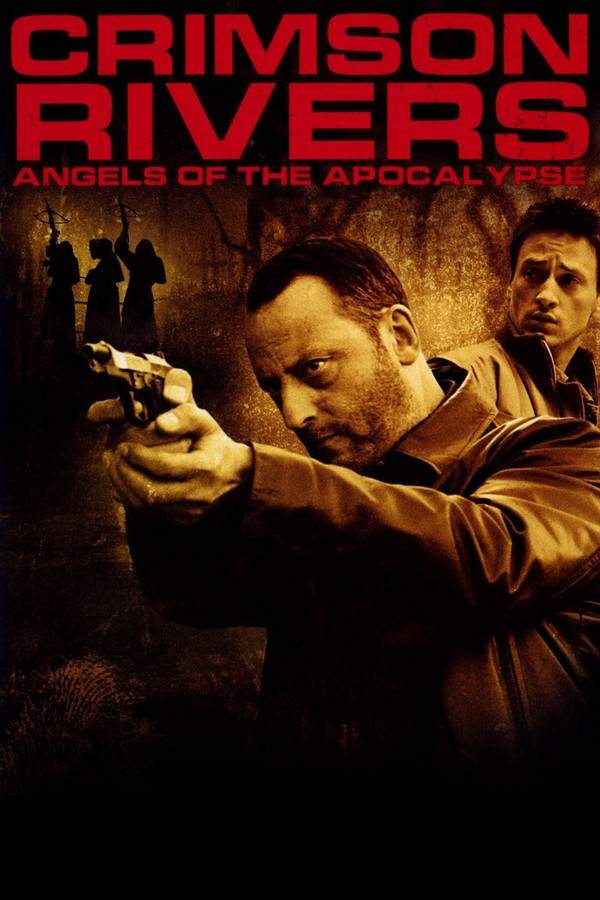
The Crimson Rivers (2001) movie poster

Plot Summary

The Crimson Rivers (2001) Plot Summary Explained

Release, runtime and language
2001 · 106 min · French
JustWatch #14,050 6
Starring
Jean Reno, Vincent Cassel
Budget
$14M

A seasoned detective and his young protégé investigate a murder at a French monastery, uncovering a complex conspiracy. Their investigation reveals a dangerous radical cult and a decades-old secret linked to World War II. As more bodies appear, they find themselves in a deadly cat-and-mouse game with forces threatening global consequences, forcing them to confront a web of intrigue and hidden agendas.

On this page (6)
  1. 1 Where to watch
  2. 2 What happens: full plot
  3. 3 Plot questions answered
  4. 4 Movie threads
  5. 5 Movies like The Crimson Rivers
  6. 6 Every angle

Where to watch

Where to Watch The Crimson Rivers (2001)

Where can you watch The Crimson Rivers? Stream, rent or buy it in the US, including on Kino Film Collection, Hoopla and Kanopy: current JustWatch availability with up-to-date prices.

Streaming availability powered by JustWatch

Full plot summary · contains spoilers

What Happens in The Crimson Rivers: Full Plot Summary

The whole story of The Crimson Rivers (2001) explained, from the opening scene to the final frame: every key event, every twist and what it all adds up to. Read it as a quick recap before the sequel, to check a scene you missed, or to finally understand what really happened.

Detective Superintendent Pierre Niemans, portrayed by Jean Reno, is sent to the isolated university town of Guernon nestled in the picturesque French Alps to investigate a horrific murder that has shaken the academic community to its core. The victim, Professor Remy Callois, a highly respected scholar and custodian of the university's secrets, has been found brutally murdered, his eyes cruelly removed. As Niemans begins to untangle the threads of this chilling case, he consults with Dr. Cherneze, played by Jean-Pierre Cassel, an ophthalmologist who sheds light on the dark legacy of inbreeding among the faculty members, a consequence of their seclusion and misguided obsession with intellectual elitism.

Meanwhile, in the neighboring town of Sarzac, Detective Inspector Max Kerkerian, brought to life by Vincent Cassel, finds himself investigating a perplexing series of events surrounding the desecration of the grave of Judith Herault, a young girl who perished in 1982. The mystery deepens as photographs of her are mysteriously stolen from the local primary school. As Niemans intensifies his inquiry, he becomes enmeshed in a sinister conspiracy that could be linked to the faculty’s medical establishment in Guernon.

His investigation takes a twist when he encounters Fanny Ferreira, a glaciologist entangled in her own secrets. As Niemans rummages through the late librarian’s office, he uncovers a chilling archive detailing the original faculty's malevolent intentions to forge a super-race through intellectual selection, bypassing physical criteria altogether. This shocking revelation hints that their inbreeding practices were not mere accidents, but rather a calculated effort to engineer a so-called "superior" being.

As Niemans and Kerkerian's paths converge, they stumble upon a second victim, killed in a similarly ritualistic manner as Callois, this time discovered within the icy depths of a glacier. The glassy eyes of the unfortunate soul send chills down their spines, solidifying their understanding that the perpetrator is not an ordinary murderer, but someone far more dangerous.

Tension escalates when Niemans rendezvous with Kerkerian at the residence of the latest victim, only to realize he has been inadvertently lured deeper into the enigma. As they piece together the puzzle, they uncover that the fingerprints on Niemans' firearm belong to none other than Judith Herault herself. The game intensifies, and the stakes soar to alarming heights.

Navigating the treacherous mountain roads to reach Fanny's residence, the duo narrowly avoids disaster thanks to the reckless driving of the Dean's wayward son. Their minds race with the dark truths being unveiled: the university's covert breeding program, which had been swapping healthy village children for those of faculty members burdened by genetic deformities from generations of inbreeding. The faculty's medical professionals had unwittingly participated, with Callois’ meticulous planning paving the way for these morally bankrupt arrangements.

The deeper they delve, the more chilling the implications become. Sertys must have switched Fanny with one of the deceased faculty babies, while her identical twin sister, Judith, was left with their family as a control subject. After Judith's recent hospital stay due to a broken wrist, her mother recognizes an uncanny likeness between Judith and Fanny, leading to a desperate escape from the hospital, pursued by the very faculty members who precipitated a tragic accident claiming her husband’s life.

As her grasp on reality weakens, the mother finds sanctuary in adopting the somber attire of a nun, while Judith becomes voraciously intent on reclaiming Fanny. The unearthed remnants of horrors—the hands and eyes of the program's victims—discovered hidden in Fanny’s basement, ominously amplify their dawning comprehension of the lurking evils.

In a climactic moment, as chaos reigns, Niemans takes charge, ordering an evacuation of the university as he and Kerkerian embark on a treacherous journey up the mountain to find Fanny. However, a shocking confrontation awaits them—Judith, in her terrifying intensity, commands Fanny to eliminate Niemans. The clash escalates into a chaotic gunfight that triggers an avalanche, burying all parties beneath the snow's relentless embrace. As the flurry settles, so do the fates of those involved, precariously awaiting the arrival of rescuers amidst the silent aftermath.
Last updated: November 22, 2024 at 14:55

Was this helpful?

Plot questions answered

The Crimson Rivers Plot Explained: Your Questions Answered

The questions people ask most about The Crimson Rivers (2001): what happens in the confusing scenes, why the characters do what they do, the twists, hidden details and what the ending means. Each answer contains spoilers.

Q1

Why was Professor Callois murdered?

Professor Callois was murdered because he was the mastermind behind the university's secret breeding program. As the architect of the scheme to swap healthy village children with genetically deformed faculty offspring, he became a liability as the investigation closed in. The killer removed his eyes as a symbolic act, reflecting the program's obsession with vision and intellectual clarity.

Foreshadowing: Earlier references to the university's secretive nature and Callois's role as the 'custodian of secrets' hint at his central position in the conspiracy.

  • professor callois
  • murder
  • motive
  • breeding program
Q2

What was the university's secret breeding program?

The breeding program was a decades-long eugenics scheme where the faculty swapped healthy children from the village with their own genetically deformed offspring. The goal was to eliminate physical weaknesses from their bloodline while passing off healthy children as their own. The program was kept hidden within the university's medical establishment, with faculty doctors participating in the swaps.

Foreshadowing: Dr. Cherneze's explanation about inbreeding among faculty members establishes the genetic problems that drove the program.

  • breeding program
  • eugenics
  • university
  • secret
  • faculty
Q3

Who is Fanny and what is her connection to Judith?

Fanny Ferreira is a glaciologist who was secretly switched at birth with Judith Herault, her identical twin sister. The university took Judith's healthy sibling for the breeding program while leaving Judith with her original family as a control subject. After Judith's hospital stay following a broken wrist, her mother noticed the resemblance between the girls, leading Judith to become obsessed with reclaiming her sister.

Foreshadowing: The desecration of Judith's grave and theft of her photographs from the school hint at someone trying to reconnect with her identity.

  • fanny ferreira
  • judith herault
  • twins
  • identical
  • switched
Q4

Why were the victims' eyes removed?

The eyes were removed as a symbolic ritual tied to the university's obsession with vision and intellectual clarity. The founder who initiated the breeding program believed that 'seeing' was the ultimate human capability, and removing the eyes from victims served as a macabre tribute to this philosophy while also instilling fear in those investigating the case.

Foreshadowing: Dr. Cherneze's ophthalmology background and his discussions about vision establish the thematic importance of eyes throughout the investigation.

  • eyes removed
  • ritual
  • killings
  • symbolic
  • murder method
Q5

Why did Judith try to kill Niemans?

Judith was driven to extreme action because she believed Fanny belonged with her and resented the separation caused by the university's program. After learning the truth about being swapped, Judith became consumed by the need to reclaim her sister. When Niemans arrived to save Fanny, Judith coercedher into killing him, viewing the detective as an obstacle to reuniting with her twin.

Foreshadowing: Judith's hospital escape and her mother's observations about her increasingly strange behavior foreshadow her psychological break.

  • judith
  • niemans
  • attack
  • fanny
  • confrontation
Q6

How are the two murder investigations connected?

Both investigations converge on the university's secret breeding program. Niemans investigates the ritualistic murder of Professor Callois in Guernon, while Kerkerian probes the desecration of Judith Herault's grave in Sarzac. The cases connect when evidence reveals Judith's fingerprints on Niemans's weapon and both paths lead to the university's decades-long scheme involving swapped children.

Foreshadowing: The timeline shows both investigations running parallel before converging at the university as the conspiracy unravels.

  • niedmans
  • kerkerian
  • connected
  • investigations
  • converge
Q7

What causes the avalanche at the end?

The avalanche is triggered during the climactic gunfight between Judith and Niemans. As bullets fly and chaos erupts on the mountain, the disturbance destabilizes the snowpack, causing a massive avalanche that buries everyone present. The ending remains ambiguous as the characters await rescue beneath the snow, with their fates left uncertain.

Foreshadowing: The journey up the mountain to Fanny's residence establishes the dangerous snowy environment that becomes critical in the climax.

  • avalanche
  • ending
  • gunfight
  • buried
  • snow
Q8

Why did the university swap village children with faculty babies?

The university swapped children to eliminate genetic deformities caused by generations of inbreeding among the faculty. Healthy village children were taken to be raised as faculty offspring, while faculty babies with disabilities were placed in the village. This ensured the faculty's 'superior' bloodline appeared physically flawless while burdening village families with the genetic consequences of their eugenicist practices.

Foreshadowing: The archive discovery reveals the original faculty's explicit goal of creating a super-race through intellectual selection, not physical criteria.

  • children swapped
  • village
  • faculty
  • deformities
  • breeding
Q9

Why was Judith Herault's grave desecrated?

Judith's grave was desecrated as part of the university's effort to maintain control over the program's secrets. Since Judith was the 'control subject' left with her original family, someone sought to erase or manipulate evidence linking her to the swapped children. The stolen photographs from the school further indicate an attempt to erase Judith's identity and cover tracks before the investigators could piece together the truth.

Foreshadowing: The timeline establishes this as an early event that sparks Kerkerian's investigation and connects to the present-day murders.

  • judith
  • grave
  • desecrated
  • stolen photos
  • cover up
Q10

Why does Judith's fingerprint appear on Niemans's gun?

Judith's fingerprint is found on Niemans's firearm because she deliberately placed it there as part of an elaborate scheme to manipulate the investigation. This discovery shocks the investigators and suggests Judith had been actively involved in the crimes, though the full truth emerges when her connection to the twins and the breeding program becomes clear.

Foreshadowing: The revelation that Judith is Fanny's identical twin and the 'control subject' explains why she had access to and motive for interacting with evidence.

  • fingerprint
  • gun
  • judith
  • niemans
  • evidence
Q11

Who is the second murder victim found in the glacier?

The second victim is another participant in the university's breeding program, killed in the same ritualistic manner as Professor Callois, eyes removed. Found frozen in the glacier, this murder confirms that the killer is targeting those involved in the program and is using the same symbolic method. The discovery deepens the investigators' understanding that they are dealing with someone seeking revenge for the program's atrocities.

Foreshadowing: The second murder occurs shortly after the first, establishing the pattern that drives the investigation forward.

  • second victim
  • glacier
  • murder
  • ritualistic
  • eyes
Q12

What is found in Fanny's basement?

Fanny's basement contains the remains of the breeding program's victims, specifically the hands and eyes of those who were killed or died as part of the scheme. These grim artifacts were hidden there by the faculty to conceal evidence of their crimes. The discovery shocks investigators and provides concrete proof of the atrocities committed over decades, connecting Fanny to the horror despite her being a victim of the program herself.

Foreshadowing: Fanny's adoption by the faculty through the program logically explains why evidence would be stored at her residence.

  • fanny
  • basement
  • remains
  • hands
  • eyes
  • evidence

Movie threads

More Movies Like The Crimson Rivers, by Mood & Story

Curated lists built around what makes The Crimson Rivers tick: the same mood, the same kind of story or the same emotional payoff. Each list explains why these movies belong together.

Thrillers about academic conspiracies like The Crimson Rivers

Thrillers where elite institutions hide disturbing secrets behind a respectable facade. If you enjoyed the dark secrets of The Crimson Rivers, discover more movies like it where investigations uncover sinister truths hidden within elite institutions. These similar thrillers and crime stories feature conspiracies, hidden agendas, and a clash between perceived respectability and deep-rooted corruption.

  • sinister
  • chilling
  • conspiratorial
  • oppressive
  • intellectual
  • suspenseful
  • Tone: dark, tense, sinister
  • Pacing: steady, investigative
Why these movies?

The story pattern: Stories in this thread typically follow an investigator or skeptic uncovering a conspiracy that is protected by an institution's authority and secrecy. The narrative builds as clues challenge the official story, leading to a confrontation that exposes the rot at the core. The journey is one of disillusionment and the struggle against a sophisticated, entrenched enemy.

Why they belong together: Movies are grouped here based on their central conflict with a corrupt, intelligent establishment. They share a tone of intellectual dread, a steady pacing of discovery, and a heavy emotional weight stemming from the betrayal of trust by supposed pillars of society.

High-tension detective thrillers like The Crimson Rivers

Gripping detective stories where the investigation itself feels dangerous and oppressive. Fans of the tense, chilling atmosphere in The Crimson Rivers will find more movies like it here. These similar mystery and crime films feature a steady, gripping pace, complex plots, and a heavy sense of dread as detectives navigate a dangerous web of clues and threats.

  • tense
  • suspenseful
  • chilling
  • gripping
  • harrowing
  • oppressive
  • Tone: tense, suspenseful, harrowing
  • Pacing: steady, relentless
Why these movies?

The story pattern: The narrative pattern involves a procedural investigation that quickly escalates beyond a simple case, revealing a larger, more personal threat. The pacing is relentless, with new discoveries raising the stakes and tightening the noose around the protagonists. The emotional journey is one of paranoia and resilience against overwhelming, sinister forces.

Why they belong together: These films are united by their masterful control of mood—specifically, a tense and suspenseful tone that generates a constant feeling of unease and impending danger. They share a high-intensity, steady pacing that keeps viewers on edge from start to finish.

If you liked this

Movies Like The Crimson Rivers

Similar movies to The Crimson Rivers: the same genre, themes or kind of story. Each one comes with its own plot summary, timeline and ending explained.

Browse all movie summaries

Every angle

The Crimson Rivers (2001) Explained: Plot, Timeline & Characters

Everything about The Crimson Rivers in one place: what happens in the plot summary, the timeline in chronological order, the characters and meaning and a spoiler-free summary. What's After the Movie adds the cast, box office and post-credit scenes.

Coming soon on iOS and Android

The Plot Explained Movie Summary App

Plot summaries, endings explained and timelines on your phone. Catch up on any movie in minutes, save your favorites and never miss a twist again.

Be the first to know when we launch. Your email stays private, always.

Learn more about the app