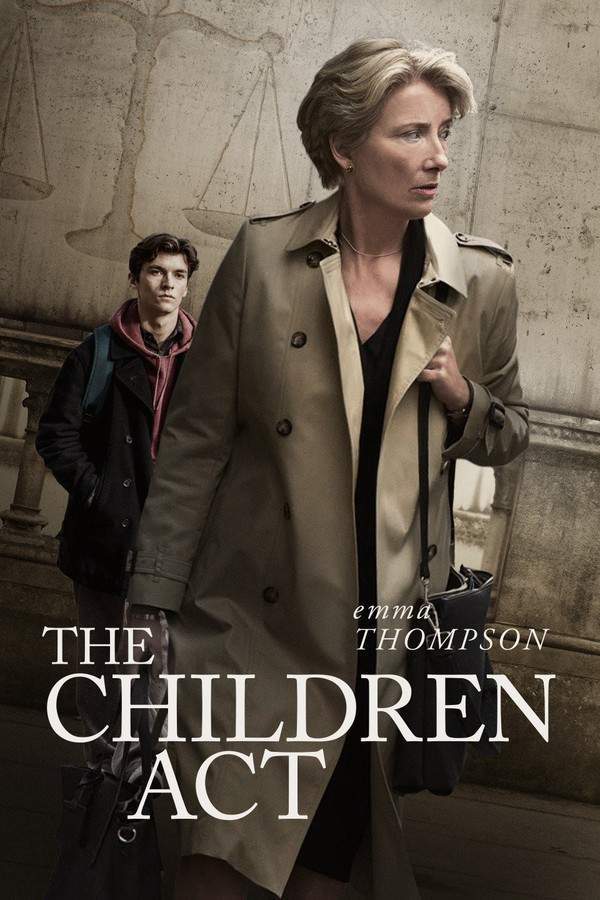
A High Court judge, Fiona Maye, presides over difficult cases while her personal life suffers. Her career takes an unexpected turn when she must rule on a case involving a teenage Jehovah's Witness who refuses a life-saving blood transfusion based on religious beliefs. As she considers the legal and ethical implications, Fiona confronts her own values and embarks on a journey of self-discovery, grappling with the complexities of upholding the law and preserving a young man’s life.
Warning: spoilers below!
Haven’t seen The Children Act yet? This summary contains major spoilers. Bookmark the page, watch the movie, and come back for the full breakdown. If you're ready, scroll on and relive the story!
Read the complete plot breakdown of The Children Act (2018), including all key story events, major twists, and the ending explained in detail. Discover what really happened—and what it all means.
Fiona Maye is a distinguished High Court Judge, recognized for her expertise in Family Law, residing in the serene surroundings of Gray’s Inn Square. As she meticulously reviews a case, she receives an unexpected visit from her husband, Jack Maye. He confesses that their marriage has become devoid of physical intimacy and expresses his desire to engage in a sexual affair with a 28-year-old statistician, seeking Fiona’s consent. This shocking revelation horrifies her, leading Fiona to firmly refuse his proposal. The root of her distress stems from a traumatic case she recently presided over, where her ruling on the separation of conjoined twins resulted in the death of one of the twins. While her peers praised her as an intelligent and elegant judge, Fiona is haunted by that verdict, a burden she chooses not to share with Jack.
In the midst of their heated argument, Fiona is interrupted by a call regarding an urgent case involving a young teen named Adam Henry, a Jehovah’s Witness battling leukemia, who is refusing a life-saving blood transfusion. As Jack storms out, Fiona heads to work, grappling with thoughts about her marriage and the absence of children in her life, a consequence of her unwavering commitment to her career. In a moment of impulsivity, she decides to change the locks on their home, fully aware of the illegal nature of her actions. Upon returning, she is struck by the realization that Jack has not attempted to return or reach out to her.
The following day, Fiona hears the arguments concerning Adam’s case. Since he is merely three months away from turning 18, she visits him in the hospital to determine whether he truly comprehends the gravity of denying medical treatment. In their meeting, Adam displays his precocious intellect and kindness, sharing poetry and offering her a heartfelt musical performance on his violin. Their impromptu duet culminates in a joyful moment. Energized by their encounter, Fiona makes the ruling that permits the hospital to administer the transfusion. However, upon returning home, she discovers that Jack has come back, regretting his earlier stance. This moment brings Fiona mixed feelings; she had just begun to accept her solitude, which she finds disappointing.
As months pass, the tension in Fiona’s marriage persists. She starts receiving letters from Adam, expressing gratitude for her decision while also revealing his growing disillusionment with his parents and religion. Fiona attempts to ignore these communications, yet the impact of Adam’s words weighs heavily on her. During a work trip to Newcastle, she runs into Adam, who reveals that he has left his home and wishes to live with her. Fiona, however, stands firm in her refusal and encourages him to reach out to his mother. In an emotionally charged farewell, their goodbye kiss unexpectedly turns into a moment of passion that leaves Fiona feeling alarmed.
After returning home, Fiona and Jack begin to rebuild their relationship, gradually growing closer. Another letter from Adam arrives, containing a religious poem that suggests he views Fiona as a temptation leading him astray from his faith. Ignoring his letters persists, yet Fiona’s focus shifts as she prepares for a Christmas concert for her colleagues. The night before the concert, she and Jack share a tender moment of reconciliation, promising to recommit to each other.
However, during the concert, Fiona receives devastating news: Adam has succumbed to his leukemia after rejecting treatment, now that he is of legal age. Heartbroken, she performs at the concert and rushes home, where she recounts the details of Adam’s case, their kiss, and his untimely death to Jack. Overwhelmed with guilt for her complicity in his tragic return to faith, she breaks down, crying herself to sleep. Yet, in the early hours, Jack reassures her of his love as Fiona opens up about her guilt, fostering a deeper connection between them amidst the turmoil.
Last Updated: November 04, 2024 at 00:03
Discover curated groups of movies connected by mood, themes, and story style. Browse collections built around emotion, atmosphere, and narrative focus to easily find films that match what you feel like watching right now.
Stories where a professional's duty clashes with profound personal morality.Movies like The Children Act, where a professional's judgment is tested by a grave moral dilemma. These films explore the heavy burden of responsibility, the clash between duty and conscience, and the quiet, devastating fallout of making an impossible choice.
These narratives typically follow a protagonist whose expertise is challenged by a case or situation that defies easy answers. The plot hinges on their deliberation process, examining the ramifications of each potential outcome. The conflict is largely internal and intellectual, with external pressures amplifying the personal crisis, often leading to a transformation or profound reckoning for the character.
They are grouped by their central, high-stakes ethical conflict, a slow-burn intensity driven by intellectual and emotional deliberation, and a melancholic, thoughtful tone. Viewers are drawn into the protagonist's agonizing thought process, creating a deeply immersive and reflective experience.
Character studies of brilliant but isolated individuals confronting their own emptiness.If you liked The Children Act's portrayal of Fiona's loneliness, you'll appreciate these movies about solitary figures. They feature protagonists who are brilliant in their field but emotionally adrift, facing a crisis that exposes the high personal cost of their professional dedication.
The story unfolds through a character's internal journey rather than external action. A catalyst—often a professional case or a personal rupture—acts as a mirror, forcing the protagonist to see the emotional barrenness of their existence. The arc involves a painful but necessary confrontation with their own choices, leading to a bittersweet acknowledgment of what has been lost and what might be salvaged.
These movies share a deeply melancholic and reflective mood, a slow, introspective pacing, and a focus on the quiet ache of loneliness. They are united by a protagonist whose intellectual prowess contrasts sharply with their emotional disconnection, creating a poignant and relatable human drama.
Don't stop at just watching — explore The Children Act in full detail. From the complete plot summary and scene-by-scene timeline to character breakdowns, thematic analysis, and a deep dive into the ending — every page helps you truly understand what The Children Act is all about. Plus, discover what's next after the movie.
Track the full timeline of The Children Act with every major event arranged chronologically. Perfect for decoding non-linear storytelling, flashbacks, or parallel narratives with a clear scene-by-scene breakdown.
Discover the characters, locations, and core themes that shape The Children Act. Get insights into symbolic elements, setting significance, and deeper narrative meaning — ideal for thematic analysis and movie breakdowns.
Get a quick, spoiler-free overview of The Children Act that covers the main plot points and key details without revealing any major twists or spoilers. Perfect for those who want to know what to expect before diving in.
Visit What's After the Movie to explore more about The Children Act: box office results, cast and crew info, production details, post-credit scenes, and external links — all in one place for movie fans and researchers.
Discover movies like The Children Act that share similar genres, themes, and storytelling elements. Whether you’re drawn to the atmosphere, character arcs, or plot structure, these curated recommendations will help you explore more films you’ll love.
The Children Act (2018) Scene-by-Scene Movie Timeline
The Children Act (2018) Movie Characters, Themes & Settings
The Children Act (2018) Spoiler-Free Summary & Key Flow
Movies Like The Children Act – Similar Titles You’ll Enjoy
Jude (1996) Ending Explained & Film Insights
The Children's Hour (1961) Detailed Story Recap
The Client (1994) Film Overview & Timeline
The Judge (2014) Movie Recap & Themes
Apostasy (2017) Plot Summary & Ending Explained
Just Ask My Children (2001) Complete Plot Breakdown
Judgment (2001) Plot Summary & Ending Explained
A Stoning in Fulham County (1988) Complete Plot Breakdown
Where Are My Children? (1916) Film Overview & Timeline
The Devil Judge (1000) Ending Explained & Film Insights
Children (1976) Plot Summary & Ending Explained
The Judge (1949) Full Summary & Key Details
Whose Child Am I? (1976) Movie Recap & Themes
Life for Ruth (1962) Ending Explained & Film Insights
A Child’s Cry for Help (1994) Movie Recap & Themes