Plot Explained Spoilers guaranteed!
Plot Explained

Browse by genre

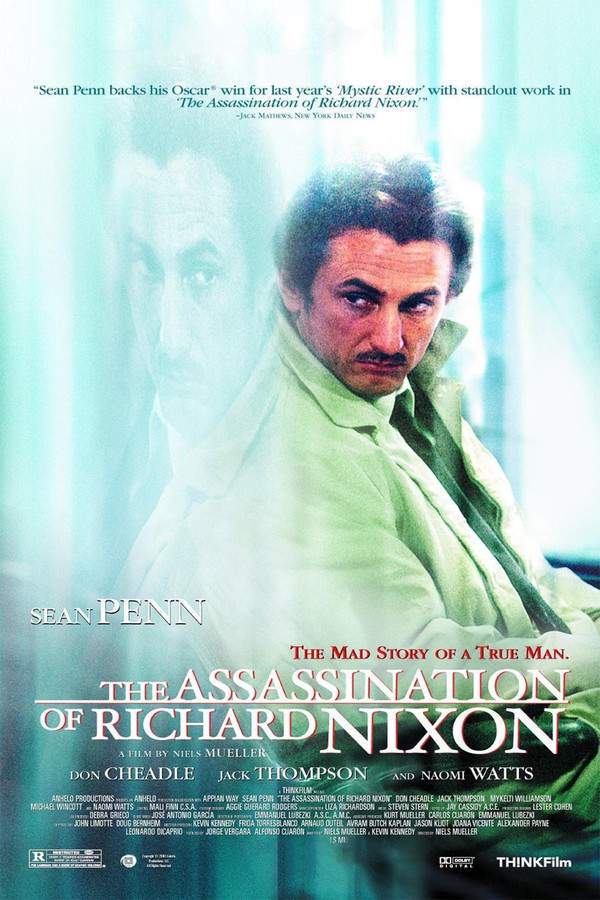
The Assassination of Richard Nixon (2004) movie poster

Timeline

The Assassination of Richard Nixon (2004) Timeline Explained – Every Event in Order

Release, runtime and language
2004 · 95 min · English
Directed by
Niels Mueller
Starring
Don Cheadle, Naomi Watts, Sean Penn

A disillusioned salesman, Samuel Bicke, becomes increasingly unhinged as his personal ideals collide with the realities of American society. Fueled by resentment towards Richard Nixon and the perceived corruption of the system, he isolates himself and sabotages relationships. His obsession leads him to formulate a desperate and dangerous plan to assassinate the president, driven by a desire to reclaim control and challenge the perceived injustices of capitalism. The situation escalates as Samuel’s mental state deteriorates, culminating in a shocking attempt to confront the nation's leader.

On this page (5)
  1. 1 Events in order (14)
  2. 2 Timeline questions answered
  3. 3 Movie threads
  4. 4 Movies like The Assassination of Richard Nixon
  5. 5 Every angle

14 events in order · contains spoilers

The Assassination of Richard Nixon Timeline: Events in Chronological Order

Every key event of The Assassination of Richard Nixon (2004) in order, scene by scene, with when and where it takes place. Use it to untangle flashbacks, time jumps and parallel storylines, to refresh your memory before the sequel or to find the exact scene you are thinking of.

  1. Sam Bicke's Misfortunes Begin

    In 1973, Sam Bicke, a 43-year-old salesman from Philadelphia, faces a series of unfortunate events that leave him struggling. Driven by his principles, he chooses to quit his job at his brother Julius's tire shop, unable to reconcile his role in lying to customers.

    When
    1973
    Where
    Philadelphia
  2. Strained Marital Relationship

    Sam's attempts to reconnect with his estranged wife, Marie, prove futile as she continues to reject him. This emotional turmoil deepens as Marie eventually sends him a divorce decree, leaving Sam heartbroken.

  3. Joining the Black Panthers

    In a misguided effort to understand societal inequalities, Sam attempts to align himself with the Black Panthers, believing that poor white people share similar struggles to racial minorities. His intentions reflect a desperation to find a place in a world that seems to exclude him.

  4. New Job at Office Furniture Store

    Sam secures a position at an office furniture store, where he faces condescension from his boss, Jack. Despite Jack's advice, Sam's social awkwardness leads to consistently poor sales performance, saturating him with a sense of inadequacy.

    Where
    Office Furniture Store
  5. Descent into Despair

    As time progresses, Sam's frustration with his societal position intensifies. After sending a government loan application to fund a mobile tire business with his friend Bonny, he anxiously awaits a response that never arrives, compounding his sense of hopelessness.

  6. Outburst at Work

    In a fit of rage, Sam deliberately sabotages a sale at work to express his discontent, leading to his eventual resignation. He watches the Watergate scandal unfold on television, echoing his disdain with a potent shout at Nixon, stating, 'It's about money, Dick!'

    Where
    Office Furniture Store
  7. Breaking Into Julius's Shop

    Desperate for funding, Sam resorts to breaking into his brother’s tire shop to place an order for Bonny. His ongoing struggles deepen when he discovers that his loan application has been denied, leaving him financially stranded and abandoned by his brother.

    Where
    Julius's Tire Shop
  8. Fixation on Nixon

    Sam begins to develop an obsession with Richard Nixon, particularly after witnessing a news segment involving a helicopter pilot’s arrest. This fixation escalates into a dark plan, where he contemplates hijacking a plane as a means of making a statement.

  9. Preparing for a Drastic Action

    In a prelude to chaos, Sam withdraws his savings and steals Bonny's gun. He hesitates when targeting Jack at a restaurant and ultimately panics, showcasing his internal conflict and desperation as he flees from the scene.

    Where
    Restaurant
  10. Final Acts of Violence

    After a sleepless night in his abandoned home, Sam commits an irrational act of violence against his family dog, indicating his deteriorating mental state. This harrowing moment is a precursor to the violence he is about to unleash upon the world.

  11. The Airport Incident

    With a gun concealed and a suitcase full of gasoline, Sam arrives at the Baltimore–Washington International Airport after mailing a confession to Leonard Bernstein. Panic ensues when he encounters heightened security and rushes onto a plane, resulting in chaos and violence.

    Where
    Baltimore–Washington International Airport
  12. Hijacking the Plane

    Once aboard the plane, Sam begins firing indiscriminately at the cockpit, fatally wounding one pilot and injuring another. In his frantic bid for control, he coerces a passenger to assume the role of co-pilot, showcasing his unraveling grip on reality.

    Where
    On the plane
  13. Confrontation with Law Enforcement

    As law enforcement attempts to intervene, Sam is shot by officers trying to subdue him. In a tragic culmination of his descent into madness, he chooses suicide over capture, encapsulating the despair that defined his final moments.

  14. Chilling Aftermath

    Following Sam's death, the repercussions of his actions resonate across the nation. Coverage of the tragic event reveals a stark contrast to the apathy of Bonny and Marie, who show little to no reaction to the calamity that unfolded around them.

Last updated: November 15, 2024 at 19:35

Was this helpful?

Timeline questions answered

The Assassination of Richard Nixon Timeline Explained: Your Questions Answered

When does it happen, and why in that order? The questions people ask about the chronology of The Assassination of Richard Nixon (2004): time jumps, flashbacks, cause and effect between scenes and the correct order of events, each answered with spoilers.

Q1

Why did Sam quit his job at his brother's tire shop?

Sam quit his job at Julius's tire shop because he couldn't bear to lie to customers. He was a man driven by strong principles and felt morally compromised selling tires he knew were overpriced or unnecessary. This decision to prioritize his ethical beliefs over financial stability marked the beginning of his descent into economic hardship and personal crisis.

Foreshadowing: Earlier, Sam's principled nature is established when he tries to align himself with the Black Panthers, showing his pattern of letting ideals override practical considerations.

  • sam bicke
  • julius
  • tire shop
  • quit job
  • principles
Q2

Why did Sam try to join the Black Panthers?

Sam attempted to join the Black Panthers in a misguided effort to find community and purpose. He believed that poor white people faced similar societal inequalities to racial minorities, and he was desperate to belong to a group that seemed to challenge the system. This reflects his growing sense of alienation and his tendency to latch onto ideological causes when feeling excluded from mainstream society.

  • sam bicke
  • black panthers
  • poverty
  • inequality
  • belonging
Q3

Why was Sam's government loan application denied?

The summary does not specify why Sam's loan application was denied, but the denial itself is significant. Sam had applied for a government loan to fund a mobile tire business with his friend Bonny. The rejection symbolizes another institutional rejection and pushes him further into despair. Combined with his mounting financial problems, overdue rent and inability to secure stable employment, the denied loan represents the final closure of his pathway to legitimate success.

  • loan application
  • denied
  • government loan
  • business
  • bonny
  • finances
Q4

Why did Julius cut ties with Sam after bailing out Bonny?

Julius bailed out Bonny (Sam's best friend and business partner) after a legal problem, but then cut ties with Sam entirely, calling him a hypocritical deadweight. Julius saw Sam as a hypocrite, someone who claimed moral superiority by quitting the tire shop yet still resorted to breaking into that same shop to place an order for Bonny. This betrayal by his own brother devastated Sam and represented the final rupture of his support system.

  • julius
  • bonny
  • cut ties
  • brother
  • betrayal
  • hypocrisy
Q5

Why did Sam become obsessed with Richard Nixon?

Sam's obsession with Nixon developed from his growing belief that the American political system was fundamentally corrupt. After watching Watergate scandal coverage and seeing Nixon on television, Sam became convinced that Nixon's presidency represented the core of the system's corruption. He famously shouted at the screen, "It's about money, Dick!" This fixation escalated when he saw a news segment about a helicopter pilot arrested for flying near the White House, giving him the idea to hijack a plane as a dramatic statement against the president.

Foreshadowing: Sam's earlier disdain for Nixon is established when his boss Jack praises Nixon as a great salesman who promised Vietnam withdrawal but didn't deliver, a parallel that Sam clearly resents.

  • nixon
  • watergate
  • obsession
  • helicopter
  • white house
  • protest
Q6

Why did Sam decide to hijack a plane?

Sam decided to hijack a plane after seeing a news segment about a helicopter pilot who flew near the White House and was arrested. This gave him the idea to stage a dramatic attack on American politics by hijacking a commercial airplane and crashing it into what he saw as the seat of governmental power. His goal was to make a statement against what he perceived as the corruption of the Nixon administration and the capitalist system.

  • plane hijacking
  • helicopter
  • white house
  • attack
  • statement
Q7

Why did Sam record a message to Leonard Bernstein?

Sam recorded a message to Leonard Bernstein (the famous conductor) because he admired him as an idol and saw him as someone who might understand his motivations. In the two weeks leading up to his attack, Sam mailed this confession to Bernstein, pouring out his emotional struggles and intentions. This reflects Sam's desperate need for validation and recognition, he wanted someone he respected to understand why he was taking such drastic action.

  • leonard bernstein
  • confession
  • idol
  • message
  • recording
Q8

Why couldn't Sam pull the trigger when trying to kill Jack?

Sam hesitated and couldn't pull the trigger when he confronted Jack at a restaurant. This moment reveals Sam's internal conflict, he was driven by rage and desperation but still had reservations about committing murder. His panic and inability to follow through forced him to flee the scene, demonstrating the tension between his violent intentions and his remaining humanity.

  • jack
  • restaurant
  • shooting
  • hesitation
  • panic
  • inability
Q9

Why did Sam kill his family dog?

Sam killed his family dog in a moment of irrational violence that marked a new low in his mental deterioration. After a sleepless night spent in the empty shell of his former home, he committed this horrifying act against his own pet. This act of violence against a defenseless animal demonstrates how far his mental state had collapsed, serving as a precursor to the broader violence he was about to unleash at the airport.

  • dog
  • violence
  • animal
  • deterioration
  • desperation
Q10

Why did Sam rush onto the plane instead of waiting?

Sam rushed onto the plane because he encountered unexpected security measures at Baltimore-Washington International Airport. He had originally planned to wait to board, but when he saw heightened security, he panicked and Sprint onto the plane, beginning the chaotic hijacking. This rash decision resulted in him shooting a police officer during the ensuing chaos.

  • airport
  • security
  • rush
  • plane
  • shooting
  • police
Q11

Why did Sam shoot the pilots on the hijacked plane?

Sam shot the pilots (fatally wounding one and injuring another) because he was trying to gain control of the aircraft. After boarding the plane, he fired indiscriminately at the cockpit, then coerced a passenger to take on the role of co-pilot. His goal was to seize control of the plane and carry out his planned attack, though the exact destination or method remained unclear given his deteriorating mental state.

  • pilots
  • shooting
  • cockpit
  • hijacking
  • control
  • plane
Q12

Why did Sam choose to kill himself instead of being captured?

Sam chose suicide over capture when law enforcement officers shot through a window during the confrontation. Rather than be apprehended and face trial, Sam shot himself, ending his life before authorities could take him into custody. This final act symbolizes his complete descent into despair and his refusal to face the consequences of his actions or experience any form of judgment or imprisonment.

  • suicide
  • capture
  • law enforcement
  • death
  • surrender
Q13

Why didn't Bonny or Marie show any reaction to Sam's actions?

The summary notes that neither Bonny (Sam's best friend) nor Marie (his estranged wife) showed any noticeable reaction to the tragedy. This absence of response highlights the emotional disconnection that had already developed in these relationships. Both had been pushed away by Sam's escalating behavior, and their lack of reaction underscores how isolated he had become, no one who knew him personally was moved or affected by his final act.

  • bonny
  • marie
  • reaction
  • apathy
  • isolation
  • relationships

Movie threads

More Movies Like The Assassination of Richard Nixon, by Mood & Story

Curated lists built around what makes The Assassination of Richard Nixon tick: the same mood, the same kind of story or the same emotional payoff. Each list explains why these movies belong together.

Downward spiral character studies like The Assassination of Richard Nixon

Character studies of individuals unraveling under societal pressures. If you were captivated by the grim portrayal of Samuel Bicke's descent, explore more movies like The Assassination of Richard Nixon. This collection features similar stories of alienation, failure, and mental health crises, focusing on characters whose ideals clash with harsh realities, leading to tragic outcomes.

  • unsettling
  • desperate
  • claustrophobic
  • anxious
  • isolating
  • grim
  • Tone: dark, bleak
  • Pacing: steady, character driven
Why these movies?

The story pattern: Narratives in this thread follow a linear, often predictable, path of decline. The protagonist, typically an ordinary person, becomes increasingly isolated as their worldview is shattered. Their actions grow more desperate and irrational, culminating in a final, often violent, act that feels both shocking and inevitable.

Why they belong together: These films are grouped by their unflinching focus on a single character's psychological deterioration. They share a heavy emotional weight, a steady pacing that builds tension, and a bleak tone that offers little relief, making the viewing experience profoundly unsettling and introspective.
Political disillusionment thrillers like The Assassination of Richard Nixon

Thrillers where personal crisis collides with a corrupt system. For viewers seeking similar stories of political anger and despair, this list features movies like The Assassination of Richard Nixon. These films explore themes of systemic failure, the corrupted American dream, and the devastating consequences when an individual takes a desperate stand against a powerful institution.

  • frustrating
  • angry
  • tense
  • grim
  • paranoid
  • cynical
  • Tone: dark, tense
  • Pacing: steady, building dread
Why these movies?

The story pattern: The plot is driven by a protagonist's growing obsession with a perceived political evil. Their personal life falls apart as they become consumed by a futile quest for justice or recognition. The story builds with a tense, steady pace towards a confrontation that highlights the immense power imbalance between the individual and the establishment.

Why they belong together: These movies share a specific vibe of frustrated idealism turning into destructive obsession. They combine the tension of a thriller with the heavy themes of a drama, resulting in a viewing experience that is intellectually stimulating and emotionally draining, centered on the failure of individuals within large, impersonal systems.

If you liked this

Movies Like The Assassination of Richard Nixon

Similar movies to The Assassination of Richard Nixon: the same genre, themes or kind of story. Each one comes with its own plot summary, timeline and ending explained.

Browse all movie summaries

Every angle

The Assassination of Richard Nixon (2004) Explained: Plot, Timeline & Characters

Everything about The Assassination of Richard Nixon in one place: what happens in the plot summary, the timeline in chronological order, the characters and meaning and a spoiler-free summary. What's After the Movie adds the cast, box office and post-credit scenes.

Coming soon on iOS and Android

The Plot Explained Movie Summary App

Plot summaries, endings explained and timelines on your phone. Catch up on any movie in minutes, save your favorites and never miss a twist again.

Be the first to know when we launch. Your email stays private, always.

Learn more about the app