Plot Explained Spoilers guaranteed!
Plot Explained

Browse by genre

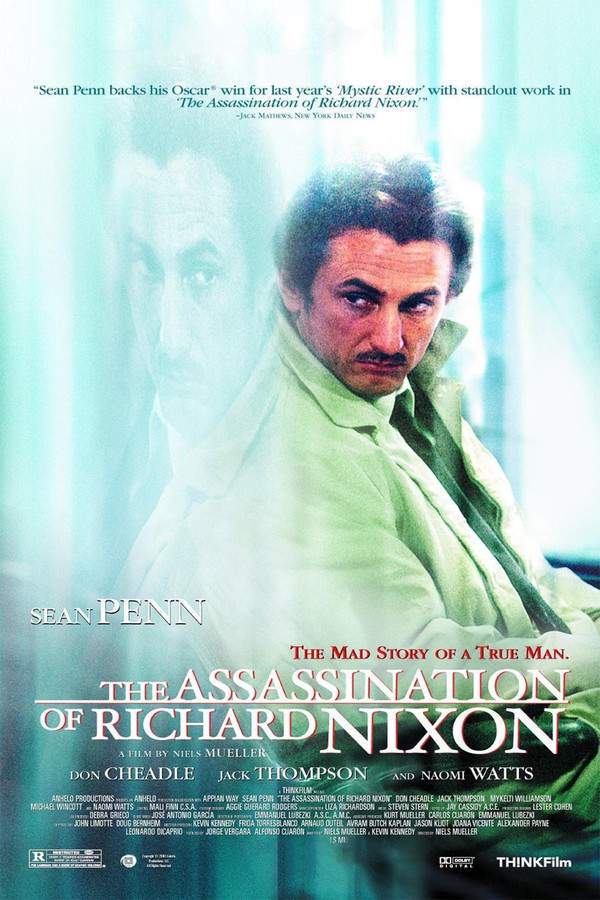
The Assassination of Richard Nixon (2004) movie poster

Characters & Themes

The Assassination of Richard Nixon (2004) Characters, Setting & Themes Explained

Release, runtime and language
2004 · 95 min · English
Directed by
Niels Mueller
Starring
Don Cheadle, Naomi Watts, Sean Penn

A disillusioned salesman, Samuel Bicke, becomes increasingly unhinged as his personal ideals collide with the realities of American society. Fueled by resentment towards Richard Nixon and the perceived corruption of the system, he isolates himself and sabotages relationships. His obsession leads him to formulate a desperate and dangerous plan to assassinate the president, driven by a desire to reclaim control and challenge the perceived injustices of capitalism. The situation escalates as Samuel’s mental state deteriorates, culminating in a shocking attempt to confront the nation's leader.

On this page (7)
  1. 1 Characters explained (3)
  2. 2 Where & when it takes place
  3. 3 Themes & meaning (3)
  4. 4 Character & meaning questions
  5. 5 Movie threads
  6. 6 Movies like The Assassination of Richard Nixon
  7. 7 Every angle

3 main characters · contains spoilers

The Assassination of Richard Nixon Characters Explained: Who Is Who

The main characters of The Assassination of Richard Nixon (2004), heroes and villains: what drives them, how they change over the course of the story and what each of them reveals about the film's bigger ideas.

  • Sam Bicke (Sean Penn)

    Sam Bicke is a profoundly troubled individual whose moral compass leads him to a series of misguided decisions. Driven by a desire for reconciliation and justice, he ultimately succumbs to despair and violence. His character embodies the struggle against societal injustices and personal demons, leading to tragic consequences.

    • 🧑‍🤝‍🧑 Protagonist
    • 💼 Salesman
    • 🥀 Troubled
  • Marie Bicke (Naomi Watts)

    Marie Bicke is Sam’s estranged wife who grapples with the fallout of their failing marriage. Her consistent rejection of Sam’s attempts for reconciliation showcases her exasperation with his instability. Marie represents the emotional toll that Sam's struggles impose on those around him, embodying the pain of unmet expectations.

    • 💔 Heartbroken
    • 👩‍❤️‍👨 Estranged Wife
    • 😞 Supporting
  • Bonny (Don Cheadle)

    Bonny is Sam’s best friend and partner in the mobile tire business venture. As an African-American mechanic, he offers a contrasting perspective to Sam's misguided beliefs about societal issues. His loyalty and attempts to support Sam reveal the complexity of friendship amidst personal crises.

    • 👬 Friend
    • 🛠️ Mechanic
    • 🖤 Supportive

Last updated: October 22, 2024 at 21:44

Was this helpful?

Setting

Where and When Does The Assassination of Richard Nixon Take Place?

The setting of The Assassination of Richard Nixon (2004): the year and time period, the places and locations, and how they shape the characters, the mood and the tension of the story.

Time period

1973

The year 1973 was marked by political disillusionment and social upheaval within America. Coming off the heels of the Vietnam War and as the Watergate scandal unraveled, many citizens grappled with their trust in government and authority. This context of unrest heavily influences Sam's mindset and decisions throughout the film.

Location

Philadelphia, Baltimore–Washington International Airport

Philadelphia serves as the backdrop for Sam Bicke's tumultuous life. Known for its rich history and cultural significance, the city is a microcosm of American dreams and disappointments. The Baltimore–Washington International Airport becomes the tragic stage for Sam's desperate actions, symbolizing the chaotic intersection of his aspirations and ultimate downfall.

  • 🏙️ City
  • ✈️ Airport

Last updated: October 22, 2024 at 21:44

Was this helpful?

3 major themes

The Assassination of Richard Nixon Meaning: Themes & Message Explained

What is The Assassination of Richard Nixon (2004) really about? The emotional, social and philosophical themes the film keeps returning to, its symbolism and the message beneath the surface.

  • Social Inequality

    The theme of social inequality permeates through Sam's struggles and motivations. He perceives the challenges faced by his own demographic as similar to those of marginalized communities. His misguided attempts to align himself with the Black Panthers embody his desire for social justice, despite the tragic path he ultimately chooses.

  • Despair

    Despair is a central theme that drives the narrative of Sam's life. With each failure, from his job loss to the dissolution of his marriage, he spirals further into a profound sense of hopelessness. His desperate actions reflect a cry for help and the tragic consequences of unaddressed mental health issues.

  • Violence

    Violence serves as the ultimate expression of Sam’s internal turmoil and desperation. His shift from an ordinary life to contemplating an act of terror illustrates a critical commentary on the extremes one might reach when pushed to the edge. This theme culminates in a tragic climax that highlights the devastating impact of violence and mental breakdown.

Last updated: October 22, 2024 at 21:44

Was this helpful?

Character & theme questions

The Assassination of Richard Nixon Characters & Meaning: Your Questions Answered

The questions people ask about The Assassination of Richard Nixon (2004): who the characters really are, their relationships, what the symbols mean, where it takes place and what the movie is really about. Each answer contains spoilers.

Q1

Where is the movie set?

The movie primarily takes place in Philadelphia, which serves as a symbolic backdrop representing American dreams and disappointments. The climax occurs at Baltimore-Washington International Airport, where Sam's desperate plan unfolds.

  • philadelphia
  • baltimore-washington airport
  • setting
  • location
Q2

What time period does the film depict?

The film is set in 1973, during a period of deep political disillusionment in America. This was the era of the Vietnam War's aftermath and the unfolding Watergate scandal, which profoundly shaped the societal atmosphere of distrust that influences Sam's mindset.

  • 1973
  • 1970s
  • watergate
  • vietnam war
  • time period
  • historical context
Q3

What does the movie say about social inequality?

The film explores social inequality through Sam Bicke's perception that he and marginalized communities face similar systemic challenges. His misguided attempt to align himself with the Black Panthers represents his distorted view of social justice, demonstrating how personal frustration can manifest in misinformed activism.

  • social inequality
  • black panthers
  • social justice
  • marginalization
Q4

How does the movie address despair and mental health?

Despair is central to the narrative, depicting Sam's gradual mental deterioration through job loss, marital failure, and increasing isolation. His desperate violent act serves as a tragic cry for help, illustrating the devastating consequences of unaddressed mental health struggles and hopelessness.

  • despair
  • mental health
  • depression
  • hopelessness
  • isolation
Q5

Why does the movie focus on violence as a theme?

The film presents violence as the ultimate expression of Sam's internal turmoil and desperation. His transition from an ordinary life to planning an act of terror serves as a stark commentary on how extreme psychological distress can lead to catastrophic actions, ultimately highlighting the tragic impact of violence on both the individual and society.

  • violence
  • desperation
  • mental breakdown
  • terrorism
  • psychological turmoil
Q6

Who is Sam Bicke as a character?

Sam Bicke is the protagonist, a profoundly troubled man whose moral compass leads him down a path of misguided decisions. Driven by a genuine desire for justice and reconciliation, he ultimately succumbs to despair and violence, embodying the tragic struggle between personal ideals and mental instability.

  • sam bicke
  • protagonist
  • sean penn
  • main character
Q7

What role does Marie Bicke play in the story?

Marie Bicke is Sam's estranged wife who represents the emotional devastation his struggles cause to those closest to her. Her consistent rejection of Sam's reconciliation attempts reflects her exhaustion with his instability, showing how a person's mental decline ripples outward to harm family members.

  • marie bicke
  • naomi watts
  • wife
  • relationship
  • family
Q8

Who is Bonny in the movie?

Bonny is Sam's best friend and business partner in their mobile tire venture, portrayed by Don Cheadle. As an African-American mechanic, he provides a contrasting perspective to Sam's misguided beliefs about societal issues, representing the complexity of friendship even when one person's worldview becomes distorted.

  • bonny
  • don cheadle
  • friend
  • mechanic
  • business partner
Q9

How does the Watergate scandal influence the story?

The Watergate scandal, unfolding during the film's 1973 setting, creates the backdrop of government corruption that fuels Sam's obsession with Richard Nixon. This era of institutional distrust amplifies Sam's paranoid beliefs that the system is fundamentally rigged against ordinary citizens.

  • watergate
  • nixon
  • government corruption
  • political scandal
  • 1970s politics
Q10

What is the movie's perspective on capitalism?

The film depicts Sam's perception that capitalism creates systemic injustices that trap ordinary people. His resentment toward what he sees as a corrupt system drives his extreme plan to assassinate Nixon, framing his action as a challenge to perceived economic and political oppression.

  • capitalism
  • corruption
  • economic injustice
  • system critique
  • oppression
Q11

What is the overall tone and atmosphere of the film?

The film maintains an overwhelmingly dark and pessimistic tone throughout, with no moments of levity or hope. It unflinchingly depicts mental deterioration and builds tension toward a bleak ending, creating a heavy emotional weight that aligns with its themes of failure, alienation, and systemic corruption.

  • tone
  • atmosphere
  • dark
  • pessimistic
  • mood
  • emotional weight

Movie threads

More Movies Like The Assassination of Richard Nixon, by Mood & Story

Curated lists built around what makes The Assassination of Richard Nixon tick: the same mood, the same kind of story or the same emotional payoff. Each list explains why these movies belong together.

Downward spiral character studies like The Assassination of Richard Nixon

Character studies of individuals unraveling under societal pressures. If you were captivated by the grim portrayal of Samuel Bicke's descent, explore more movies like The Assassination of Richard Nixon. This collection features similar stories of alienation, failure, and mental health crises, focusing on characters whose ideals clash with harsh realities, leading to tragic outcomes.

  • unsettling
  • desperate
  • claustrophobic
  • anxious
  • isolating
  • grim
  • Tone: dark, bleak
  • Pacing: steady, character driven
Why these movies?

The story pattern: Narratives in this thread follow a linear, often predictable, path of decline. The protagonist, typically an ordinary person, becomes increasingly isolated as their worldview is shattered. Their actions grow more desperate and irrational, culminating in a final, often violent, act that feels both shocking and inevitable.

Why they belong together: These films are grouped by their unflinching focus on a single character's psychological deterioration. They share a heavy emotional weight, a steady pacing that builds tension, and a bleak tone that offers little relief, making the viewing experience profoundly unsettling and introspective.

Political disillusionment thrillers like The Assassination of Richard Nixon

Thrillers where personal crisis collides with a corrupt system. For viewers seeking similar stories of political anger and despair, this list features movies like The Assassination of Richard Nixon. These films explore themes of systemic failure, the corrupted American dream, and the devastating consequences when an individual takes a desperate stand against a powerful institution.

  • frustrating
  • angry
  • tense
  • grim
  • paranoid
  • cynical
  • Tone: dark, tense
  • Pacing: steady, building dread
Why these movies?

The story pattern: The plot is driven by a protagonist's growing obsession with a perceived political evil. Their personal life falls apart as they become consumed by a futile quest for justice or recognition. The story builds with a tense, steady pace towards a confrontation that highlights the immense power imbalance between the individual and the establishment.

Why they belong together: These movies share a specific vibe of frustrated idealism turning into destructive obsession. They combine the tension of a thriller with the heavy themes of a drama, resulting in a viewing experience that is intellectually stimulating and emotionally draining, centered on the failure of individuals within large, impersonal systems.

If you liked this

Movies Like The Assassination of Richard Nixon

Similar movies to The Assassination of Richard Nixon: the same genre, themes or kind of story. Each one comes with its own plot summary, timeline and ending explained.

Browse all movie summaries

Every angle

The Assassination of Richard Nixon (2004) Explained: Plot, Timeline & Characters

Everything about The Assassination of Richard Nixon in one place: what happens in the plot summary, the timeline in chronological order, the characters and meaning and a spoiler-free summary. What's After the Movie adds the cast, box office and post-credit scenes.

Coming soon on iOS and Android

The Plot Explained Movie Summary App

Plot summaries, endings explained and timelines on your phone. Catch up on any movie in minutes, save your favorites and never miss a twist again.

Be the first to know when we launch. Your email stays private, always.

Learn more about the app