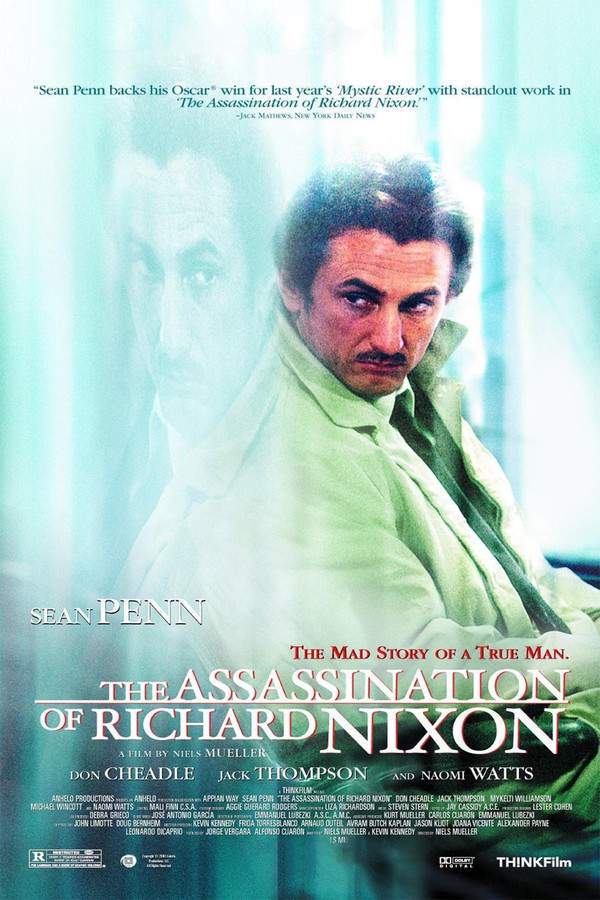
Year: 2004
Runtime: 95 min
Language: English
Director: Niels Mueller
A disillusioned salesman, Samuel Bicke, becomes increasingly unhinged as his personal ideals collide with the realities of American society. Fueled by resentment towards Richard Nixon and the perceived corruption of the system, he isolates himself and sabotages relationships. His obsession leads him to formulate a desperate and dangerous plan to assassinate the president, driven by a desire to reclaim control and challenge the perceived injustices of capitalism. The situation escalates as Samuel’s mental state deteriorates, culminating in a shocking attempt to confront the nation's leader.
Warning: spoilers below!
Haven’t seen The Assassination of Richard Nixon yet? This summary contains major spoilers. Bookmark the page, watch the movie, and come back for the full breakdown. If you're ready, scroll on and relive the story!
Read the complete plot breakdown of The Assassination of Richard Nixon (2004), including all key story events, major twists, and the ending explained in detail. Discover what really happened—and what it all means.
In 1973, Sam Bicke (portrayed by Sean Penn), a 43-year-old salesman from Philadelphia, finds himself battling a wave of misfortune. He yearns to mend the rift with his estranged wife, Marie (played by Naomi Watts). A man driven by his principles, he quit his job at his brother Julius’s (rendered by Michael Wincott) tire shop, claiming it was because he couldn’t bear to lie to customers. In a misguided belief that society’s inequalities impact poor white people in a similar way to racial minorities, he tries to align himself with the Black Panthers. His ultimate ambition revolves around launching a mobile tire business alongside his best friend, Bonny (performed by Don Cheadle), an African-American mechanic.
Sam secures a position at an office furniture store, where his new boss, Jack (played by Jack Thompson), offers him condescending advice while Sam’s social awkwardness hampers his sales performance. Jack praises Richard Nixon, calling him the greatest salesman for promising U.S. withdrawal from Vietnam while basking in his re-election victory in 1972 with a similar promise, a stark reminder of the disillusionment that grips Sam.
As time goes by, he grows increasingly frustrated with his place in society. Desperate to obtain a government loan for his venture with Bonny, he anxiously anticipates a response in the mail. His performance continues to plummet, and suspicion arises regarding his marital status since Jack only hires married salesmen. Meanwhile, Marie’s consistent rejection of Sam’s sporadic attempts at reconciliation—culminating in her sending him a divorce decree—leaves him heartbroken and in tears. In a moment of anger, he sabotages his work sale to make a statement and, subsequently, quits his job. Watching Nixon during the Watergate scandal, he shouts at the screen, >“It’s about money, Dick!”
With the loan application still unapproved, Sam resorts to breaking into his brother’s tire shop to place a substantial order for Bonny. Soon, however, his application is denied, his rent is overdue, and he learns that Julius has taken matters into his own hands by bailing out Bonny following a legal mishap. This revelation seals Sam’s fate as Julius cuts ties with him entirely, deeming him a hypocritical deadweight.
As despair tightens its grip, Sam becomes fixated on Nixon. After witnessing a news segment about a helicopter pilot who flew near the White House and was subsequently arrested, a dark plan starts to take shape in his mind—a plot to hijack a commercial airplane and crash it into the very heart of American politics. In the subsequent two weeks leading up to his drastic action, he records a message to his idol, Leonard Bernstein, outlining his intentions and emotional struggles.
In preparation for this audacious act, Sam withdraws his savings, steals Bonny’s gun, and targets a restaurant where Jack is dining. He finds himself unable to pull the trigger and panics, fleeing the scene. He then spends a restless night in the empty shell of his former home before committing an unthinkable act of violence against their family dog. The following day, he heads to the Baltimore–Washington International Airport, concealing a gun against his leg and carrying a suitcase of gasoline. After mailing his confession to Bernstein, he initially plans to wait to board his flight but, overwhelmed by unexpected security measures, he sprints onto the plane, shooting a police officer in the chaos.
Once aboard, he indiscriminately fires at the cockpit, fatally wounding one pilot and injuring another. In a frantic bid to assert control, he coerces a passenger to take on the role of co-pilot. However, as law enforcement intervenes, he is shot through a window but tragically opts for suicide before authorities can apprehend him. The chilling aftermath of his actions plays out on television, yet neither Bonny nor Marie shows any noticeable reaction to the tragedy surrounding Sam’s descent into madness.
Last Updated: November 15, 2024 at 19:35
Discover curated groups of movies connected by mood, themes, and story style. Browse collections built around emotion, atmosphere, and narrative focus to easily find films that match what you feel like watching right now.
Character studies of individuals unraveling under societal pressures.If you were captivated by the grim portrayal of Samuel Bicke's descent, explore more movies like The Assassination of Richard Nixon. This collection features similar stories of alienation, failure, and mental health crises, focusing on characters whose ideals clash with harsh realities, leading to tragic outcomes.
Narratives in this thread follow a linear, often predictable, path of decline. The protagonist, typically an ordinary person, becomes increasingly isolated as their worldview is shattered. Their actions grow more desperate and irrational, culminating in a final, often violent, act that feels both shocking and inevitable.
These films are grouped by their unflinching focus on a single character's psychological deterioration. They share a heavy emotional weight, a steady pacing that builds tension, and a bleak tone that offers little relief, making the viewing experience profoundly unsettling and introspective.
Thrillers where personal crisis collides with a corrupt system.For viewers seeking similar stories of political anger and despair, this list features movies like The Assassination of Richard Nixon. These films explore themes of systemic failure, the corrupted American dream, and the devastating consequences when an individual takes a desperate stand against a powerful institution.
The plot is driven by a protagonist's growing obsession with a perceived political evil. Their personal life falls apart as they become consumed by a futile quest for justice or recognition. The story builds with a tense, steady pace towards a confrontation that highlights the immense power imbalance between the individual and the establishment.
These movies share a specific vibe of frustrated idealism turning into destructive obsession. They combine the tension of a thriller with the heavy themes of a drama, resulting in a viewing experience that is intellectually stimulating and emotionally draining, centered on the failure of individuals within large, impersonal systems.
Don't stop at just watching — explore The Assassination of Richard Nixon in full detail. From the complete plot summary and scene-by-scene timeline to character breakdowns, thematic analysis, and a deep dive into the ending — every page helps you truly understand what The Assassination of Richard Nixon is all about. Plus, discover what's next after the movie.
Track the full timeline of The Assassination of Richard Nixon with every major event arranged chronologically. Perfect for decoding non-linear storytelling, flashbacks, or parallel narratives with a clear scene-by-scene breakdown.
Discover the characters, locations, and core themes that shape The Assassination of Richard Nixon. Get insights into symbolic elements, setting significance, and deeper narrative meaning — ideal for thematic analysis and movie breakdowns.
Get a quick, spoiler-free overview of The Assassination of Richard Nixon that covers the main plot points and key details without revealing any major twists or spoilers. Perfect for those who want to know what to expect before diving in.
Visit What's After the Movie to explore more about The Assassination of Richard Nixon: box office results, cast and crew info, production details, post-credit scenes, and external links — all in one place for movie fans and researchers.
Discover movies like The Assassination of Richard Nixon that share similar genres, themes, and storytelling elements. Whether you’re drawn to the atmosphere, character arcs, or plot structure, these curated recommendations will help you explore more films you’ll love.
The Assassination of Richard Nixon (2004) Scene-by-Scene Movie Timeline
The Assassination of Richard Nixon (2004) Movie Characters, Themes & Settings
The Assassination of Richard Nixon (2004) Spoiler-Free Summary & Key Flow
Movies Like The Assassination of Richard Nixon – Similar Titles You’ll Enjoy
All the President's Men (1976) Movie Recap & Themes
Frost/Nixon (2008) Story Summary & Characters
Nixon (1995) Complete Plot Breakdown
Interview with the Assassin (2002) Spoiler-Packed Plot Recap
18½ (2022) Movie Recap & Themes
Tricky Dick (1000) Full Movie Breakdown
Cover-Up (1991) Story Summary & Characters
Secret Honor (1984) Spoiler-Packed Plot Recap
Assassination (1987) Full Movie Breakdown
The Final Days (1989) Ending Explained & Film Insights
The Kidnapping of the President (1980) Film Overview & Timeline
Watergate: Blueprint for a Scandal (1000) Full Movie Breakdown
The Assassination (1972) Detailed Story Recap
The Assassination File (1996) Ending Explained & Film Insights
Kissinger and Nixon (1995) Ending Explained & Film Insights