Plot Explained Spoilers guaranteed!
Plot Explained

Browse by genre

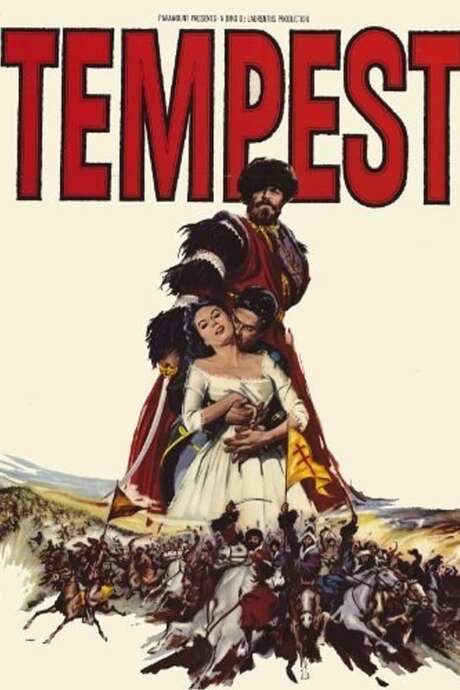
Tempest (1958) movie poster

Plot Summary

Tempest (1958) Plot Summary Explained

Release, runtime and language
1958 · 120 mins · Italian
Directed by
Alberto Lattuada
Starring
Finlay Currie, Oskar Homolka, Helmut Dantine, Agnes Moorehead, Van Heflin, Geoffrey Horne

En route to a remote outpost in Empress Catherine’s Russian army, a young officer saves a nearly frozen stranger during a violent snowstorm. The rescued man vows gratitude, but when a Cossack uprising besieges the fort, the officer discovers the rebel leader is the very stranger he rescued, forcing a bitter clash of loyalty and survival.

On this page (7)
  1. 1 Where to watch
  2. 2 What happens: full plot
  3. 3 Plot questions answered
  4. 4 The book behind the movie
  5. 5 Movie threads
  6. 6 Movies like Tempest
  7. 7 Every angle

Where to watch

Where to Watch Tempest (1958)

Where can you watch Tempest? Stream, rent or buy it in the US, including on Amazon Video, Apple TV Store and Google Play Movies: current JustWatch availability with up-to-date prices.

Streaming availability powered by JustWatch

Full plot summary · contains spoilers

What Happens in Tempest: Full Plot Summary

The whole story of Tempest (1958) explained, from the opening scene to the final frame: every key event, every twist and what it all adds up to. Read it as a quick recap before the sequel, to check a scene you missed, or to finally understand what really happened.

In the year 1770, in imperial Russia, a young lieutenant Grinyov, Geoffrey Horne is caught drunk during a military inspection. As punishment, Empress Catherine II orders him to be reassigned to the remote fortress town of Belogorsk. On the long, cold journey to this distant outpost, Grinyov helps a man caught in a brutal snowstorm—unaware at first that the stranger is Yemelyan Pugachev, Van Heflin a Cossack whose charisma and restless energy will soon ignite a rebellion that could shake the empire to its core.

Upon arriving at Belogorsk, Grinyov comes under the command of Captain Mironov, Robert Keith a humane and principled officer whose steady leadership earns the loyalty of his soldiers and the respect of the fortress community. Mironov is a guardian of the post’s integrity, and his house is a center of warmth in a place that otherwise testifies to the harshness of frontier life. Mironov has a daughter named Masha, Agnes Moorehead a capable and loving presence who brightens the fortress with her quiet strength. It is there, under Mironov’s watchful eye, that Grinyov’s gaze is drawn to Masha, and a fervent, unfolding affection quickly takes root.

That love, however, collides with competition from another officer at the post—Lieutenant Shvabrin, Helmut Dantine—a man of charm and ambition who is also enamored with Masha. What begins as a tender courtship soon becomes a tense triangular dynamic, where pride and desire threaten to undermine the discipline the fortress must maintain. As the personal tensions rise, the broader horizon darkens: the threat of a massive Cossack uprising grows nearer, and the man Grinyov once rescued, Pugachev, looms as both a symbol and a catalyst for a rebellion that could redefine the fate of the empire.

Throughout these interwoven pressures—duty clashing with longing, loyalty tested by whispers of treason, and a political storm gathering strength—the fortress becomes a small stage for larger forces at play. Grinyov must navigate not only the dangerous climb of romance and rivalries within Belogorsk but also the perilous political landscape outside its walls, where orders from the throne and the rumors of rebellion pull in opposing directions. The characters must weigh what they owe to the army, what they owe to each other, and what survival will demand of them when the empire itself seems to tremble at the edge of upheaval.

As events unfold, the story centers on a web of loyalties and choices set against a backdrop of impending revolt. Grinyov confronts the hard realities of command, honor, and resilience, while his personal feelings for Masha test the boundaries between passion and prudence. The looming uprising—led by the very man Grinyov once saved—casts a long shadow over the fortress, forcing each character to decide where their true loyalties lie: with an emperor and an oath, with a people and a cause, or with the fragile bonds of family and love that hold them together in times of political turmoil and danger. In the end, the narrative captures the delicate balance between surviving the moment and shaping a future beyond it, a balance defined by courage, fidelity, and the stubborn will to endure amid chaos.

Last updated: February 24, 2026 at 13:46

Was this helpful?

Plot questions answered

Tempest Plot Explained: Your Questions Answered

The questions people ask most about Tempest (1958): what happens in the confusing scenes, why the characters do what they do, the twists, hidden details and what the ending means. Each answer contains spoilers.

Q1

Why was Lieutenant Grinyov reassigned to Belogorsk?

Grinyov was punished for being caught drunk during a military inspection in 1770, which brought shame on himself and his unit. Empress Catherine II ordered his reassignment to the remote frontier outpost of Belogorsk as punishment for this infraction.

  • grinyov
  • punishment
  • catherine
  • belogorsk
  • reassignment
  • drunk
Q2

Why did Grinyov save the stranger in the snowstorm?

While traveling to Belogorsk, Grinyov encountered a man caught in a brutal snowstorm and chose to help him, acting on mercy and compassion. He had no idea at the time that this stranger was Yemelyan Pugachev, the Cossack who would soon lead a massive rebellion against the empire.

Foreshadowing: The rescue establishes the ironic moral dilemma that will later force Grinyov to choose between loyalty to the empire and the man he once saved.

  • rescue
  • snowstorm
  • pugachev
  • compassion
  • stranger
Q3

Who is Pugachev and why is he important?

Yemelyan Pugachev is a charismatic Cossack who leads a major rebellion against Empress Catherine's empire in the 1770s. His uprising threatens to shake the entire empire, and he becomes the central political threat that looms over Belogorsk fortress throughout the story.

  • pugachev
  • cossack
  • rebellion
  • uprising
  • revolution
Q4

Why is Pugachev's identity significant to Grinyov?

The twist reveals that the stranger Grinyov rescued in the snowstorm is actually Pugachev, the rebel leader. This creates a profound moral dilemma for Grinyov, who must now face the man he once saved while torn between loyalty to the empire and the debt of gratitude he owes.

Foreshadowing: The rescue earlier in the story directly sets up this ironic confrontation.

  • pugachev
  • identity
  • moral dilemma
  • grinyov
  • gratitude
Q5

What role does the love triangle play in the story?

Grinyov falls in love with Masha, the daughter of Captain Mironov, but faces competition from Lieutenant Shvabrin, another officer who also pursues Masha. This romantic rivalry creates tension within the fortress and forces Grinyov to balance his personal desires with his military duties.

  • masha
  • shvabrin
  • love triangle
  • rivalry
  • romance
Q6

Who is Captain Mironov and why does he matter?

Captain Mironov is the commander of Belogorsk fortress, a humane and principled officer whose leadership earns the respect and loyalty of his soldiers. He represents the integrity of the imperial military and serves as a moral anchor for Grinyov throughout the story.

  • mironov
  • commander
  • fortress
  • leadership
  • integrity
Q7

What motivates Lieutenant Shvabrin's rivalry with Grinyov?

Shvabrin is both charmed and ambitious, competing with Grinyov for Masha's affection while also challenging Grinyov's position at the fortress. His desire for Masha and professional rivalry threaten the discipline and harmony of the military unit.

  • shvabrin
  • rivalry
  • ambition
  • masha
  • competition
Q8

What loyalty conflicts does Grinyov face during the uprising?

Grinyov must navigate conflicting loyalties: to Empress Catherine and his military oath, to Captain Mironov who commands him, to his love for Masha, and to Pugachev whom he accidentally saved. The approaching rebellion forces him to make difficult choices between personal relationships and duty.

  • loyalty
  • rebellion
  • conflict
  • duty
  • empire
Q9

What happens when the Cossack uprising reaches Belogorsk?

The fortress faces siege as Pugachev's rebellion spreads, forcing the characters to choose sides and endure hardship. The political turmoil tests every character's loyalties and forces Grinyov to confront the reality of the man he saved leading an attack against his own post.

  • siege
  • belogorsk
  • rebellion
  • attack
  • battle
Q10

What are the main themes of the movie?

The film explores loyalty, love, and survival amid political upheaval and rebellion. It shows how a single act of compassion can ripple through history, creating complex moral dilemmas. The story underscores the tension between personal desire and duty, and how individuals must choose where their true loyalties lie during times of crisis.

  • themes
  • loyalty
  • rebellion
  • love
  • survival
  • honor
Q11

Is the Pugachev Rebellion historically accurate?

The film is set during the real Pugachev Rebellion of 1773-1775, a major Cossack uprising against Empress Catherine the Great's rule. Yemelyan Pugachev was an actual historical figure who claimed to be the assassinated Tsar Peter III and led a rebellion that nearly toppled the empire.

  • pugachev
  • catherine
  • history
  • rebellion
  • 1770s
  • empire
Q12

How does the story end for Grinyov and Masha?

The narrative ends on a bittersweet note, with significant loss and a resolution that comes at great personal cost rather than a clear victory. Grinyov must ultimately choose between his loyalty to the empire and his connection to Pugachev, with the outcome reflecting the harsh realities of survival amid political chaos.

  • ending
  • conclusion
  • grinyov
  • masha
  • bittersweet

Movie threads

More Movies Like Tempest, by Mood & Story

Curated lists built around what makes Tempest tick: the same mood, the same kind of story or the same emotional payoff. Each list explains why these movies belong together.

Historical dramas about torn loyalties like Tempest

Characters caught between duty and personal bonds during an uprising. Explore movies like Tempest where characters grapple with divided loyalties amid rebellion. If you enjoyed the bitter clash between duty and personal bonds in Tempest, you'll find similar intense historical dramas here featuring moral conflict and political turmoil.

  • moral conflict
  • torn loyalties
  • historical drama
  • rebellion
  • tragic
  • suspenseful
  • Tone: tense, tragic, morally complex
  • Pacing: steady, building
Why these movies?

The story pattern: Stories in this thread follow a protagonist, often a soldier or official, whose sense of duty is severely tested. A personal connection to a rebel leader or cause creates a profound internal conflict, escalating as the rebellion intensifies. The narrative builds towards a climax where loyalties are irrevocably broken, often leading to a bittersweet or tragic resolution.

Why they belong together: These films are grouped by their central theme of a loyalty crisis, a tense and morally complex tone, and a high-stakes historical setting. They share a heavy emotional weight, exploring the human cost of political conflict through deeply personal dilemmas.

Movies with tense siege survival stories like Tempest

Desperate characters endure a prolonged, tense siege against overwhelming odds. Discover movies with the desperate survival feel of Tempest. If the tense, atmospheric siege and claustrophobic dread of Tempest captivated you, this collection features similar films about characters enduring against overwhelming odds in historical and military settings.

  • siege
  • survival
  • tense
  • desperate
  • atmospheric
  • claustrophobic
  • Tone: tense, grim, desperate
  • Pacing: steady, suspenseful
Why these movies?

The story pattern: The narrative pattern involves a group or individual being isolated and besieged. The story methodically builds a sense of claustrophobia and dread as resources dwindle and tensions rise internally. The focus is less on large-scale battles and more on the psychological toll, moral degradation, and desperate acts of survival under constant threat.

Why they belong together: These movies share a strongly tense and suspenseful tone, a steady pacing that builds dread, and a heavy emotional weight rooted in survival. They are united by the atmospheric pressure of a siege, depicting the grim reality and moral challenges faced by those under sustained attack.

If you liked this

Movies Like Tempest

Similar movies to Tempest: the same genre, themes or kind of story. Each one comes with its own plot summary, timeline and ending explained.

Browse all movie summaries

Every angle

Tempest (1958) Explained: Plot, Timeline & Characters

Everything about Tempest in one place: what happens in the plot summary, the timeline in chronological order, the characters and meaning and a spoiler-free summary. What's After the Movie adds the cast, box office and post-credit scenes.

Coming soon on iOS and Android

The Plot Explained Movie Summary App

Plot summaries, endings explained and timelines on your phone. Catch up on any movie in minutes, save your favorites and never miss a twist again.

Be the first to know when we launch. Your email stays private, always.

Learn more about the app