#201 Year: 2026
Runtime: 1 h 40 m
Language: english
Director: Anthony Maras
Echo Score: 76Budget: $80M
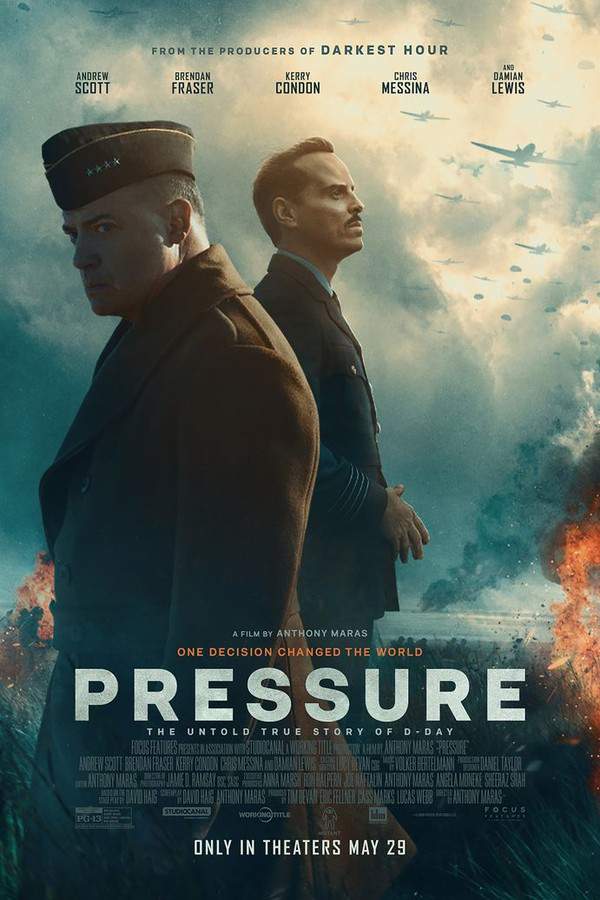
During the tense 72‑hour window before the Normandy landings, General Dwight D. Eisenhower and meteorologist Captain James Stagg wrestle with a critical decision. They must decide whether to launch the largest, hazardous seaborne invasion in history—risking massive casualties—or delay, forfeiting the chance to turn the tide of World II.
Find where to stream, rent, or buy Pressure (2026) in the US with current JustWatch availability, up-to-date pricing, and platform listings for subscription, rental, and digital purchase options.
Warning: spoilers below!
Haven’t seen Pressure yet? This summary contains major spoilers. Bookmark the page, watch the movie, and come back for the full breakdown. If you're ready, scroll on and relive the story!
Read the complete plot breakdown of Pressure (2026), including all key story events, major twists, and the ending explained in detail. Discover what really happened, and what it all means.
In June 1944, the Allied forces stand on the brink of Operation Overlord, a monumental bid to liberate Nazi-occupied Europe. The success of the invasion hinges on a tiny, 72-hour weather window over the English Channel. General Dwight D. Eisenhower [Brendan Fraser] consolidates command at Southwick House, where the fate of the assault rests on the meteorological briefings that fill the room with careful debate and high-stakes pressure.
At the heart of the drama are two lead forecasters with sharply different approaches. James Stagg [Andrew Scott], a meticulous Scottish meteorologist, reads real-time barometric data and identifies a massive storm system marching in from the Atlantic. By contrast, Irving P. Krick [Chris Messina], an American forecaster with a confident bedside manner, leans on historical weather patterns to predict a window of clear skies and “invasion-perfect” conditions, even as darker forecasts echo from the past.
As June 5 looms, the tension in the command centers thickens. Field Marshal Bernard Montgomery [Damian Lewis] worries about losing the element of surprise and presses for the plan to stay true to the timetable, while Stagg pushes for caution, grounding every move in precision science and the unsettling sway of the data. The room becomes a crucible where strategy, risk, and the unpredictable sea collide.
Personal stakes also thread through the story. Stagg’s mounting anxiety is intensified by the knowledge that his wife is in the hospital, a reminder that the clock’s tick-tock carries real lives beyond maps and forecasts. Kay Summersby [Kerry Condon], Ike’s trusted aide and confidante, serves as a steady voice in the chaos, helping the General weigh the mortal dangers of a fragile amphibious assault against the peril of waiting too long.
Haunted by the memory of Exercise Tiger, Ike makes a harrowing choice to delay the invasion by 24 hours. In the tense moments that follow, Stagg’s data takes on renewed gravity, and the possibility of a brief lull the next morning becomes the key thread that allows the final order to pivot toward action.
When the weather finally shifts toward that fragile window, the plan to strike on the morning of June 6 is set in motion, and the invasion proceeds, a turning point that would reshape the course of World War II. The film widens its lens beyond the forecasts, showing how the decision ripples through the war rooms and naval commands as the coordinated effort to launch requires more than science—it demands trust, resolve, and a collective will to push forward.
The narrative is anchored by a robust ensemble that includes Admiral Bertram Ramsay [Robert Portal] guiding naval operations and General Omar Bradley [Alexander Hanson] coordinating the American forces on the ground, illustrating how forecast, strategy, and frontline action converge under extraordinary pressure. The result is a measured, immersive portrait of a moment when weather, leadership, and courage intersect to alter history.
Last updated: June 09, 2026 at 07:36
Explore frequently asked questions about Pressure (2026) with spoiler-rich answers covering the full plot summary, major story beats, character motivations, hidden details, and ending meaning. This movie summary FAQ helps explain confusing scenes, plot twists, and narrative decisions in clear, searchable detail.
Eisenhower delayed the invasion by 24 hours because meteorologist James Stagg warned of a massive storm system approaching from the Atlantic. Stagg's barometric data showed conditions would deteriorate significantly on June 5, the originally planned date. Eisenhower had also been haunted by the memory of Exercise Tiger, a disastrous rehearsal that resulted in heavy casualties, and he chose to prioritize safety over the element of surprise.
Earlier in the film, Eisenhower is shown haunted by the memory of Exercise Tiger, establishing his fear of launching another amphibious assault under dangerous conditions.
Stagg and Krick used fundamentally different forecasting methods. Stagg relied on real-time barometric pressure readings and current Atlantic storm data, which showed a volatile storm system building. Krick, by contrast, analyzed historical weather patterns and predicted clear skies, arguing conditions would be invasion-perfect. Their conflicting approaches created the central tension in the command center.
The film establishes early on that the two forecasters bring 'opposing approaches' to predicting weather, foreshadowing their clash.
Exercise Tiger was a full-scale rehearsal for D-Day that took place in April 1944 at Slapton Sands. It resulted in friendly fire casualties when American landing craft were mistaken for German torpedo boats. The deadly mistake haunted Eisenhower, making him extremely cautious about launching the invasion without adequate weather information. The memory of those lost lives drives his willingness to delay the assault.
The film references Exercise Tiger's shadow looming over the decision, showing Eisenhower's haunted expression when considering the risk of another amphibious disaster.
The weather directly determined whether Allied landing craft could cross the English Channel safely. Rough seas would swamp the amphibious vehicles, scatter naval bombardment, and prevent gliders from landing troops. Beyond the immediate danger, poor visibility would also hinder air support and give German defenders advantage. A narrow 72-hour weather window was the only opportunity to launch the largest seaborne invasion in history.
The opening establishes that the invasion 'hinges on a narrow meteorological forecast rather than sheer force of arms.'
While advising the military leadership, Stagg dealt with the knowledge that his pregnant wife was hospitalized. This personal crisis compounded his professional pressure to get the forecast right. The stakes extended beyond his professional duty, he was simultaneously worried about his family's wellbeing while shouldering the weight of potentially thousands of soldiers' lives based on his meteorological advice.
Stagg's mounting anxiety is shown early, connected to his wife's hospitalization, giving emotional weight to his determination to accurately predict the storm.
Kay Summersby served as Eisenhower's trusted aide and confidante at Southwick House. She provided emotional support and served as a steady voice amid the chaos of competing forecasts and military pressure. While not a military commander, she helped Eisenhower weigh the mortal dangers of a fragile amphibious assault against the peril of waiting too long, anchoring the human dimension of the strategic choice.
Summersby is introduced as a 'steady voice in the chaos' who helps the General navigate the decision.
Field Marshal Bernard Montgomery and other high-ranking officers pushed back against any postponement because a delay risked losing the element of surprise. Additional waiting could give German defenders time to reinforce their Atlantic Wall defenses. The longer the invasion was postponed, the greater the chance Hitler would deploy more troops to Normandy, potentially turning a tactical advantage into a bloody stalemate.
The timeline notes Montgomery worrying about 'losing the element of surprise' and pressing to stay true to the timetable.
On June 5, the scheduled invasion date, violent storms swept across the English Channel, exactly as Stagg had predicted based on his barometric data. This concrete verification made Stagg's credibility soar in Eisenhower's eyes. The storm proved that science-driven forecasting was more reliable than historical pattern analysis, and it vindicated Stagg's urgent calls for caution.
Stagg had been tracking barometric trends showing conditions would deteriorate, warnings that initially faced skepticism from Krick and military leaders.
After the storm passed on June 5-6, meteorologist James Stagg identified a brief window of calmer weather the following morning. This temporary lull in the Atlantic storm system provided the narrow opportunity the Allies needed to launch Operation Overlord. Stagg's data showed the weather would improve just enough for a few hours, making the June 6 assault feasible.
Stagg's analysis had been building toward identifying this precise moment, with the timeline noting 'a brief lull offers renewed opportunity.'
Stagg used empirical scientific methods, reading real-time barometric pressure, tracking current storm systems, and analyzing data as it changed by the hour. Krick relied on historical weather pattern analysis, looking at what weather typically occurred in the Channel during early June. Stagg's approach was dynamic and data-driven; Krick's was statistical and somewhat static, which led to their conflicting predictions.
The timeline describes their methods as 'sharply different approaches' with Stagg reading 'real-time barometric data' while Krick relies on 'historical weather patterns.'
The window was narrow because the Allied invasion required simultaneous coordination across naval, aerial, and ground forces, all dependent on manageable weather. Strong winds would capsize landing craft, low clouds would prevent aerial support, and rough seas would scatter the massive naval fleet. A broader delay risked losing surprise or encountering worse weather later, making that brief window the best, and perhaps only, chance to launch.
The film establishes early that the Allies awaited 'a 72-hour window of manageable weather,' emphasizing the tightness of the opportunity.
If Eisenhower had launched on June 5 as originally planned, the invasion would have faced the full force of the Atlantic storm. Landing craft likely would have capsized in high waves, naval bombardment would have been ineffective due to poor visibility, and glider troops would have missed their landing zones. The resulting casualties could have dwarfed Exercise Tiger's losses, potentially forcing the Allies to abandon the Normandy invasion entirely and changing the course of World War II.
The stakes are established early, the film notes the invasion is 'risking massive casualties' if the weather turns against the Allies.
The 24-hour delay required cascading adjustments across all Allied commands. Naval forces had to hold position or return to port, airborne units had to stand down from their gliders, and the massive logistical apparatus of the invasion had to be quietly repositioned. The decision demonstrated that even the supreme commander could adapt plans based on scientific input, setting a precedent for data-driven military decision-making.
The summary notes the decision 'ripples through the war rooms and naval commands' requiring coordinated effort beyond just the weather forecast.
Discover curated groups of movies connected by mood, themes, and story style. Browse collections built around emotion, atmosphere, and narrative focus to easily find films that match what you feel like watching right now.
Films where leaders face impossible choices with massive consequences.Explore more films like Pressure where leaders grapple with impossible wartime choices. These historical dramas and thrillers capture the intense pressure and heavy responsibility of command, perfect for viewers who enjoy tense decision-making narratives.
Narratives in this thread typically unfold in a constrained timeframe, focusing on a pivotal decision point. The protagonist, often a leader or expert, must analyze complex information, manage conflicting advice, and overcome personal turmoil to make a call with monumental consequences. The drama is internal and psychological, driven by the weight of responsibility.
Movies are grouped here for their shared focus on the intense psychological pressure of leadership. They feature a tense, methodical tone, a high-stakes historical or military setting, and a narrative that makes the viewer feel the immense gravity of a single, world-altering choice.
Thrillers where experts race against time using data to avert disaster.Find more movies similar to Pressure that focus on experts working against the clock. These methodical thrillers use real history and specialized fields like meteorology to build nail-biting suspense for fans of intelligent, high-anxiety dramas.
Stories follow a methodical, often minute-by-minute structure as a team of specialists confronts a complex problem. The conflict is less about physical action and more about intellectual debate, data interpretation, and battling uncertainty. The narrative thrust is a race against an external clock to validate a theory and convince skeptical authorities.
These movies share a specific vibe: they are tense, methodical, and intellectually engaging. They combine a historical setting with a procedural thriller plot, focusing on the anxiety of using expertise to assess risk and make critical recommendations under extreme pressure.
Don't stop at just watching - explore Pressure in full detail. From the complete plot summary and scene-by-scene timeline to character breakdowns, thematic analysis, and a deep dive into the ending - every page helps you truly understand what Pressure is all about. Plus, discover what's next after the movie.
Track the full timeline of Pressure with every major event arranged chronologically. Perfect for decoding non-linear storytelling, flashbacks, or parallel narratives with a clear scene-by-scene breakdown.
Discover the characters, locations, and core themes that shape Pressure. Get insights into symbolic elements, setting significance, and deeper narrative meaning - ideal for thematic analysis and movie breakdowns.