Plot Explained Spoilers guaranteed!
Plot Explained

Browse by genre

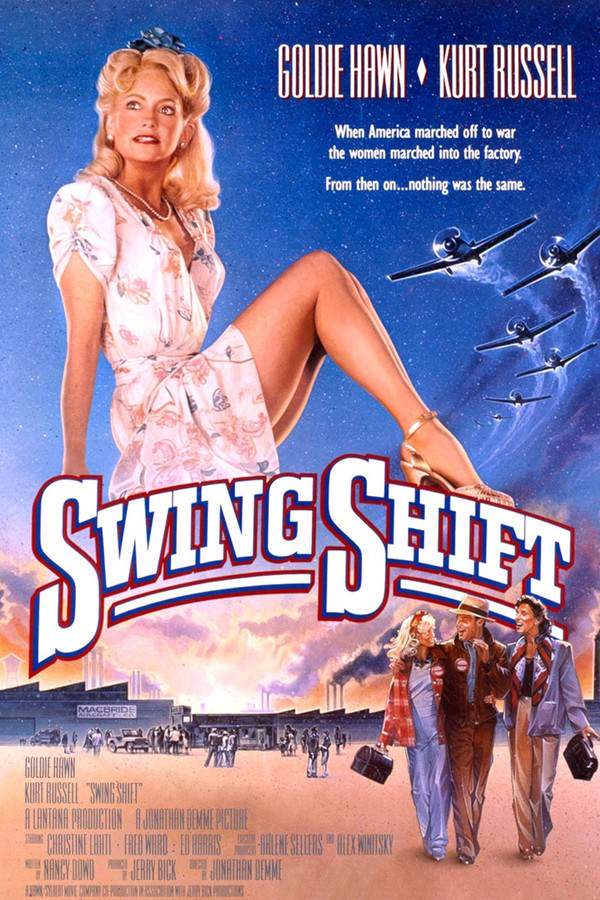
Swing Shift (1984) movie poster

Timeline

Swing Shift (1984) Timeline Explained – Every Event in Order

Release, runtime and language
1984 · 100 min · English
Loading streaming availability…
Directed by
Jonathan Demme
Starring
Kurt Russell, Holly Hunter, Ed Harris, Goldie Hawn, Fred Ward, Christine Lahti

During World War II, a woman supporting her Navy husband finds an unexpected connection while working at an aircraft factory. She develops feelings for a charming man who was deemed unsuitable for military service. When her husband returns home, a complex situation arises, testing their loyalties and challenging their relationships as hidden emotions surface.

On this page (6)
  1. 1 Where to watch
  2. 2 Events in order (12)
  3. 3 Timeline questions answered
  4. 4 Movie threads
  5. 5 Movies like Swing Shift
  6. 6 Every angle
Loading streaming availability…

12 events in order · contains spoilers

Swing Shift Timeline: Events in Chronological Order

Every key event of Swing Shift (1984) in order, scene by scene, with when and where it takes place. Use it to untangle flashbacks, time jumps and parallel storylines, to refresh your memory before the sequel or to find the exact scene you are thinking of.

  1. Jack joins the Navy after Pearl Harbor

    After the attack on Pearl Harbor, Jack Walsh enlists and becomes a U.S. Navy Seaman, heading into WWII duty overseas. While he is away, his wife Kay begins laying groundwork for their future by signing up to work in an armaments factory in California.

    When
    December 1941
    Where
    Pearl Harbor, Hawaii
  2. Kay starts factory work in California

    Kay signs up to work in an armaments factory in California, taking on dangerous wartime production to support the war effort. The loneliness of separation pushes her to seek connection, and she begins forming bonds with people around the plant.

    When
    Early 1942
    Where
    California armaments factory
  3. Kay befriends Hazel, the club singer

    Kay forms a friendship with Hazel, a club singer who becomes a confidante during the long war months. Their bond deepens as Kay also meets Lucky, a factory worker and musician who flirts with her on a weekly basis.

    When
    1942
    Where
    Factory break room / Hazel's circle, California
  4. Kay agrees to date Lucky and keeps it secret

    After months of Lucky's persistent flirting, Kay agrees to go on a date with him, seeking a spark beyond her isolation. On the date, she spots her landlords at Hazel's place, ducks out before they spot her, and tells Lucky she can't because she's married, then goes home alone.

    When
    1943
    Where
    Hazel's neighborhood / Kay's home
  5. Factory jamboree and Lucky's trumpet moment

    A weekend factory jamboree brings Kay and Hazel into the spotlight, and Kay finally sees Lucky perform on the trumpet. The performance draws her in, and Lucky takes her home that night, nudging their relationship toward something more than friendship.

    When
    1943
    Where
    Factory jamboree, California
  6. The entangled trio spends time together

    Kay, Hazel, and Lucky begin spending time together, treating their evolving dynamic as a shared space despite the tension it creates. The situation grows more complicated as the war drags on and Jack remains overseas.

    When
    1944
    Where
    Hazel's place and surrounding circles
  7. Jack returns on a 48-hour leave and confronts Kay

    Summer 1944 brings Jack back on a secret 48‑hour leave, and he confronts Kay at Hazel's place. He discovers the closeness Kay has developed with Lucky and initially misreads the situation, leading to a tense dinner and sharp words.

    When
    Summer 1944
    Where
    Hazel's home
  8. Jack returns to his ship; the marriage is strained

    The confrontation ends with Jack returning early to his ship the next morning, while Kay faces her new reality and the consequences of the affair. The homefront divide within the couple deepens as he departs.

    When
    Summer 1944
    Where
    Hazel's home / aboard ship
  9. Kay, Hazel, and Lucky's ongoing tensions

    Lucky takes Hazel to the club and the trio's complicated dynamics continue to simmer. Kay arrives in a taxi to see Hazel there and, unsettled, returns home rather than joining them. Later, Lucky hints that a tour with his band is in the works.

    When
    Late 1944
    Where
    Kay's home / Lucky's club
  10. End of the war changes the factory and relationships

    With Japan's surrender, the airplane factory lets the women go and servicemen begin returning home. Kay writes a farewell letter to Lucky as he heads off on tour, while Jack's letters or looming return begin to shift the relationship dynamics.

    When
    Late 1945
    Where
    California factory / home
  11. Servicemen come home and Hazel moves on

    As the war ends, the household shifts again: Jack returns to Kay, and Hazel marries the club owner who had supported her. The trio's wartime arrangements give way to new domestic realities.

    When
    Late 1945
    Where
    Homefront California / Hazel's club
  12. Resolution and new beginnings

    Jack and Kay reconcile, choosing to face the future together after the upheavals of the wartime years. Hazel's marriage to the club owner signals a new stability for Hazel, ending the triangle romance that defined their recent years.

    When
    Post-1945
    Where
    Kay and Jack's home; Hazel's club

Last updated: October 09, 2025 at 15:36

Was this helpful?

Timeline questions answered

Swing Shift Timeline Explained: Your Questions Answered

When does it happen, and why in that order? The questions people ask about the chronology of Swing Shift (1984): time jumps, flashbacks, cause and effect between scenes and the correct order of events, each answered with spoilers.

Q1

Why did Kay agree to go on a date with Lucky while her husband was away at war?

Kay agreed to date Lucky because the prolonged loneliness of wartime separation had worn her down. After months of avoiding his persistent flirting, she was seeking human connection and emotional intimacy that her marriage couldn't provide while Jack was overseas. The date represented a moment of weakness in her resolve, but when the reality of her situation confronted her, seeing her landlords and realizing the risk of discovery, she chose to confess her marriage and go home alone.

Foreshadowing: Earlier, the summary establishes that Kay becomes "steadily more aware of her own isolation" which sets up her willingness to seek connection outside her marriage.

  • Kay
  • Lucky
  • date
  • marriage
  • loneliness
  • affair
Q2

Why did Kay tell Lucky she was married and go home alone on their date?

Kay confessed she was married because the guilt and risk of her situation suddenly became real when she spotted her landlords at Hazel's place. The fear of being discovered, combined with her internal conflict about betraying Jack, made her pull back. She went home alone, choosing her marriage over the fleeting excitement of the affair, though this moment revealed her internal struggle between duty and desire.

Foreshadowing: This moment shows Kay's initial moral boundary, which makes her later relationship with Lucky more significant as a complete departure from this decision.

  • Kay
  • Lucky
  • married
  • confession
  • guilt
Q3

What made Kay finally allow a relationship with Lucky after seeing him perform at the factory jamboree?

Seeing Lucky perform on the trumpet at the factory jamboree was the turning point for Kay. The music revealed a depth to Lucky's character that she hadn't seen before, making her see him as more than just a flirtatious factory worker. The magic of the performance gave her "permission to let down her guard," allowing her to act on the emotional connection she had been resisting for months.

Foreshadowing: The buildup of months of tension between Kay and Lucky, with Lucky's persistent flirting and Kay's avoidance, culminates in this musical moment that breaks through her resistance.

  • Lucky
  • trumpet
  • jamboree
  • Kay
  • performance
  • relationship
Q4

Why did Jack assume the Leadman shirt belonged to another man when he returned?

When Jack returned unexpectedly on a 48-hour leave and found Kay at Hazel's place with Lucky, he was already primed to suspect infidelity. The discovery of the Leadman work shirt in Kay's closet, something Jack didn't recognize as her work uniform, confirmed his suspicions. Kay's promotion to Leadman at the factory was something she hadn't shared with Jack, making the shirt look like evidence of another man rather than proof of her professional growth.

Foreshadowing: The tension builds as Kay has been developing a life separate from Jack, including her career advancement, which creates the gap in knowledge that fuels Jack's misinterpretation.

  • Jack
  • Leadman shirt
  • 误会
  • promotion
Q5

Why did Kay leave and go home when she arrived at the club and saw Hazel there with Lucky?

Kay arrived at Lucky's club after Hazel had already gone there with him, and seeing them together, knowing Hazel was her friend and that Hazel was aware of her affair, created a devastating moment of realization. The sight confirmed that the relationship dynamics had shifted beyond her control, and feeling like an outsider in the very world Lucky had introduced her to, she retreated home instead of facing the painful scene.

Foreshadowing: This moment demonstrates the consequence of the complicated triangle the three had formed, where loyalty and boundaries became increasingly blurred.

  • Kay
  • Hazel
  • Lucky
  • club
  • jealousy
  • retreat
Q6

Why did Kay send Lucky a farewell letter when the war ended?

Kay wrote a farewell letter to Lucky because the end of the war meant the end of the circumstances that had brought them together. With Jack returning and the factory closing, the temporary wartime arrangement could no longer exist. The letter symbolized Kay's conscious choice to close that chapter and commit to rebuilding her marriage, acknowledging that Lucky represented a life that could only exist during the abnormal conditions of war.

Foreshadowing: Lucky's earlier announcement that he would go on tour with a band had already signaled the end of their dynamic, making the farewell letter the formal conclusion to their relationship.

  • farewell letter
  • Lucky
  • war ends
  • marriage
  • chapter closed
Q7

Why did Kay choose to stay with Jack despite her affair with Lucky?

Kay chose to stay with Jack because, despite the emotional connection she developed with Lucky, her fundamental commitment to her marriage never completely dissolved. The affair represented a escape from wartime loneliness rather than a desire to end her marriage. When Jack returned, the reality of their life together, their home, their future, and the normalcy that peace would bring, became more significant than the transient passion of the wartime romance.

Foreshadowing: The bittersweet tone of the film, noted in the meta notes, reflects this choice: reconciliation rather than abandonment, acknowledging the profound changes while choosing to move forward together.

  • Kay
  • Jack
  • reconciliation
  • marriage
  • choice
  • affair
Q8

Why did Hazel sleep with Lucky when she knew about Kay's situation?

Hazel slept with Lucky in the aftermath of Jack's confrontational visit, during a night when Kay had already gone home. The situation reflects the blurred boundaries that had developed in their triangle, Hazel had become both Kay's confidante and Lucky's romantic interest, and the emotional chaos of that night led to a moment of weakness. This event further complicated the trio's relationship and contributed to Kay's later retreat when she discovered what happened.

Foreshadowing: The friendship between Kay and Hazel was built on shared loneliness, but the evolving romantic tension between all three created inevitable betrayals.

  • Hazel
  • Lucky
  • affair
  • betrayal
  • Kay
Q9

Why did Kay, Hazel, and Lucky continue spending time together even after Jack returned?

The trio continued spending time together because they had become entangled in each other's lives during the war years, and the emotional bonds, even when complicated, were hard to break. Additionally, Jack returned only briefly on a 48-hour leave and then left again, leaving Kay in the same isolated position. The wartime abnormalcy had created a dynamic that persisted until the war's end provided a natural conclusion to their arrangement.

Foreshadowing: The timeline shows the trio's continued entanglement through late 1944, with the war's end in 1945 serving as the external force that finally disbands them.

  • trio
  • Hazel
  • Lucky
  • Kay
  • relationship
  • dynamic
Q10

What did Kay's promotion to Leadman at the factory represent in the story?

Kay's promotion to Leadman represented her transformation from a lonely housewife waiting for her husband into a confident, capable woman with her own identity and achievements. This growth made her a different person than the woman Jack married, which is why the discovery of the Leadman shirt caused such tension, it symbolized how much Kay had changed during his absence, changes Jack wasn't aware of and felt excluded from.

Foreshadowing: The promotion marks Kay's arc from isolation to empowerment, a key thematic element of the film about women's wartime experiences.

  • Kay
  • Leadman
  • promotion
  • growth
  • independence
  • factory

Movie threads

More Movies Like Swing Shift, by Mood & Story

Curated lists built around what makes Swing Shift tick: the same mood, the same kind of story or the same emotional payoff. Each list explains why these movies belong together.

Bittersweet Wartime Dramas like Swing Shift

Personal dramas of love and loyalty unfold on the home front. If you liked the complex emotions and homefront setting of Swing Shift, you'll find similar stories here. These movies explore love triangles, personal growth, and the bittersweet choices faced by women and men during times of war, blending historical drama with deep relational conflict.

  • yearning
  • nostalgic
  • tense
  • tender
  • reflective
  • melancholic
  • Tone: bittersweet, melancholic, nostalgic
  • Pacing: steady, character-driven
Why these movies?

The story pattern: Stories typically center on a character, often a woman, whose life is transformed by the war. A separation from a loved one creates a void, which is filled by a new, compelling connection. The central conflict arises when loyalties are tested, leading to a bittersweet resolution that acknowledges profound personal change.

Why they belong together: They are grouped by their shared setting of a society at war, a focus on the homefront experience, and a narrative driven by a poignant love triangle. The tone is consistently bittersweet, balancing personal liberation with the emotional cost of difficult choices.

Movies about the Consequences of Infidelity like Swing Shift

Stories where emotional choices quietly unravel relationships over time. For viewers who appreciated the steady, thoughtful exploration of marital strain in Swing Shift, this list features similar films. These dramas focus on the complex aftermath of infidelity, where guilt, tension, and unresolved feelings create a poignant and emotionally resonant story.

  • tense
  • melancholic
  • reflective
  • tender
  • yearning
  • lonely
  • Tone: bittersweet, tense, reflective
  • Pacing: steady, deliberate
Why these movies?

The story pattern: The narrative pattern involves a protagonist making a choice that fundamentally challenges their primary relationship. Instead of immediate, high-drama confrontation, the story unfolds at a steady pace, focusing on the internal guilt, simmering tension, and the subtle ways lives are altered before culminating in a realistically complex resolution.

Why they belong together: They share a specific focus on the emotional consequences of relational transgressions, portrayed with a medium intensity and a steady, reflective pacing. The mood is consistently tense, melancholic, and tender, prioritizing psychological realism over sensationalism.

If you liked this

Movies Like Swing Shift

Similar movies to Swing Shift: the same genre, themes or kind of story. Each one comes with its own plot summary, timeline and ending explained.

Browse all movie summaries

Every angle

Swing Shift (1984) Explained: Plot, Timeline & Characters

Everything about Swing Shift in one place: what happens in the plot summary, the timeline in chronological order, the characters and meaning and a spoiler-free summary. What's After the Movie adds the cast, box office and post-credit scenes.

Coming soon on iOS and Android

The Plot Explained Movie Summary App

Plot summaries, endings explained and timelines on your phone. Catch up on any movie in minutes, save your favorites and never miss a twist again.

Be the first to know when we launch. Your email stays private, always.

Learn more about the app