Plot Explained Spoilers guaranteed!
Plot Explained

Browse by genre

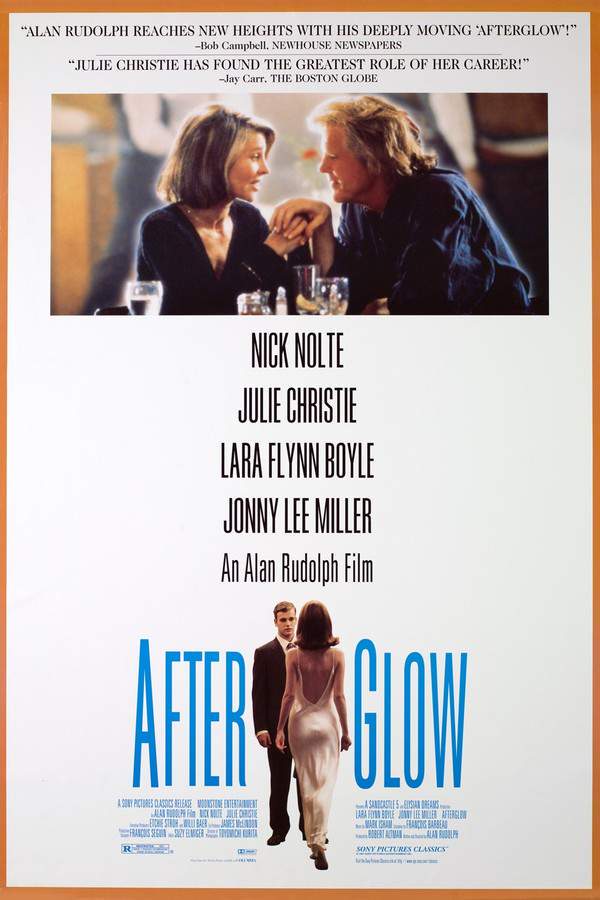
Afterglow (1997) movie poster

Plot Summary

Afterglow (1997) Plot Summary Explained

Release, runtime and language
1997 · 119 min · English
JustWatch #18,938 2
Directed by
Alan Rudolph
Starring
Nick Nolte, Julie Christie

Contractor Lucky Mann discovers he's just as adept at mending fractured relationships as he is at construction. When Marianne, a woman feeling unfulfilled in her marriage, is drawn to Lucky’s appeal, it sets off a surprising sequence of events. Marianne’s husband, Jeffrey, becomes entangled in the developing situation, and Lucky’s wife, Phyllis, unexpectedly finds a renewed connection with Jeffrey, sparking a chain reaction of desires and ultimately revitalizing their marriages with humor and unexpected romance.

On this page (6)
  1. 1 Where to watch
  2. 2 What happens: full plot
  3. 3 Plot questions answered
  4. 4 Movie threads
  5. 5 Movies like Afterglow
  6. 6 Every angle

Where to watch

Where to Watch Afterglow (1997)

Where can you watch Afterglow? Stream, rent or buy it in the US, including on Amazon Prime Video, Fawesome and Hoopla: current JustWatch availability with up-to-date prices.

Streaming availability powered by JustWatch

Full plot summary · contains spoilers

What Happens in Afterglow: Full Plot Summary

The whole story of Afterglow (1997) explained, from the opening scene to the final frame: every key event, every twist and what it all adds up to. Read it as a quick recap before the sequel, to check a scene you missed, or to finally understand what really happened.

In Montreal, two unhappily married couples become entangled as their private disappointments collide against the hum of a city that seems to offer both escape and consequences. The first pair centers on Lucky Mann, Nick Nolte, and his wife Phyllis Hart, Julie Christie. Their marriage has been fraying for years, especially after Phyllis reveals that Cassie, their daughter, is not Lucky’s biological child — a truth tied to a past where Phyllis bore Cassie with an actor while Lucky served in the Navy. The couple moved from California to Montreal in a tense bid to find Cassie, yet years of silence persist between them. Phyllis, now haunted by her husband’s infidelities and the recent death of her former co-star Jack Dana, spends time reevaluating her life and mortality, revisiting old films that once defined her. She and Lucky live with a quiet, almost ritualized distance: a tacit agreement to avoid sex, even as Lucky’s cheating with clients’ wives—glimpsed in the open cracks of their marriage—continues beneath the surface.

The second pair revolves around Jeffrey Byron, a corporate executive, and his wife Marianne, who yearn for a different future. Marianne longs for children and affection that Jeffrey, absorbed in his own ego, seems unable to provide. Depression shadows Jeffrey, and he wrestles with looming questions about desire and identity. Marianne, feeling emotionally starved, suggests sexual intimacy to spark life back into their union, but Jeffrey rebuffs her. The plot thickens when Marianne hires a contractor to begin work on a baby-ready room in their condo — the pick falls to Lucky Mann, linking the two troubled households through a practical coincidence. Marianne is immediately drawn to the rugged, older contractor, and that spark ignites an affair, drawing them deeper into a web of secrecy and risk.

As the affair unfolds, Jeffrey encounters Phyllis in a bar, where she has just witnessed Marianne and Lucky on a date. A magnetic pull to older companions and a flickering sense of possibility pull Jeffrey toward Phyllis, and his curiosity about life beyond conventional roles grows stronger. He has already shown a complex attraction to his older secretary Helene, hinting at a restlessness that could redefine his life. Marianne, meanwhile, finds herself irresistibly attracted to the rough-edged Lucky, while Jeffrey contemplates the boundaries of fidelity. The two couples’ trajectories collide when Jeffrey invites Phyllis to a weekend getaway at a resort. Phyllis hesitates, returns to Lucky, and then, driven by a mixture of curiosity and a hunger for meaning, joins Jeffrey. At the resort, they encounter Bernard Ornay, a powerful client, and his mistress Monica Bloom, who also take an interest in Phyllis. Ornay’s flirtation with Phyllis creates a rift with Jeffrey, threatening the thoughline of their liaisons. The weekend spins with near-misses: a potential nighttime tryst that dissolves when Jeffrey ends contact after Phyllis responds flirtatiously to Ornay’s knocks at her door. They depart the resort the following morning, tension already stitching itself into their fates.

When the two couples converge again, the bar of a hotel becomes a crucible for shared history and hidden agendas. A violent clash erupts between Jeffrey and Lucky, each man entangled in loyalties and betrayals that stretch back to older wounds. Marianne and Phyllis retreat together to the Byrons’ apartment, where Marianne drops a bomb: she is pregnant — with Lucky’s baby — unaware that Phyllis is his wife. Phyllis is startled and upset, but she conceals her own shock with a practiced composure. Jeffrey and Marianne reconcile in the glow of their uncertain future, the idea of a child binding them in a fragile bond. Meanwhile, Lucky, in a quieter moment, finds Cassie and restores a thread of connection that had long seemed severed. The reconciliation with Cassie hints at a possibility of rebuilding from fragments.

The story closes by mirroring a fate that befell Phyllis early on: Marianne, too, is poised to raise a child fathered by another man, and she tells her friend Isabel that the father is Jeffrey, not Lucky. She does not reveal this truth to Lucky, echoing Phyllis’s earlier strategy of guarding her own and Cassie’s paternity as a private truth. The final image lingers on Phyllis, in bed and crying, overwhelmed by the knowledge that Marianne will carry Lucky’s child, and by the ache of Cassie’s return home. The film settles on a quiet, bittersweet note where love, duty, and the longing for belonging collide, leaving each character to navigate a future colored by secrets kept and connections renewed.
Last updated: November 22, 2025 at 15:58

Was this helpful?

Plot questions answered

Afterglow Plot Explained: Your Questions Answered

The questions people ask most about Afterglow (1997): what happens in the confusing scenes, why the characters do what they do, the twists, hidden details and what the ending means. Each answer contains spoilers.

Q1

Why did Phyllis keep Cassie’s paternity secret from Lucky for so long?

Phyllis had Cassie with actor Jack Dana while Lucky was serving in the Navy. She likely kept the secret to protect her marriage and avoid the shame of her infidelity. The revelation only emerged years later when their relationship had already deteriorated, causing lasting damage to their trust.

Foreshadowing: The film opens with the revelation of this secret, establishing the fractured foundation of the Manns' marriage.

  • phyllis
  • cassie
  • paternity
  • secret
  • lucky
  • infidelity
Q2

Why does Marianne say the baby is Jeffrey’s when it’s actually Lucky’s?

Marianne chooses to hide Lucky’s paternity the same way Phyllis hid Cassie’s. By telling her friend Isabel the baby belongs to Jeffrey, she ensures Lucky will never know the truth. This mirrors Phyllis’s earlier decision to protect her own secret about Cassie, creating a tragic cycle where both women deceive their husbands.

Foreshadowing: The film establishes early on that Phyllis kept Cassie’s paternity hidden from Lucky, setting up Marianne’s identical choice at the end.

  • marianne
  • baby
  • jeffrey
  • lucky
  • paternity
  • secret
  • deception
Q3

Why is Jeffrey drawn to Phyllis?

Jeffrey is attracted to older, more worldly women, a pattern shown through his interest in his older secretary Helene. At the bar, he encounters Phyllis and senses a kindred spirit: someone also trapped in an unfulfilling marriage. His curiosity about life beyond conventional roles makes Phyllis intriguing, and he pursues a weekend getaway to explore this attraction.

Foreshadowing: Jeffrey’s attraction to older women is hinted at early through his interactions with his secretary Helene.

  • jeffrey
  • phyllis
  • attraction
  • affair
  • older
  • women
Q4

Why do Jeffrey and Marianne reconcile despite Marianne’s affair with Lucky?

Marianne’s pregnancy becomes a unifying force that pulls the Byrons back together. Jeffrey, struggling with depression and identity questions, finds purpose in the idea of becoming a father. Marianne, despite her infidelity, sees this as a chance to rebuild their marriage. The baby gives them both something to hold onto, even amidst the uncertainty.

Foreshadowing: Marianne’s desperation for children and affection was established early, making her cling to this opportunity for reconciliation.

  • jeffrey
  • marianne
  • reconcile
  • affair
  • baby
  • marriage
Q5

Why does Phyllis agree to go to the resort with Jeffrey?

Phyllis is at a low point: depressed after Jack Dana’s death, grappling with mortality, and aware of Lucky’s ongoing infidelities. When Jeffrey invites her to a weekend getaway, she sees it as a chance to feel alive again. She hesitates, returns to Lucky, but ultimately chooses curiosity over commitment, seeking meaning outside her dying marriage.

Foreshadowing: Phyllis’s depression and reflections on her past films with Jack Dana establish her vulnerability and longing for connection.

  • phyllis
  • jeffrey
  • resort
  • affair
  • curiosity
  • escape
Q6

Why does Jeffrey cut off contact after Ornay knocks on Phyllis’s door?

Jeffrey sees Ornay’s flirtation with Phyllis as a betrayal of their own developing connection. When Ornay knocks on her door at night, Jeffrey realizes the dynamic has shifted, he’s no longer the one in control or the primary object of Phyllis’s attention. This triggers him to end their weekend early, choosing to leave rather than compete.

Foreshadowing: Ornay’s attraction to Phyllis was evident throughout the resort stay, creating tension in the romantic triangle.

  • jeffrey
  • phyllis
  • ornay
  • resort
  • jealousy
  • departure
Q7

Why does Lucky reconnect with Cassie at the end?

Despite learning Cassie isn’t his biological child, Lucky chooses to pursue a relationship with her anyway. This moment represents his attempt to rebuild something genuine after years of infidelity and emotional distance. Cassie returning home offers Lucky a chance at fatherly connection he’s long been denied, providing a rare moment of hope amid the wreckage of his marriage.

Foreshadowing: The Manns moved to Montreal specifically to find Cassie, establishing this as a long-unresolved goal.

  • lucky
  • cassie
  • reconnect
  • daughter
  • paternity
  • family
Q8

How did Marianne become pregnant with Lucky’s baby?

Marianne and Lucky had an affair after she hired him to build the nursery in her condo. Their physical relationship resulted in Marianne getting pregnant. She hid the affair from Jeffrey, and when she discovers she’s pregnant, she initially doesn’t know who the father is, until she realizes it must be Lucky.

Foreshadowing: Marianne’s attraction to the rugged contractor was immediate from the moment Lucky arrived at her condo.

  • marianne
  • lucky
  • pregnancy
  • affair
  • baby
  • paternity
Q9

Why do both marriages end up following the same pattern of deception?

The film deliberately mirrors the two couples: both wives (Phyllis and Marianne) become pregnant by men other than their husbands, and both choose to hide the truth. This circularity suggests the characters are trapped in repeating patterns of infidelity and secrecy. The ending shows Phyllis crying as she realizes Marianne will raise Lucky’s child, exactly as Phyllis raised Cassie without Lucky knowing the truth.

Foreshadowing: Phyllis’s revelation about Cassie’s paternity at the start establishes the pattern that Marianne repeats at the end.

  • deception
  • pattern
  • cycle
  • marriage
  • infidelity
  • paternity
  • mirroring
Q10

What causes Jeffrey’s depression throughout the film?

Jeffrey struggles with depression linked to ego, identity, and feeling emotionally disconnected from Marianne. He’s unable to provide the affection and children she desires, and he wrestles with questions about his own desires and role. His attraction to older women hints at a deeper restlessness. The film suggests he’s stuck in a life that feels unfulfilling, leading to his willingness to pursue an affair with Phyllis.

Foreshadowing: Jeffrey’s depression is introduced early, with Marianne noting his emotional unavailability andego absorption.

  • jeffrey
  • depression
  • identity
  • ego
  • marianne
  • emotional
Q11

Why does Lucky cheat on Phyllis with his clients?

Lucky’s marriage to Phyllis has been dead for years, since she revealed Cassie wasn’t his child. They live in a tacit agreement to avoid sex, and Lucky fills his emotional void through affairs with clients’ wives. These infidelity glimpses show he seeks connection elsewhere because his marriage offers none. His pattern of cheating reflects the same emptiness that drives the other characters to stray.

Foreshadowing: Phyllis discovering Lucky’s affairs is shown early in the timeline, revealing the fractured state of their marriage.

  • lucky
  • affairs
  • phyllis
  • infidelity
  • marriage
  • cheating
Q12

Why is Phyllis crying in the final scene?

Phyllis lies in bed crying for two reasons: first, Marianne will raise Lucky’s child, another woman bearing another man’s baby while the husband remains unaware, exactly what Phyllis did with Cassie. Second, Cassie is finally coming home, but the reunion is bittersweet because it reminds Phyllis of all the years of deception. The ending captures her knowing the cycle of secrets will continue, leaving her trapped in the same tragedy she created years ago.

Foreshadowing: The entire film builds toward this echo of Phyllis’s original sin, with the parallel to her own past made explicit at the end.

  • phyllis
  • crying
  • ending
  • sorrow
  • cycle
  • deception
  • cassie

Movie threads

More Movies Like Afterglow, by Mood & Story

Curated lists built around what makes Afterglow tick: the same mood, the same kind of story or the same emotional payoff. Each list explains why these movies belong together.

Movies about marital intrigue like Afterglow

Unhappy couples explore affairs and secrets, leading to messy reconciliations. If you enjoyed the complex web of relationships in Afterglow, explore these similar movies about marital problems, secrets, and affairs. These films capture the bittersweet and introspective mood of couples navigating emotional loneliness and unexpected connections, perfect for viewers who like character-driven relationship dramas.

  • romantically charged
  • melancholic
  • introspective
  • wistful
  • emotionally complex
  • quietly intense
  • Tone: bittersweet, melancholic, reflective
  • Pacing: steady, character-driven
Why these movies?

The story pattern: These stories typically follow the intertwining lives of two or more couples, where dissatisfaction in one relationship leads to an affair with a member of another. The narrative unfolds through secrets being revealed, forcing characters to confront their desires and the consequences of their actions, ultimately leading to a recalibration—but not always a perfect resolution—of their marriages.

Why they belong together: Movies are grouped here based on their shared focus on the intricate and often painful dynamics of adult relationships, a bittersweet tone, and a steady, character-driven pace that allows for deep exploration of emotional motives and consequences.

Quiet character study movies similar to Afterglow

Subtle dramas where internal emotional conflicts drive the narrative. Fans of the reflective and introspective mood of Afterglow will appreciate these other quiet character studies. These movies share a medium intensity and steady pacing, focusing on internal emotional conflicts, loneliness, and the complex inner lives of their characters in a realistic, thoughtful way.

  • introspective
  • melancholic
  • reflective
  • lonely
  • wistful
  • quietly intense
  • Tone: melancholic, introspective, bittersweet
  • Pacing: steady, slow-burn
Why these movies?

The story pattern: The narrative pattern is less about external events and more about the gradual unfolding of a character's inner world. The story progresses through nuanced interactions and moments of quiet realization, building towards a climax that is often an emotional confrontation or acceptance rather than a dramatic action sequence.

Why they belong together: This thread connects films that share a specific mood and pacing: a melancholic, introspective feel combined with a steady, deliberate rhythm that allows the audience to sit with the characters' emotions. The similarity lies in the atmospheric and psychological approach to storytelling.

If you liked this

Movies Like Afterglow

Similar movies to Afterglow: the same genre, themes or kind of story. Each one comes with its own plot summary, timeline and ending explained.

Browse all movie summaries

Every angle

Afterglow (1997) Explained: Plot, Timeline & Characters

Everything about Afterglow in one place: what happens in the plot summary, the timeline in chronological order, the characters and meaning and a spoiler-free summary. What's After the Movie adds the cast, box office and post-credit scenes.

Coming soon on iOS and Android

The Plot Explained Movie Summary App

Plot summaries, endings explained and timelines on your phone. Catch up on any movie in minutes, save your favorites and never miss a twist again.

Be the first to know when we launch. Your email stays private, always.

Learn more about the app