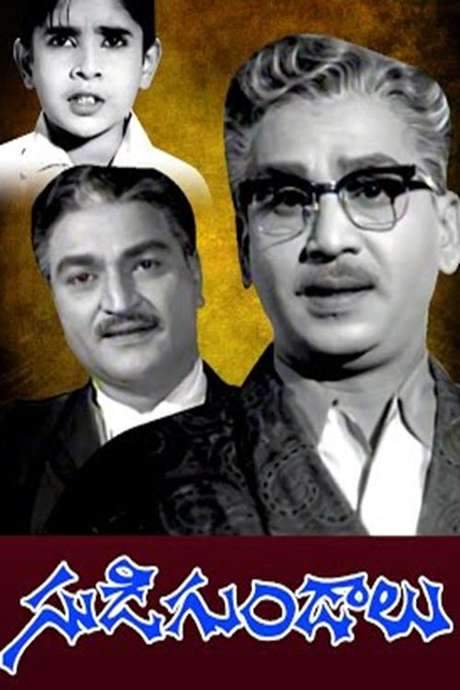
Year: 1968
Runtime: 180 mins
Language: Telugu
Director: Adurthi Subba Rao
Judge Chandrasekharam, renowned for his compassion, loses his wife in childbirth and his son Raja is murdered by youths Prasanna Rani and Vijayachander. He later defends the culprits, exposing the true motives. Sudigundalu (Whirlpools), a 1968 Telugu drama, won the National Film Award for Best Feature Film and features Nagarjuna Akkineni’s cameo.
Warning: spoilers below!
Haven’t seen Sudigundalu yet? This summary contains major spoilers. Bookmark the page, watch the movie, and come back for the full breakdown. If you're ready, scroll on and relive the story!
Explore the full timeline and setting of Sudigundalu (1968). Follow every major event in chronological order and see how the environment shapes the story, characters, and dramatic tension.
Last updated: October 04, 2025 at 15:26
Meet the key characters of Sudigundalu (1968), with detailed profiles, motivations, and roles in the plot. Understand their emotional journeys and what they reveal about the film’s deeper themes.
Last updated: October 04, 2025 at 15:26
Explore the central themes of Sudigundalu (1968), from psychological, social, and emotional dimensions to philosophical messages. Understand what the film is really saying beneath the surface.
Last updated: October 04, 2025 at 15:26
Browse frequently asked questions about Sudigundalu (1968) focused on characters, relationships, themes, symbols, setting, and story context. This movie info FAQ gives spoiler-aware explanations for character arcs, world details, and thematic interpretation so readers can better understand what the film is really about.
The movie takes place in an urban Indian city, with the narrative anchored around a courtroom drama. Key locations include the court hall where the legal proceedings unfold, schools that reveal the characters' upbringing, and city neighborhoods that expose the social pressures shaping their lives. The city serves as a backdrop where wealth, politics, and public perception deeply influence justice and everyday interactions.
While an exact era is not explicitly stated, the 1968 release year and the film's visual style, clothing, and social context suggest a mid-20th century setting in India. The storytelling reflects the social dynamics and judicial processes typical of that period in Indian society.
Judge Chandra Shekaram is the central moral figure in the film, a noble and compassionate judge who shelters families affected by his court decisions. He values morality over rigid legal interpretation and is willing to defend the accused when deeper truths emerge. His personal tragedy, losing his wife in childbirth and his son Raja to murder, tests his commitment to justice, leading him to make significant personal sacrifices in pursuit of truth.
Vikram Kumar is the son of politician Panakala Rao, portrayed as a charming young man whose privilege masks a dangerous personality. His relationship with Sandhya Rani reveals how wealth and status can erode moral judgment. His actions demonstrate the film's critique of how affluent upbringing without proper guidance can lead to destructive behavior.
Sandhya Rani is the daughter of wealthy businessman Koteswara Rao. She embodies the decadence that comes with wealth while maintaining an emotional connection to Vikram. Her upbringing and social status heavily influence her choices, and her relationship with Vikram exposes the complex tensions between privilege, desire, and moral responsibility.
Raja is a motherless infant raised by Judge Chandra Shekaram's family, who grows into a bright and beloved boy. His apparent happiness conceals the vulnerability of a child scrutinized by society when tragedy occurs. His memory becomes the catalyst for examining parental responsibility and how public perception shapes justice, driving the judge's moral journey.
Pankajam is Vikram's stepmother, a figure of similar age to him who influences his development. Her apathetic stance toward wrongdoing highlights the harmful behavior enabled within wealthy family environments. She represents the familial dysfunction and lack of moral guidance that contributes to Vikram's destructive tendencies.
The film explores how the pursuit of truth exposes biases shaped by upbringing and class. Judge Chandra Shekaram reframes a seemingly straightforward case by examining deeper motives, demonstrating that justice cannot be separated from moral responsibility. The climax questions whether formal verdicts alone suffice without addressing the underlying roots of crime.
The film emphasizes how parents fundamentally shape their children's ethics and choices. Vikram and Sandhya's actions reveal how neglect, privilege, and permissiveness can corrupt young lives. The judge argues that responsible parenting is essential to raise citizens with integrity, suggesting that societal reform must begin in the home as much as in the courtroom.
Wealth and social status create powerful incentives and blind spots for the characters. The affluent couple, Vikram and Sandhya, use money and influence to shield their wrongdoing, complicating the pursuit of justice. The film contrasts material power with moral accountability, exposing the dangerous edge of privilege in Indian society and how wealth can distort the course of justice.
The courtroom serves as the dramatic anchor where the film's moral debate unfolds. It is the space where Judge Chandra Shekaram confronts the limits of formal justice and chooses to defend those he once would have judged. The legal proceedings reveal how wealth and politics influence outcomes, transforming the courtroom into a arena for examining truth, class prejudice, and the failure of systems designed to deliver justice.
The film depicts how political power, embodied by Panakala Rao, creates obstacles to justice. His status and expectations shape his son Vikram's behavior while attempting to influence court proceedings. The narrative shows that in an urban Indian setting where politics and wealth intersect, achieving true justice requires confronting not just individuals but the systemic corruption that protects the privileged.
Discover curated groups of movies connected by mood, themes, and story style. Browse collections built around emotion, atmosphere, and narrative focus to easily find films that match what you feel like watching right now.
Legal proceedings crack under the weight of a lawyer's personal tragedy.Explore similar movies where the legal world collides with crushing personal tragedy. If you liked Sudigundalu's central twist of a grieving father defending his child's killers, you'll find powerful stories here about justice, sacrifice, and moral duty in the face of unimaginable loss.
These stories typically begin with a horrific personal crime that directly impacts a figure within the justice system. The narrative then pivots to the courtroom, where the professional seeks an unconventional form of justice or truth, forcing them to confront their own grief and ethics in a public arena. The resolution often focuses on a moral or philosophical victory rather than a purely legal one.
Movies are grouped here based on their shared premise of a legal professional personally entangled in their case, creating a unique blend of procedural intrigue and intense emotional drama. They explore the tension between professional duty and personal anguish.
Stories where neglectful parenting culminates in irreversible societal tragedy.Find movies similar to Sudigundalu that explore the heavy theme of parental duty and its catastrophic fallout. These dramas often involve youth crime stemming from a lack of guidance, leading to a gripping and melancholic story about grief, justice, and societal critique.
The narrative pattern involves establishing a stark contrast between a responsible, loving family and a dysfunctional one, often divided by class. The actions of the neglected youth trigger a central tragedy, which then unfolds methodically, scrutinizing the parents' role. The story is less about suspense and more about the bleak, reflective aftermath and the search for moral reckoning.
These films are united by their thematic focus on parental responsibility as a root cause of societal crime. They share a dark, somber mood, a steady pacing that allows for deep reflection, and a narrative that is both a tragedy and a harsh social commentary.
Don't stop at just watching - explore Sudigundalu in full detail. From the complete plot summary and scene-by-scene timeline to character breakdowns, thematic analysis, and a deep dive into the ending - every page helps you truly understand what Sudigundalu is all about. Plus, discover what's next after the movie.
Read a complete plot summary of Sudigundalu, including all key story points, character arcs, and turning points. This in-depth recap is ideal for understanding the narrative structure or reviewing what happened in the movie.
Track the full timeline of Sudigundalu with every major event arranged chronologically. Perfect for decoding non-linear storytelling, flashbacks, or parallel narratives with a clear scene-by-scene breakdown.
Discover movies like Sudigundalu that share similar genres, themes, and storytelling elements. Whether you’re drawn to the atmosphere, character arcs, or plot structure, these curated recommendations will help you explore more films you’ll love.
Sudigundalu (1968) Plot Summary & Movie Recap
Sudigundalu (1968) Scene-by-Scene Movie Timeline
Sudigundalu (1968) Spoiler-Free Summary & Key Flow
Movies Like Sudigundalu – Similar Titles You’ll Enjoy
Narasimha Naidu (2001) Ending Explained & Film Insights
Bava Nachadu (2001) Film Overview & Timeline
Vamsodharakudu (2000) Movie Recap & Themes
Chennakesava Reddy (2002) Detailed Story Recap
Radha Gopalam (2005) Full Movie Breakdown
Sainikudu (2006) Ending Explained & Film Insights
Chukkallo Chandrudu (2006) Detailed Story Recap
Justice Chowdhary (1982) Movie Recap & Themes
Muddula Mavayya (1989) Story Summary & Characters
Naandhi (2021) Full Summary & Key Details
Adavi Donga (1985) Spoiler-Packed Plot Recap
Sangam (1964) Complete Plot Breakdown
Sundara Killadi (1998) Plot Summary & Ending Explained
Achchamundu Achchamundu (2009) Spoiler-Packed Plot Recap
Chinarayudu (1992) Ending Explained & Film Insights