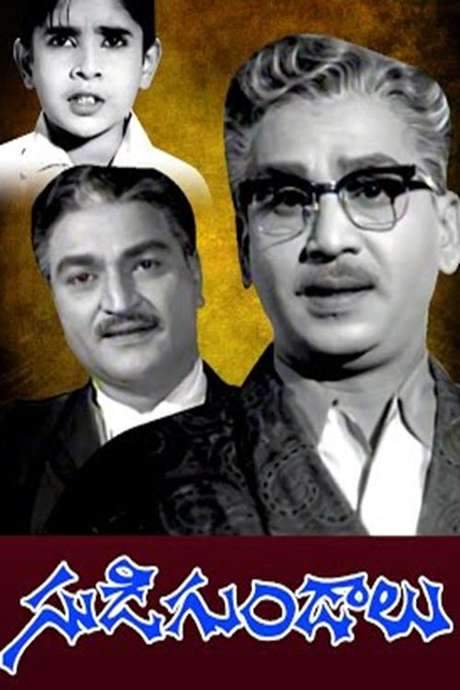
Sudigundalu

Sudigundalu

Year: 1968

Runtime: 180 mins

Language: Telugu

Director: Adurthi Subba Rao

Drama

Judge Chandrasekharam, renowned for his compassion, loses his wife in childbirth and his son Raja is murdered by youths Prasanna Rani and Vijayachander. He later defends the culprits, exposing the true motives. Sudigundalu (Whirlpools), a 1968 Telugu drama, won the National Film Award for Best Feature Film and features Nagarjuna Akkineni’s cameo.

Warning: spoilers below!

Haven’t seen Sudigundalu yet? This summary contains major spoilers. Bookmark the page, watch the movie, and come back for the full breakdown. If you're ready, scroll on and relive the story!

Sudigundalu (1968) – Full Plot Summary & Ending Explained

Read the complete plot breakdown of Sudigundalu (1968), including all key story events, major twists, and the ending explained in detail. Discover what really happened, and what it all means.

Justice Chandra Shekaram is a noble and generous judge who shelters the families afflicted by his judgments. Under his loving care, these households grow into a close, conjugal unit and raise Raja, a motherless infant, with an outpouring of affection. As Raja blossoms into a bright, beloved boy, the home becomes a beacon of warmth and trust, where the line between dispense of justice and personal duty blurs in the best possible way.

Years pass, and Raja attends school on his birthday, only to vanish without a trace. The sudden disappearance throws the family into a tremor of fear and confusion, and the next day the police recover Raja’s body, shattering the peace that had surrounded them. The community reels from the tragedy, and a profound inquiry begins to peel back the layers of this quiet, prosperous world.

The investigation uncovers two minors, Vikram Kumar and Sandhya Rani, who come from starkly different corners of high society. Vikram is the son of Panakala Rao, a politician who speaks for the poor, while Sandhya is the daughter of a wealthy businessman, Koteswara Rao. The two are romantically involved, adding a complicated dimension to the case. Vikram’s world includes his stepmother Pankajam, who is around his age, and the two share a tense, uneasy relationship.

In a dramatic courtroom turn, Justice Chandra Shekaram steps forward to defend the accused, startling everyone. He dismantles the surface appearances and presents a chilling motive, arguing that the killings were acts born of madness rather than malice. He reveals that a school-play moment—where Raja and Sandhya’s younger brother competed for a prize—seeded jealousy, and Vikram had vowed to kill Raja to win Sandhya’s affection. To justify the crime, Vikram mimics the method he had read in crime novels that Pankajam had read, planning to lure Raja to a swimming pool and drown him. He confesses that the act began as a sensation-seeking spree and grew into a grim certainty.

Through relentless cross-examination of Panakala Rao, Koteswara Rao, and their wives, the judge demonstrates that the youths’ fates were shaped by their upbringings. Vikram’s parents failed to instill morality, while Sandhya’s household used wealth and influence to shield her from consequence, letting her drift toward vice even as a minor. The defense underscores a larger truth: the environment forged the children’s choices more than any single act of rebellion.

Chandra Shekaram’s proclamation that parents bear a fundamental duty to raise responsible, moral citizens resonates with the jury and the audience. His words prompt a moment of self-reflection among the accused families, and the jurors revise their stance in response to the moral reckoning he presents. Yet, even as the courtroom drama points toward reform, the film grounds its tragedy in the personal cost borne by the judge himself.

The narrative culminates in a heartrending climax as Chandra Shekaram’s moral crusade ends in tragedy within the court hall, reminding viewers that justice and sacrifice can coexist with personal ruin. The story remains a stark meditation on duty, privilege, and the responsibilities of parenthood in shaping the next generation.

The film also features a notable cameo by Nagarjuna Akkineni and includes the presence of two Gumasta officers, Nageshwara Rao Akkineni and Sakshi Ranga Rao in the cast, reinforcing the social and institutional landscape that frames the drama.
Last updated: October 09, 2025 at 11:26

Was this helpful?

Sudigundalu (1968) Plot Questions Answered – Summary FAQ

Explore frequently asked questions about Sudigundalu (1968) with spoiler-rich answers covering the full plot summary, major story beats, character motivations, hidden details, and ending meaning. This movie summary FAQ helps explain confusing scenes, plot twists, and narrative decisions in clear, searchable detail.

Q1

Why did Judge Chandra Shekaram agree to defend Raja's murderers?

A.

Judge Chandra Shekaram defended the accused minors because he believed exposing the true motive would reveal how negligent parenting drove two children to commit murder. Rather than simply convicting them, he wanted to demonstrate that Vikram and Sandhya were products of their upbringing, Vikram's parents failed to instill morality, while Sandhya's wealthy family shielded her from consequences. His goal was to hold parents accountable rather than just punish the children.

Earlier scenes establish that Chandra Shekaram shelters families affected by his judgments, showing his belief that environment shapes behavior.

judgedefenseparentingnegligencecourtroom
Q2

What was the actual motive behind Raja's murder?

A.

The murder was not premeditated with malice but rather a thrill-seeking act born from obsession. Vikram wanted to win Sandhya's affection and believed killing Raja would prove his worth. A school play where Raja competed with Sandhya's younger brother for a prize had planted jealousy in Vikram. He then studied crime novels for methods and lured Raja to a swimming pool to drown him, treating it as an adventure rather than a calculated crime.

The school competition scene establishes Vikram's unhealthy obsession with Sandhya before the murder occurs.

vikramsandhyajealousythrillcrime novels
Q3

How did Chandra Shekaram prove the parents were responsible during the trial?

A.

Through relentless cross-examination of Panakala Rao, Koteswara Rao, and their wives, the judge demonstrated that Vikram's politician father failed to teach him morality, while Sandhya's wealthy parents used their influence to shield her from consequences, allowing her to drift toward vice as a minor. He showed that the children's fates were shaped by their upbringing rather than inherent wickedness, making the case about societal failure rather than individual guilt.

cross-examinationparentsupbringingaccountability
Q4

What happened to Judge Chandra Shekaram at the end of the trial?

A.

Despite achieving a moral victory by convincing the jury to reconsider its stance, Chandra Shekaram collapsed in the court hall and died. His personal crusade to expose parental negligence came at the ultimate cost, while his arguments resonated and prompted reflection, he sacrificed himself in the process, underscoring the tragedy that justice and personal ruin can coexist.

The narrative foreshadows this outcome through the heavy emotional weight and the judge's willingness to blur the line between judicial duty and personal mission.

deathcourtroomsacrificetragedy
Q5

How did Vikram manage to drown Raja at the swimming pool?

A.

Vikram studied crime novels that described drowning as a method and used that knowledge to plan the murder. He lured Raja to a swimming pool by pretending it was an adventure or outing, then drowned him using the technique he had read about. The judge revealed this during the trial, exposing how dangerous fascination with crime fiction combined with a lack of moral guidance created a deadly situation.

The presence of crime novels in Vikram's environment, particularly those read by his stepmother Pankajam, hints at his exposure to such material.

swimming pooldrowningcrime novelsmethod
Q6

Why was Raja's murder described as a thrill-seeking crime?

A.

The judge argued that the killing was driven by a desire for excitement and sensation rather than deep-seated hatred. Vikram confessed that the act began as a desire for adrenaline and grew into grim certainty. There was no long-standing grudge against Raja, just a shallow motivation to prove himself to Sandhya and experience the thrill of committing something dramatic.

thrillconfessionmotivationexcitement
Q7

What was Pankajam's role in Vikram's life and the crime?

A.

Pankajam was Vikram's stepmother, approximately the same age as him, and shared a tense, uneasy relationship. While not directly involved in the murder, she represented the troubled family dynamic that contributed to Vikram's lack of moral guidance. The judge noted that Vikram's parents failed to instill values, and Pankajam's presence highlighted the dysfunction in the household.

stepmotherfamily tensionupbringing
Q8

Why didn't the judge seek revenge instead of defending the accused?

A.

Chandra Shekaram believed that punishing children without addressing the root cause would achieve nothing. His philosophy, established throughout the film, was that environment and upbringing shape character. By defending Vikram and Sandhya, he sought to reform society's approach to parenting rather than simply satisfy his personal grief. His moral crusade prioritized systemic change over personal vengeance.

His lifelong practice of sheltering families affected by his judgments establishes his belief that compassion and understanding prevent future tragedies.

revengecompassionreformjustice
Q9

What was the judge's final message about parental responsibility?

A.

Chandra Shekaram's closing argument emphasized that parents bear a fundamental duty to raise their children as moral, responsible citizens. He proclaimed that upbringing, not inherent evil, shaped the children's choices. This moral reckoning prompted the jury to revise its stance, acknowledging that parents must be held accountable for the values they instill in their children.

parentingresponsibilitymoral dutyjury
Mobile App Preview

Coming soon on iOS and Android

The Plot Explained Mobile App

From blockbusters to hidden gems - dive into movie stories anytime, anywhere. Save your favorites, discover plots faster, and never miss a twist again.

Sign up to be the first to know when we launch. Your email stays private, always.

Explore Movie Threads

Discover curated groups of movies connected by mood, themes, and story style. Browse collections built around emotion, atmosphere, and narrative focus to easily find films that match what you feel like watching right now.

Courtroom dramas with personal stakes like in Sudigundalu

Legal proceedings crack under the weight of a lawyer's personal tragedy.Explore similar movies where the legal world collides with crushing personal tragedy. If you liked Sudigundalu's central twist of a grieving father defending his child's killers, you'll find powerful stories here about justice, sacrifice, and moral duty in the face of unimaginable loss.

tensegrippingtragicsombermoral conflictcourtroomgrief

Narrative Summary

These stories typically begin with a horrific personal crime that directly impacts a figure within the justice system. The narrative then pivots to the courtroom, where the professional seeks an unconventional form of justice or truth, forcing them to confront their own grief and ethics in a public arena. The resolution often focuses on a moral or philosophical victory rather than a purely legal one.

Why These Movies?

Movies are grouped here based on their shared premise of a legal professional personally entangled in their case, creating a unique blend of procedural intrigue and intense emotional drama. They explore the tension between professional duty and personal anguish.

Tragedies of parental neglect like in Sudigundalu

Stories where neglectful parenting culminates in irreversible societal tragedy.Find movies similar to Sudigundalu that explore the heavy theme of parental duty and its catastrophic fallout. These dramas often involve youth crime stemming from a lack of guidance, leading to a gripping and melancholic story about grief, justice, and societal critique.

sombertragicmelancholicreflectivegrippingclass disparitygriefmoral duty

Narrative Summary

The narrative pattern involves establishing a stark contrast between a responsible, loving family and a dysfunctional one, often divided by class. The actions of the neglected youth trigger a central tragedy, which then unfolds methodically, scrutinizing the parents' role. The story is less about suspense and more about the bleak, reflective aftermath and the search for moral reckoning.

Why These Movies?

These films are united by their thematic focus on parental responsibility as a root cause of societal crime. They share a dark, somber mood, a steady pacing that allows for deep reflection, and a narrative that is both a tragedy and a harsh social commentary.

Unlock the Full Story of Sudigundalu

Don't stop at just watching - explore Sudigundalu in full detail. From the complete plot summary and scene-by-scene timeline to character breakdowns, thematic analysis, and a deep dive into the ending - every page helps you truly understand what Sudigundalu is all about. Plus, discover what's next after the movie.

Sudigundalu Timeline

Track the full timeline of Sudigundalu with every major event arranged chronologically. Perfect for decoding non-linear storytelling, flashbacks, or parallel narratives with a clear scene-by-scene breakdown.

Sudigundalu Timeline

Characters, Settings & Themes in Sudigundalu

Discover the characters, locations, and core themes that shape Sudigundalu. Get insights into symbolic elements, setting significance, and deeper narrative meaning - ideal for thematic analysis and movie breakdowns.

Characters, Settings & Themes in Sudigundalu

Sudigundalu Spoiler-Free Summary

Get a quick, spoiler-free overview of Sudigundalu that covers the main plot points and key details without revealing any major twists or spoilers. Perfect for those who want to know what to expect before diving in.

Sudigundalu Spoiler-Free Summary

More About Sudigundalu

Visit What's After the Movie to explore more about Sudigundalu: box office results, cast and crew info, production details, post-credit scenes, and external links - all in one place for movie fans and researchers.

More About Sudigundalu

Similar Movies to Sudigundalu

Discover movies like Sudigundalu that share similar genres, themes, and storytelling elements. Whether you’re drawn to the atmosphere, character arcs, or plot structure, these curated recommendations will help you explore more films you’ll love.