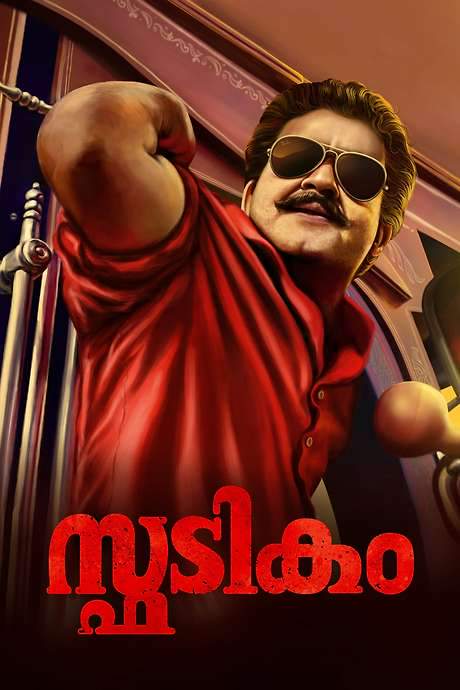
Thomas Chacko, Mohanlal, better known by his alias Aadu Thoma, stands as a formidable quarry owner and an undefeated gangster who carves his life on his own terms. His presence casts a long shadow over his father, the retired school headmaster C.P. Chacko, nicknamed “Kaduva Chacko,” a man celebrated for mathematics with a President’s Medal to his name. Thoma’s defiance becomes a blemish on his father’s reputation, and the two never see eye to eye. His mother Mary and sister Jancy are left to pick sides as the family fractures, while his brother Manimala Vakkachan stands in Thoma’s corner, offering a rare, quiet support amidst the tension.
In a searing flashback, young Thoma reveals a genius for gadgets rather than numbers. He fashions an AM radio receiver inside a soap case, a symbol of his restless curiosity in a time when phonographs are all the rage. While others marvel, his father dismisses the talent, pressing Thoma toward mathematics and harshly steering Ravunni, his teacher, to fail him to provoke a “better” effort. When Thoma discovers this manipulation, he is enraged enough to burn Ravunni’s answer sheet and flee the village after a violent act against Balu, a top student who becomes a bitter memory. Fourteen years pass, and Thoma returns not as a prodigy but as a hardened man—now a quarry owner, a lorry driver, and a gang leader. The father’s contempt remains, and the father’s love seems tethered to his daughter’s future rather than Thoma’s.
As Thoma builds his empire, Pookoya, a local baron, rises as his enemy, aided by his sub-inspector friend, Kuttikkadan, who oppose Thoma for backing the romance between Pookoya’s daughter and a penniless teacher. Thoma’s private life also hits the public stage when his relationship with a prostitute becomes known, a scandal that humiliates him and strains Jancy’s approaching wedding. The clash escalates when Thoma betrays trust and exposes Thoma to the police, a shock that even Kuttikadan finds astonishing. The rift between Thoma and his father widens when an insult is heaped on Thoma’s pride: Chacko repaints Thoma’s lorry with the word Chekuthan (devil) and plants a coconut tree in front of their house in an ostentatious act of humiliation.
Yet Thoma’s capacity for change remains alive. He intervenes to salvage Jancy’s marriage, and Ravunni—having resigned after the pain of Thoma’s fate—returns with his daughter Thulasi, a childhood friend of Thoma. The Tension between generations shifts toward mediation as Thoma’s family contends with the possibility of reconciliation. Thulasi, the gentle mediator, and Vakkachan work to bring Thoma back into the fold and invite him to Jancy’s wedding. Thoma attends in hopes of reconciliation, but the old wounds resurface when his father’s pride and scorn are laid bare. Jancy, choosing her own heart, states she values Thoma’s small possession—a necklace given by Thalusa—over her high dowry; the necklace becomes a symbol of Thoma’s bond with a past he cannot fully release, and this act fractures more deeply the fragile ties in the family. Mary, awaiting the wedding, ultimately turns away from Thoma. Ravunni then reveals a painful truth: Chacko never truly loved anyone; his affection was a performance to degrade Thoma, a revelation that shakes the father to his core and leaves him alone to rethink his choices.
The arc of revenge soon tightens. Thoma’s enemies unite to eliminate him, hatching a plot to plant a bomb in his lorry and pin it on Chacko. Thoma escapes the trap, but tragedy strikes when Kuttikadan fatally shoots Chacko in a hospital corridor, fueling Thoma’s fury. In a fit of rage, Thoma battles back, killing Kuttikadan in a blaze of vengeance. After visiting his father in the hospital, Thoma is taken into police custody on charges stemming from the earlier turmoil, leaving Thulasi and the rest of the family overwhelmed with grief and a future that feels uncertain.
Throughout this saga, the film threads together loyalty, pride, and forgiveness. The dynamics between Thoma and his father—their battles, reconciliations, and ultimate fall—anchor a story about the cost of expectations and the possibility of redemption. It is a narrative where Thoma’s own evolution—from a feared gangster to a man who seeks to protect his kin—unfolds against a backdrop of family upheaval, societal judgment, and the fragile threads that bind a family together in the face of violence and loss.
- Kuttikkadan plays a pivotal foil, with Spadikam George infusing menace into the role, while V K Sreeraman embodies the menacing Pookoya. The female-led supporting figures, including KPAC Lalitha as Mary and Urvashi as Thulasi, provide emotional resonance, and Chippy brings Jancy to life with a quiet resilience. The film also features the presence of Silk Smitha as Laila, whose character adds another layer to the world in which Thoma moves. The young Aadu Thoma is portrayed again by Roopesh Peethambaran, who captures the seeds of the man who will someday become a force to be reckoned with. Paravoor Bharathan and Nedumudi Venu contribute to the texture of the story with their performances as Joseph and Ravunni Master, respectively, while Thilakan lends gravitas to the role of Chacko Master, the stern teacher who helps shape the arc of the family’s conflict.