










Plot Explained Spoilers guaranteed!
Plot Explained

Browse by genre

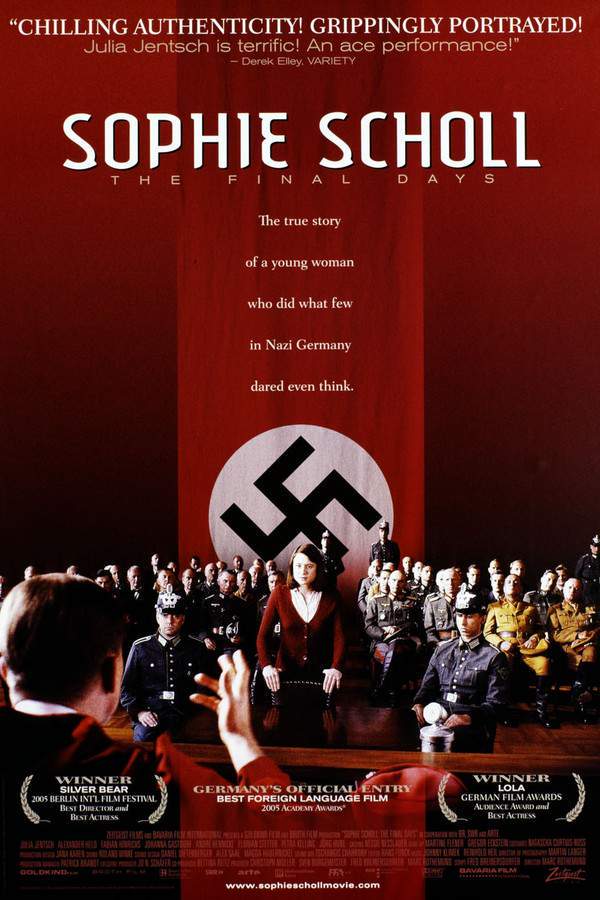
Sophie Scholl: The Final Days (2006) movie poster

Timeline

Sophie Scholl: The Final Days (2006) Timeline Explained – Every Event in Order

Release, runtime and language
2006 · 120 min · German
JustWatch #8,333 12
Directed by
Marc Rothemund
Starring
Fabian Hinrichs, Julia Jentsch

Based on true events, this film portrays the final days of Sophie Scholl, a young woman who participated in the White Rose non-violent resistance movement against the Nazi regime in Germany. It follows her experiences from arrest to trial and execution, showcasing her unwavering conviction and courage in the face of immense pressure and oppression. Julia Jentsch delivers a compelling performance as Sophie, highlighting the intensity of her defiance during this harrowing six-day ordeal.

On this page (5)
  1. 1 Where to watch
  2. 2 Events in order (15)
  3. 3 Timeline questions answered
  4. 4 Movie threads
  5. 5 Every angle

Where to watch

Where to Watch Sophie Scholl: The Final Days (2006)

Where can you watch Sophie Scholl: The Final Days? Stream, rent or buy it in the US, including on Chai Flicks, Kino Film Collection and OVID: current JustWatch availability with up-to-date prices.

Streaming availability powered by JustWatch

15 events in order · contains spoilers

Sophie Scholl: The Final Days Timeline: Events in Chronological Order

Every key event of Sophie Scholl: The Final Days (2006) in order, scene by scene, with when and where it takes place. Use it to untangle flashbacks, time jumps and parallel storylines, to refresh your memory before the sequel or to find the exact scene you are thinking of.

  1. The White Rose Formation

    In wartime Munich, a group of courageous students, known as the White Rose, is formed by Sophie Scholl and her brother Hans. They are united in their mission against the oppressive Nazi regime, aiming to raise awareness and encourage resistance through their leaflets.

    Where
    Munich
  2. Distributing Leaflets

    Sophie and Hans gather a significant amount of anti-Nazi leaflets and decide to distribute them at Munich University. They place stacks of leaflets near lecture halls, hoping to reach fellow students and inspire them to question the regime.

    Where
    Munich University
  3. Caught by the Janitor

    In a rush to drop more leaflets, Sophie climbs to the top floor and attempts to disperse them over the railing. Unfortunately, a watchful janitor catches the siblings in the act, leading to their immediate apprehension.

    Where
    Munich University
  4. Imprisonment in Stadelheim

    Following their capture, Sophie and Hans are taken to the grim Stadelheim Prison, where they face the Gestapo. The atmosphere is oppressive, and the reality of their situation sets in as they realize the grave consequences of their actions.

    Where
    Stadelheim Prison
  5. Intense Interrogation

    Sophie undergoes rigorous interrogation by Gestapo investigator Robert Mohr. Although she initially downplays her involvement, claiming ignorance, the atmosphere of intimidation begins to wear her down as the evidence mounts against her.

    Where
    Stadelheim Prison
  6. Fellow Dissidents

    While in prison, Sophie is placed in a cell with fellow dissident Else Gebel, who shares a tragedy similar to hers. Their conversations reinforce the sense of solidarity among those fighting against oppressive regimes, further fueling Sophie's resolve.

    Where
    Stadelheim Prison
  7. Self-Incrimination

    In a poignant moment of integrity, Sophie confesses her involvement in the distribution of leaflets, taking responsibility along with Hans. This act of bravery highlights her commitment to the cause and the solidarity she feels with her brother.

    Where
    Stadelheim Prison
  8. Confronting Morality

    During her interrogation, Sophie fiercely opposes the idea that the laws of the Nazi regime are just or protective. She passionately argues that these laws suppress freedom of speech and support heinous acts against humanity, demonstrating her unwavering principles.

    Where
    Stadelheim Prison
  9. The Show Trial Begins

    Sophie, Hans, and Christoph Probst face relentless charges of treason during a show trial overseen by the notorious Roland Freisler. The proceedings are skewed, and each defendant is subjected to ruthless scrutiny, revealing the kangaroo nature of the justice they are facing.

  10. Sophie’s Defiant Stand

    Sophie uses her final moments in court to deliver a powerful statement, asserting that she is not merely following her brother’s lead. Her fierce declaration stands as a testament to her conviction, challenging the unjust system that seeks to silence her.

  11. Guilty Verdicts

    The verdict is delivered swiftly, with guilty sentences pronounced on Sophie, Hans, and Christoph. They are given a minimal opportunity to speak, and Sophie's last words serve as a haunting reminder of the brutal consequences of standing against dictatorship.

  12. Facing Execution

    Sophie learns the heartbreaking news of her execution, which is set to occur unusually fast, ignoring standard protocol. In her final hours, she finds solace in a prayer and a farewell filled with love and pride from her family, showcasing her unyielding spirit.

    Where
    Stadelheim Prison
  13. A Moment of Reflection

    Before her execution, Sophie shares a cigarette with Hans and Christoph, cherishing their last moments together. As she steps out to face her fate, she observes, 'The sun is still shining,' a powerful statement of hope amidst despair.

    Where
    Stadelheim Prison
  14. The Execution

    Sophie is executed by guillotine, marking a tragic end to her courageous fight against tyranny. Following her death, Hans and Christoph meet the same fate, representing the brutal reality faced by many who opposed the Nazi regime.

    Where
    Stadelheim Prison
  15. Legacy of Resistance

    In a powerful conclusion, leaflets descend over Munich, symbolizing the lasting impact of the White Rose's message. Though they paid the ultimate price, their ideals continue to inspire resistance against oppression, as copies of their manifesto spread across Germany.

    Where
    Munich

Last updated: November 15, 2024 at 20:05

Was this helpful?

Timeline questions answered

Sophie Scholl: The Final Days Timeline Explained: Your Questions Answered

When does it happen, and why in that order? The questions people ask about the chronology of Sophie Scholl: The Final Days (2006): time jumps, flashbacks, cause and effect between scenes and the correct order of events, each answered with spoilers.

Q1

Why did Sophie Scholl confess to distributing leaflets during interrogation?

Sophie confessed because she wanted to protect her fellow White Rose members. When her brother Hans insisted he alone was responsible, Sophie contradicted him and revealed that the leaflet distribution was a joint effort by both siblings. This act of self-incrimination was intentional, she chose to share the burden rather than let Hans take full responsibility alone, demonstrating her solidarity with the resistance movement.

Foreshadowing: Earlier in the film, Sophie and Hans are shown acting as equal partners in planning and executing the leaflet drops, establishing her as a willing co-conspirator rather than a passive follower.

  • sophie scholl confession
  • white rose interrogation
  • gestapo
  • hans scholl
Q2

Why was Sophie Scholl executed so quickly after her trial?

Sophie was executed the same day as her trial, bypassing the standard 99-day waiting period that typically preceded executions in Nazi Germany. This unusual haste reflected the Nazi regime's determination to silence her quickly, especially given her prominent role as a female resistance figure and the growing public attention on her case. Her warning to judge Roland Freisler, 'where we stand today, you will stand soon', likely further急ed the authorities to expedite her death.

Foreshadowing: During the trial, Sophie's defiant statements and her prediction of Freisler's future downfall signal that her fate was already sealed due to her unyielding defiance.

  • sophie scholl execution
  • 99 day waiting period
  • roland freisler
  • stadelheim prison
Q3

What happened to the White Rose leaflets after Sophie and Hans were caught?

Despite Sophie and Hans being apprehended, their message continued to spread. The film concludes with leaflets descending over Munich, showing that copies of their manifesto were secretly delivered to the Allied forces. The Allies subsequently printed and distributed millions of copies throughout Germany, keeping the White Rose's resistance message alive even after the students' deaths.

Foreshadowing: The opening scenes establish the White Rose's mission to spread anti-Nazi leaflets, and their determination to continue this work despite the risks foreshadows the posthumous spread of their message.

  • white rose leaflets
  • resistance message
  • allies
  • munich
Q4

How did the Gestapo discover Sophie's involvement in the White Rose?

Sophie initially claimed during interrogation that she merely stumbled upon the leaflets and acted impulsively, leading investigators to believe she might be released. However, the Gestapo subsequently discovered concrete evidence linking both Sophie and Hans to the distribution of the anti-Nazi propaganda, confirming their involvement beyond doubt.

Foreshadowing: The janitor who catches Sophie and Hans at the university physically witnesses Sophie dropping leaflets from the top floor, providing the initial evidence that connects her to the distribution.

  • gestapo evidence
  • sophie scholl arrest
  • leaflet distribution
  • munich university
Q5

Why did Sophie say 'The sun is still shining' before her execution?

When Sophie stepped into the courtyard for her execution, she observed, 'The sun is still shining.' This statement represents her unwavering hope and defiance in the face of death, she refused to let the darkness of the Nazi regime extinguish her spirit. It reflects her deep belief that truth and freedom would ultimately prevail, even as she faced her tragic fate.

Foreshadowing: Throughout the film, Sophie's consistent optimism and moral conviction hint at her ability to find hope even in the bleakest circumstances.

  • sophie scholl last words
  • final statement
  • hope
  • defiance
Q6

What was Sophie's final statement at her trial?

Sophie used her final statement to assert her own agency and reject any suggestion that she was merely following her brother. She declared that her involvement in the White Rose was her own choice, highlighting the silent agreement among many Germans with her ideals. Most memorably, she warned Judge Freisler, 'Where we stand today, you will stand soon,' prophesying the eventual downfall of the Nazi regime.

Foreshadowing: Earlier interactions between Sophie and Hans show them making decisions together as equals, establishing that Sophie was a leader, not a follower, in the White Rose.

  • sophie scholl trial statement
  • roland freisler
  • final words
  • resistance
Q7

Why did Gestapo investigator Robert Mohr focus on Sophie during interrogation?

Robert Mohr specifically targeted Sophie because he believed she would be more vulnerable to pressure and might provide information about the broader White Rose network. He attempted to use her family's history, specifically her father's prior imprisonment, to persuade her to cooperate, suggesting that obedience to Nazi laws would protect her family. Despite his manipulative tactics, Sophie remained steadfast in her principles.

Foreshadowing: Mohr's strategy of targeting younger or seemingly weaker defendants is hinted at during the early interrogation scenes, where he tries to exploit family connections.

  • robert mohr
  • gestapo interrogation
  • sophie scholl father
  • manipulation
Q8

What happened to Christoph Probst during the show trial?

Christoph Probst, a devoted father of three, was the first defendant examined during the show trial. Judge Roland Freisler displayed clear bias against him, dismissing Probst's desperate pleas with disdain. Despite Probst's attempts to explain the humanitarian motives behind the White Rose's actions, the kangaroo court swiftly convicted him alongside Sophie and Hans. He was executed the same day.

Foreshadowing: The timeline shows Probst as a central member of the White Rose, and his importance is established when he is included in the leaflet distribution planning sessions.

  • christoph probst
  • show trial
  • roland freisler
  • execution
Q9

How did the White Rose movement continue after Sophie and Hans's execution?

The White Rose movement inspired continued resistance even after Sophie's execution. The Allies received copies of the White Rose manifesto and distributed millions of leaflets throughout Germany, carrying the students' message of resistance to occupied territories. This posthumous distribution kept their cause alive and demonstrated the lasting impact of their sacrifice.

Foreshadowing: The film establishes early on that the White Rose aimed to awaken the German people to resist the Nazi regime, a goal that extended beyond the individual members' lives.

  • white rose legacy
  • resistance movement
  • allies
  • leaflet campaign
Q10

Why did Sophie contradict her brother Hans during interrogation?

Sophie contradicted Hans because he tried to take full responsibility for the leaflet distribution, hoping to protect her. Sophie refused to let him bear the burden alone, she insisted that the leaflets were a joint effort by both siblings. This decision reflected her deep sense of solidarity and her refusal to let others sacrifice themselves while she remained silent.

Foreshadowing: The siblings are shown working together throughout the film, making joint decisions about where and how to distribute the leaflets.

  • hans scholl
  • sibling solidarity
  • self-incrimination
  • white rose

Movie threads

More Movies Like Sophie Scholl: The Final Days, by Mood & Story

Curated lists built around what makes Sophie Scholl: The Final Days tick: the same mood, the same kind of story or the same emotional payoff. Each list explains why these movies belong together.

Historical Defiance Stories like Sophie Scholl: The Final Days

True stories of individuals standing against overwhelming tyranny. If you were moved by the courage in Sophie Scholl: The Final Days, explore more movies like it. This section features similar historical dramas and biographical films about moral courage, political resistance, and individuals facing down oppressive systems. Discover powerful true stories of defiance.

  • tense
  • defiant
  • somber
  • courageous
  • oppressive
  • tragic
  • Tone: tense, grim, defiant
  • Pacing: steady, linear
Why these movies?

The story pattern: These narratives typically follow a linear, factual progression, often leading to a foregone tragic conclusion. The drama arises not from surprise, but from witnessing the unwavering strength of conviction in the face of immense pressure, culminating in a legacy that outlives the individual.

Why they belong together: Movies are grouped here for their shared focus on true stories of resistance, their high-stakes tension, and their heavy emotional weight. They create a specific, intense viewing experience defined by moral clarity and the cost of standing up for one's beliefs.

Movies with an Inevitable Tragic Arc like Sophie Scholl: The Final Days

Stories that move with grim certainty toward a devastating end. For viewers seeking the specific emotional experience of Sophie Scholl: The Final Days, this list features movies with a similar sense of inevitable tragedy. Find films like this one, where a steady pace builds towards a known, sad ending, creating a heavy, somber, and deeply moving viewing experience.

  • grim
  • somber
  • tragic
  • suspenseful
  • devastating
  • inevitable
  • Tone: somber, tense, tragic
  • Pacing: steady, deliberate
Why these movies?

The story pattern: The narrative pattern is defined by a steady, often linear, progression toward a pre-determined tragic endpoint. The dramatic tension stems from the characters' awareness or the audience's foreknowledge of the outcome, focusing on the dignity, despair, or defiance displayed during the final act.

Why they belong together: These films are grouped by their shared structural and emotional core: a steady pacing that builds unbearable dread, a straightforward narrative leading to a sad ending, and an overwhelmingly heavy emotional weight that leaves a lasting impact.

Every angle

Sophie Scholl: The Final Days (2006) Explained: Plot, Timeline & Characters

Everything about Sophie Scholl: The Final Days in one place: what happens in the plot summary, the timeline in chronological order, the characters and meaning and a spoiler-free summary. What's After the Movie adds the cast, box office and post-credit scenes.

Coming soon on iOS and Android

The Plot Explained Movie Summary App

Plot summaries, endings explained and timelines on your phone. Catch up on any movie in minutes, save your favorites and never miss a twist again.

Be the first to know when we launch. Your email stays private, always.

Learn more about the app