










Plot Explained Spoilers guaranteed!
Plot Explained

Browse by genre

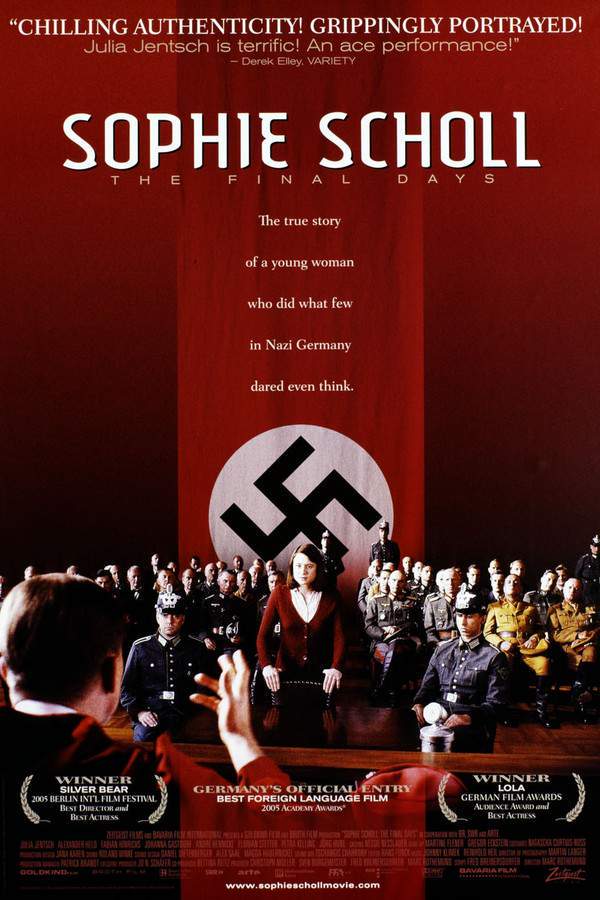
Sophie Scholl: The Final Days (2006) movie poster

Characters & Themes

Sophie Scholl: The Final Days (2006) Characters, Setting & Themes Explained

Release, runtime and language
2006 · 120 min · German
JustWatch #8,344 1
Directed by
Marc Rothemund
Starring
Fabian Hinrichs, Julia Jentsch

Based on true events, this film portrays the final days of Sophie Scholl, a young woman who participated in the White Rose non-violent resistance movement against the Nazi regime in Germany. It follows her experiences from arrest to trial and execution, showcasing her unwavering conviction and courage in the face of immense pressure and oppression. Julia Jentsch delivers a compelling performance as Sophie, highlighting the intensity of her defiance during this harrowing six-day ordeal.

On this page (7)
  1. 1 Where to watch
  2. 2 Characters explained (3)
  3. 3 Where & when it takes place
  4. 4 Themes & meaning (3)
  5. 5 Character & meaning questions
  6. 6 Movie threads
  7. 7 Every angle

Where to watch

Where to Watch Sophie Scholl: The Final Days (2006)

Where can you watch Sophie Scholl: The Final Days? Stream, rent or buy it in the US, including on Chai Flicks, Kino Film Collection and OVID: current JustWatch availability with up-to-date prices.

Streaming availability powered by JustWatch

3 main characters · contains spoilers

Sophie Scholl: The Final Days Characters Explained: Who Is Who

The main characters of Sophie Scholl: The Final Days (2006), heroes and villains: what drives them, how they change over the course of the story and what each of them reveals about the film's bigger ideas.

  • Sophie Scholl

    Sophie Scholl is a resilient and courageous young woman whose convictions drive her to resist the Nazi regime. Throughout the film, she demonstrates unwavering bravery in the face of oppression, choosing to stand up for justice and truth. Her interactions with the Gestapo reveal her intelligence and moral strength, making her an emblem of the resistance movement.

    • 👩 Courage
    • 📜 Activism
    • 🕊️ Freedom
  • Hans Scholl

    played by Fabian Hinrichs

    Hans Scholl, Sophie’s elder brother, is depicted as a committed activist whose deep sense of justice inspires his sister’s involvement in the resistance. He stands as a voice of defiance against the Nazi regime, often supporting Sophie and sharing her beliefs. His willingness to risk everything for their cause highlights the sibling bond and shared commitment to their ideals.

    • 👨 Activism
    • 🔥 Passion
    • 🛡️ Brotherhood
  • Robert Mohr

    Robert Mohr is the persistent Gestapo investigator tasked with interrogating Sophie. He embodies the oppressive regime, utilizing psychological tactics to extract confessions and maintain control. Despite his authoritative position, Mohr's interactions with Sophie reveal cracks in his resolve as he confronts her unwavering determination.

    • 👮 Authority
    • 📖 Manipulation
    • ⚔️ Conflict

Last updated: October 22, 2024 at 21:42

Was this helpful?

Setting

Where and When Does Sophie Scholl: The Final Days Take Place?

The setting of Sophie Scholl: The Final Days (2006): the year and time period, the places and locations, and how they shape the characters, the mood and the tension of the story.

Time period

World War II

The events unfold during World War II, a period marked by immense suffering and conflict across Europe. This time saw the rise of oppressive regimes and widespread resistance movements, where individuals risked everything in pursuit of freedom and justice. The collective fight against fascism shaped many narratives of bravery and sacrifice.

Location

Munich, Stadelheim Prison, Munich University

Munich, the vibrant capital of Bavaria, is known for its rich cultural heritage and history. During World War II, it served as a focal point of resistance against the Nazi regime, particularly through organizations like the White Rose. Stadelheim Prison is notorious for its role in detaining political dissidents, where many faced grave consequences for their beliefs.

  • 🏙️ City
  • 🏛️ University
  • 🚔 Prison

Last updated: October 22, 2024 at 21:42

Was this helpful?

3 major themes

Sophie Scholl: The Final Days Meaning: Themes & Message Explained

What is Sophie Scholl: The Final Days (2006) really about? The emotional, social and philosophical themes the film keeps returning to, its symbolism and the message beneath the surface.

  • Resistance

    The film embodies the theme of resistance against tyranny and oppression. Sophie Scholl and her fellow activists bravely challenge the Nazi regime, advocating for freedom of speech and human rights. Their actions symbolize a profound commitment to justice, inspiring future generations to stand against injustice.

  • Sacrifice

    The narrative highlights the theme of sacrifice, showcasing how Sophie and her companions willingly risk their lives for their beliefs. Their willingness to confront an oppressive regime at the cost of their own safety underscores the dire consequences faced by those who oppose tyranny. The story serves as a poignant reminder of the cost of standing up for one's convictions.

  • Justice

    The pursuit of justice is critically examined through the biased judicial proceedings faced by Sophie and her fellow activists. Their show trial, devoid of true legal fairness, reflects the manipulation of justice for political gain. The film brings to light the importance of true justice in a society plagued by moral corruption.

Last updated: October 22, 2024 at 21:42

Was this helpful?

Character & theme questions

Sophie Scholl: The Final Days Characters & Meaning: Your Questions Answered

The questions people ask about Sophie Scholl: The Final Days (2006): who the characters really are, their relationships, what the symbols mean, where it takes place and what the movie is really about. Each answer contains spoilers.

Q1

Where is Sophie Scholl: The Final Days set?

The film is set primarily in Munich, the capital of Bavaria, during World War II. Key locations include Munich University, where the White Rose distributed leaflets, and Stadelheim Prison, where political dissidents were detained and executed. Munich was a focal point of resistance against the Nazi regime, making it a symbolically significant setting for this story of non-violent protest.

  • munich
  • white rose
  • stadelheim prison
  • setting
  • world war 2
Q2

What historical period does the film depict?

The film takes place during World War II, a period marked by oppressive regimes and widespread resistance movements across Europe. This era saw individuals risking everything in pursuit of freedom and justice. The story unfolds over Sophie Scholl's final six days, from her arrest to her execution, capturing a critical moment in the fight against fascism.

  • world war 2
  • historical period
  • 1942
  • wwii
  • german resistance
Q3

Who was Sophie Scholl in the White Rose?

Sophie Scholl was a resilient and courageous young woman who became a central member of the White Rose, a non-violent student resistance movement against the Nazi regime. She demonstrated unwavering bravery in distributing anonymous leaflets calling for the overthrow of Hitler and advocating for freedom of speech and human rights. Her convictions led her to stand up for justice and truth despite knowing the fatal consequences.

  • sophie scholl
  • white rose
  • resistance fighter
  • student activist
  • non-violent resistance
Q4

Who was Hans Scholl in the film?

Hans Scholl was Sophie Scholl's elder brother and a co-founder of the White Rose resistance movement. Depicted as a deeply committed activist, his sense of justice inspired his sister's involvement in the resistance. He shared Sophie's beliefs and willingness to risk everything for their cause, highlighting the sibling bond and their shared commitment to opposing the Nazi regime.

  • hans scholl
  • white rose cofounder
  • brother
  • sibling
  • resistance movement
Q5

Who was Robert Mohr in the film?

Robert Mohr is the Gestapo investigator who interrogates Sophie Scholl after her arrest. He embodies the oppressive nature of the Nazi regime, using psychological tactics to extract confessions and maintain control. However, his interactions with Sophie reveal growing cracks in his resolve as he confronts her unwavering determination and moral strength.

  • robert mohr
  • gestapo
  • investigator
  • interrogator
  • antagonist
  • secret police
Q6

What is Stadelheim Prison's significance in the story?

Stadelheim Prison in Munich was notorious for detaining political dissidents during the Nazi regime. Many faced grave consequences, including execution, for their beliefs. In the film, it serves as the final setting where Sophie Scholl and her fellow activists are held, interrogated, and ultimately executed, making it a symbol of the regime's brutal suppression of opposition.

  • stadelheim prison
  • munich prison
  • political detention
  • execution site
  • concentration camp jail
Q7

What does the film say about resistance against tyranny?

The film embodies the theme of resistance against tyranny and oppression, showing how Sophie Scholl and her fellow White Rose activists bravely challenged the Nazi regime. Their non-violent resistance through peaceful leaflets and speeches advocated for freedom of speech and human rights. Their actions symbolize a profound commitment to justice that inspired future generations to stand against injustice.

  • resistance
  • tyranny
  • oppression
  • non-violent protest
  • white rose
  • defiance
  • anti-nazi
Q8

What does the film say about sacrifice?

The film highlights the theme of sacrifice by showcasing how Sophie and her companions willingly risked their lives for their beliefs. Their willingness to confront an oppressive regime at the cost of their own safety underscores the dire consequences faced by those who oppose tyranny. The story serves as a poignant reminder of the high price paid by those who stand up for their convictions.

  • sacrifice
  • bravery
  • martyrdom
  • death
  • beliefs
  • 代价
  • moral courage
Q9

How does the film examine justice?

The pursuit of justice is critically examined through the biased judicial proceedings faced by Sophie and her fellow activists. Their show trial, devoid of true legal fairness, reflects how the Nazi regime manipulated justice for political gain. The film brings to light the importance of true justice in a society plagued by moral corruption, showing how the courts became tools of oppression rather than fairness.

  • justice
  • show trial
  • unfair trial
  • judicial
  • legal system
  • injustice
  • corruption
Q10

What was the White Rose movement?

The White Rose was a non-violent student resistance movement founded at Munich University that actively opposed the Nazi regime during World War II. Led by Hans and Sophie Scholl along with other students, they distributed six anonymous leaflets calling for the end of Hitler's rule and the restoration of basic human rights. Their peaceful protest stood in stark contrast to the violence of the Nazi regime.

  • white rose
  • student resistance
  • leaflet
  • munich university
  • anti-hitler
  • nonviolent resistance
Q11

What are the main themes in Sophie Scholl: The Final Days?

The film explores three interconnected themes: resistance against tyranny, where Sophie and her fellow activists bravely challenge the Nazi regime for freedom and human rights; sacrifice, showing their willingness to risk their lives for their beliefs; and justice, examining the biased show trials that manipulated legal proceedings for political purposes. These themes交织 together to create a powerful story of moral courage.

  • themes
  • resistance
  • sacrifice
  • justice
  • moral courage
  • anti-nazi
  • oppression

Movie threads

More Movies Like Sophie Scholl: The Final Days, by Mood & Story

Curated lists built around what makes Sophie Scholl: The Final Days tick: the same mood, the same kind of story or the same emotional payoff. Each list explains why these movies belong together.

Historical Defiance Stories like Sophie Scholl: The Final Days

True stories of individuals standing against overwhelming tyranny. If you were moved by the courage in Sophie Scholl: The Final Days, explore more movies like it. This section features similar historical dramas and biographical films about moral courage, political resistance, and individuals facing down oppressive systems. Discover powerful true stories of defiance.

  • tense
  • defiant
  • somber
  • courageous
  • oppressive
  • tragic
  • Tone: tense, grim, defiant
  • Pacing: steady, linear
Why these movies?

The story pattern: These narratives typically follow a linear, factual progression, often leading to a foregone tragic conclusion. The drama arises not from surprise, but from witnessing the unwavering strength of conviction in the face of immense pressure, culminating in a legacy that outlives the individual.

Why they belong together: Movies are grouped here for their shared focus on true stories of resistance, their high-stakes tension, and their heavy emotional weight. They create a specific, intense viewing experience defined by moral clarity and the cost of standing up for one's beliefs.

Movies with an Inevitable Tragic Arc like Sophie Scholl: The Final Days

Stories that move with grim certainty toward a devastating end. For viewers seeking the specific emotional experience of Sophie Scholl: The Final Days, this list features movies with a similar sense of inevitable tragedy. Find films like this one, where a steady pace builds towards a known, sad ending, creating a heavy, somber, and deeply moving viewing experience.

  • grim
  • somber
  • tragic
  • suspenseful
  • devastating
  • inevitable
  • Tone: somber, tense, tragic
  • Pacing: steady, deliberate
Why these movies?

The story pattern: The narrative pattern is defined by a steady, often linear, progression toward a pre-determined tragic endpoint. The dramatic tension stems from the characters' awareness or the audience's foreknowledge of the outcome, focusing on the dignity, despair, or defiance displayed during the final act.

Why they belong together: These films are grouped by their shared structural and emotional core: a steady pacing that builds unbearable dread, a straightforward narrative leading to a sad ending, and an overwhelmingly heavy emotional weight that leaves a lasting impact.

Every angle

Sophie Scholl: The Final Days (2006) Explained: Plot, Timeline & Characters

Everything about Sophie Scholl: The Final Days in one place: what happens in the plot summary, the timeline in chronological order, the characters and meaning and a spoiler-free summary. What's After the Movie adds the cast, box office and post-credit scenes.

Coming soon on iOS and Android

The Plot Explained Movie Summary App

Plot summaries, endings explained and timelines on your phone. Catch up on any movie in minutes, save your favorites and never miss a twist again.

Be the first to know when we launch. Your email stays private, always.

Learn more about the app