Year: 1979
Runtime: More mins
Language: Marathi
Director: Jabbar Patel
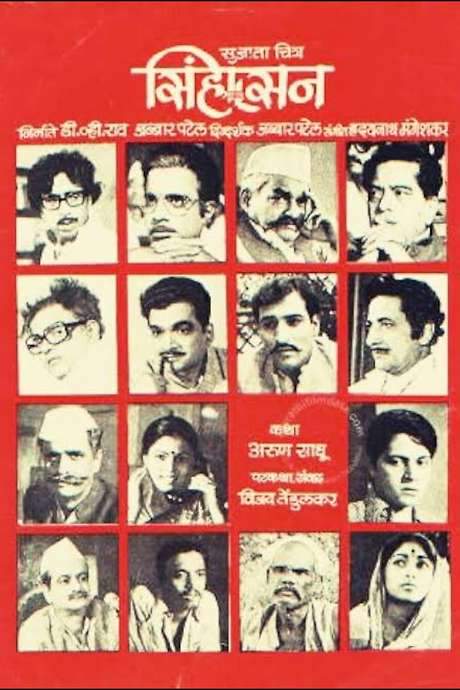
The film follows a fierce contest for the chief‑minister’s seat as the incumbent faces a rival from within his own party, with political intrigue unfolding behind the scenes through the eyes of a journalist. Directed by Jabbar Patel and drawn from Arun Sadhu’s novels Mumbai Dinank and Simhasan, this early Indian political drama features Arun Sarnaik, Shriram Lagoo and Nilu Phule.
Warning: spoilers below!
Haven’t seen Sinhasan yet? This summary contains major spoilers. Bookmark the page, watch the movie, and come back for the full breakdown. If you're ready, scroll on and relive the story!
Trace every key event in Sinhasan (1979) with our detailed, chronological timeline. Perfect for unpacking nonlinear stories, spotting hidden connections, and understanding how each scene builds toward the film’s climax. Whether you're revisiting or decoding for the first time, this timeline gives you the full picture.
Last updated: October 09, 2025 at 11:11
Find frequently asked questions about the Sinhasan (1979) timeline, including chronological order, nonlinear jumps, cause-and-effect links, and scene sequence clarifications. This timeline FAQ helps explain when key events happen, how moments connect, and why the story unfolds in that specific order.
The anonymous caller claims to be a well-wisher and informs the CM that members within his own party are secretly plotting to topple him. This revelation rattles the state's political machinery and triggers a cascade of covert maneuvers, setting off the central power struggle of the film.
The Finance Minister begins compiling MLA support to position himself as the next CM after suspicion falls on him regarding the conspiracy against the current Chief Minister. His ambition represents the opportunistic nature of political loyalty in the film, where colleagues readily turn against each other when power becomes attainable.
Digu Tipnis's frustration with the corrupt system and his investigation into the web of telephone tapping, trade union-politician alliances, and systemic corruption gradually wears on his mental state. His breakdown symbolizes the destruction wrought by unbridled political rot and the erosion of public trust.
D'casta emerges as a pivotal voice in the conflict, challenging smugglers and exposing the underbelly of corruption. He announces a conference to reveal confidential secrets that could shift the balance of power, making him a key player whose actions threaten the existing political order.
In the barber shop, the barber presses Digambar about the future of Maharashtra's CM, and the journalist bluntly responds by questioning whether whoever becomes CM will make any changes in the life of a common man. This moment punctuates the political drama with public cynicism, highlighting the emotional gulf between those in power and ordinary citizens.
The Finance Minister's affair with his daughter-in-law adds another layer of tension to the corridors of influence. This personal entanglement mirrors the broader theme that personal and political lives are inseparable in a system where every alliance is transactional, and loyalties become instruments in the power game.
Digu Tipnis uncovers a hidden web of telephone tapping, covert alliances between trade unions and politicians, and a pattern of corruption linking Mumbai's entrepreneurial scene to the state's ruling class. His investigative work reveals how easily corridors of power bend when media attention, labor unrest, and business interests align.
In the tense climax, CM Arun Sarnaik's health and judgment are strained by anonymous warnings and escalating intra-party scheming. Ministers urge caution while others push ahead, and the cycle of power continues with lasting consequences for the common man. The ending is bleak, showing ambition corroding accountability.
A young criminal portrayed by Nana Patekar enters the scene as a reminder that violence and crime can also shape the political landscape. His presence illustrates how the underworld intersects with politics, reinforcing the film's depiction of a system where every alliance is transactional.
Discover curated groups of movies connected by mood, themes, and story style. Browse collections built around emotion, atmosphere, and narrative focus to easily find films that match what you feel like watching right now.
Unflinching stories that dissect the rot within political systems and the price of power.If you liked the tense, cynical power struggle in Sinhasan, explore more movies that dissect political corruption, media scrutiny, and backroom deals. These films share a heavy emotional weight and a bleak outlook on the human cost of ambition within complex systems.
The narrative pattern follows a high-stakes power struggle, often within a government or institution, where an observer investigates the corrupt mechanisms at play. The journey typically involves uncovering layers of deception and moral decay, leading to a conclusion that offers little hope for systemic change, emphasizing the personal disillusionment of the characters.
Movies in this thread are grouped by their shared focus on political intrigue, their tense and cynical tone, and their complex depiction of systemic failure. They create a gripping, oppressive mood through steady pacing and high emotional intensity, delivering a sobering view of power.
Gripping tales where a journalist's pursuit of truth reveals a dark and disillusioning reality.For viewers who appreciated the journalist's perspective in Sinhasan, this thread gathers films where media scrutiny exposes harsh truths. These stories are characterized by a steady, complex narrative, a tense atmosphere, and a heavy emotional journey that often ends on a bleak note.
The narrative follows a journalist's investigation as the central driving force. As they dig deeper, they uncover layers of conspiracy and moral compromise, facing pressure and threats. The arc is typically one of growing disillusionment, where exposing the truth comes at a great personal cost and rarely leads to meaningful change.
These films share a common protagonist archetype and narrative engine: the investigative journalist. They are united by a mood of anxious suspense, a complex plot structure, and a thematic focus on the conflict between truth-seeking and powerful, corrupt systems, resulting in a heavy, often bleak viewing experience.
Don't stop at just watching - explore Sinhasan in full detail. From the complete plot summary and scene-by-scene timeline to character breakdowns, thematic analysis, and a deep dive into the ending - every page helps you truly understand what Sinhasan is all about. Plus, discover what's next after the movie.
Read a complete plot summary of Sinhasan, including all key story points, character arcs, and turning points. This in-depth recap is ideal for understanding the narrative structure or reviewing what happened in the movie.
Discover the characters, locations, and core themes that shape Sinhasan. Get insights into symbolic elements, setting significance, and deeper narrative meaning - ideal for thematic analysis and movie breakdowns.