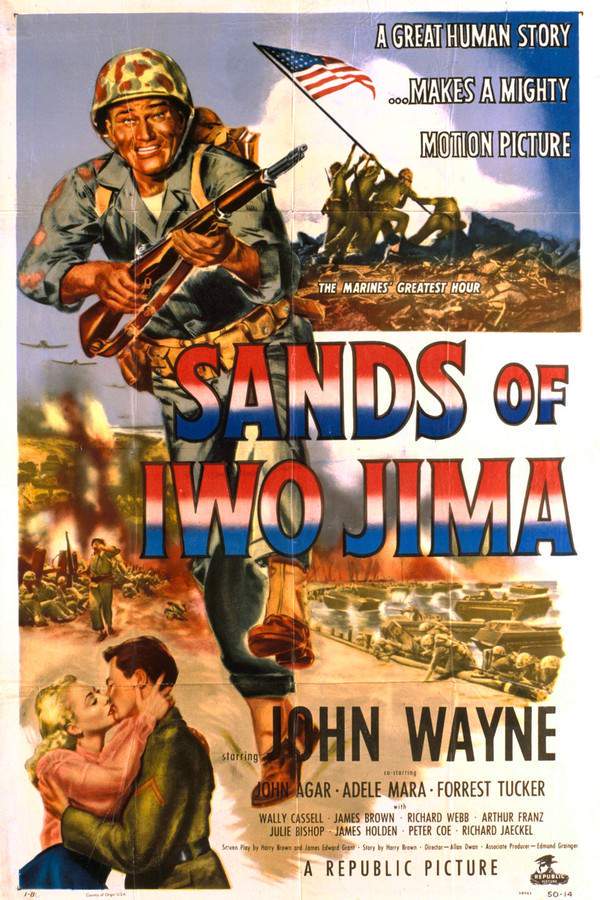
During World War II, Marine Sergeant John Stryker leads his men in a brutal and relentless fight for Iwo Jima. Through strict discipline and proven battle strategies, he earns their respect while facing the enemy in one of history's most challenging campaigns. The soldiers must rely on Stryker's determination and leadership to overcome the intense fighting and survive the devastating consequences of war.
Find where to stream, rent, or buy Sands of Iwo Jima (1950) in the US with current JustWatch availability, up-to-date pricing, and platform listings for subscription, rental, and digital purchase options.
Warning: spoilers below!
Haven’t seen Sands of Iwo Jima yet? This summary contains major spoilers. Bookmark the page, watch the movie, and come back for the full breakdown. If you're ready, scroll on and relive the story!
Read the complete plot breakdown of Sands of Iwo Jima (1950), including all key story events, major twists, and the ending explained in detail. Discover what really happened, and what it all means.
In 1943, after his wife leaves him and takes their son, Sgt. John M. Stryker becomes a bitter man who directs his frustration towards his inexperienced recruits. These young Marines struggle to withstand Stryker’s relentless drills and unyielding nature. Even his former comrades begin to question whether he has transformed from the embodiment of a disciplined Marine drill instructor to a man on the brink of despair.
Tension mounts particularly between Stryker and recruit Peter Conway. Conway, whose father was Stryker’s commanding officer at Guadalcanal, grapples with feelings of inadequacy as a Marine. He is resentful of Stryker’s harsh leadership style, which lacks empathy towards his men, and he clashes with Stryker’s expectations, especially since he is perceived as more lenient in combat. Al Thomas, another recruit, also bears a grudge against Stryker for being demoted in their past assignments, adding to the discord within the ranks.
As the squad prepares for the November 1943 assault on the Japanese base at Tarawa, Stryker’s grueling training is pushed to the limits. The Marines face a formidable underground bunker at the beachhead, where machine-gun fire devastates their ranks before Stryker courageously detonates the bunker with satchel charges, earning the respect of his men.
The perilous situation escalates when Thomas and fellow Marines, Charlie Bass and Hellenopolis, become cut off from their unit. In a moment of hesitation while obtaining fresh ammunition, Thomas falls prey to a Japanese ambush, resulting in a heart-wrenching loss for the squad.
That night, while guarding the beachhead, they hear a voice crying out for help in the darkness. Stryker, suspecting a trap set by the Japanese, refrains from revealing their location, creating a moral crisis when the voice calls out his name. Peter Conway, driven by a sense of duty, insists on rescuing the man—but Stryker, in a moment of desperation, nearly shoots him to prevent his reckless move, torn between risking a fellow Marine’s life and maintaining their position.
The island is ultimately secured, and the wounded are retrieved. Months later, Bass returns to duty inquiring about Al Thomas. Stryker confronts Thomas, leading to a volatile altercation broken up by a Marine Colonel. Thomas, filled with remorse, admits his cowardice and expresses a willingness to take responsibility for the loss of his comrades. Through this confrontation, Stryker finds a path to forgiveness.
Struggling with his inner demons, Stryker ultimately reaches out to a grieving military widow, revealing his softer side. As fate would have it, they receive orders to deploy to Iwo Jima, where they will confront 20,000 Japanese troops entrenched in a formidable island stronghold—one that withstands the most extensive naval bombardment in history. During these fierce battles, Conway saves Stryker’s life from an attacking Japanese soldier.
The final push sees the Marines ascend Mount Suribachi amid relentless fire. As they reach the summit, Stryker instructs four Marines to raise the U.S. flag. Just when he seems to attain a sense of peace, tragedy strikes as he is shot by a sniper. In the aftermath, Conway, Thomas, Bass, and their comrades can only discover and read an unfinished letter to Stryker’s son, on the day they triumphantly raise the flag atop the mountain.
Last updated: November 07, 2024 at 23:34
Explore frequently asked questions about Sands of Iwo Jima (1950) with spoiler-rich answers covering the full plot summary, major story beats, character motivations, hidden details, and ending meaning. This movie summary FAQ helps explain confusing scenes, plot twists, and narrative decisions in clear, searchable detail.
Stryker becomes bitter and emotionally shattered after his wife leaves him and takes their son in 1943. He channels his personal pain into relentless Marine training, pushing his recruits to their limits as a way to cope with his grief and prove his own worth. His harshness stems from wanting to prepare them for the brutal reality of combat, though his methods alienate even his former comrades.
The film establishes Stryker's bitterness early on through his strained interactions with the recruits.
Conway is the son of Stryker's former commanding officer at Guadalcanal, and he struggles with the weight of his father's legacy. He resents Stryker's harsh leadership and feels inadequate as a Marine, especially since he is perceived as more lenient in combat situations. Their conflict represents a father-son dynamic where Conway must earn Stryker's respect the same way any soldier would.
Conway's tension with Stryker builds throughout the training period at Tarawa.
Al Thomas previously served with Stryker but was demoted in their past assignments, which creates deep resentment toward his former drill instructor. This grudge adds significant discord within the squad, as Thomas struggles with feelings of being wronged while also facing accusations of cowardice during combat.
Thomas's resentment is visible from the earliest training scenes.
During the night at Tarawa, the squad hears a voice calling for help in the darkness. Conway, driven by a sense of duty, insists on rescuing whoever is calling out. Stryker suspects a Japanese trap and nearly shoots Conway to prevent him from jeopardizing the unit's position, torn between protecting his men and preventing a reckless行动.
This moral crisis is set up by the tension between Conway's idealism and Stryker's battle-hardened caution.
Yes, Thomas experiences a redemption arc. After being ambushed while obtaining ammunition, resulting in the deaths of comrades Bass and Hellenopolis, Thomas is consumed by guilt. He admits his cowardice to Stryker and expresses willingness to take responsibility. This confrontation allows Stryker to find forgiveness, and Thomas ultimately proves himself during the Iwo Jima battle.
Thomas's cowardice is directly tied to his earlier demotion and resentment toward Stryker.
Struggling with his inner demons and the psychological burden of command, Stryker reaches out to a grieving military widow, revealing his softer, more vulnerable side. This moment signifies his transformation from a bitter, hardened sergeant to a more compassionate leader capable of empathy, showing his humanity amid the harsh military environment.
This character development occurs after his confrontation with Thomas about cowardice.
During the fierce battle on Iwo Jima, Conway proves his growth as a Marine by saving Stryker from an attacking Japanese soldier. This act of bravery marks a turning point in their relationship, as Conway transforms from a resentful recruit into a soldier who deeply respects and is willing to sacrifice for his sergeant.
The shift in their relationship is foreshadowed by Conway's earlier challenges to Stryker's authority.
Stryker is shot by a sniper just as the Marines reach the summit of Mount Suribachi and prepare to raise the American flag. His death occurs at the moment of their greatest triumph, making his loss profoundly poignant. This tragic ending underscores the brutal cost of war even amid victory.
The film builds to this moment through the intense battle to ascend the mountain.

After Stryker's death, his comrades discover an unfinished letter he had been writing to his son. This poignant discovery reveals Stryker's private thoughts and emotions, things he struggled to express directly. It underscores the personal sacrifices of war and the bonds between soldiers, providing emotional closure to his character arc.
The letter represents Stryker's ongoing struggle with his estranged family.
The flag-raising symbolizes the U.S. victory at Iwo Jima and represents the culmination of the Marines' brutal fight to capture the island. It is a historic moment in World War II, signifying triumph against overwhelming odds. However, in the film, this victory is immediately undercut by Stryker's death, creating a bittersweet tone that captures the true cost of war.
The battle to reach the summit builds toward this iconic moment.
Discover curated groups of movies connected by mood, themes, and story style. Browse collections built around emotion, atmosphere, and narrative focus to easily find films that match what you feel like watching right now.
Hardened leaders forge unbreakable bonds in the crucible of conflict.Find more movies like Sands of Iwo Jima that focus on tough, uncompromising leaders. These similar war and action dramas explore the heavy responsibility of command, the forging of brotherhood under fire, and the personal cost of making hard decisions for the survival of the group.
These stories follow a central figure, typically in a high-stakes profession like military or law enforcement, whose strict methods initially create conflict. Through a series of intense challenges, their wisdom and dedication become clear, culminating in a profound, often bittersweet, respect from their subordinates.
Movies are grouped here for their shared exploration of authoritarian leadership styles, the theme of earning respect through shared hardship, and the heavy emotional weight of responsibility. The journey from resentment to reverence is a core narrative beat.
Stories where triumph is achieved, but at a devastating personal price.If you liked the ending of Sands of Iwo Jima, explore these movies where success comes with a heavy price. These similar dramas and war films feature bittersweet conclusions, exploring themes of sacrifice, the psychological toll of conflict, and the true cost of achieving a goal.
The plot builds towards a clear objective, whether a battle, a heist, or a personal goal. The climax sees the objective achieved, but this success is immediately undercut by a major character death or a deep moral compromise, reframing the entire journey and emphasizing sacrifice over celebration.
This thread connects films through their shared narrative structure of a pyrrhic victory and their dominant bittersweet ending feel. The emotional experience is defined by the juxtaposition of success and loss, creating a heavy, contemplative mood.
Don't stop at just watching - explore Sands of Iwo Jima in full detail. From the complete plot summary and scene-by-scene timeline to character breakdowns, thematic analysis, and a deep dive into the ending - every page helps you truly understand what Sands of Iwo Jima is all about. Plus, discover what's next after the movie.
Track the full timeline of Sands of Iwo Jima with every major event arranged chronologically. Perfect for decoding non-linear storytelling, flashbacks, or parallel narratives with a clear scene-by-scene breakdown.
Discover the characters, locations, and core themes that shape Sands of Iwo Jima. Get insights into symbolic elements, setting significance, and deeper narrative meaning - ideal for thematic analysis and movie breakdowns.
Discover movies like Sands of Iwo Jima that share similar genres, themes, and storytelling elements. Whether you’re drawn to the atmosphere, character arcs, or plot structure, these curated recommendations will help you explore more films you’ll love.
Sands of Iwo Jima (1950) Scene-by-Scene Movie Timeline
Sands of Iwo Jima (1950) Movie Characters, Themes & Settings
Sands of Iwo Jima (1950) Spoiler-Free Summary & Key Flow
Movies Like Sands of Iwo Jima – Similar Titles You’ll Enjoy
Midway (2019) Movie Recap & Themes
Midway (1976) Movie Recap & Themes
Letters from Iwo Jima (2006) Detailed Story Recap
Flags of Our Fathers (2006) Plot Summary & Ending Explained
Marine Raiders (1944) Movie Recap & Themes
Bataan (1943) Full Movie Breakdown
Wake Island (1942) Movie Recap & Themes
Tarawa Beachhead (1958) Story Summary & Characters
Beach Red (1967) Story Summary & Characters
To the Shores of Tripoli (1942) Film Overview & Timeline
Beachhead (1954) Ending Explained & Film Insights
The Fighting Seabees (1944) Spoiler-Packed Plot Recap
To the Shores of Iwo Jima (1945) Ending Explained & Film Insights
Battle Cry (1955) Story Summary & Characters
Okinawa (1952) Story Summary & Characters