


Plot Explained Spoilers guaranteed!
Plot Explained

Browse by genre

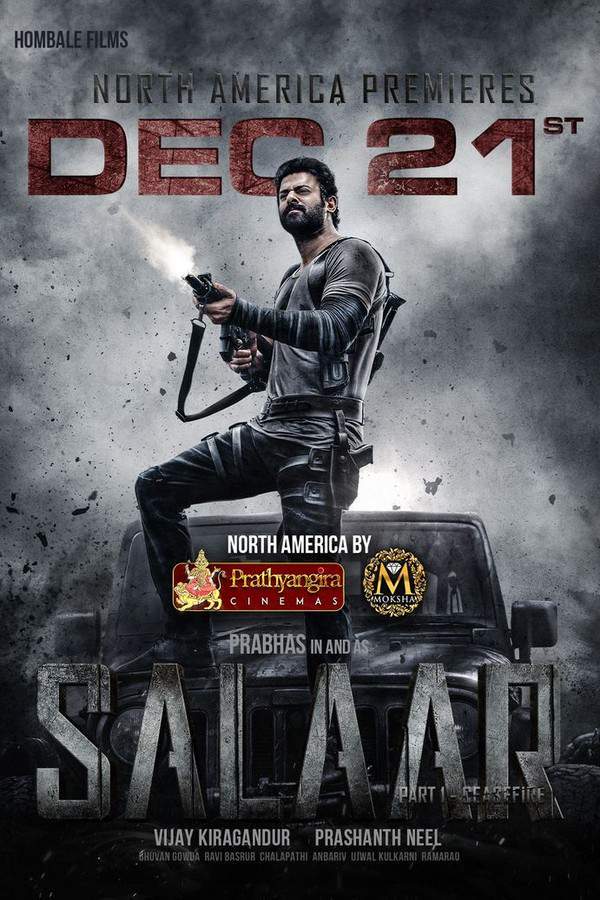
Salaar: Part 1 – Ceasefire (2023) movie poster

Ending Explained

Salaar: Part 1 – Ceasefire (2023) Ending Explained – Final Scene & Meaning

Release, runtime and language
2023 · 2 h 55 m · Telugu
Echo score 83
JustWatch #31,800 2
Directed by
Prashanth Neel
Starring
Shreya Reddy, Prabhas, Tinnu Anand, Jagapathi Babu, Prithviraj Sukumaran, Shruti Haasan
Budget
$34M

A fierce gang leader is compelled to confront rival crews in a struggle to keep a promise made to a fallen friend. As loyalties are challenged and conflict escalates, his unwavering commitment becomes the key to restoring a tenuous peace in a dangerous and chaotic world.

On this page (7)
  1. 1 Where to watch
  2. 2 What happens at the end
  3. 3 Final events in order
  4. 4 Ending questions answered
  5. 5 Movie threads
  6. 6 Movies like Salaar: Part 1 – Ceasefire
  7. 7 Every angle

Where to watch

Where to Watch Salaar: Part 1 – Ceasefire (2023)

Where can you watch Salaar: Part 1 – Ceasefire? Stream, rent or buy it in the US, including on Netflix and Netflix Standard: current JustWatch availability with up-to-date prices.

Streaming availability powered by JustWatch

Ending explained · contains spoilers

What Happens at the End of Salaar: Part 1 – Ceasefire?

How Salaar: Part 1 – Ceasefire (2023) ends, what the final scene means, which earlier moments set it up and how to read the ending if the film leaves it open. The full ending explained, with every spoiler.

At the end of Salaar: Part 1 – Ceasefire, the film leaves audiences with more questions than answers. After a tumultuous series of events set across decades, we see the character of Deva, a fierce and complex figure, implicated in a brutal cycle of violence and loyalty rooted in his past. The story shows his childhood trauma in Khansaar, where he and Vardha form an unbreakable bond, built on a promise of loyalty. As an adult, Deva’s life becomes a whirlwind of violence and protectiveness—particularly toward women and his close allies—yet his true motivations remain shrouded in mystery. The film ends with multiple layers of chaos: Deva is shown to be both a protector and a ferocious fighter, but the nature of his enemy and his ultimate goal stays purposely vague. The narrative hints that more conflicts are brewing, especially with Vardha, whose relationship with Deva is more marred by ambiguity than camaraderie. The film’s rapid, flash-heavy visual style adds to the confusion, immersing viewers in a relentless assault on the senses rather than a clear resolution. Ultimately, Salaar sets up a larger story, teeming with myth-building, political intrigue, and personal vendettas, but it leaves audiences explicitly in the dark about where this chaos is heading. The ending is a chaotic, visceral tease—fueling anticipation for the next installment, while deliberately leaving the depth and direction of Deva’s journey unresolved. It’s a film that emphasizes spectacle and myth over clarity, hinting that what’s truly at stake is a sprawling, ongoing conflict that will probably continue beyond the first part.

Last updated: June 25, 2025 at 08:44

Was this helpful?

The last 4 events

How Salaar: Part 1 – Ceasefire Ends: The Final Events in Order

The last events of Salaar: Part 1 – Ceasefire (2023) in chronological order, the run-up to the ending explained above. The complete timeline has all 15 events, scene by scene.

Open the full timeline
  1. The 13th Century Tribal Alliance

    Moving back in time to the early 13th century, the Manners, Shouryaangas, and Ghaniyaars unite, claiming dominance over Khansaar. This period marks the foundation of a complex legacy that would echo through generations, leading to future conflicts.

    When
    13th century
    Where
    Khansaar
  2. Shift in Territorial Integrity After 1947

    Post-1947, following the decision of Shiva Mannar to assert autonomy, Khansaar witnesses significant territorial fragmentation. This decision catalyzed a series of power struggles that would define the region's fate for decades to come.

    When
    After 1947
    Where
    Khansaar
  3. The Power Struggle in 1985

    With the demise of Shiva Mannar in 1985, Khansaar plunges into chaos as Raja Mannar brutally murders Dhaara, the chief of the Shouryaanga tribe. This treachery solidifies Raja Mannar’s dominance and shifts the balance of power amid prevailing hostilities.

    When
    1985
    Where
    Khansaar
  4. Emergence of a New Generation of Leaders

    In 2010, Vardha seeks refuge in Bharuch while tensions boil over, revealing the urgency for alliances. Amidst betrayal and vengeance, Deva is recognized as a rightful heir, becoming a symbol of hope and resistance against the reigning powers.

    When
    2010
    Where
    Bharuch

Ending questions answered

Salaar: Part 1 – Ceasefire Ending: Your Questions Answered

The questions people ask most about the ending of Salaar: Part 1 – Ceasefire (2023): what the final scene means, how the twist works, what happens to each character and how to read the ending. Each answer contains spoilers.

Q1

Why does the ending leave so many questions unanswered?

The ending is deliberately ambiguous because this is only Part 1 of a larger saga. The film establishes the core conflict, introduces Deva and Vardha's complicated history, and sets up the political power struggle in Khansaar, but intentionally withholds resolution to build anticipation for the sequel. The filmmakers chose to prioritize spectacle and myth-building over closure.

Foreshadowing: The non-linear structure that weaves multiple timelines throughout the film primes viewers for a story that unfolds across installments rather than resolving in one film.

  • unanswered questions
  • sequel setup
  • ambiguous ending
  • part 1
  • cliffhanger
Q2

What is Deva's true motivation in the ending?

Deva's true motivations remain deliberately obscure at the end of Part 1. While he is shown as a fierce protector of women and allies, and is driven by a violent past rooted in his Khansaar childhood, the film does not reveal his ultimate goal. The narrative hints at a larger vendetta connected to the tribal massacre from his past, but the specifics are left for future installments.

Foreshadowing: Deva's childhood trauma in Khansaar and his unbreakable bond with Vardha, built on a promise of loyalty, establish that his actions are motivated by deep-seated vengeance and loyalty.

  • Deva motivation
  • vengeance
  • Khansaar
  • childhood trauma
  • promise
Q3

What happens to Vardha at the end of the film?

Vardha's fate at the end is intentionally left ambiguous. While he shares a childhood bond with Deva built on loyalty, the film presents their relationship as 'marred by ambiguity rather than camaraderie' by the conclusion. The ending suggests conflict is brewing between them, setting up their rivalry or alliance as a central conflict for future parts.

Foreshadowing: The film establishes early that their bond was formed through a promise of loyalty, but the ending hints this promise will be tested.

  • Vardha fate
  • Deva Vardha relationship
  • childhood friends
  • loyalty promise
Q4

What is the nature of Deva's enemy in the ending?

The nature of Deva's enemy remains vague and purposely unclear in the ending. While the film depicts him engaging in violence against various rival crews, the specific antagonist or organized threat driving the main conflict is not definitively established. The ending suggests conflicts are brewing from multiple directions, but the primary enemy is left unresolved.

Foreshadowing: The political machinations involving multiple tribes and family lineages hinted at throughout the narrative suggest a complex web of enemies rather than a single antagonist.

  • Deva enemy
  • antagonist
  • rival crews
  • conflict setup
Q5

Why is Deva shown as both a protector and a violent fighter?

Deva embodies both roles as a reflection of his traumatic past and the code of loyalty he lives by. His protectiveness toward women and close allies stems from his childhood experiences in Khansaar, while his ferocity in battle is how he responds to the violence that shaped him. The film presents this duality as central to his character, someone who uses violence as a tool for protection rather than aggression.

Foreshadowing: The brutal tribal massacre from his past directly informs his violent methodology and his drive to protect those close to him.

  • Deva character
  • protector
  • violence
  • duality
  • loyalty code
Q6

What is the promise Deva made to Vardha?

The specific content of the promise between Deva and Vardha is not revealed in the ending. The film establishes that they formed an 'unbreakable bond' during their childhood in Khansaar, built on a promise of loyalty, but the details of what that promise entails remain mysterious. This uncertainty contributes to the ambiguity surrounding their relationship in the present day.

Foreshadowing: The childhood scenes in Khansaar showing their bond establish that some form of commitment was made between them, the specifics of which are withheld.

  • promise
  • Vardha
  • Deva
  • loyalty
  • childhood bond
  • Khansaar
Q7

What does the ending set up for Part 2?

The ending establishes several threads for the sequel: the unresolved power struggle in Khansaar, the ambiguous relationship between Deva and Vardha, the true extent of Deva's vendetta, and the larger conflict involving political intrigue and personal vendettas. The 'sprawling, ongoing conflict' suggests Part 2 will focus on the full-scale war and the resolution of the central power struggle.

Foreshadowing: The rapid, flash-heavy visual style throughout the film foreshadows that the chaos depicted is merely the beginning of a larger story.

  • part 2 sequel
  • Salaar Part 2
  • future conflict
  • Khansaar war
  • continuation
Q8

What is the significance of Khansaar in the ending?

Khansaar serves as the origin point for Deva's journey and the source of the film's central conflict. The ending references his childhood trauma there and the bond formed with Vardha, establishing that the territory and its violent history are central to understanding Deva's present-day actions. The political intrigue mentioned in the ending is likely centered on Khansaar's power structure.

Foreshadowing: The 13th century timeline mentioned in the narrative structure hints at deep historical roots to the conflict in Khansaar.

  • Khansaar
  • origin
  • childhood
  • tribal conflict
  • territory
Q9

Why does the film end so chaotically without resolution?

The chaotic ending reflects the film's intent as a myth-building exercise rather than a self-contained story. The filmmakers wanted to establish the tone of violence, political intrigue, and personal vendettas that will drive the larger saga. By leaving the central power struggle unresolved, the film creates anticipation for Part 2 while demonstrating that this is the opening chapter of an epic conflict.

Foreshadowing: The constant threat of violence and the tragic history fueling the narrative establish that resolution is impossible in the first installment.

  • chaotic ending
  • no resolution
  • myth building
  • political intrigue
  • epic setup
Q10

What does the ending imply about Deva's journey going forward?

The ending implies Deva's journey is just beginning. Despite being shown as a fierce and capable fighter, his 'ultimate goal stays purposely vague,' suggesting the events of Part 1 are merely the setup for his true purpose. The chaos surrounding him and the brewing conflicts indicate his path will involve confronting the larger power structure in Khansaar and potentially facing Vardha as an adversary.

Foreshadowing: The tested friendship between Deva and Vardha, combined with the unresolved vendetta from his past, points toward a journey of confrontation and potentially tragic choices.

  • Deva journey
  • character arc
  • future
  • vendetta
  • confrontation

Movie threads

More Movies Like Salaar: Part 1 – Ceasefire, by Mood & Story

Curated lists built around what makes Salaar: Part 1 – Ceasefire tick: the same mood, the same kind of story or the same emotional payoff. Each list explains why these movies belong together.

Mythic action epics of loyalty and vengeance like Salaar: Part 1 – Ceasefire

Stories where unwavering loyalty fuels epic, violent conflicts in chaotic worlds. If you liked the intense action and deep bonds of loyalty in Salaar, explore more movies like it. This list features similar high-stakes stories of friendship, revenge, and chaotic power struggles in gritty, mythic settings, perfect for fans of heavy emotional weight and relentless pacing.

  • mythic
  • violent
  • loyal
  • vengeful
  • gritty
  • intense
  • Tone: dark, violent, brooding
  • Pacing: fast, relentless
Why these movies?

The story pattern: Narratives in this thread often follow a singular, formidable figure whose defining trait is an unbreakable oath. This commitment forces them into brutal conflicts against rival factions or corrupt systems, unfolding in a non-linear or epic scope that explores the origins and consequences of their loyalty. The journey is less about redemption and more about the brutal, often tragic, fulfillment of a duty.

Why they belong together: Movies are grouped here for their shared focus on the mythic scale of personal bonds, a consistently dark and gritty atmosphere, and narratives driven by high-intensity action. They create a coherent experience of chaotic worlds where the line between savior and destroyer is blurred by unwavering commitment.
Complex political thrillers in lawless territories like Salaar: Part 1 – Ceasefire

Gripping tales of power vacuums, tribal conflicts, and brutal machinations. For viewers who enjoyed the political power struggles and tribal conflict of Salaar, this section collects similar movies. Discover other complex thrillers about inheritance, rescue missions, and corruption within dangerous, chaotic settings, all sharing a fast pace and ambiguous resolutions.

  • political
  • tense
  • gritty
  • chaotic
  • corrupt
  • power struggle
  • Tone: dark, tense, gritty
  • Pacing: fast, variable
Why these movies?

The story pattern: The narrative pattern involves multiple factions vying for power in a volatile setting, often unveiled through a non-linear structure that explores past betrayals and historical grievances. Characters are often pawns or players in a larger game, with personal motives deeply entangled with political ambitions. The endings are frequently ambiguous, reflecting the ongoing, cyclical nature of the conflict.

Why they belong together: These movies are united by their focus on the mechanics of power in anarchic environments, a complex narrative structure that weaves together different timelines and factions, and a pervasive sense of tension and moral grayness. They deliver a specific vibe of calculated chaos and systemic breakdown.

If you liked this

Movies Like Salaar: Part 1 – Ceasefire

Similar movies to Salaar: Part 1 – Ceasefire: the same genre, themes or kind of story. Each one comes with its own plot summary, timeline and ending explained.

Browse all movie summaries

Every angle

Salaar: Part 1 – Ceasefire (2023) Explained: Plot, Ending, Timeline & Characters

Everything about Salaar: Part 1 – Ceasefire in one place: what happens in the plot summary, the timeline in chronological order, the characters and meaning, the ending explained and a spoiler-free summary. What's After the Movie adds the cast, box office and post-credit scenes.

Coming soon on iOS and Android

The Plot Explained Movie Summary App

Plot summaries, endings explained and timelines on your phone. Catch up on any movie in minutes, save your favorites and never miss a twist again.

Be the first to know when we launch. Your email stays private, always.

Learn more about the app