Plot Explained Spoilers guaranteed!
Plot Explained

Browse by genre

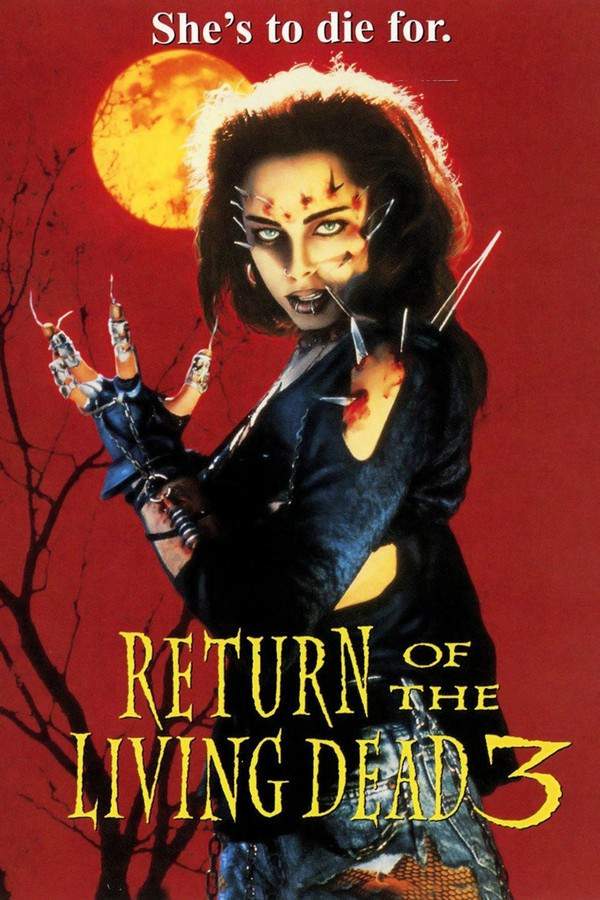
Return of the Living Dead III (1993) movie poster

Plot Summary

Return of the Living Dead III (1993) Plot Summary Explained

Release, runtime and language
1993 · 97 min · English
Loading streaming availability…
Directed by
Brian Yuzna
Starring
Sarah Douglas, Abigail Lenz, Billy Kane, J. Trevor Edmond, James T. Callahan, Jill Andre

A teenager's attempt to cheat death backfires when his actions unleash a dangerous military experiment, bringing his girlfriend back to life as one of the undead. Now, faced with a rapidly growing horde of the reanimated, he must find a way to contain the escalating crisis and confront the terrifying consequences of his desperate attempt to overcome mortality.

On this page (6)
  1. 1 Where to watch
  2. 2 What happens: full plot
  3. 3 Plot questions answered
  4. 4 Movie threads
  5. 5 Movies like Return of the Living Dead III
  6. 6 Every angle
Loading streaming availability…

Full plot summary · contains spoilers

What Happens in Return of the Living Dead III: Full Plot Summary

The whole story of Return of the Living Dead III (1993) explained, from the opening scene to the final frame: every key event, every twist and what it all adds up to. Read it as a quick recap before the sequel, to check a scene you missed, or to finally understand what really happened.

Teenager Curt Reynolds steals his father's security key card, embarking on an adventure with his girlfriend, Julie. Their exploration leads them to the military base where Curt's father, Colonel John Reynolds alongside Col. Peck and Lt. Col. Sinclair, supervises a shocking experiment involving a deceased body exposed to 2-4-5 Trioxin gas, resulting in its reanimation as a zombie. The military envisions using these creatures as combat units, but quickly discovers their uncontrollable nature, driven by an insatiable hunger for human brains.

In an attempt to manage the zombies, Sinclair proposes a method to attach them permanently to exoskeletons, while Reynolds advocates for a chemical approach called "paretic infusion." This method aims to freeze the zombie's brain temporarily. However, during a lab test, the infusion proves insufficient, allowing the zombie to attack and kill a scientist. As the chaos unfolds, the bites lead to a chain of reanimations, resulting in quarantined survivors and Reynolds’ reassignment to Oklahoma City, whereas Sinclair takes control of the project.

Faced with another relocation, Curt and Julie flee, but tragedy strikes when a playful moment distracts Curt while riding his motorcycle. Julie is thrown against a telephone pole, dying instantly. Devastated, Curt brings her body back to the military base and uses his key card to access the Trioxin gas, desperate to bring her back to life. After a temporary reanimation, Julie and Curt confront the ghastly reality of her new state—free from pain but also devoid of a normal appetite.

As hunger strikes, the couple ventures to a store where an altercation with a gang erupts. In the ensuing chaos, Julie's primal urges emerge, leading her to consume a fresh corpse. They escape only to find themselves hiding in the sewers with Riverman, a vagrant who provides refuge. Here, Julie discovers pain as a means to suppress her cravings, leading to a brutal self-mutilation that adorns her body with spikes and glass.

When the gang discovers their hideout, Julie seduces their leader before gruesomely dispatching him with her new weapons. As her body grows more acclimated to the pain, she turns on Riverman, killing him and leaving a trail of chaos behind. Meanwhile, the military closes in on the zombies, knowingly or unknowingly capturing and neutralizing them after the gang is dealt with.

Realizing that Julie's fate is sealed as a military asset, Curt succumbs to rage, releasing the zombies in a bid to save her. The ensuing mayhem leads to a fiery conclusion at the base, where Curt is bitten by the very zombie from the beginning. In a heartbreaking moment, Curt's father pleads with him to escape, but Curt’s loyalty remains with Julie. In their final act, he leads her to the furnace, uttering, > “where we belong,” as their lips meet one last time, surrounded by flames and fading to darkness.
Last updated: November 03, 2024 at 21:09

Was this helpful?

Plot questions answered

Return of the Living Dead III Plot Explained: Your Questions Answered

The questions people ask most about Return of the Living Dead III (1993): what happens in the confusing scenes, why the characters do what they do, the twists, hidden details and what the ending means. Each answer contains spoilers.

Q1

Why does Curt steal his father's security key card?

Curt steals his father's key card out of teenage curiosity and rebelliousness. He wants to explore the military base where his father works, viewing it as an adventure with his girlfriend Julie. This impulsive decision sets off the entire chain of events in the film.

Foreshadowing: Earlier scenes establish Curt as impulsive and willing to take risks for excitement.

  • curt reynolds
  • key card
  • military base
  • stealing
Q2

Why does Julie die in the motorcycle accident?

Julie dies because Curt gets distracted during their escape. While riding the motorcycle, a playful moment causes Curt to lose focus, and Julie is thrown against a telephone pole, resulting in instant death. This tragedy directly leads to Curt's desperate decision to resurrect her.

Foreshadowing: The timeline frames this as a turning point after their flight from the chaos.

  • julie death
  • motorcycle accident
  • curt reynolds
Q3

Why does Curt bring Julie back to life with Trioxin gas?

After Julie's sudden death, Curt is devastated and cannot accept losing her. Using his stolen key card, he accesses the military base's Trioxin gas to resurrect her. His desperate love drives him to risk bringing her back, even knowing the horror that awaits her.

Foreshadowing: Curt's earlier attachment to Julie foreshadows his willingness to do anything to keep her alive.

  • trioxin gas
  • julie resurrection
  • curt
  • love
Q4

Why does Julie cut herself and inflict pain?

Julie discovers that self-inflicted pain temporarily suppresses her zombie hunger for brains. As her cravings grow stronger, she resorts to stabbing herself with spikes and glass to stay in control. This brutal coping mechanism shows her desperate attempt to maintain some humanity.

Foreshadowing: Her earlier restraint at the store hints at her struggle against primal urges.

  • julie
  • self-harm
  • pain
  • hunger
  • zombie
Q5

Why does Julie kill Riverman?

Julie kills Riverman because her zombie instincts override her humanity as she becomes more acclimated to her transformed state. After killing the gang leader, her descent into monstrosity accelerates, and she turns on the vagrant who had sheltered them.

Foreshadowing: Her killing of the gang leader marks a clear escalation in her violence.

  • riverman
  • julie kills
  • sewers
  • betrayal
Q6

Why does Curt release the zombies from the military facility?

Curt releases the zombies because he realizes the military plans to capture Julie and use her as an asset for their experiments. In a desperate attempt to save her from becoming a weapon, he frees the zombies, triggering chaos at the base.

Foreshadowing: The military's earlier interest in controlling zombies sets up this conflict.

  • curt releases zombies
  • military
  • save julie
  • escape
Q7

Why does Curt let Julie bite him at the end?

Curt allows Julie to bite him because he would rather join her in death than live in a world without her. When the zombie from the initial experiment bites him, his father begs him to escape, but Curt chooses to stay with Julie. They share a final embrace in the furnace, choosing to die together.

Foreshadowing: Curt's earlier devotion to Julie throughout the film makes this sacrifice consistent with his character.

  • curt bitten
  • julie
  • furnace
  • ending
  • death
Q8

Why does the military want to capture Julie?

The military wants to capture Julie because she represents a successful reanimation with unique properties. After the paretic infusion failed and other zombies proved uncontrollable, Julie's relatively stable condition makes her valuable as a potential weapon or test subject for their zombie program.

Foreshadowing: The military's earlier experiments with paretic infusion and exoskeletons show their desperation for controllable undead.

  • military
  • julie
  • capture
  • weapon
  • experiments
Q9

Why do the zombies in this movie want brains?

The Trioxin gas reanimates corpses with a primal hunger for human brains specifically. The military discovered during their experiments that these creatures are driven by an insatiable craving for brains, which makes them both dangerous and useful as potential combat units, though they prove impossible to control.

Foreshadowing: The initial reanimation experiment establishes this brain hunger immediately.

  • zombies
  • brains
  • trioxin
  • hunger
  • reanimation
Q10

What is the paretic infusion and why does it fail?

Paretic infusion is Colonel Reynolds' proposed chemical solution to temporarily freeze a zombie's brain activity, making them controllable. However, during the lab demonstration, the infusion proves insufficient, the zombie breaks free and kills a scientist, proving the method unreliable and triggering the wider outbreak.

Foreshadowing: Sinclair's exoskeleton proposal hints at the military's struggle to find any workable solution.

  • paretic infusion
  • chemical
  • reynolds
  • control
  • failure
Q11

What happens to Curt's father Colonel Reynolds?

Colonel Reynolds is Curt's father who oversees the zombie experiments. After the outbreak, he is reassigned to Oklahoma City. In the final chaos, he pleads with Curt to escape when Curt is bitten, showing his concern for his son despite the circumstances, but Curt chooses to stay with Julie.

Foreshadowing: Reynolds' earlier involvement in the experiments establishes his role in the tragedy.

  • colonel reynolds
  • father
  • curt
  • military
  • oklahoma city

Movie threads

More Movies Like Return of the Living Dead III, by Mood & Story

Curated lists built around what makes Return of the Living Dead III tick: the same mood, the same kind of story or the same emotional payoff. Each list explains why these movies belong together.

Gothic Body Horror Romances like Return of the Living Dead III

Love stories where devotion leads to monstrous transformations and irreversible tragedy. Discover movies like Return of the Living Dead III that explore tragic love stories through the lens of body horror. If you appreciated the desperate romance and gruesome transformation in this film, you'll find similar tales of devotion leading to monstrous change in these selections.

  • tragic romance
  • body horror
  • gothic
  • desperate
  • gruesome
  • oppressive
  • Tone: dark, tragic, oppressive
  • Pacing: steady, escalating
Why these movies?

The story pattern: The narrative pattern follows a protagonist whose love for another person drives them to instigate or endure a horrific physical transformation. This act, meant to preserve or resurrect the relationship, instead sets in motion an irreversible descent into tragedy. The story unfolds as a desperate attempt to hold onto a connection that is being destroyed by the very means used to save it, culminating in profound loss.

Why they belong together: These movies are grouped by their unique fusion of a central, driving romance with intense body horror. They share a dark, tragic tone, a heavy emotional weight derived from loss, and a focus on the gruesome physical consequences of love and desperation. The pacing is often fast or steady, leading inexorably toward a bleak conclusion.

Movies about Catastrophic Consequences like Return of the Living Dead III

Personal grief and reckless actions trigger a cascading, large-scale catastrophe. If you liked the premise of Return of the Living Dead III, where a personal act of grief sparks a large-scale disaster, explore these similar stories. These films feature characters whose desperate choices have devastating, widespread repercussions, leading to fast-paced, high-intensity survival scenarios.

  • desperate
  • apocalyptic
  • anxious
  • gritty
  • catastrophe
  • consequences
  • Tone: dark, desperate, anxious
  • Pacing: fast, chaotic
Why these movies?

The story pattern: The narrative begins with a character facing an immense personal tragedy. In a moment of desperate, often misguided love or rebellion, they commit an act that unintentionally unleashes a dangerous force. The story then follows the rapid, chaotic escalation of this event from a personal crisis into a widespread, societal collapse. The protagonist is forced to confront the horrific scale of the disaster they caused.

Why they belong together: These films share a core narrative engine: a personal, emotional catalyst that ignites a global threat. They are united by a high-intensity, fast-paced tone, a focus on the consequences of grief and rash decisions, and a bleak, hopeless atmosphere. The experience is defined by anxiety, desperation, and the grim fallout of a single mistake.

If you liked this

Movies Like Return of the Living Dead III

Similar movies to Return of the Living Dead III: the same genre, themes or kind of story. Each one comes with its own plot summary, timeline and ending explained.

Browse all movie summaries

Every angle

Return of the Living Dead III (1993) Explained: Plot, Timeline & Characters

Everything about Return of the Living Dead III in one place: what happens in the plot summary, the timeline in chronological order, the characters and meaning and a spoiler-free summary. What's After the Movie adds the cast, box office and post-credit scenes.

Coming soon on iOS and Android

The Plot Explained Movie Summary App

Plot summaries, endings explained and timelines on your phone. Catch up on any movie in minutes, save your favorites and never miss a twist again.

Be the first to know when we launch. Your email stays private, always.

Learn more about the app