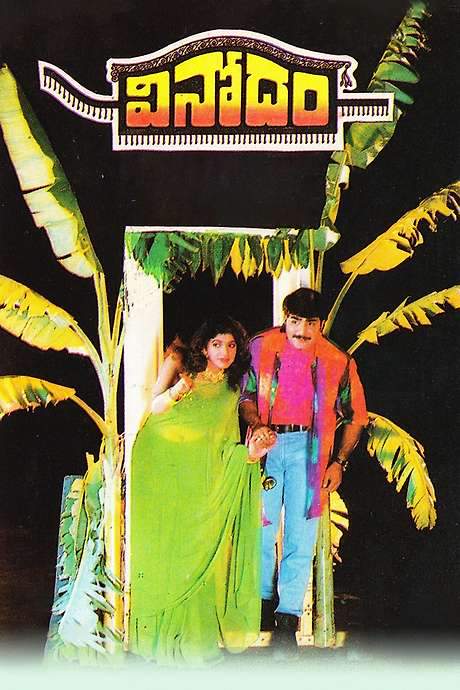
An unemployed graduate, Kamal Haasan, lives in a ramshackle lodge called Anand Bhavan and dreams of a fortune that seems just out of reach. He tries to flaunt his meagre wealth to a roadside beggar, only to be gently slapped by reality when he discovers the beggar has somehow accumulated more money than he has. This small humiliation plants a seed of curiosity about luck, status, and what it takes to change one’s lot in life.
While wandering through the city, he slips into a bustling emporium and crosses paths with a young woman trying on earrings. He offers his unsolicited advice about the earrings, a moment that foreshadows his tendency to meddle in others’ destinies. That same woman resurfaces later when he’s waiting in a job queue, and she mistakes the expensive car he leans against as his own. He plays along, delighted to be seen in a life he’s barely glimpsed, and he realizes she is the Magician’s daughter, Amala Akkineni.
One night, fate takes a sharper turn. The graduate finds a drunk rich man unconscious by the roadside and discovers a key to a suite in the plush "Pushpak" hotel in the man’s pocket. Seizing the moment, he abducts the rich man from Anand Bhavan and moves into the rich man’s suite at Pushpak, effectively stepping into a lifestyle that isn’t his. The rich man’s wife begins an extramarital affair with his friend, the latter of whom hires a contract killer to remove the husband without her knowledge. The killer, paid in part with money and only a suite number to go on, stalks the Pushpak corridors, and his hunt centers on the graduate who has now switched lives.
The killer mistakes the graduate for his target, while the young woman—the Magician’s daughter—appears again in a suite across from his balcony. A buffet encounter leads to a comic misstep when she slaps him, thinking he’s pulled a prank; she soon learns the joke was actually popularized by a boy, and their misunderstanding dissolves into a tentative, growing connection. As they navigate these tangled loyalties, they attend the funeral of the hotel owner, a moment that feels like a turning point: the owner’s life—once marked by hardship—appears to mirror the graduate’s own possible future if he changes course. The pair begin spending more time together, their relationship quietly deepening.
Meanwhile, the killer makes several desperate attempts to eliminate the graduate, using ice daggers and other methods, but each plan fails. The graduate remains unaware of the ongoing threat until the danger becomes undeniable. The intruder breaches the graduate’s suite, and a tense struggle ends with the killer nearly fatally electrocuted; the body is discarded back into the graduate’s space as the aggressor regains consciousness and flees.
The killer travels to the extramarital lover’s bungalow to report his failure, and the graduate follows, uncovering the truth about the conspiracy. The Rich man’s wife learns of her lover’s treachery and ultimately leaves him, severing a dangerous strand of deceit that has held the lives of several people in its grip.
A montage centered on the Hotel owner reveals that he began life as a poor man, much like the graduate, and that he achieved something meaningful not through greed but through fair means. This revelation makes the graduate question his own choices. He discovers that the roadside beggar has died; municipal workers arrive to take away the body, yet the beggar’s stash leads the officials to squabble over the money instead of honoring the dead. This moment crystallizes the inner conflict within the graduate, pushing him toward a pivotal decision.
Deciding to abandon his deceit, the graduate frees the Rich man and writes him a letter explaining everything. The Rich man and his wife reconcile, and the husband commits to stopping his own destructive habits. The graduate then resolves to come clean to the Magician’s daughter as well. He learns that the magician’s family is preparing to leave Pushpak, and he shares the truth with her through a letter. To his relief, she forgives him. As they part, she sketches a clue about her distant home and drops a rose wrapped in paper from her car window for him to find. The paper is blown into a gutter by the wind, but the gesture lingers as the graduate stands in line once more, waiting for a chance to apply for a job—this time, perhaps, with a wiser heart and a clearer sense of what really matters.