Year: 1986
Runtime: 103 min
Language: English
Director: Paul Mazursky
Budget: $14M
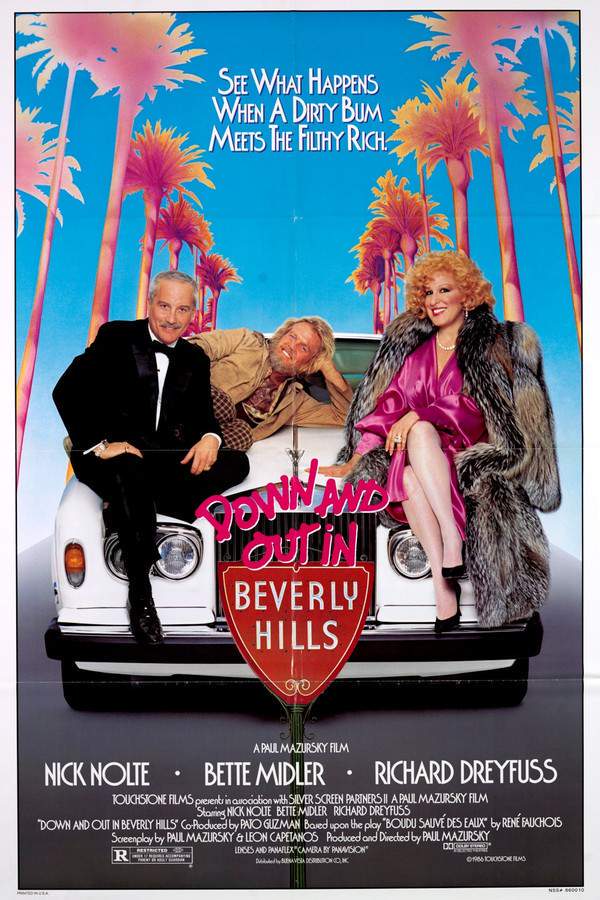
After a failed suicide attempt, a homeless man named Jerry unexpectedly finds himself working for a wealthy executive, Dave. Thrust into the opulent lifestyle of Beverly Hills, Jerry's presence disrupts the family dynamic, particularly with the maid, Carmen, whom he both charms and irritates. He observes and satirizes the extravagant habits of the Beverly Hills elite, leading to humorous and awkward situations.
Warning: spoilers below!
Haven’t seen Down and Out in Beverly Hills yet? This summary contains major spoilers. Bookmark the page, watch the movie, and come back for the full breakdown. If you're ready, scroll on and relive the story!
Read the complete plot breakdown of Down and Out in Beverly Hills (1986), including all key story events, major twists, and the ending explained in detail. Discover what really happened—and what it all means.
In the affluent enclave of Beverly Hills, a pervasive sense of stagnation envelops the Whiteman family like a heavy shroud. The once-vibrant marriage between Dave, the dynamic entrepreneur behind a wire garment hanger company called Dave-Bar, and his wife Barbara has sadly devolved into mere coexistence—with their two decades together reduced to a monotonous routine of impersonal exchanges. This unraveling of their relationship is exacerbated by Dave’s passionate affair with Carmen, their live-in maid, as Barbara seeks solace from her escalating discontent through a mix of New Age therapies and compulsive shopping habits.
Meanwhile, their teenage son Max grapples with a profound disconnect from his parents, opting instead to convey his feelings through avant-garde video art that serves as both an exploration of his own identity crisis and a critique of his family’s superficial lifestyle. The Whitemans’ daughter Jenny, a 19-year-old navigating her own turbulent journey, faces increasing friction with her father, who suspects her struggles with self-image and poor decisions stem from an eating disorder. Additionally, their pet dog Matisse reflects the household’s dysfunction through his troubling behaviors, further showcasing the family’s struggles.
Amidst this chaos enters Jerry Baskin, a homeless man who is mourning his lost companion. In a desperate moment by the Whitemans’ pool, as he attempts to end his life, Dave intervenes, saving him and offering temporary refuge in their home. This unexpected encounter leads to an unlikely friendship as Jerry shares stories about his past fortune and success, starkly juxtaposing Dave’s prevailing materialistic values.
As Jerry becomes a part of the Whiteman household, his presence begins to work wonders. He ignites Barbara’s long-dormant passions, leading to a profound connection between them. However, this rekindled intimacy introduces tensions with both Carmen and Dave, as Jerry’s closeness pushes against the family’s existing dynamics. Furthermore, Max finds himself opening up about his gender identity, encouraged by Jerry’s understanding demeanor.
The tension climaxes during a lavish party thrown by the Whitemans. In a shocking revelation, Jenny expresses her newfound feelings for her father and underscores her recovery from anorexia, provoking a physical clash between Dave and Jerry. This chaotic confrontation escalates, involving partygoers and ends with all three men floundering helplessly in the swimming pool.
As dawn breaks on the following day, Jerry faces the ramifications of his stretched truths. He acknowledges the fictional nature of the tales he recounted about his former life, steadfastly preparing himself to leave the Whiteman estate. Now accompanied by Matisse, Jerry slowly walks down the service alleyway, his steps resonating in the silence as he takes a last look at the household staff, whose expressions reflect a blend of yearning and resignation.
In a contemplative moment, Jerry’s gaze meets those of his newfound friends, their collective stare imbued with poignant farewell. The atmosphere is dense with unexpressed feelings as Jerry’s face softens in the realization of their shared bond, prompting him to rejoin the group. Together, they make their way back into the estate grounds, a space that now feels steeped in an aura of warmth and connection.
Last Updated: November 22, 2024 at 11:21
Discover curated groups of movies connected by mood, themes, and story style. Browse collections built around emotion, atmosphere, and narrative focus to easily find films that match what you feel like watching right now.
An unexpected guest turns a troubled household upside down, forcing change.If you enjoyed how Jerry upended the Whiteman household in Down and Out in Beverly Hills, you'll like these movies about disruptive outsiders. These films feature similar fish-out-of-water characters who challenge a family's comfortable but flawed existence, leading to humorous and poignant revelations.
The narrative typically follows a static, insulated group (like a wealthy family) whose routines are shattered by the arrival of an unconventional character. This outsider, often from a contrasting background, observes and critiques their way of life. The resulting conflict forces the family members to confront their own unhappiness and dysfunction, culminating in a bittersweet but hopeful resolution where some connections are strengthened while others break.
These movies are grouped together because they share a core narrative structure of disruption and observation. They balance satirical humor with genuine emotional weight, creating a specific vibe where comedy arises from awkward social collisions and poignant moments of human connection.
Comedies that skewer the emptiness of luxury while finding the humanity within.Fans of the class satire in Down and Out in Beverly Hills will appreciate these movies. They explore similar themes of alienation and materialism within affluent settings, blending humorous critique with a bittersweet look at the personal crises hidden behind a facade of success.
Stories in this thread are set in worlds of affluence but center on characters experiencing a sense of alienation or midlife crisis. The plot often involves a disruptive event or person that exposes the hypocrisy and loneliness beneath the surface of luxury. The tone is primarily comedic and observational, but it carries a melancholic undercurrent, questioning the true value of wealth and status without offering easy answers.
These films are united by their specific tone: a blend of sharp social satire and underlying melancholy. They share a steady, observational pacing that allows for both humorous set-pieces and quieter moments of character revelation, creating a coherent experience of laughing at absurdity while feeling the poignant truth behind it.
Don't stop at just watching — explore Down and Out in Beverly Hills in full detail. From the complete plot summary and scene-by-scene timeline to character breakdowns, thematic analysis, and a deep dive into the ending — every page helps you truly understand what Down and Out in Beverly Hills is all about. Plus, discover what's next after the movie.
Track the full timeline of Down and Out in Beverly Hills with every major event arranged chronologically. Perfect for decoding non-linear storytelling, flashbacks, or parallel narratives with a clear scene-by-scene breakdown.
Discover the characters, locations, and core themes that shape Down and Out in Beverly Hills. Get insights into symbolic elements, setting significance, and deeper narrative meaning — ideal for thematic analysis and movie breakdowns.
Get a quick, spoiler-free overview of Down and Out in Beverly Hills that covers the main plot points and key details without revealing any major twists or spoilers. Perfect for those who want to know what to expect before diving in.
Visit What's After the Movie to explore more about Down and Out in Beverly Hills: box office results, cast and crew info, production details, post-credit scenes, and external links — all in one place for movie fans and researchers.
Discover movies like Down and Out in Beverly Hills that share similar genres, themes, and storytelling elements. Whether you’re drawn to the atmosphere, character arcs, or plot structure, these curated recommendations will help you explore more films you’ll love.
Down and Out in Beverly Hills (1986) Scene-by-Scene Movie Timeline
Down and Out in Beverly Hills (1986) Movie Characters, Themes & Settings
Down and Out in Beverly Hills (1986) Spoiler-Free Summary & Key Flow
Movies Like Down and Out in Beverly Hills – Similar Titles You’ll Enjoy
Life Stinks (1991) Complete Plot Breakdown
Down to Earth (2001) Plot Summary & Ending Explained
Slums of Beverly Hills (1998) Complete Plot Breakdown
Going Down (2003) Movie Recap & Themes
Going Down in LA-LA Land (2012) Detailed Story Recap
Scenes from the Class Struggle in Beverly Hills (1989) Plot Summary & Ending Explained
He Comes Up Smiling (1918) Plot Summary & Ending Explained
Beverly Hills Brats (1989) Film Overview & Timeline
Down to Earth (1917) Spoiler-Packed Plot Recap
Hollywood or Bust (1956) Full Movie Breakdown
Another Fine Mess (1930) Film Overview & Timeline
No Down Payment (1957) Story Summary & Characters
Knockin’ on Heaven’s Door (1997) Story Summary & Characters
The Beverly Hillbillies (1993) Plot Summary & Ending Explained
Hollywood Boulevard (1976) Complete Plot Breakdown