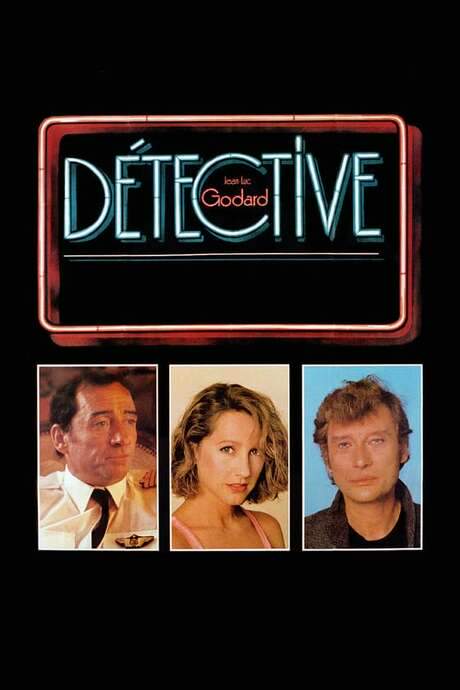
Julien Vercel, Jean-Louis Trintignant, is a south of France estate agent who spends a quiet morning by a lake, chasing ducks while a rival hunter, Massoulier, works the same stretch of water. The day takes a sharp turn when Massoulier is shot dead, and Julien returns to his office to find himself immediately pulled into the investigation. He discovers that, as he left the hunt, he briefly saw Massoulier’s car and turned its lights off to conserve the battery, leaving a door ajar that bore a fingerprint he did not intend to leave. The police quickly zero in on him as the chief suspect, a conclusion reinforced by the tangled personal history they uncover: Massoulier and Julien’s wife, Marie-Christine, had been carrying on a secret relationship.
Marie-Christine Vercel, Caroline Silhol, confronts Julien at home with a calm admission of adultery, a revelation that rattles him but also sets the plot in motion. Marie-Christine hides as the detectives press Julien for answers, and when he is briefly taken to the police station for a second interview, his fate seems sealed until his lawyer, Maître Clément, Philippe Laudenbach, steps in and arranges his release. The respite is brief, however: Marie-Christine herself is murdered, and Julien finds himself elevated from suspect to prime target as the killer’s presumed logic tightens around him.
To prove his innocence, Julien plans a trip to Nice—the place where Marie-Christine had previously worked. His secretary and assistant, Barbara Becker, Fanny Ardant, urges him to let her handle the search. She takes a bold, indirect route: while her boss dozes off at the office, Barbara mounts a quiet, strategic inquiry into Marie-Christine’s past, all the while harboring a private, unspoken affection for Julien that blurs into professional loyalty.
Barbara’s digging uncovers a web of hidden identities and debts. Marie-Christine’s real name is Josiane Kerbel, and her life before meeting Julien is shadowed by gambling losses and a previous marriage to a man who rode the horse-race fever to perilous depths. She joined Julien’s life largely to escape a spiraling financial trap. The trail from Nice draws Barbara and Julien into a sequence of settings that feel theatrical: a movie theater, a glittery nightclub, and ultimately the darker labyrinths of the city’s prostitution zones. In a dangerous misstep, the pair accosts a suspicious man they mistake for the killer, only to discover they have attacked Massoulier’s brother instead.
Back at the theater, a box-office clerk—an ex-lover of Massoulier who had accused Julien of the murder over the phone—is stabbed to death, amplifying the sense that every character is entangled in a larger scheme. Barbara, at her most determined, seeks out Julien’s lawyer, and through him uncovers a deeper, more painful truth: Maître Clément and Marie-Christine had been lovers. Clément was drawn into the relationship by Marie-Christine’s insistence that she would not divorce Julien, and his motive crystallizes into a dangerous, layered web of control and betrayal. He killed Massoulier at Marie-Christine’s request, killed Marie-Christine when she refused to leave Julien, and killed the clerk because she knew the full extent of the affair and would reveal it all.
With the truth exposed, Barbara and a perceptive police officer craft a trap that anticipates Clément’s actions. When he realizes the net closing in, Clément retreats to a telephone booth and takes his own life, confessing everything into the phone as the police close in. In the aftermath, Julien and Barbara find a rare, quiet victory: they are married in a simple ceremony conducted by Massoulier’s brother, a clergyman who serves as The Priest in the case, bringing a sense of closure to a case that began with suspicion and suspicion alone.
The resolution turns on the resilience of those who sought truth under pressure. Julien’s trust in Barbara, tempered by the danger of the case, culminates in a commitment that ties their fates to the family they never fully had, and to the memory of a man—the late Massoulier—whose death set everything in motion. The narrative remains a careful study of motive, alibi, and the frailties of human relationships, framed against a sunlit, coastal backdrop that never quite softens the moral complexity at its core.